The backlink list is useful, but the claim needs a filter
A founder-style backlink list is a good starting point, not a finished SEO strategy.
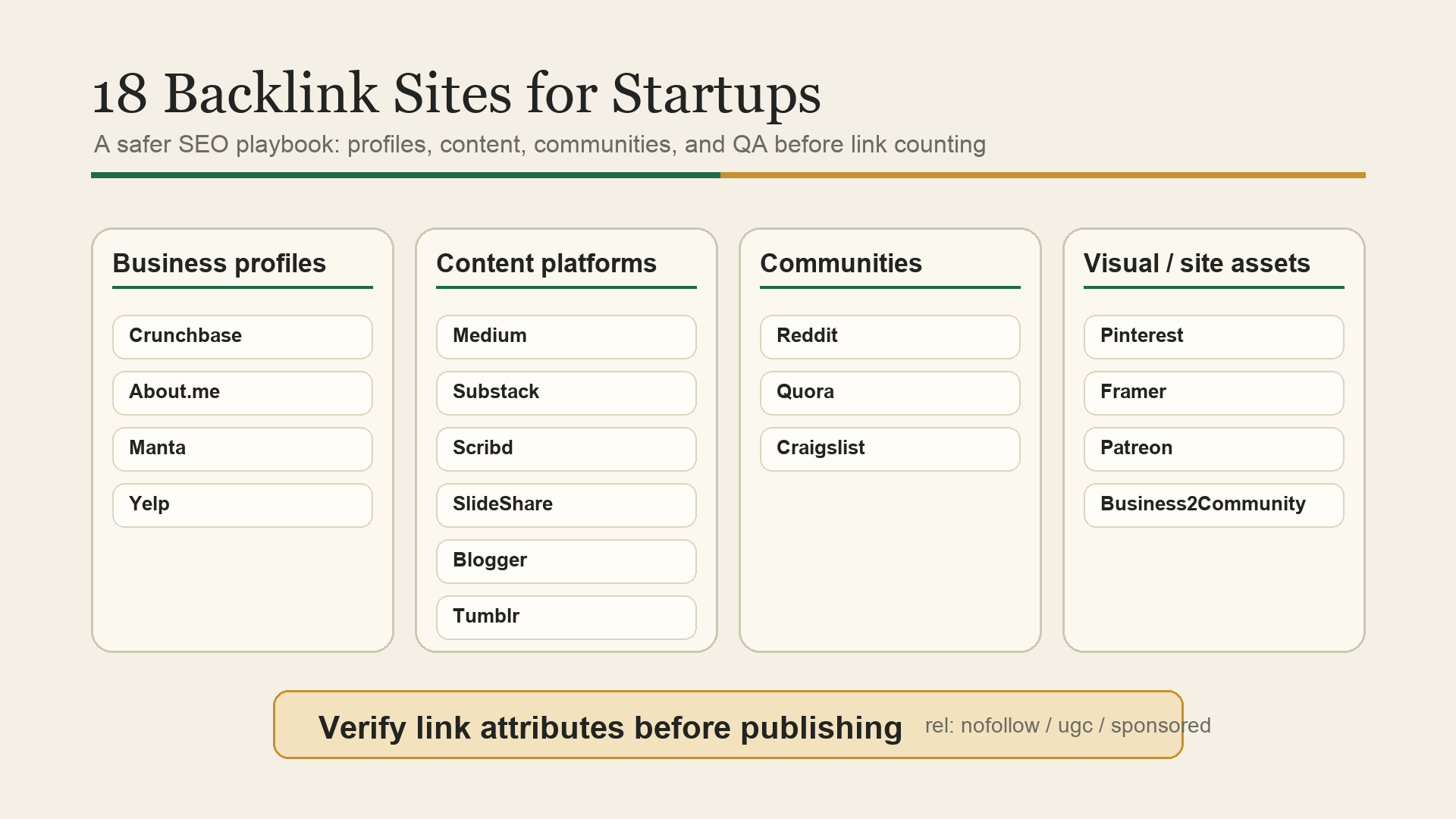
The shared list says "17 websites," but it includes 18 domains: Viralmarketinglab, Crunchbase, Patreon, Scribd, Medium, SlideShare, Craigslist, Tumblr, Reddit, Pinterest, Quora, Business2Community, Yelp, Blogger, Manta, About.me, Framer, and Substack.
The real lesson is simple: startups should build a visible footprint on trusted third-party platforms. Some of those pages may send referral traffic. Some may help search engines and AI systems understand your brand entity. A smaller number may give you a clean, followed backlink.
Do not assume every link is "do follow." Many large platforms add nofollow, ugc, or redirect handling to user-generated links. That does not make them useless, but it changes the goal. Treat each platform as a visibility asset first and a backlink source second.
Google's guidance on qualifying outbound links explains how site owners can use rel="nofollow", rel="sponsored", and rel="ugc". Google's spam policies also warn against manipulative link schemes, low-quality directories, and spammy user-generated links. So the safe version of this tactic is not "drop your URL everywhere." It is "build complete, useful profiles and content on platforms where your startup genuinely belongs."
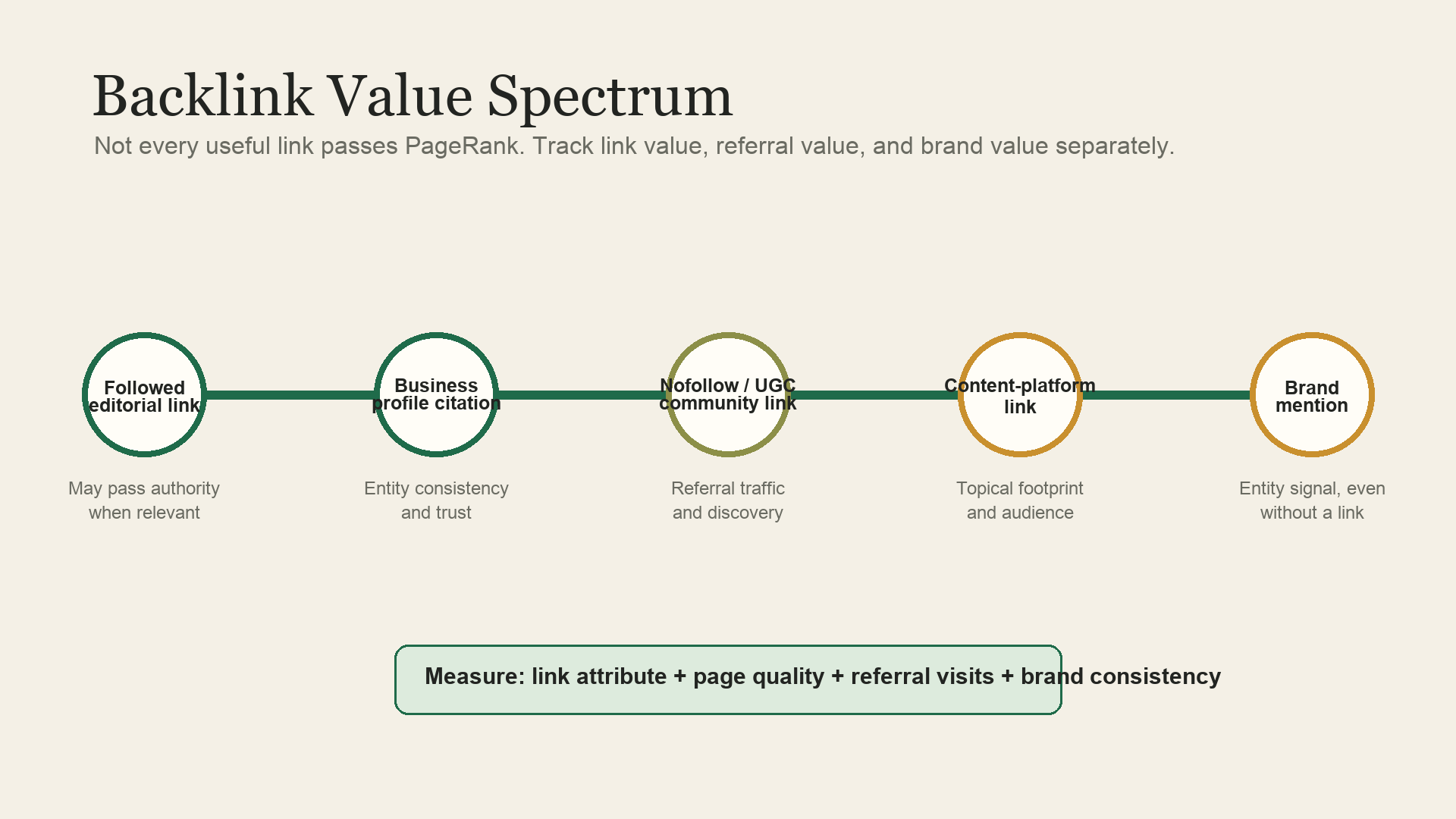
Caption: Not every useful link works the same way. Some links help authority, some help referral traffic, and some help brand/entity clarity.
The better way to think about "do follow" backlinks
There is no magic rel="dofollow" tag. In everyday SEO language, a "do follow" link usually means a normal crawlable link that is not marked with nofollow, ugc, or sponsored.
But startup link building should not be judged by one attribute alone.
A link can help in four different ways:
Link type | What it can do | What to watch |
|---|---|---|
Followed editorial link | May pass ranking signals and discovery value | Harder to earn; usually requires real editorial value |
Business profile citation | Helps brand/entity consistency | Often nofollow or redirected |
Community link | Can send qualified referral traffic | Usually marked UGC or moderated heavily |
Content-platform link | Builds topical footprint and thought leadership | Duplicate, thin, or self-promotional content can backfire |
Local/directory listing | Helps local trust and NAP consistency | Low-quality directories can look spammy |
The practical takeaway: measure more than link count. Track referral visits, branded searches, indexed profile pages, AI search mentions, and conversions from these platforms.
How to use the 18 sites
Here is a safer interpretation of the shared list.
Site | Best use for startups | SEO value to expect | Risk level |
|---|---|---|---|
Viralmarketinglab.com | Startup listing or marketing directory, if the site is active and editorially maintained | Possible citation or listing link | Medium, verify quality first |
Crunchbase.com | Company profile, funding history, founders, product category, official website | Strong entity citation and brand trust | Low |
Patreon.com | Creator, community, or paid content page if your startup has a creator angle | Brand and referral value | Medium, only use if relevant |
Scribd.com | Upload public guides, research summaries, templates, or documentation | Content discovery and document visibility | Medium |
Medium.com | Publish original essays, founder notes, tutorials, and thought leadership | Referral traffic and topical footprint | Medium |
SlideShare.net | Repurpose decks, webinars, reports, and pitch-style explainers | Discovery from presentation content | Medium |
Craigslist.org | Local service or hiring visibility where appropriate | Mostly local/referral value | High if irrelevant |
Tumblr.com | Lightweight brand blog or visual content archive | Weak SEO alone, useful for brand footprint | Medium |
Reddit.com | Helpful participation in relevant communities | Referral traffic, feedback, product discovery | High if promotional |
Pinterest.com | Visual search, product imagery, templates, checklists, infographics | Strong for visual niches | Medium |
Quora.com | Answer high-intent questions with useful explanations | Referral traffic and answer visibility | High if spammy |
Business2Community.com | Contributed articles or syndicated business content, if accepted | Editorial visibility | Medium |
Yelp.com | Local business profile, reviews, service-area trust | Local SEO and brand trust | Low for local businesses |
Blogger.com | Owned support blog, changelog, or resource archive | Only useful if maintained well | Medium to high if used as a link farm |
Manta.com | Business directory profile | Citation consistency | Low to medium |
About.me | Founder or company identity page | Brand/entity citation | Low |
Framer.com | Website, landing page, template, or showcase page if you actually use Framer | Product-led visibility | Medium |
Substack.com | Newsletter archive, founder essays, category commentary | Audience building and branded search | Low to medium |
The pattern is clear. Crunchbase, About.me, Manta, and Yelp are mostly entity/citation plays. Medium, Substack, Scribd, SlideShare, Blogger, Tumblr, and Framer are content or owned-presence plays. Reddit and Quora are community plays. Pinterest is a visual discovery play. Craigslist is only useful for certain local or service-based startups.
What most teams get wrong
Most bad backlink campaigns fail for boring reasons.
They use the same anchor text everywhere. They publish empty profiles. They add links before earning any reason for the reader to click. They treat Reddit and Quora like free ad space. They build ten thin pages in a day, then wonder why nothing moves.
A safer campaign looks slower on the surface, but it compounds better.
Instead of creating a blank Medium post that says "visit our AI tool," publish a short teardown of a real customer problem. Instead of dropping a link into Reddit, answer the question first and only link when the resource genuinely saves the reader time. Instead of making a Blogger site just to point links at your homepage, use it only if you can maintain a real support or update archive.
The question is not "Can I place my URL here?"
The better question is: "Would this page still deserve to exist if the backlink did nothing?"
If the answer is no, skip it.
The 7-day startup backlink sprint
Use this as a small, controlled campaign. Do not try to finish every platform in one sitting.
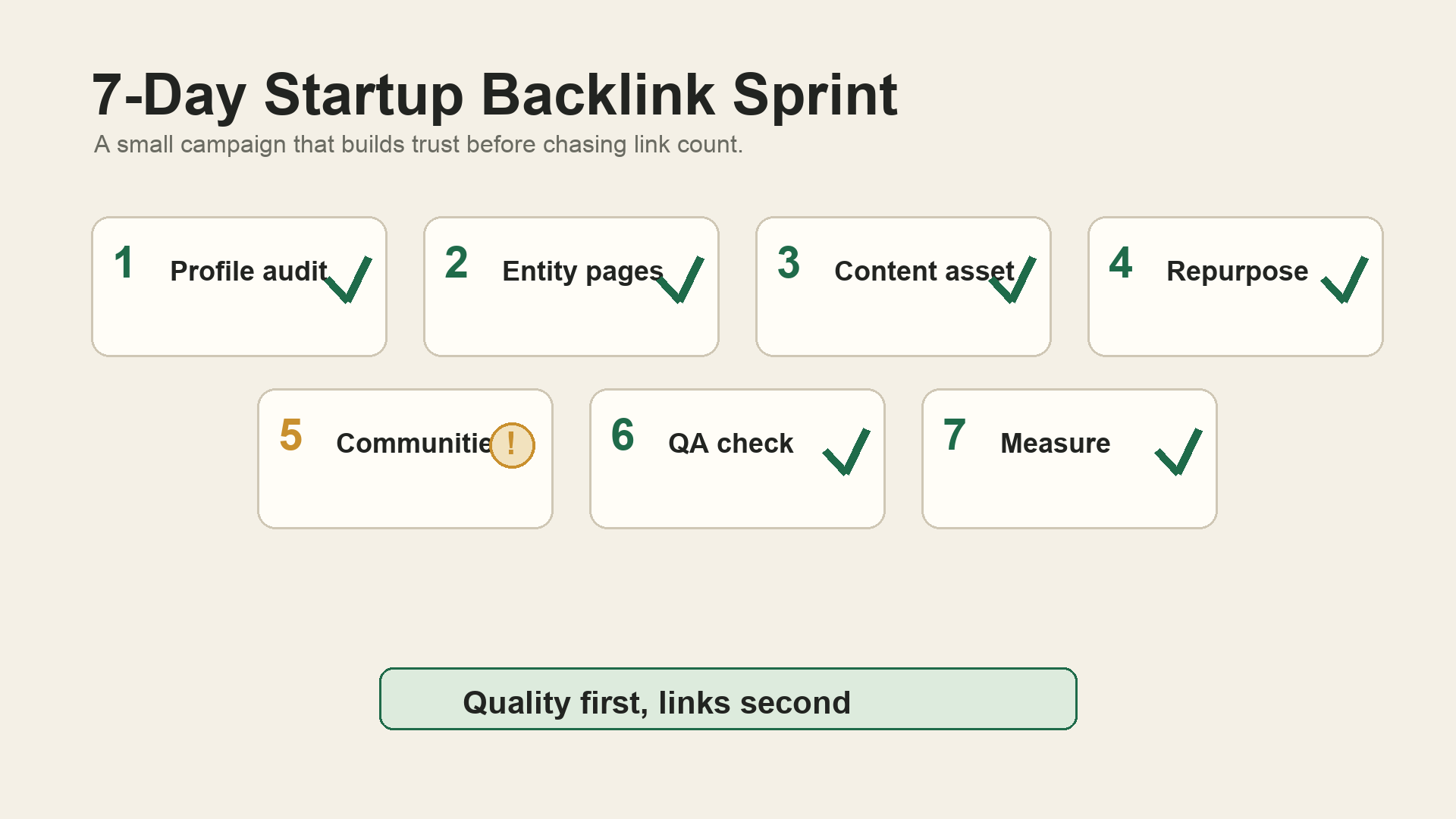
Caption: A one-week backlink sprint should include profile cleanup, entity pages, real content assets, careful community participation, QA, and measurement.
Day | Task | Output |
|---|---|---|
Day 1 | Audit your current brand facts | One consistent company description, category, URL, founder names, social links |
Day 2 | Build core entity profiles | Crunchbase, About.me, Manta, Yelp if local |
Day 3 | Create one real content asset | A guide, checklist, comparison, deck, or founder essay |
Day 4 | Repurpose the asset | Medium, Substack, Scribd, SlideShare, Pinterest where relevant |
Day 5 | Join two communities carefully | Reddit and Quora, with answers first and links second |
Day 6 | Inspect link attributes and page quality | Record URL, anchor, rel attribute, indexability, and notes |
Day 7 | Measure early signals | Referral traffic, indexed pages, branded searches, assisted conversions |
For a SaaS startup, one good workflow might be:
- Complete a Crunchbase profile.
- Publish a founder essay on Substack about the problem your product solves.
- Turn the essay into a checklist on Medium.
- Turn the checklist into a SlideShare deck.
- Create a Pinterest pin for the checklist if the topic has visual search demand.
- Answer two Quora questions without forcing exact-match anchor text.
- Mention the resource in one Reddit thread only if the community rules allow it.
That is already enough for a first sprint.
Backlink QA checklist
Before you count a link as useful, check the page.
Check | How to inspect it | Good sign |
|---|---|---|
Link attribute | Inspect the anchor tag in browser dev tools | No spammy redirect chain; attribute matches context |
Page quality | Read the page like a human | Complete profile, real content, no scraped junk |
Anchor text | Look at the visible linked text | Brand name, URL, product name, or natural phrase |
Indexability | Search the exact profile URL or use indexing tools | Page can be discovered |
Relevance | Ask if your ideal buyer would understand why you are there | Platform matches your category or audience |
Traffic | Check analytics referral reports | Some visits, even if small |
Brand consistency | Compare description, category, name, and URL | Same facts across profiles |
If you use Auspia, this is also a good moment to run a basic site health check with the Website SEO Score Checker before you send more authority signals to a weak homepage. Backlinks help more when the destination page is clear, crawlable, and worth citing.
Anchor text rules for this kind of campaign
Keep anchor text boring.
Use:
- Your brand name
- Your homepage URL
- Your product name
- A natural phrase like "read the full checklist"
- A page title if it matches the context
Avoid:
- Repeating one exact keyword across every platform
- Stuffing commercial anchors into profiles
- Linking every profile to the homepage only
- Adding links to pages with no content depth
- Using communities only for self-promotion
For a startup, branded links are usually safer than aggressive keyword anchors. They also help with entity recognition, which matters for search engines and AI answer systems.
Which sites should you prioritize first?
If you only have one afternoon, do not start with all 18.
Start here:
Startup type | Prioritize first |
|---|---|
B2B SaaS | Crunchbase, Medium, Substack, Quora, SlideShare |
Local service business | Yelp, Manta, Craigslist, About.me, Pinterest |
Creator-led startup | Substack, Patreon, Medium, Pinterest, Reddit |
Design or no-code product | Framer, Pinterest, Medium, product-related communities |
Research-heavy startup | Scribd, SlideShare, Medium, Substack, Crunchbase |
Consumer product | Pinterest, Reddit, Yelp if local, Substack, Medium |
The mistake is treating every high-authority domain as equally useful. A backlink from a platform your buyers never use is not the same as a profile that sends qualified visitors every month.
Auspia take
This shared backlink list is useful because it reminds startups to build a public footprint outside their own website. That part is right.
The risky part is the "do follow" framing. Link attributes change by platform, page type, and policy. Large user-generated platforms often qualify outbound links. Some links will help with referral traffic rather than PageRank. Some profiles are useful for brand/entity consistency even when they do not act like classic backlinks.
So use the list, but do not worship the list.
A better startup SEO system has three layers:
- A technically clean website with clear landing pages.
- A consistent brand/entity footprint across trusted third-party platforms.
- A small number of genuinely earned editorial links from partners, customers, tools, reports, and industry publishers.
The 18 sites can help with layer two. They may occasionally help with layer three. They cannot replace a real reason for people to cite you.
FAQ
Are these sites guaranteed to give dofollow backlinks?
No. Link attributes can vary by platform, page type, account status, moderation rules, and time. Always inspect the actual link on the published page before counting it as followed.
Are nofollow links useless for SEO?
No. A nofollow or UGC link may still send referral traffic, help people discover your brand, and contribute to a broader entity footprint. It should not be valued the same way as an earned editorial link from a relevant article.
Should startups create profiles on all 18 sites?
Only if the profile or content makes sense. Crunchbase and About.me are broadly useful. Yelp is mainly useful for local businesses. Patreon only makes sense if you have a creator or membership angle. Reddit and Quora require real participation.
Is it safe to use Blogger or Tumblr for backlinks?
It depends on intent and quality. A maintained brand blog, update archive, or resource hub can be fine. A thin blog created only to push links at your main site is a bad idea.
How many backlinks should a new startup build in the first month?
Think in terms of quality assets, not raw count. A good first month might include five complete profiles, two repurposed content assets, and a few helpful community answers. That is better than 50 weak links from irrelevant pages.
What should I measure after publishing these links?
Track referral traffic, branded search growth, profile indexation, assisted conversions, and whether AI search tools can identify your company more accurately. Do not rely only on third-party backlink counts.
Source notes
- Google Search Central: Qualify your outbound links
- Google Search Central: Spam policies for Google web search
- Moz: Domain Authority
Author: Hannah Pierce, 12-Year B2B SEO Growth Practitioner at Auspia. Hannah writes about startup SEO, buyer-focused content, and practical search workflows for small growth teams.