The short version
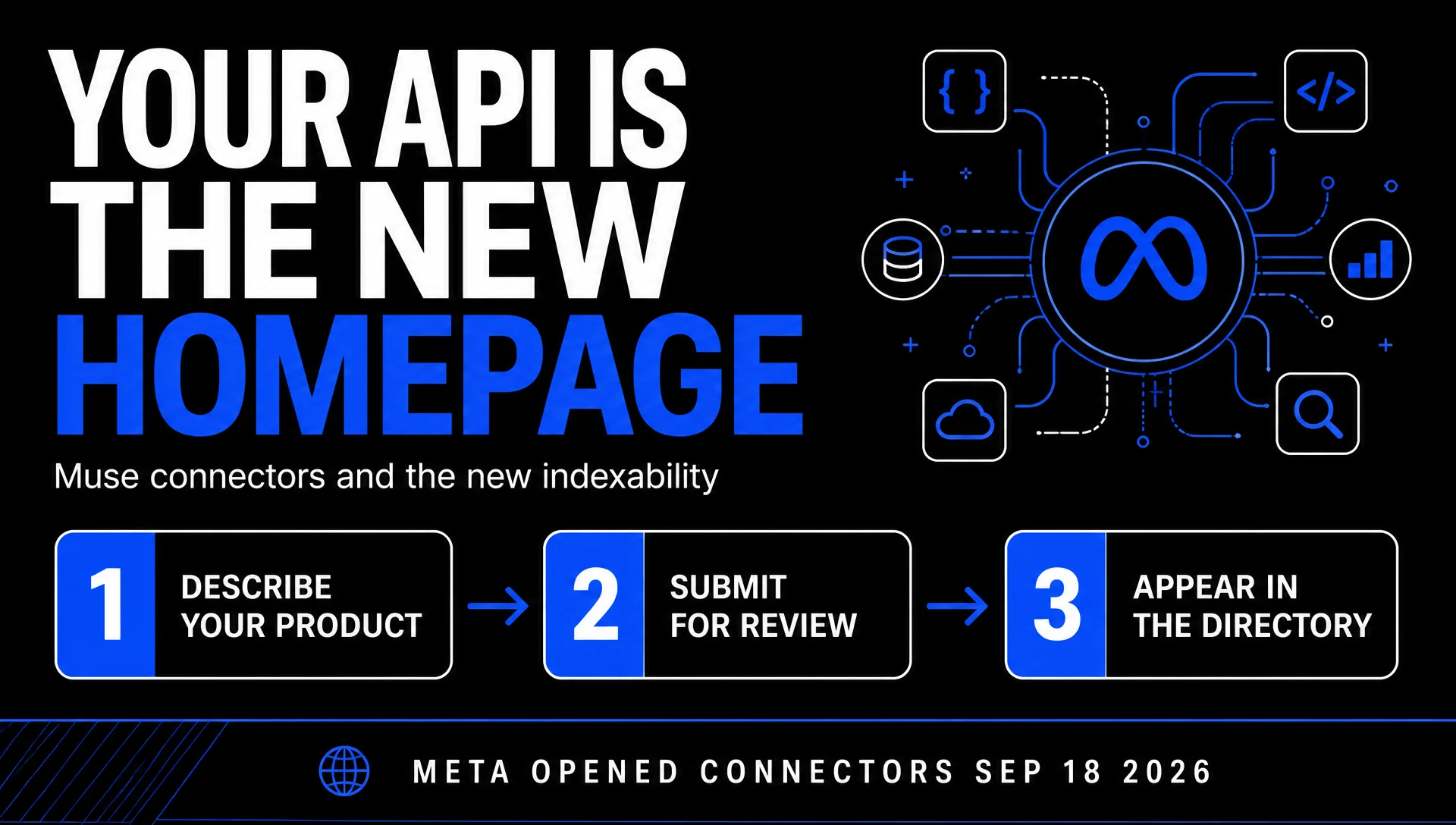
On September 18, 2026, eleven days after Muse launched, Meta opened connectors to all developers. Zuckerberg's framing was four words: "You bring the API."
That sentence is the whole story. For twenty years, the way to be found was to have a page a crawler could index. Now there is a second requirement layered on top: a service an agent can act through. A page can be read. A connector can be used.
The practical consequence is uncomfortable for anyone whose discovery strategy stops at content. If your competitor has a connector and you do not, the agent does not compare your pages. It uses the tool it has.
New to Muse? Start with What Is Meta Muse? for what it does and who it partners with.
What a connector actually is
A connector links Muse to an app or service so the agent can do things there: read a calendar, write an email, place an order, check an order status. Each connector is a separate authorization. The user approves it once, and Muse can then read from that tool and, in some cases, act on the user's behalf.
Two classes exist, and the difference matters:
Type | Who builds it | Who reviews it | Risk posture |
|---|---|---|---|
Official connector | Submitted by the developer, built as a Meta skill | Meta reviews function, security, and legal requirements, then runs end-to-end tests | Listed in the directory; gets Meta's privilege separation |
Custom connector | Muse builds it on the user's request | Nobody at Meta | User supplies API credentials; Meta explicitly does not review or endorse it |
The official path is the one with distribution. The custom path is the one with no gatekeeping and no protection. Meta is clear that it does not review custom connectors or how they use user information, which is a warning, not a feature.
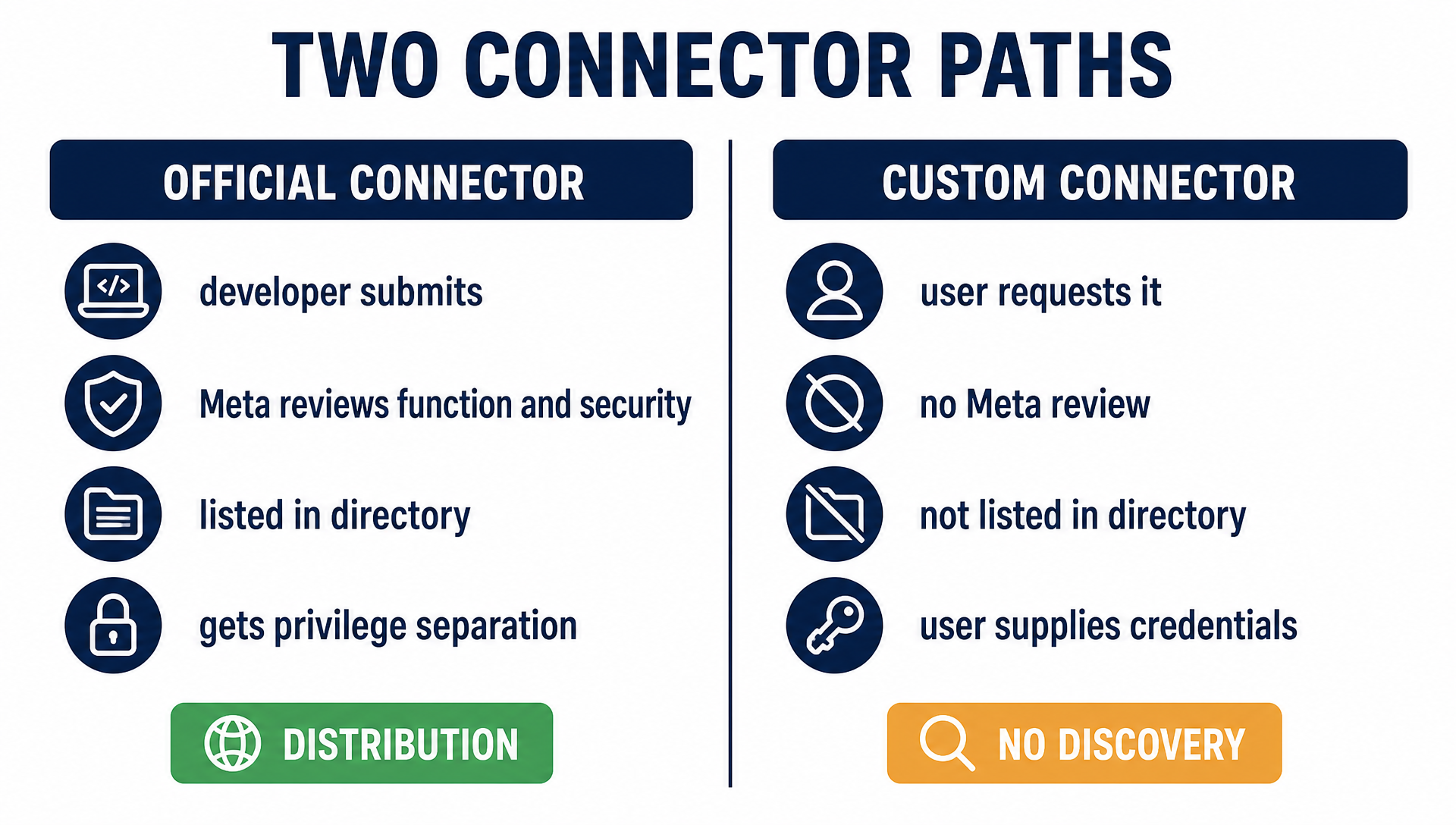
Only the official path gets distribution. The custom path is a fallback for users who already want you, not a discovery channel.
The submission flow, as published
Meta's platform page describes three steps:
- Describe your product — a form, not a code submission
- Submit for review — Meta checks functional, security, and legal requirements and runs end-to-end testing
- Appear in the directory — once listed, editorial may consider featuring it
Payments run through Stripe Link, which means a connector can accept payment natively rather than sending the user somewhere else.
Now the part that should shape your planning. Meta has published no SDK, no API specification, no fee schedule, no revenue share, no review timeline, and no developer terms on that page. The form asks you to describe your product, not to write code. It does not say who writes the connector.
That is not a reason to wait. It is a reason to treat the connector program as early and to expect the terms to change.
Why this is the new indexability
Think about what made a page indexable. Clean markup, a crawlable structure, a reachable URL, and content that answered a query. Get those right and a search engine could find you and rank you.
A connector changes the verb. The agent does not need to find your page and summarize it. It needs to complete a task. That requires:
- A documented, stable API the agent can call
- Authentication that a user can grant without friction
- Narrow, predictable endpoints that behave safely when retried
- A response format the agent can interpret without guessing
- A payment path if the task involves money
Miss any of these and the agent falls back to whatever tool it does have. There is no partial credit for a beautiful page the agent cannot act through.
The comparison to mobile is the one practitioners keep making. Greg Isenberg's framing, reported by Business Insider, was that getting in early is "as valuable as getting into the App Store in 2009," and that every company will need an agent strategy the way it needed a mobile strategy. That is a prediction, not a result. But the underlying logic holds: when a new distribution surface opens, the businesses that build for it first set the defaults.
What the directory means for discovery
Meta has not published a connector list. It lives inside the Muse app under Settings, then Connectors, and it changes weekly. Third-party trackers counted roughly 37 live connectors and about 5 announced-but-unavailable as of September 23, 2026. Treat those numbers as estimates, because they are reconstructed from screenshots, vendor announcements, and press coverage rather than from Meta.
The important structural point is that the directory is a shelf. Being in it is the difference between an agent that can use your service and an agent that cannot. And the third step of the flow — editorial consideration for a feature — means there is a placement layer on top of mere inclusion, exactly like an app store's featured section.
If that sounds familiar, it should. This is the same dynamic as being indexed versus ranking, compressed into one program.
What to build, concretely
If you are deciding whether to pursue a connector, work through these in order.
1. Audit what an agent could actually do with your API today. Not what your docs say. What happens when a caller with no session, no browser, and no patience hits your endpoints. If the answer requires a human to click through three screens, you do not have an agent-ready surface.
2. Make the endpoints idempotent and narrow. An agent retries. If a retry creates a duplicate order or a duplicate email, you have a bug that only shows up under agent traffic. Design endpoints so a repeated call is safe.
3. Write the description for a reviewer, not a buyer. The first step of the submission is describing your product. Meta is evaluating function, security, and legal fit. Lead with what the connector lets an agent do, not with your positioning.
4. Decide your payment posture before you submit. Stripe Link integration is available. If your connector involves a transaction, knowing whether you can accept payment natively changes what you can offer.
5. Do not rely on the custom-connector path for distribution. It exists, it works, and Meta does not review it. That means no directory listing, no privilege separation, and no endorsement. It is a fallback for users who want you, not a discovery channel.
What is still unknown
Be honest about the gaps when you plan.
- No published fee, revenue share, or review timeline
- No SDK or API specification
- No statement on who writes the connector code
- No published list of connectors, only third-party reconstructions
- No clarity on how directory placement is ordered or whether it can be paid for
- Muse is still US-only, so connector reach is US-only
Anyone telling you they know the connector economics is guessing.
Auspia's view
Indexability was a technical requirement that most teams eventually treated as table stakes. Connector reachability is heading for the same status, and the window where it is a differentiator is open right now.
The teams that move early will not win because they guessed Meta's ranking logic. They will win because they built a surface an agent can act through while their competitors were still optimizing pages for a crawler that no longer decides the purchase.
Do the boring part first: make your API safe to call, narrow, and documented. Then submit. The directory is a shelf, and shelves fill up.
FAQ
Do I need a connector to be found by Muse? Not to be found. Muse can research the open web and read your pages. You need a connector to be acted through — to have the agent complete a task in your product rather than just describe it.
Is a connector the same as MCP? The concept is the same family. MCP is an open standard for connecting tools to AI systems. Meta's connector program is Muse-specific and runs through Meta's own review and directory.
What does it cost? Nothing published. No fee schedule, no revenue share, no developer terms have been released. Payments route through Stripe Link.
How long does review take? Unknown. Meta has not published a timeline.
Can I skip review with a custom connector? Yes, and you should understand what you give up. Custom connectors are not reviewed or endorsed by Meta and do not get privilege separation. They are for users who already want you, not for discovery.
Is this worth doing if Muse is US-only? If your customers are in the US, yes. If they are not, watch and prepare. The program will likely expand, and the submission work is portable.
Author: Camille Rhodes, Architect of 300+ AI Content Workflows at Auspia. Camille writes about AI-assisted content workflows, automation, publishing systems, and editorial quality control.