What changed
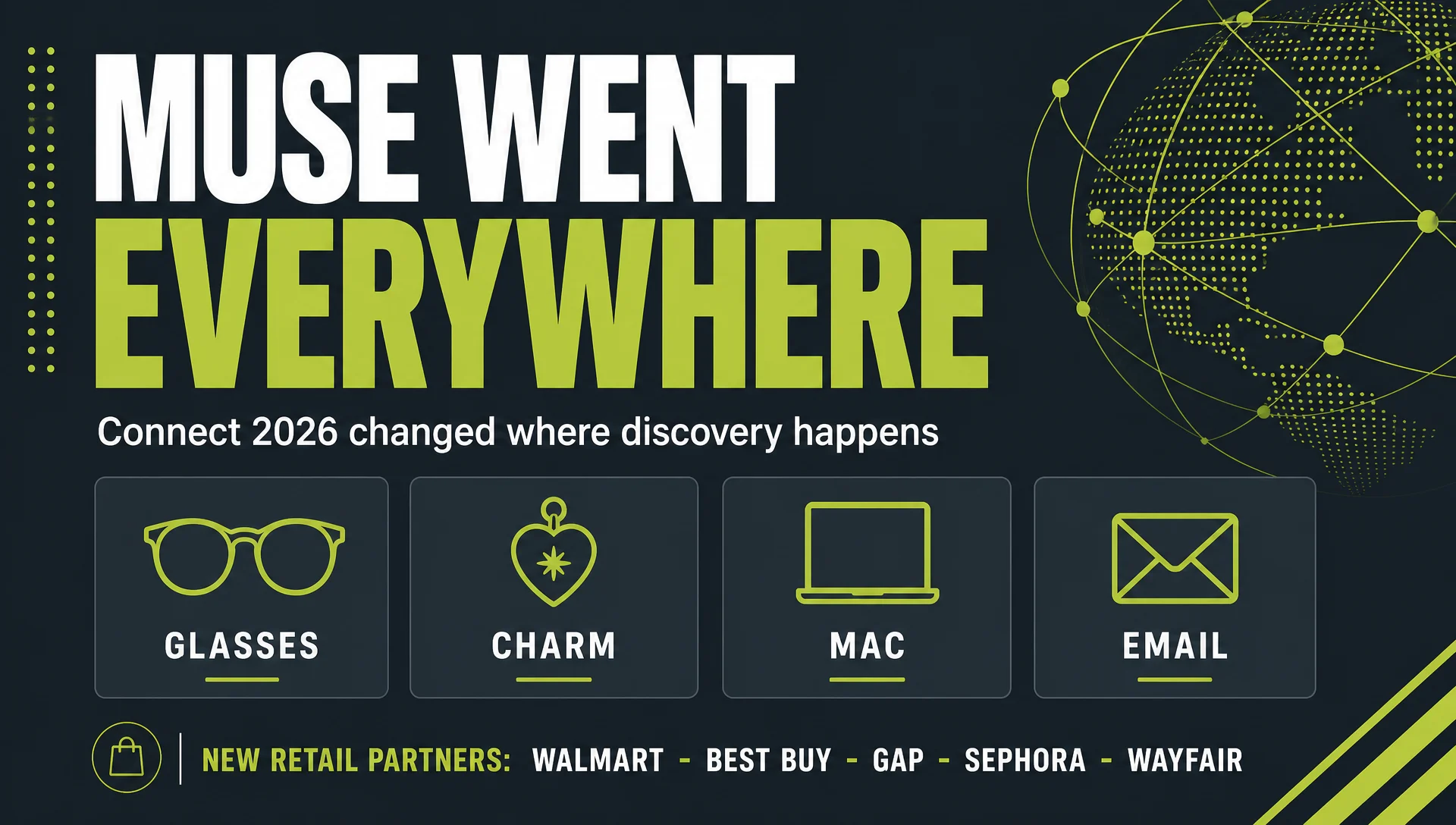
On September 23, 2026, at Connect, Meta stopped treating Muse as an app and started treating it as a layer. In one keynote, Muse moved onto glasses, into a keychain-sized device, onto the Mac desktop, and into its own email address. The retail partner list grew from a handful of platforms to a set of named merchants.
The short version of what was announced:
Announcement | What it means |
|---|---|
Muse on Meta AI glasses | Activation by name, rolling out over the coming months |
Muse Charm | Palm-sized device with screen, camera, mics, fingerprint activation; holiday target, no price |
Mac computer use | Muse can operate desktop apps and keep working after you walk away |
Muse email address | Coming soon; you can add Muse to a thread or forward mail for it to handle |
New retail partners | Walmart, Best Buy, Gap, Sephora, Wayfair added to the shopping connectors |
Connector program | Meta opened connectors; 1,500+ developer applications in under a week, per Alexandr Wang |
Monetization signal | Zuckerberg said Meta expects to take a small fee on transactions later |
Two of these matter far more for search and discovery than the rest. The retail partner list, because it decides which merchants an agent can actually buy from. And the connector program, because it decides who can plug into the agent at all.
Why the partner list is the real story
If you are new to Muse, start with What Is Meta Muse?.
Before Connect, Muse shopping ran through Shopify, PayPal, Stripe Link, Expedia, and Instacart. That is infrastructure. After Connect, it includes named retailers: Walmart, Best Buy, Gap, Sephora, Wayfair.
That is a different kind of list. Infrastructure partners make a channel possible. Named retailers decide which brands a shopper sees inside it.
If you sell in a category those retailers dominate, this is the moment to pay attention. A shopper asking Muse for a gift, a kitchen item, or a skincare product may now be routed toward a partner catalog rather than the open web. That is a meaningful shift in where the recommendation happens.
It also sharpens the question we raised after the Amazon block: who controls the shelf? Meta is building a partner shelf. Amazon runs its own. Shopify syndicates to both. The brands that appear in the most shelves have the widest reach.
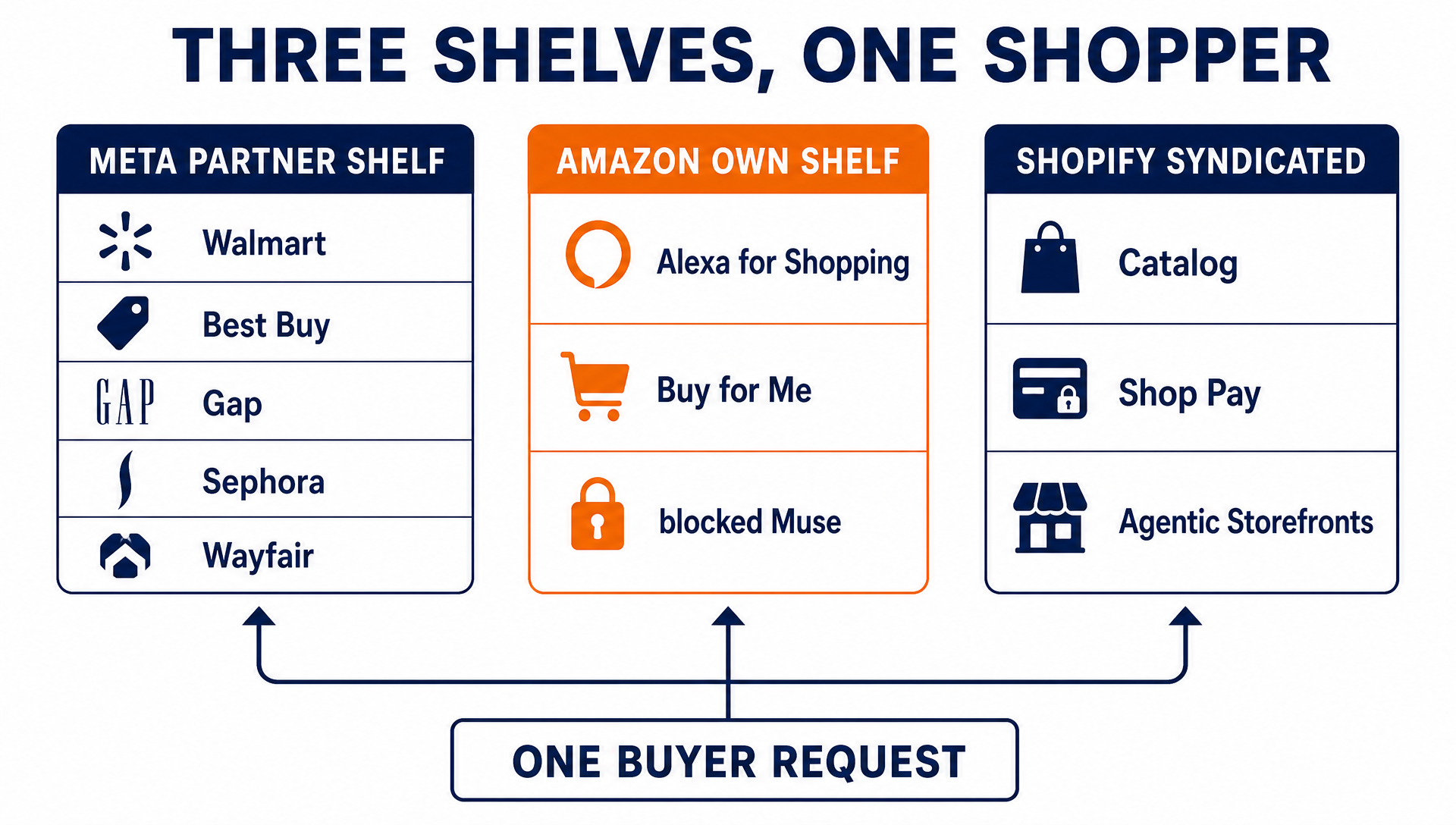
Three shelves now compete for the same shopper. Meta is building a partner shelf, Amazon runs its own, and Shopify syndicates to both.
The connector program is the new SEO surface
Meta opened connectors at Connect, and Alexandr Wang said more than 1,500 developers applied in under a week.
Read that as a discovery signal. A connector is how a service makes itself available to the agent without waiting for a bespoke partnership. For a brand or a platform, being connector-accessible is the agent-era equivalent of being indexable. It is table stakes for being in the consideration set.
The practical question for a growth team is whether your platform, your CMS, or your commerce stack is on a path to a Muse connector. If it is not, and a competitor's is, the competitor gets the default position.
What the Mac client changes
Muse on Mac is the most underrated announcement for anyone who works in content or SEO.
Meta released the Mac app on September 18, and at Connect it gained computer use: Muse can operate desktop apps and continue working after you step away. That means the agent can read files, summarize notes, search a downloads folder, and act on what it finds.
For a brand, this is a new place your content can be encountered. A Muse user asking their Mac-based agent to research a category is running a different retrieval path than a browser search. Your pages need to be readable in both.
It also raises the same risk we flagged in the security coverage. The Mac client had an undocumented dictation endpoint that a researcher demonstrated could be redirected. Meta hot-fixed it. Adding always-on voice and a camera on the Charm, behind the same agent permissions, extends that surface rather than shrinking it.
What is still unknown
Be careful with confident claims here. As of September 24, 2026:
- Muse Charm has no public price, no radio specification, and no device-trust model. Zuckerberg said only a few units exist and component layout is still being finalized.
- The December shipping target is a target, not a commitment.
- The Muse email address is "coming soon," with no date.
- Meta has not published how it will rank or select products inside the new retail partnerships.
- The transaction fee Zuckerberg described has no published rate or start date.
- Muse is still US-only.
Treat every one of these as a direction, not a fact you can plan a quarter around.
What teams should do this week
1. Check whether your category is now partner-dominated. If Walmart, Best Buy, Gap, Sephora, or Wayfair sells what you sell, assume the agent may route there first. Decide whether that is acceptable or whether you need a connector path of your own.
2. Ask your platform about connectors. If you are on a commerce or CMS platform, ask directly whether a Muse connector is planned. A vague answer is itself information.
3. Re-run your product data audit. Nothing about the Connect announcements changes what makes a product recommendable. Accurate titles, attributes, stock, and price still decide whether an agent can act on you.
4. Add the new surfaces to your access map. Glasses, Charm, Mac, and the Muse email address are four new entry points to the same agent. If you maintain an agent-reachability map, they belong on it.
5. Watch the fee. Zuckerberg confirmed Meta intends to take a small transaction fee. When that rate is published, it changes the economics of every agent-completed order and belongs in your channel margin model.
Auspia's view
Connect 2026 answered the question of whether Muse was a product or a platform. It is a platform, and Meta is building the shelf, the connectors, and the fee at the same time.
For brands, the useful takeaway is not the hardware. It is that discovery is consolidating into partner catalogs and connector programs, both of which are gated. The open web still matters, but the path from a buyer's request to a purchase increasingly runs through a list someone else controls.
The work that still belongs to you is unchanged: be findable, be parseable, be corroborated, and be purchasable. What changed is how many places you now need to be all four.
FAQ
Is Muse Charm available to buy? No. Meta showed it at Connect and targeted a December holiday ship, but Zuckerberg said only a few units exist and the design is not final. There is no public price.
Do the new retail partners replace Shopify or PayPal? No. They add merchant-level reach on top of the existing payment and catalog infrastructure. Shopify, PayPal, and Stripe Link still handle the checkout rails.
Does this affect my SEO? Indirectly. The partner list changes where recommendations happen, which changes where demand flows. Your own pages still need to be readable and accurate for the agents that research the open web.
Should I worry about the transaction fee? Not yet, because no rate has been published. Do model it once it is, since it will sit on top of your existing payment costs.
What about the security concerns? The Mac client had a documented vulnerability that Meta patched within a day. The Charm adds always-on voice and camera behind the same agent permissions, which is a larger surface. If you manage devices for a team, treat Muse across glasses, Mac, and Charm as one identity with one revoke list.
Where should I start? Check whether your category is now dominated by a partner retailer, and ask your platform whether a connector is planned. Those two answers shape everything else.
Author: Jasper Quinn, AI Search Product Researcher Tracking 60+ Feature Changes at Auspia. Jasper writes about search product updates, AI platform changes, and how new agent surfaces change discovery.