Teams adopting agents in 2026 keep asking the same question in the wrong shape. "Which agent is best?" has no useful answer. "Which agent for which job?" does.
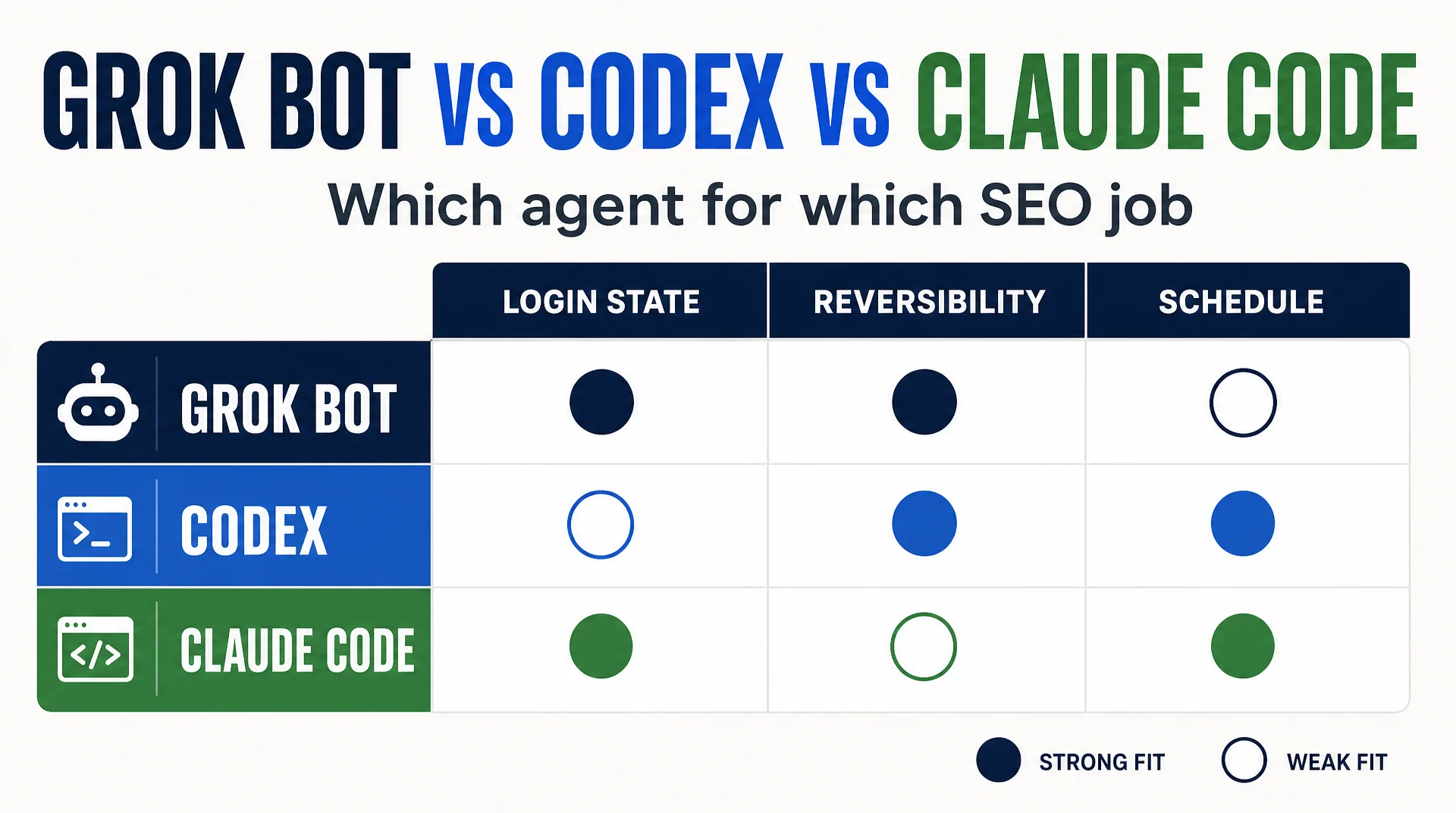
Grok Bot, Codex, and Claude Code are built for different conditions. Grok Bot lives on a persistent cloud computer with live browser sessions. Codex and Claude Code work in a repository with diffs, review, and rollback. Route the job to the right condition and all three work well. Route it wrong and you get a confident mess.
The routing rule
Three questions decide where a job belongs:
- Does it need a live login? If yes, it belongs on a persistent browser.
- Does it change a file in a repository? If yes, it belongs with a code agent.
- Is the change irreversible? If yes, a human owns it regardless of the tool.
Apply them in order. Most SEO jobs resolve on the first question.
Job | Needs login? | Changes a repo? | Route to |
|---|---|---|---|
Check how ChatGPT answers 40 buyer questions | Yes | No | Grok Bot |
Pull underperforming pages from Search Console | Yes | No | Grok Bot |
Audit schema across 500 URLs | No | No | Either, code agent if scripted |
Fix 40 page titles in the CMS | Yes | No | Grok Bot, with approval |
Fix 40 page titles in the codebase | No | Yes | Codex or Claude Code |
Add hreflang tags across a site | No | Yes | Codex or Claude Code |
Publish a finished article | Yes | Maybe | Human gate, then tool |
Change conversion tracking | Yes | Maybe | Human |
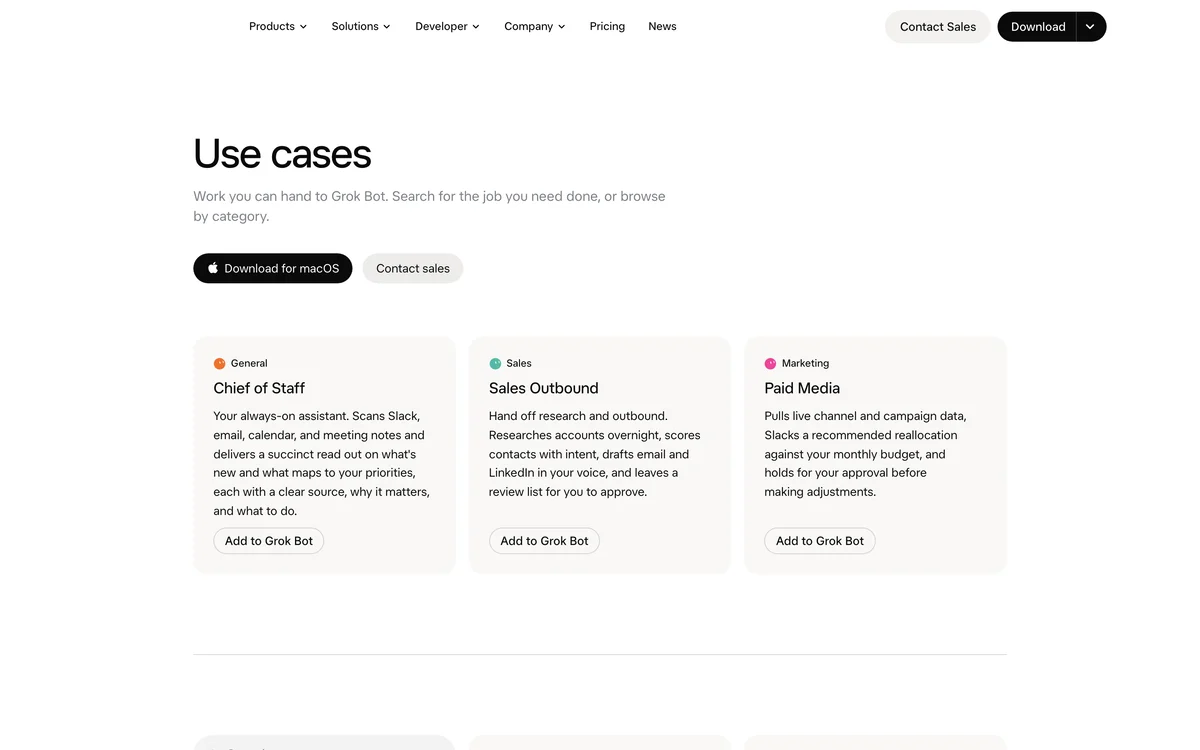
Grok Bot's differentiator is the persistent machine and live session, not the model. Source: x.ai/bot, captured September 23, 2026.
Grok Bot: the logged-in layer
Best for: recurring checks and light changes inside logged-in tools.
Grok Bot's structural advantage is that each Bot runs on a persistent cloud computer with a browser, filesystem, and terminal, and all Bots share one machine's login state. That makes it the only one of the three that can comfortably sit inside Search Console, GA4, or an AI answer surface and look at what a real user sees.
Strong jobs:
- Weekly GEO visibility checks across four AI answer surfaces
- Pulling Search Console data and turning it into a worklist
- Checking a competitor's pricing page and summarizing what changed
- Small, reversible CMS edits after a human approves the list
Weak jobs:
- Anything needing a guaranteed deterministic output
- Large-scale code changes across a repository
- Anything you cannot undo
The catch: output varies between runs, and the shared machine means every credential is available to every Bot. Use a dedicated account.
Codex: the repository worker
Best for: changes that live in code, need a diff, and need to be reviewable.
Codex works where the artifact is a file in a repository. That gives you the three things Grok Bot cannot promise: a diff, a review step, and a rollback.
Strong jobs:
- Fixing titles, meta descriptions, or schema in a codebase
- Adding or correcting hreflang and canonical tags
- Building a script that pulls and normalizes SEO data
- Auditing a site's rendered HTML for technical issues
Weak jobs:
- Anything requiring a live logged-in session
- Tasks where the output is a judgment call rather than a file change
The catch: it does not see the live logged-in state of your tools. It works on the artifact, not the session.
If you want a starting point, our Codex SEO automation guide walks through a first workflow.
Claude Code: the repository worker with a different feel
Best for: the same class of jobs as Codex, with a different working style.
Claude Code occupies the same slot: repository changes with diffs and review. The practical difference is in how it plans and how it explains its work, which some teams prefer for longer, multi-file changes.
Strong jobs:
- Multi-file refactors that touch templates and content together
- Content changes that need to respect an existing editorial system
- Work where you want a detailed plan before edits begin
Weak jobs:
- The same weak jobs as Codex: no live session, no logged-in surfaces
The catch: same as Codex. It is a repository tool, not a browser tool.
Our Claude Code SEO guide covers the repository-change workflow in detail.
The three-way comparison
Dimension | Grok Bot | Codex | Claude Code |
|---|---|---|---|
Live logged-in session | Strong | None | None |
Repository diff and rollback | Weak | Strong | Strong |
Scheduled recurring runs | Strong | Limited | Limited |
Deterministic output | Weak | Strong | Strong |
Multi-tool research | Strong | Moderate | Moderate |
Reviewability of changes | Weak | Strong | Strong |
Best single job | Logged-in recurring checks | Code changes | Code changes |
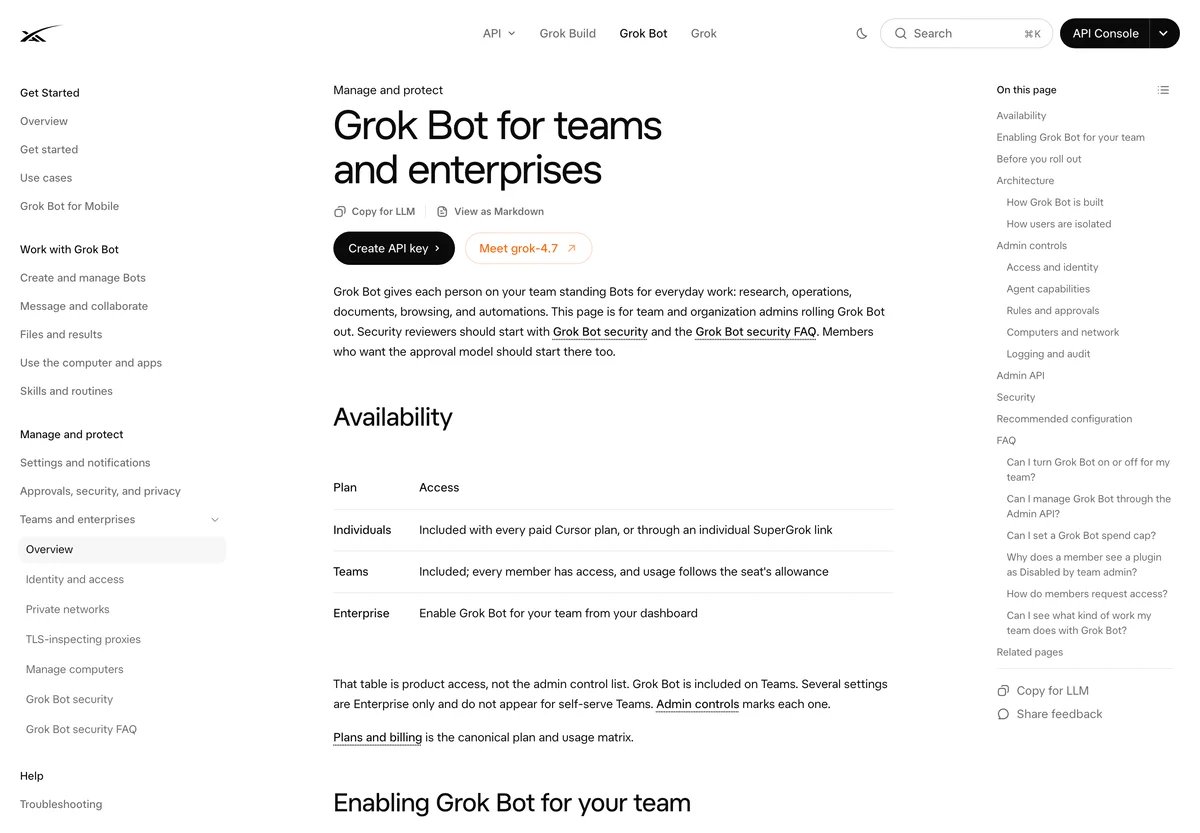
Grok Bot adds admin controls and identity management for teams, which matters when the machine holds live sessions. Source: docs.x.ai/grok-bot/teams-and-enterprises, captured September 23, 2026.
The pattern that uses all three
The most advanced setup reported in the launch window was a front-door agent that routes work and owns the irreversible gate, with Codex, Claude Code, and Gemini running as workers underneath it. That is the right shape.
A practical version for an SEO team:
- Grok Bot as the front door. It holds the live sessions, runs the recurring checks, and produces the worklist.
- A code agent as the worker. When the worklist requires a repository change, the code agent makes the change with a diff.
- A human as the gate. Anything irreversible waits for approval.
This is the same four-layer model we described in the agentic SEO guide, applied to a specific tool set.
Choose neither when
Some jobs should not go to an agent at all:
- Strategy and prioritization. An agent can gather evidence. It should not decide what matters.
- Anything customer-facing without review. Publishing, sending, and posting stay behind a human.
- One-off judgment calls. If you will do it once and it needs taste, do it yourself.
- Anything you cannot verify. If you have no way to check the output, you cannot trust it.
Verification checklist
- [ ] You applied the three routing questions before choosing a tool.
- [ ] Logged-in recurring work went to Grok Bot.
- [ ] Repository changes went to a code agent.
- [ ] Irreversible actions have a human gate.
- [ ] Every agent job has a verification step you can run by hand.
- [ ] Credentials on the shared machine are scoped, not personal.
- [ ] You can explain why each job went where it did.
Common mistakes
Asking which agent is best. The question is which agent for which job. Route by condition, not by preference.
Using Grok Bot for repository changes. It can, but you lose the diff and rollback that make code changes reviewable.
Using a code agent for logged-in checks. It cannot see the session. You will get a plausible answer built from public pages.
Automating the irreversible. Publishing, sending, and spending stay behind a human gate no matter which tool you use.
Skipping verification. An agent output you never checked is a guess with better formatting.
FAQ
Can I use Grok Bot and Codex together? Yes, and that is the recommended pattern. Grok Bot produces the worklist from live sessions; a code agent makes the repository change.
Which is cheaper? It depends on your plans and usage. Compare on the cost per completed job, not the sticker price, since a cheap tool that needs rework is not cheap.
Do I need all three? No. Most teams start with one. Add a second when a specific job keeps landing in the wrong tool.
What about other agents? The routing rule generalizes. Any agent with a persistent browser fills the Grok Bot slot; any agent that works in a repository fills the code agent slot.
Where should a beginner start? Start with the job you repeat most often. For most SEO teams that is a recurring logged-in check, which points to Grok Bot.
Author: Aaron Wolfe, Organic Growth Systems Designer with 15 Years in SEO/GEO at Auspia. Aaron writes about organic growth systems, SEO and GEO process design, and how teams route work across humans and agents.