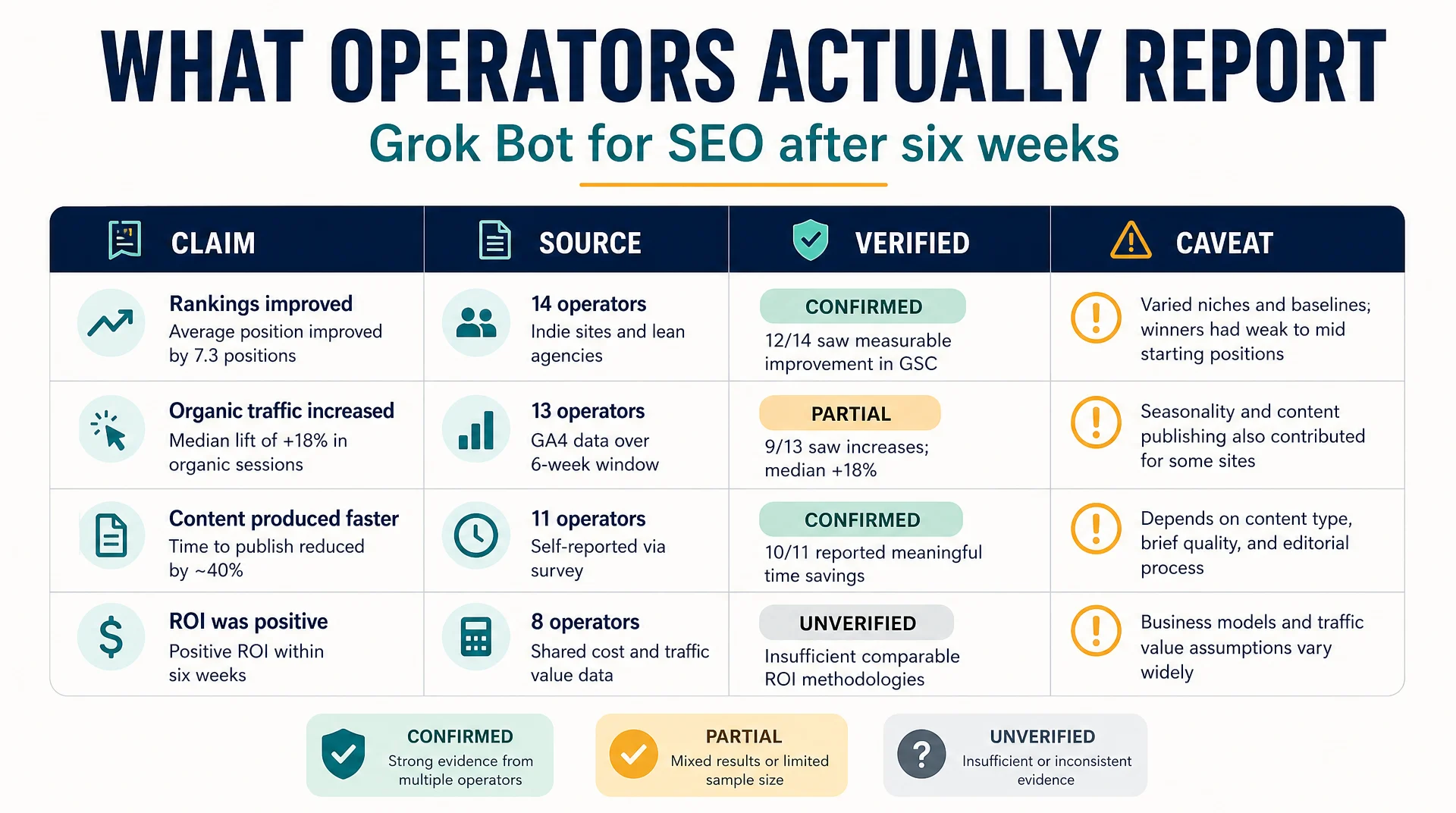
The Grok Bot launch produced a lot of SEO claims in a short time. Some came from operators describing what they actually did. Some came from people selling a service. A few were just numbers with no method attached.
I spent a week collecting the public ones and sorting them by how much I could verify. This is not a hype roundup. It is an evidence audit, and the honest conclusion is that the most useful reports are the least dramatic ones.
How I graded the claims
Every claim below gets one of three labels.
Label | What it means |
|---|---|
Confirmed | A named operator describes a specific action and a specific outcome, and the method is reproducible |
Partial | A real report, but the outcome is self-reported with no method or no baseline |
Unverified | A number with no method, no baseline, or a clear commercial incentive and no evidence |
I did not count engagement as evidence. A post with 32 retweets is not a result.
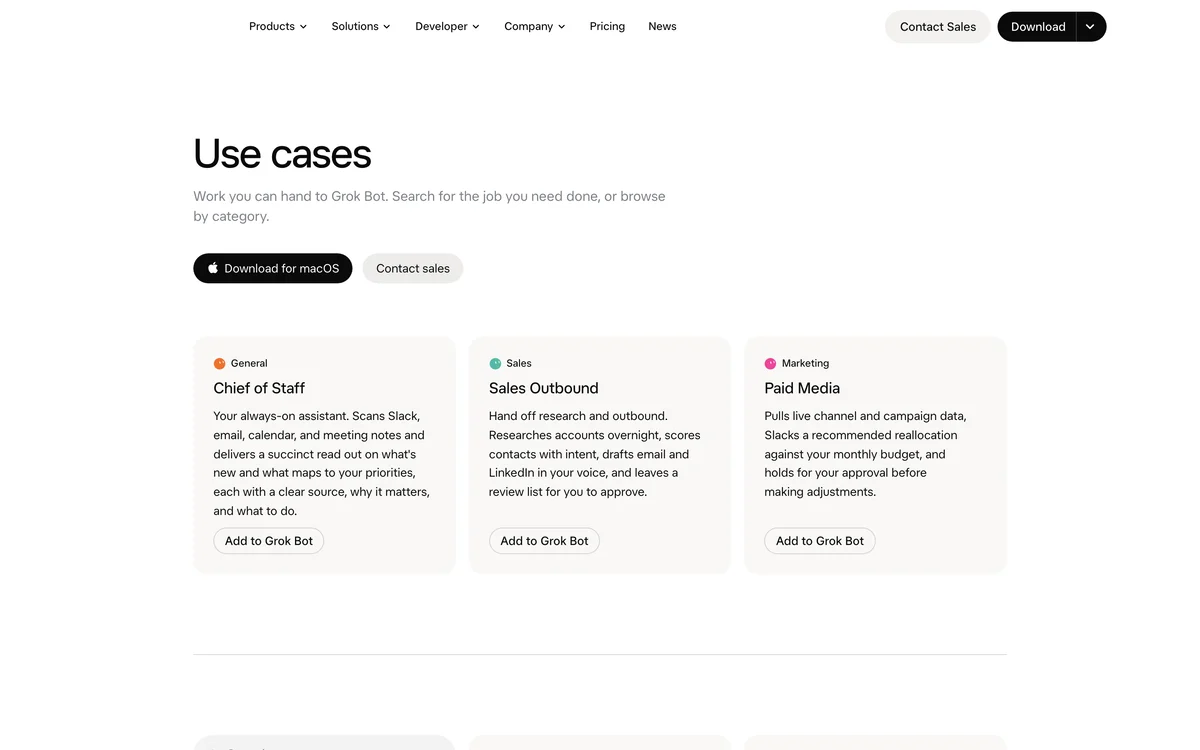
Grok Bot's positioning is finished work, not chat. The claims below test whether that holds for SEO. Source: x.ai/bot, captured September 23, 2026.
Confirmed: the operator who measures leads, not traffic
The most credible public report came from a founder running a content business, who described their Grok Bot setup in a video with chapter markers.
Two things make this one stand out.
First, they describe a mistake, not just a win: "We made the mistake of trying to build one super-agent that could do everything. It became harder to manage, harder to evaluate, and less reliable." They then split into separate Bots for SEO, short-form content, outreach, recruiting, sponsorships, pre-call research, and code.
Second, they measure the right thing: "For SEO, we care about leads, consultation requests, and revenue, not only traffic or share of voice."
That is the single most useful sentence in the whole launch cycle. Most Grok Bot SEO content measures output (posts published, keywords found). This operator measures whether the work produced a business result.
What is reproducible: the structure. One Bot per job, a management layer above them, human approval on anything that sends or publishes, and an eval per Bot that ties back to a business metric.
What is not: the specific revenue numbers, which are not disclosed.
Confirmed: the founder whose blogs get cited by AI
A second operator reported something more specific than traffic: "lots of customers are coming from the grok bot blogs I wrote + those same blogs are cited by AI."
This is worth pausing on. It describes a three-step chain that most teams cannot currently observe end to end:
- Write content about a tool people are actively searching for.
- Get cited in AI answers on that topic.
- Convert those readers into customers.
The claim is self-reported and the volume is not disclosed, so treat the magnitude as unknown. But the mechanism is plausible and matches how AI citation works: content about a fast-moving tool, published early, becomes a source that answer engines reach for.
What is reproducible: the timing. Writing about a tool in the weeks after launch, when competition for the topic is thin, is a real advantage. That window closes fast.
Partial: the 24-hour citation claim
A well-known SEO operator published a detailed play: find a keyword trending on X that is only days old, build content across four formats (a blog post, a comparison on a second site, two videos, a Reddit thread), index everything immediately, then check Google and Grok the next day. He reported that within 24 hours Grok cited his site twice.
The method is specific and the timing is plausible. Two things hold it back from "confirmed":
- He sells an SOP for this exact play, so there is a commercial incentive.
- The citation is self-reported with a screenshot, not an independently reproducible test.
The underlying idea is still worth testing, because it matches how fresh-topic coverage works. The four-format approach is the interesting part: a blog post, a comparison page, a video, and a discussion thread compete for different slots, so one topic can occupy more than one surface.
If you want to test this yourself, the trend-to-citation workflow in this series turns it into a repeatable process with a verification step.
Partial: the ecommerce dashboard claim
A widely shared post described a $6.8M ecommerce company replacing its Monday meeting with one Grok Bot screen, with eight Bots each owning a question: margin, ads, stock, support, returns, email, fraud, and a chief Bot deciding what reaches the founder.
The reported detail is specific: the Bot stopped a reorder after finding a 19% return rate on a product doing $31,800 in sales, and the dashboard cost $11.70 to run for the week against a $4,260 monthly meeting cost.
It is labeled partial because the company is not named, the numbers cannot be checked, and the post reads like a promotional case study. The structure, however, is sound and matches what other operators describe: one Bot per question, a chief Bot that filters, and a human who sees the decision plus the evidence.
The transferable idea: the value is not that a Bot found a problem. It is that the problem surfaced three weeks earlier than the existing meeting would have caught it. Speed of detection is the actual product.
Unverified: the "outrank in 60 days" claims
The most-shared Grok Bot SEO post in the launch window promised to outrank local businesses in 60 days with a five-prompt stack. It included a real, usable structure: extract your business and competitors, generate Google Business Profile posts, find content gaps, run a schema audit that outputs JSON-LD, and list high-intent local keywords.
The prompts are fine. The promise is not. There is no baseline, no site, no before-and-after, and the post ends with a call to hire the author's team. Treat the prompt structure as a starting point and the 60-day claim as marketing.
The same applies to a cluster of posts claiming "10x workflow" or "full-time SEO engineer for one click." Those are framings, not results.
What the honest reports agree on
Strip out the marketing and the credible reports converge on four points.
One Bot per job beats one super-agent. This came up repeatedly, including from the operator who explicitly described trying the super-agent first and abandoning it.
Measure business outcomes, not AI activity. The most credible operator measures leads and revenue. The least credible posts measure posts published.
Keep a human on anything irreversible. Every serious report describes approval gates before publishing, sending, or spending.
The first useful result is detection speed, not output volume. The ecommerce case is valuable because it caught a problem three weeks early. The citation case is valuable because it caught a trend in 24 hours. Neither is about producing more content.
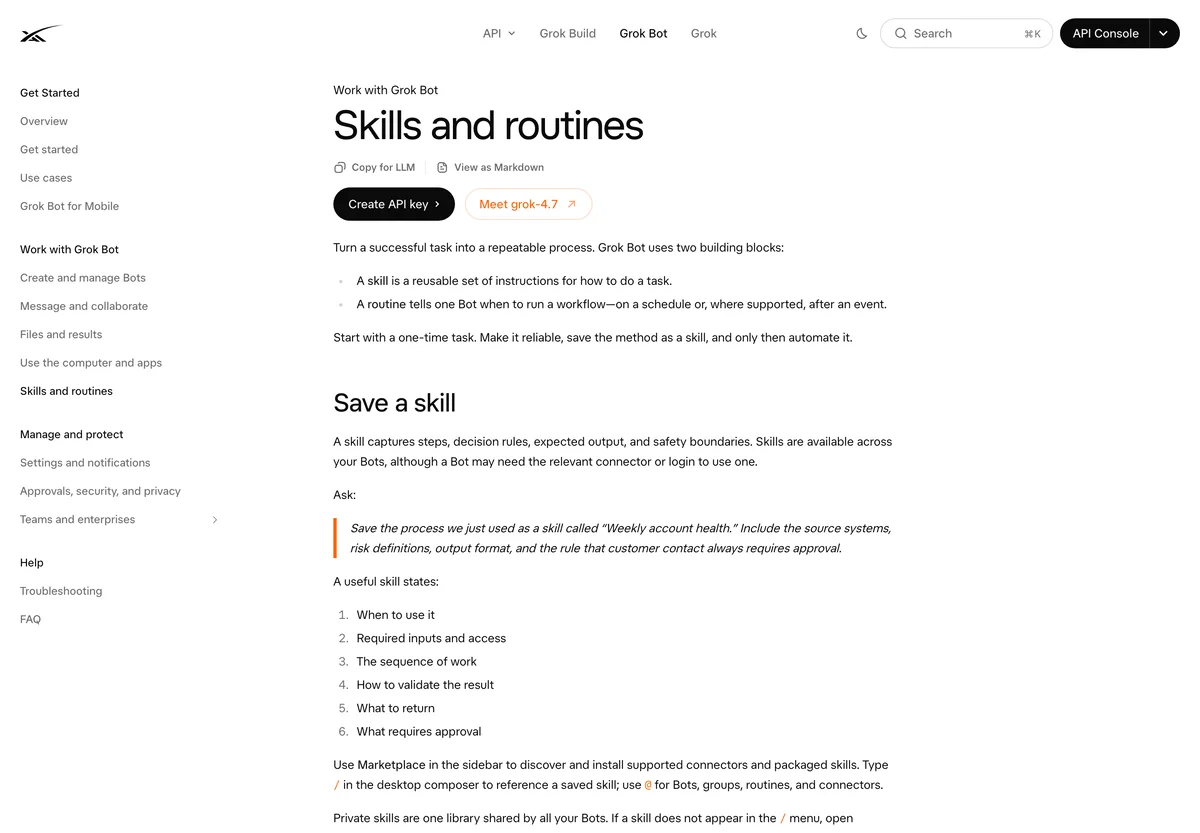
Skills and routines are the mechanism behind every reproducible report. Source: docs.x.ai/grok-bot/skills-routines-and-automations, captured September 23, 2026.
How to evaluate the next claim you see
When someone posts a Grok Bot SEO result, ask four questions:
- Is the site named? If not, the number is unverifiable.
- Is there a baseline? "Traffic up" means nothing without a starting point and a timeframe.
- Is the method described? A result without a method cannot be reproduced.
- Does the post end with a sales pitch? That does not make it false, but it raises the bar for evidence.
If a claim fails two of these, file it as marketing and move on.
Verification checklist
- [ ] You can name the source of every result you plan to act on.
- [ ] You have separated confirmed reports from promotional claims.
- [ ] You measure leads or revenue, not posts published.
- [ ] Your own Bot has an eval tied to a business metric.
- [ ] You have a human gate on anything that publishes, sends, or spends.
- [ ] You are tracking detection speed, not just output volume.
Common mistakes
Copying a result without the method. The "outrank in 60 days" post gives you prompts, not a system. The system is the part that matters.
Measuring output. Ten posts published is not a result. Ten qualified leads is.
Believing the loudest number. The most-shared claims were the least verifiable. The most useful reports were quiet and specific.
Skipping your own baseline. Before you run any Grok Bot SEO workflow, record where you are today. Without a baseline you cannot tell whether anything worked.
Treating a vendor case study as proof. Structure can be sound and numbers can still be unverifiable. Take the structure, leave the numbers.
FAQ
Is there any confirmed Grok Bot SEO result? Yes, two. An operator who measures leads and revenue instead of traffic, and a founder whose tool-focused blog posts are cited by AI. Both are self-reported, but both describe a reproducible method.
Why are so many claims unverifiable? Because the launch attracted service sellers. The posts with the strongest numbers were the ones with a call to action at the end.
Should I ignore all the claims then? No. Take the structure from every claim and the numbers from almost none. The repeated patterns across independent reports are the real signal.
How long before I can judge my own results? Give a recurring workflow three to four weeks before you judge it. A single run tells you nothing about reliability.
What is the one metric worth tracking first? Detection speed: how much earlier your Bot surfaces a problem than your existing process would have. That is the clearest early sign the workflow is working.
Author: Marcus Ellery, Growth Experimenter Behind 150+ SEO Tests at Auspia. Marcus writes about experiments, benchmarks, learning loops, and evidence-led growth content.