The short version
On November 12, Google put Gemini 4, codenamed Hydrogen, into Search for all users globally. Robby Stein, VP of Product for Google Search, called it "the biggest model upgrade to Search yet."
Four capabilities shipped together. Three of them are about answering: better intent parsing on multi-part questions, more visual responses, richer language understanding. The fourth is the one that changes who gets traffic.
Google's own wording: Hydrogen's reasoning "supercharges our query fan-out technique in Search, connecting you to a broader range of helpful links than before," and here is the sentence to keep, "Search helps you find sites you previously might not have discovered."
That is a distribution claim. It is not a claim that ranking factors changed, and it is not a claim that the rules for appearing in AI features changed. Those rules are still the same ones Google documented: your page needs to be indexed and eligible to show a snippet, and there are "no additional requirements to appear in AI Overviews or AI Mode, nor other special optimizations necessary."
So the model got better at asking several questions at once. The set of candidates it asks about got wider. Whether your pages are in that set is now a slightly different question than whether you rank.
What fan-out was already doing
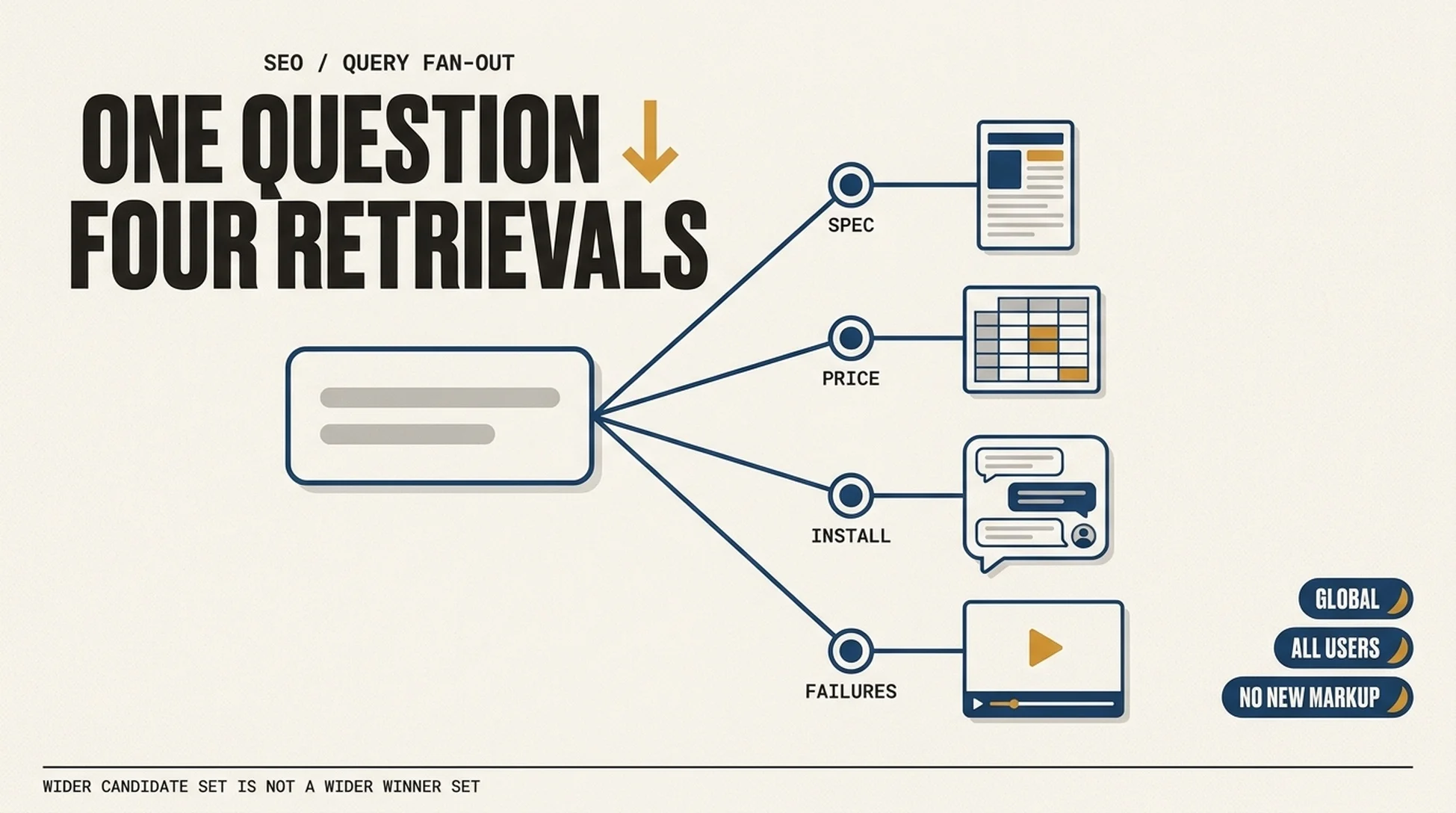
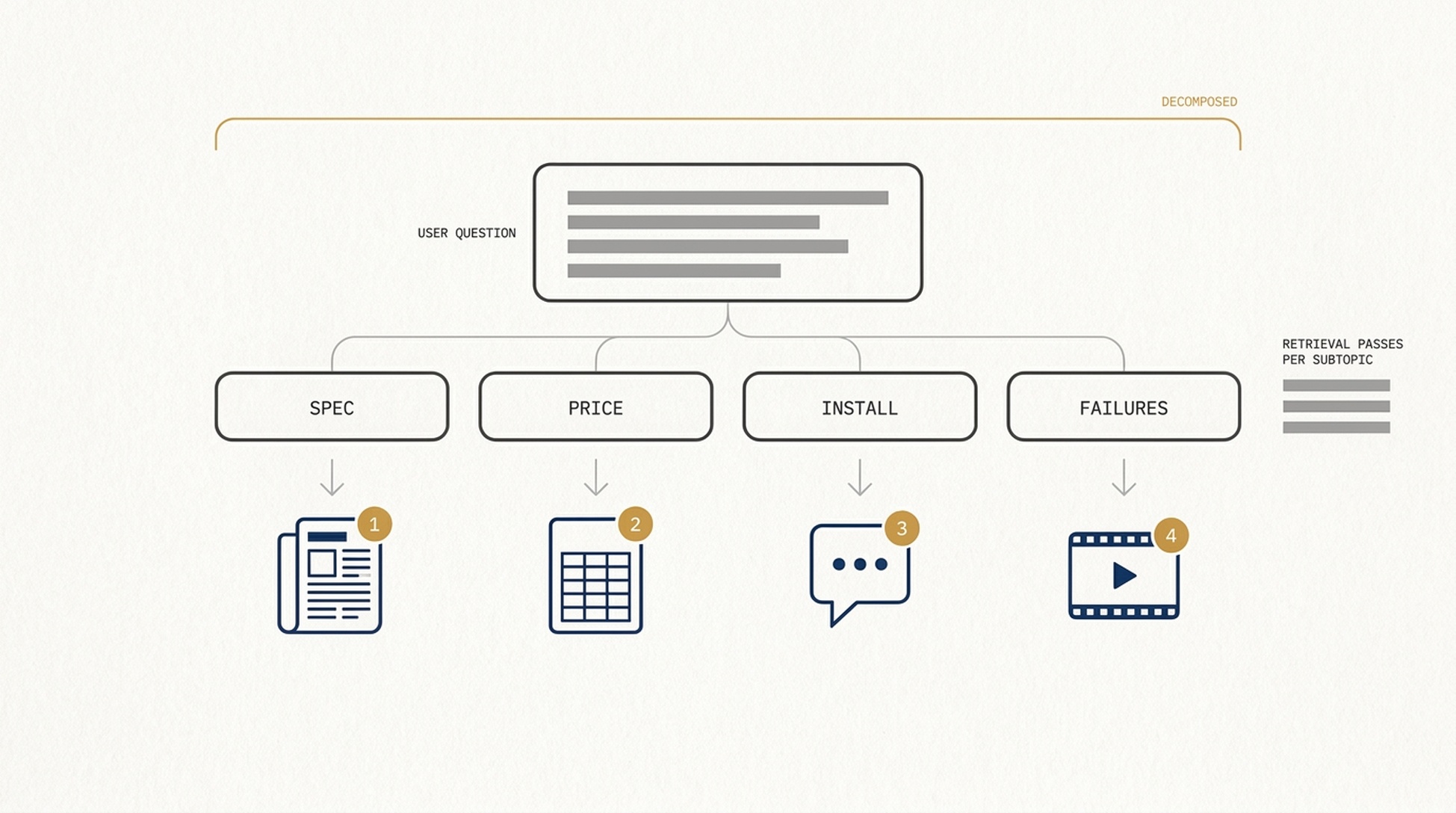
Query fan-out is not new. In its documentation on AI features, Google describes it as issuing "multiple related searches across subtopics and data sources." What the update changed is the reasoning behind the expansion: a stronger model decomposes a question more thoroughly, which produces more subtopics, which produces more retrieval passes.
Picture the difference concretely. A question like "is a heat pump worth it in a cold climate, and what rebates apply in my state" has at least four retrievable subtopics: cost comparison, cold-climate performance, state incentive programs, and installation constraints. A weaker decomposition might retrieve two of those well. A stronger one retrieves all four, and each retrieval is a separate chance for a page to be pulled into the response.
That is the mechanism behind "sites you previously might not have discovered." More subtopics means more retrieval slots, and more retrieval slots means more mid-tail and specialist pages get a path into the answer that a single-query top-ten never gave them.
The flip side is equally real. If a page is only relevant to one of the four subtopics, it now competes inside a retrieval pass for that subtopic alone, against everything the wider decomposition surfaces. Broad relevance got a wider door. Shallow coverage of one subtopic got a narrower one, because more competitors are walking through it.
What the update did not change
Three things stay put, and each one saves you wasted work.
No new file requirements. Google states you do not need to create new machine-readable files, AI text files, or special markup for AI features. Anyone selling you an "AI visibility file format" is selling you a format Google says it does not require.
No new eligibility gate. The documented requirements are being indexed and being eligible for a snippet. That has not moved.
No new ranking guarantee. A wider retrieval set is a wider set of candidates, not a wider set of winners. Fan-out decides what gets considered; the response still selects.
The practical implication is that the update rewards the boring work (clean indexing, unique value per URL, extractable structure) and punishes the thing that was already starting to fail, which is one page trying to cover a topic that fan-out now splits into five.
The three checks worth running this week
This is not a general audit. It is the specific test of whether Hydrogen's wider fan-out can actually reach you.
Check 1: Is your subtopic coverage real, or is it a section heading?
Pick five questions your buyers ask in your own words. For each one, list the subtopics a careful person would need answered. Then check whether you have a distinct, indexable URL that answers each subtopic on its own.
What good looks like: four subtopics, four URLs, each one citable in isolation. The failure you will find: four subtopics, one URL with four h2 sections. That page can still enter a retrieval pass, but each section competes with the whole page's relevance signal for a single query.
Recovery path: start with the subtopic where you have the strongest proprietary evidence, usually a number nobody else has. Split that one out first. Do not restructure the whole cluster on a Friday.
Check 2: Can a retrieval system lift a standalone claim?
Take the page you would most want cited. Remove all surrounding context and read only the first 120 words.
What good looks like: the first 120 words contain a specific claim with a number, a date, or a named entity, and the claim is true without the rest of the page.
The failure you will find: the first 120 words define the topic and promise to explain it. Nothing is liftable. A model decomposing a question into subtopics has no reason to keep reading a page whose opening does not answer any of them.
Recovery path: rewrite the opening paragraph, not the article. One specific claim, then the explanation.
Check 3: Are you tracking retrieval or only clicks?
Pull 60 days of server logs. Count requests by user agent for Google's AI surfaces separately from classic search crawling. Record repeat fetches per URL.
What good looks like: you can name the URLs fetched repeatedly, and that list differs from your top-clicked pages.
The failure you will find: you cannot separate the two, because the logs were never parsed that way. This is common and it is the biggest blind spot in this whole area: the widening happens in retrieval, and retrieval is invisible in analytics.
Recovery path: start with a raw log export and a simple count. A spreadsheet is enough for the first pass.
A table you can use in a planning meeting
Question fan-out asks | What it rewards | What it punishes | First fix |
|---|---|---|---|
What is this thing? | A clear definition, early | Long preambles | Rewrite the opening |
What does it cost or produce? | Specific numbers with dates | "Varies by provider" | Publish your own data |
How does it compare? | Explicit comparison tables | Implied comparisons in prose | Add a real table |
Who says so? | Named sources and provenance | Unattributed claims | Name the source |
Does it apply to me? | Segment-specific pages | One page for every segment | Split the top segment out |
Read the right-hand column as an edit list rather than a content strategy. Most of it costs hours, not quarters.
Where the evidence is thinner than the headlines
Two things to keep straight.
Google has not published how fan-out decomposes queries, how many retrieval passes run, or how the response selects among candidates. The blog post describes capability, not mechanics. Anyone who tells you the exact number of sub-queries is guessing, including people quoting round numbers.
And "sites you previously might not have discovered" is a statement about possibility, not an observed lift. It describes a wider candidate set. It does not promise that any specific site's traffic will rise, and no publisher-level data has been published to test it. If your traffic drops in the next few weeks, the honest diagnosis is "unknown, run the checks," not "Hydrogen did it."
There is a reasonable prior here, though: if the retrieval set genuinely widened, then over time you should see a longer tail of domains appearing in AI answers for multi-part questions, and a shorter tail for single-fact questions where one authoritative source is enough. That prediction is testable with prompt tracking. It is the thing to measure, rather than watching a single site's click curve and guessing.
The strategic read
Model upgrades that improve reasoning tend to move value from pages that restate a topic to pages that supply something the model cannot generate on its own. A stronger decomposition can find more pages, but it still cannot invent your pricing data, your test results, or your customer counts.
So the widening is an opportunity skewed toward publishers who own a specific fact. For those sites, more retrieval passes means more entries into answers they were previously shut out of because the question was too broad to surface them. For sites whose value was restating the consensus, the wider set is mostly more competition.
That is the same conclusion we reached about the earlier Gemini 4 release in AI Mode and about modelling images in AI answers: the model changes the plumbing, and the plumbing rewards whoever supplies the input.
FAQ
Do I need to do anything technical to benefit from the wider fan-out? No new files or markup. Google states there are no additional requirements to appear in AI features beyond being indexed and eligible for a snippet. The work is in coverage and extractability.
Does Hydrogen change how AI Overviews pick sources? Google has not described a change to selection. What it described is broader link coverage coming out of fan-out. Treat selection rules as unchanged until documented otherwise.
Will splitting pages into more URLs hurt or help? It helps when each URL answers a distinct subtopic completely. It hurts when the split produces thin pages that each need context from the others. The test is whether a single URL can be cited on its own.
How fast would a change show up? Retrieval behavior changes can appear in logs within days because fetching happens before any user-visible effect. Ranking and citation shifts typically take longer and are noisier. Watch logs first.
Is query fan-out the same as keyword clustering? No. Clustering is a planning exercise you run. Fan-out is a retrieval behavior the search system runs at query time, on questions you did not choose.
Author: Gabriel Finch, Search Retrieval Researcher at Auspia. He writes about how retrieval systems decide what to fetch and which sources an answer ends up resting on.