The answer first
If your analytics platform and Search Console report different numbers for the same period, you are almost certainly not looking at a bug. You are looking at two systems that measure different events under different rules, and Google documented those rules explicitly in an update published on November 12, 2026.
The three differences that account for most of the gap:
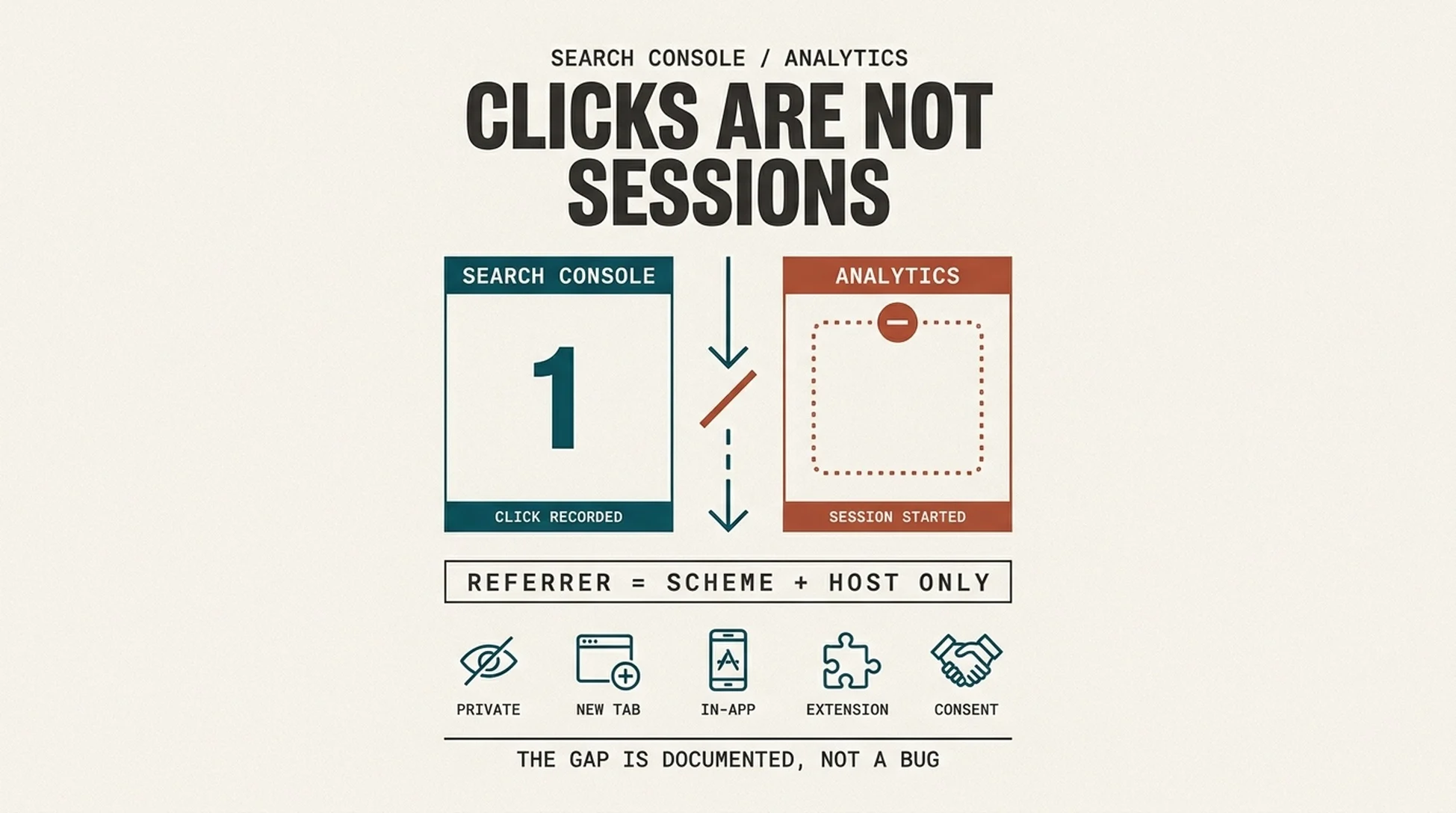
- Search Console counts clicks on a result. Analytics counts sessions that began after a page loaded. A click that never finishes loading, or a click where the session gets attributed elsewhere, is a click without a session.
- Referrer values are stripped down to scheme and host. With the referrer policy Google documents, an incoming Referer contains
https://www.google.com/and nothing about the path or the query. Anything that reads the query string out of a referrer is reading something that was never there. - Referrers can be absent entirely. Google lists five distinct situations that produce an empty Referer, and every one of them silently drops the visit into direct traffic.
Add a fourth, which is not a mismatch at all but gets read as one: Search Console reports on organic clicks only, and never includes paid.
That is the whole diagnosis. What follows is how to apply it per surface, because the rule set differs by where the click came from.
The referrer rules, in a table you can keep
Where the click came from | Referrer value Google documents |
|---|---|
Google Search on the web |
|
Google app on Android |
|
Google app on iOS |
|
Discover | Carries through as the surface where the click happened |
Other Google web properties, such as Images | Same-origin value, indistinguishable from Search |
Two consequences hide in that table.
The Android app referrer is not an https URL. It is an app-scheme URI. Any filter in your analytics that matches "referrer starts with https://www.google." will miss every Android app click, which in many consumer categories is a large share of mobile traffic.
And Search, Images, and other same-origin Google properties can arrive with the same referrer value. If you need to separate them, the referrer will not do it. You need landing URL patterns, or Search Console's own surface reporting.
Google also notes a detail that trips up anyone building a self-hosted report: only landing page requests carry a meaningful referrer. Requests for images, CSS, and JavaScript on your page carry your own page URL as the referrer. Counting all requests rather than the first one will inflate or distort the segment depending on how you filter.
The five empty-referrer cases
Google's documentation lists these as reasons the Referer can be missing:
- The visit originated from private browsing or anti-fingerprinting measures.
- The user opened the result in a new tab from some browsers, which drops the referrer.
- A native mobile widget handed the URL to an external browser.
- Privacy extensions or strict privacy settings removed it.
- JavaScript-based tracking was blocked by privacy settings, consent state, or an ad blocker.
Every one of those produces a visit that lands in direct or none in most analytics setups. For a mid-size site, this is frequently the single largest explanation for "Search Console shows more clicks than analytics shows organic sessions." It is not lost traffic. It is traffic whose attribution was removed by the user's environment, and the user was entitled to remove it.
The honest implication: your organic session count is a floor, not a census. That has been true for years, and privacy changes keep pushing the floor further from the census.
The four reasons a referrer arrives but does not match
Google's update also enumerates why a referrer can be present yet still fail to be classified as search:
Privacy settings and client configuration changed the value or removed it after the fact.
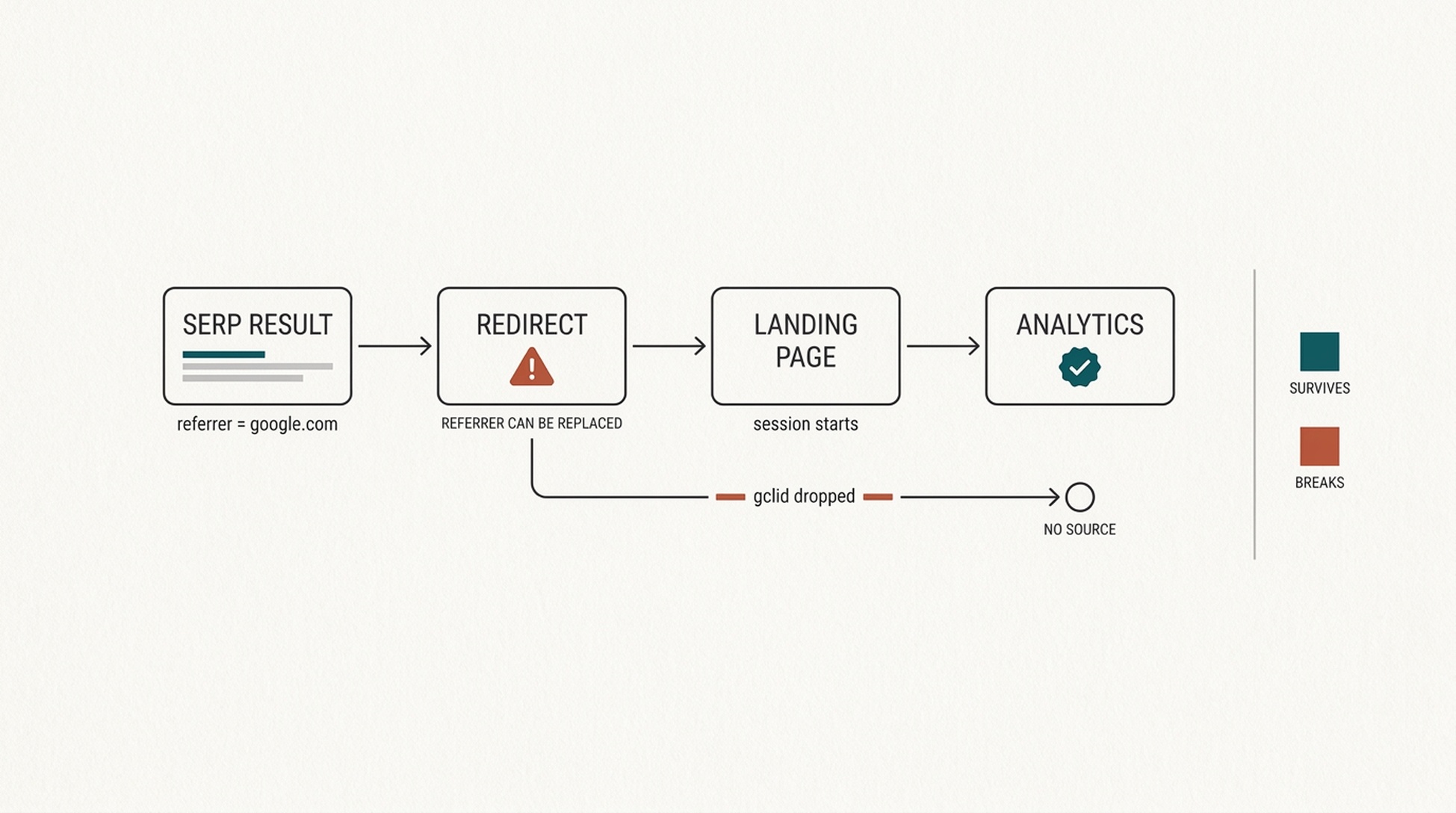
An on-site redirect replaced the referrer with an internal URL, or dropped the gclid parameter along the way. This is the one you can actually fix, and it is the most common self-inflicted cause. A redirect chain that starts at the landing page will overwrite the referrer with your own domain.
A stricter Referrer-Policy on your side reduced what got sent onward. If your headers ask for no-referrer, do not be surprised when the next hop in the chain arrives anonymous.
Different measurement definitions: Search Console records the click, the analytics tool records a session that began after the page loaded. These will never be equal, and the difference is not an error.
Diagnosing which of the four you are facing takes about twenty minutes:
- Pull a sample of landing page URLs from Search Console for the period.
- In server logs, look for requests to those URLs with a Google referrer.
- Compare the count to the sessions your analytics tool recorded for the same URLs.
- Where logs and Search Console agree but analytics is lower, the loss is at the tracking layer, not the referrer. Where logs show the referrer but analytics shows direct, the referrer was stripped in transit, so look at redirects and policy headers first.
The AI surface problem this documentation does not solve
Here is where the update is silent, and the silence matters.
An AI answer surface can present a link that a reader clicks. When that happens, the referral may carry a Google referrer value and be indistinguishable from an ordinary organic click. Or the reader may never click, because the answer was sufficient. The second case produces no referral at all, and no referrer-based method will ever count it.
That is not a documentation gap Google can close with a referrer table. It is a structural fact about answer surfaces: the value they deliver is partly the answer, and the answer does not generate a page load.
What follows for measurement is uncomfortable but simple. Clicks from AI surfaces are a lower bound on AI influence, and that gap widens as answers get better. If you want to see the part that does not click, referrer data cannot show it, which is why the generative AI performance report exists as a separate surface. You need brand-side signals: direct and branded search volume, return visits, branded query lift. And you need to accept that they are directional.
There is a second-order effect worth logging now. If AI surfaces cite your page and a reader arrives later by typing your brand, that visit is recorded as direct or branded organic. The referral is real; the referrer is gone. Over a year, a rising branded-search share alongside flat click counts is one of the few available signals that an answer surface is working for you.
A short quarterly routine
Run this once a quarter. It takes about an hour and it prevents a class of panicked meetings.
Step 1: Fix the totals comparison before arguing about segments. Compare Search Console clicks to analytics sessions from the same property, same timezone, same date range. Record the ratio. Do not expect 1:1 and do not treat the gap as a defect.
Step 2: Audit your redirect chain on the ten highest-traffic landing pages. Follow the chain from the initial request. If a redirect replaces the referrer, fix the redirect.
Step 3: Read your own Referrer-Policy header. One line of configuration can strip attribution for every downstream hop. Check what you send.
Step 4: Check your Google referrer filter. If it requires an https prefix, you are missing app traffic. Add the app-scheme pattern.
Step 5: Split landing-page requests from subresource requests in any custom report, so you are counting visits rather than assets.
Step 6: Record a branded-search baseline for the same period. It is the only durable proxy for the AI influence that never becomes a session.
Definition of done: you have one number for the click-to-session ratio, a list of landing pages with clean redirect chains, a confirmed referrer policy, and a branded-search baseline with a date on it. Next quarter, you compare against it rather than starting over.
What to say when a stakeholder asks
The version that survives a meeting:
Search Console and analytics measure different things by design. Google documents that referrers are reduced to scheme and host, that five common situations produce no referrer at all, and that Search Console counts clicks while analytics counts sessions. The remaining gap is usually a redirect or a policy header on our side, which we can fix. And one part of the gap is not measurable by referrer at all: readers who got their answer from an AI surface and never clicked. We track that with branded search, not with referrals.
That is accurate, it is defensible, and it stops the conversation from becoming an argument about whose dashboard is broken.
FAQ
Why does Search Console show more clicks than analytics shows sessions? Clicks are counted when a result is clicked. Sessions are counted when a page loads and tracking executes. Loads that fail, tracking that is blocked, and sessions attributed to another source all break the one-to-one relationship. Google's documentation also lists five situations where the referrer is absent entirely.
Why do my Google referrers have no query string? Because the referrer is reduced to scheme and host by design. The path and query are not transmitted. Any tool claiming to read the search query from a referrer is either reading stored data from elsewhere or guessing.
How do I segment Android app traffic? Match the app-scheme referrer pattern rather than an https prefix. A filter written only for https://www.google.com/ will drop these visits.
Can I see AI Overview clicks separately? Not from referrer data. They arrive with an ordinary Google referrer when they arrive at all. Google's AI performance reporting is the surface-specific source, and it does not replace referrer analysis.
Does fixing my redirects really change the numbers? Sometimes substantially, when the landing page is the first hop in a chain. Test it on your top ten pages before assuming it is a platform problem.
Author: Julian Mercer, Technical SEO Practitioner at Auspia. He writes about crawlability, tracking integrity, and the gap between what a dashboard reports and what a server actually served.