Hermes Agent is Nous Research's open-source AI agent framework, runnable from a terminal with hermes chat. It can search the web with websearch and webextract, automate a browser, run scheduled jobs with cronjobs, and extend itself with user-defined skills and MCP toolsets. The official documentation and source code cover each capability. Its delegation documentation describes subagent work that can run in parallel. That is useful when a page depends on product documentation, author facts, first-hand process notes, public reputation signals, and technical trust checks. It also creates a new problem: a polished summary can hide which subagent found a fact, which source supported it, and where two investigators disagreed.
This workflow treats delegation as evidence collection, not consensus. Subagents return source-backed findings. A separate reconciliation step preserves conflicts. A human decides what becomes publishable. As of mid-2026, Google's helpful content guidance still emphasizes content that demonstrates genuine experience and expertise, so the desks below treat E-E-A-T as an evidence discipline rather than a score.
At a glance
Item | Detail |
|---|---|
Audience | SEO leads, content editors, and technical writers who delegate research to AI agents |
Result | A repeatable four-desk E-E-A-T workflow: shared scope, parallel evidence reports, provenance manifest, contradiction queue, and a human approval brief |
Prerequisites | Hermes Agent CLI, one target page or draft, an approved source list |
Estimated time | 45 to 75 minutes per audit cycle, mostly subagent research time and owner replies |
Definition of done | Every finding has a manifest row, open contradictions have owners, no writes or memory pollution, and a human approved the brief |
The four desks and the editor
Use separate task briefs rather than telling several agents to "audit E-E-A-T." Each desk has a narrow job.
Desk | Job | Must return | Must not infer |
|---|---|---|---|
Experience | Check claims of use, testing, observation, or process | Method, date, scope, original asset location, and limitations | That an author used a product because the prose sounds first-hand |
Expertise | Check author/reviewer facts and technical support | Approved fact source, primary references, and unresolved questions | Credentials, licenses, or competence from a title alone |
Authority | Check relevant public references and organization context | Exact public source, relationship, date, and claim supported | Endorsement, leadership, or reputation from a mention alone |
Trust | Check sourcing, contradictions, policies, ownership, and page consistency | Claim conflicts, accountable owner, visible policy/source, and technical mismatch | Safety, compliance, or trustworthiness without evidence |
Reconciliation editor | Merge the four reports without erasing disagreements | Provenance manifest, contradiction queue, and approval brief | Majority vote as truth |
The editor keeps an uncertain finding uncertain even when two subagents used similar wording.
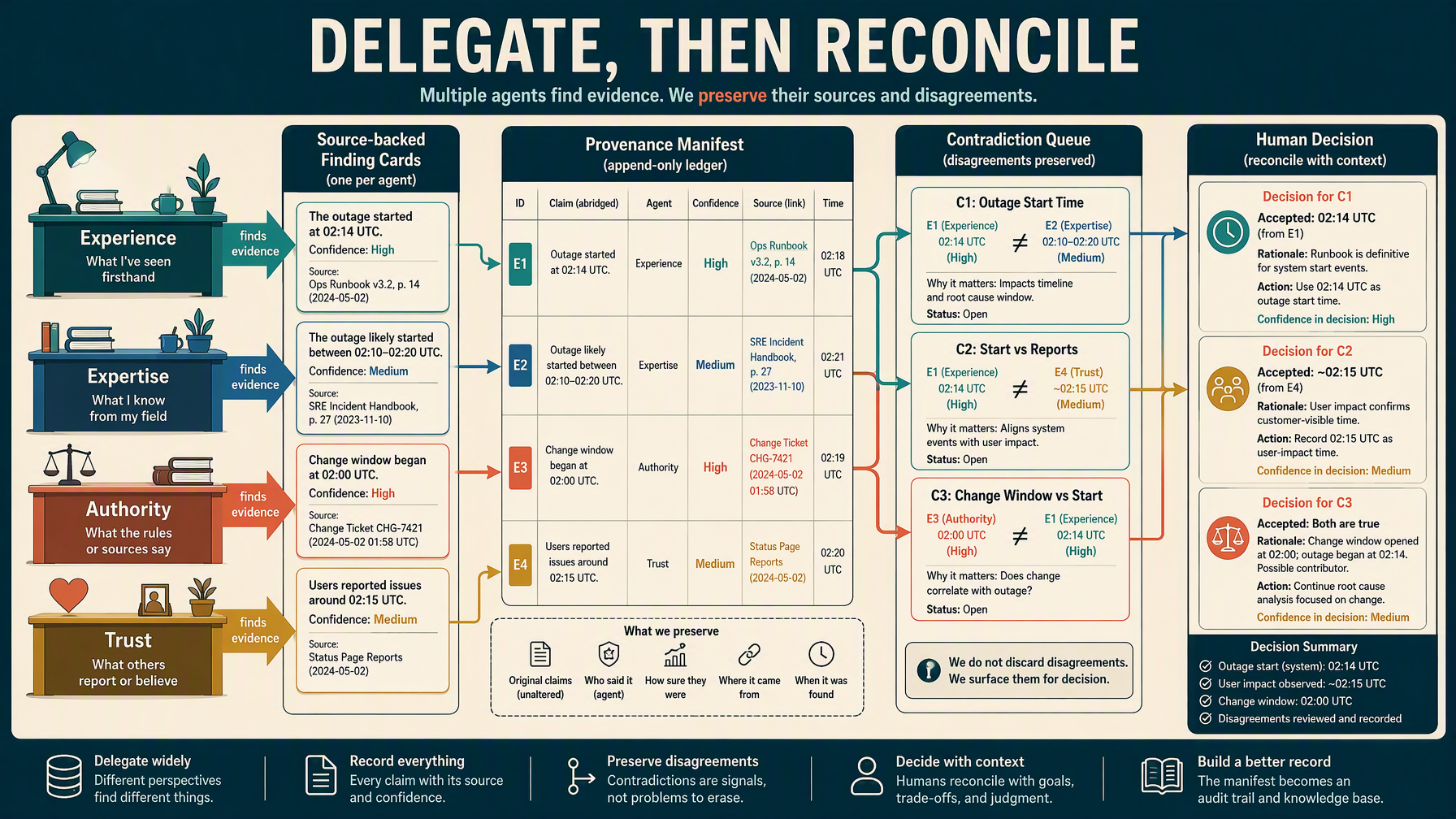
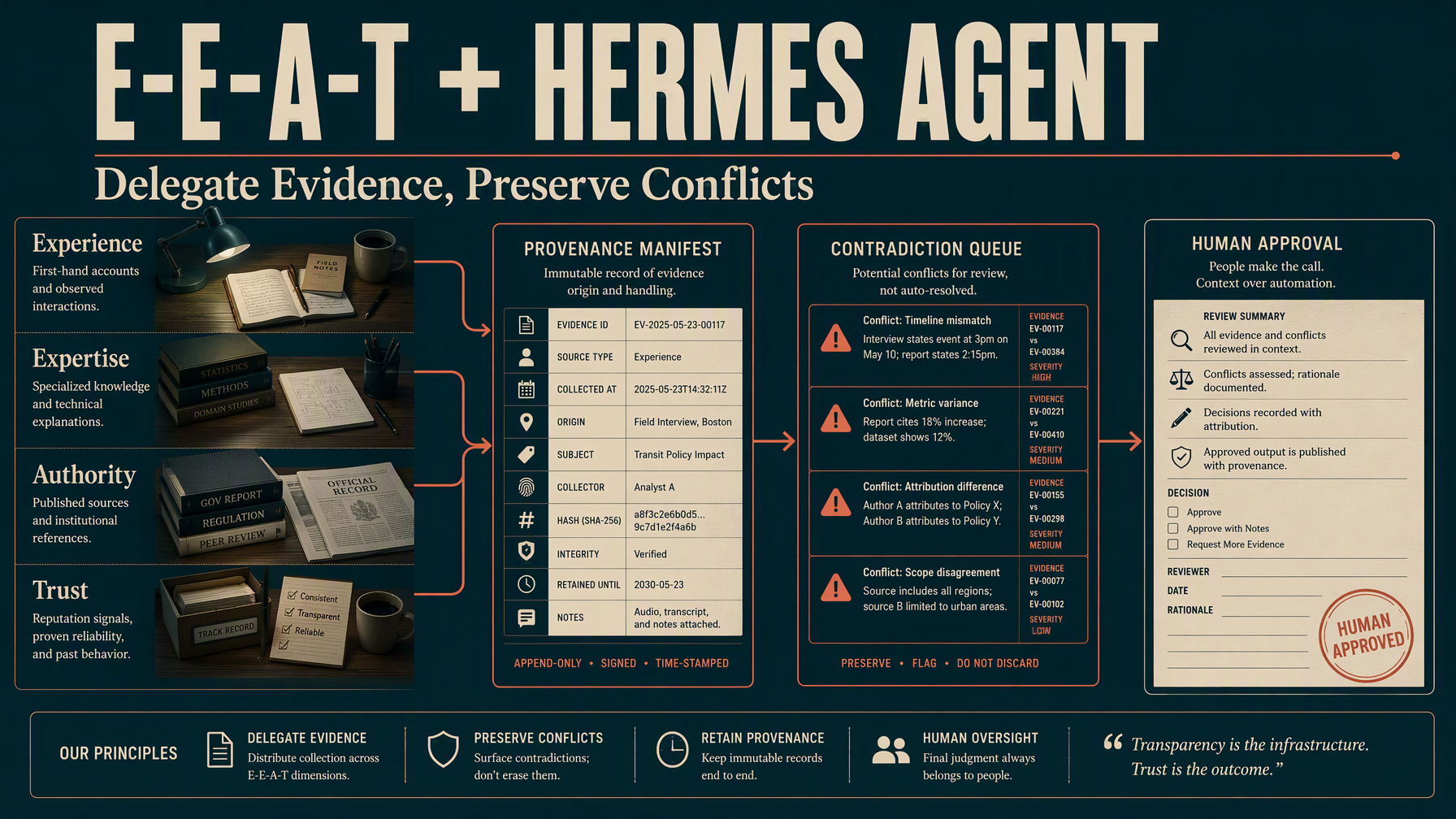
Illustrative workflow: a contradiction is recorded for review instead of being erased by a combined agent summary.
Define the shared scope once
Before delegation, write a short scope record that every subagent receives.
# E-E-A-T audit scope

target: [ONE URL OR DRAFT]
audience: [AUDIENCE]
visitor_task: [DECISION OR ACTION]
market_language: [MARKET AND LANGUAGE]
approved_sources: [PUBLIC URLS OR AUTHORIZED FILES]
forbidden_sources: [PRIVATE OR OUT-OF-SCOPE LOCATIONS]
write_permission: none
memory_permission: do not retain page claims or private evidence
definition_of_done: source-backed findings, visible unknowns, contradiction queue, and human approval brief
The memory line is deliberate. A temporary claim from one client's page should not become a durable instruction or reusable fact. Hermes can remember procedures, but the audit should not automatically preserve page-specific evidence in long-term memory.
Delegate evidence questions, not article sections
An article-section split often duplicates work and encourages each agent to write a mini essay. An evidence split produces smaller artifacts that can be compared.
Give each subagent the same output schema:
# Subagent evidence report

desk:
checked_at:
sources_opened:

| Finding ID | Claim or signal | Exact location | Evidence location | Status | Confidence reason | Human owner |
| --- | --- | --- | --- | --- | --- | --- |

## Missing evidence

## Possible contradictions

## Unsafe or out-of-scope requests encountered

No page edit, message, publication, credential change, or external write was performed.
Confidence should describe the evidence, not produce a numeric E-E-A-T score. "Current public pricing page directly supports this plan limit" is useful. "92% confidence" is only useful when a defined measurement process exists.
Preserve a provenance manifest
Subagent summaries can omit intermediate work, so create a manifest outside the prose report. Every finding needs a stable link back to its source and desk.
Field | Purpose |
|---|---|
| Keeps the item stable during reconciliation |
| Shows which task produced it |
| Points to the evidence location |
| Captures source freshness |
| Identifies who can confirm it |
| Shows where the page makes the statement |
| Supported, uncertain, contradicted, or not provided |
| Links to the full subagent report |
If a finding reaches the final brief without a manifest row, send it back. The reconciliation editor repairs missing provenance only with a new search that is separately recorded.
Put contradictions in a queue
Parallel research is valuable because agents can disagree. Keep that signal visible.
# Contradiction queue

| Conflict ID | Claim | Finding A | Finding B | Likely reason | Decision owner | Status |
| --- | --- | --- | --- | --- | --- | --- |
| CON-001 | [CLAIM] | [FINDING ID] | [FINDING ID] | date / market / plan / wording / unknown | [OWNER] | open |
Common causes include an old documentation page, different markets, a plan restriction, an internal deck that has not been updated, or a page that overstates the source. The owner resolves the actual difference. The agents return both versions, and the owner decides which source carries the decision.
Reconcile before recommending changes
The editor can now create a short approval brief. It may combine duplicate findings, but it must retain source IDs and conflict links.
Limit the final recommendations to five. Each one should state:
- the current claim or accountability gap;
- the source-backed observation;
- any open conflict;
- the proposed action;
- the person who must approve it;
- the page or system that may change;
- the after-release check.
A recommendation with an open material contradiction should normally be hold or request proof, not edit now.
Decide what Hermes may learn from the audit
Hermes has persistent memory and can create reusable skills. That is useful for the procedure, but risky for the facts.
Safe reusable lessons include the report schema, the rule that product plan claims need current documentation, and the requirement to separate visible facts from owner-supplied evidence. Unsafe memories include a customer's private revenue, an unapproved author biography, a temporary product limitation, or a conclusion about a person or organization.
Use a memory admission check:
Question | If the answer is no |
|---|---|
Is this a general procedure rather than a page-specific fact? | Discard it |
Is it free of private or personal evidence? | Discard it |
Can another team use it without inheriting this page's assumptions? | Keep it in the audit folder only |
Has a human approved the reusable rule? | Leave memory unchanged |
Self-improvement improves the audit method; yesterday's evidence stays where it was recorded.
Example: four agents, three dates, one claim
A health software page says its guide was "reviewed by clinicians." The Experience desk finds a dated review note from one person. The Expertise desk finds an approved role description but no license information. The Authority desk finds a conference bio from two years earlier. The Trust desk finds that the public page does not name the reviewer or review date.
The editor should not merge these into "medically reviewed by our clinical team." A defensible next step is to ask the responsible owner whether the named review can be disclosed and whether the wording is current. Until then, the page states only what the evidence shows.
The multi-agent workflow helped because each desk exposed a different boundary. Its job was not to manufacture a complete credential story.
Verification and escalation
Before the brief moves to implementation:
- every final finding has a provenance manifest row;
- open contradictions have a named owner;
- page-specific evidence has not entered long-term memory;
- no subagent performed a write or contacted a third party;
- the editor did not add sources that are missing from the desk reports;
- high-stakes claims are held for qualified human review.
If a subagent fails, rerun only that bounded desk so its own rerun, not the editor, regenerates the missing findings. If the same source is repeatedly unavailable, mark the gap and escalate it to the owner. Other failures recover as follows:
- A desk returns an empty
sources_openedcolumn. Rerun that desk with the approved source list attached and one claim per request. - A finding reaches the brief without a manifest row. Send it back to its desk so the desk supplies the row.
- A source URL stops resolving after retrieval. Keep the
retrieved_atdate and any saved copy, mark the finding "not provided", and ask the owner for a current URL. - Two desks return the same claim with different statuses. Keep both rows in the queue with their finding IDs; the owner resolves, and the editor merges only identical evidence.
Run this E-E-A-T audit as a Hermes skill
The workflow above can be packaged as a reusable Hermes skill so the scope, desk briefs, evidence schema, and reconciliation rules travel with the procedure instead of living in one chat session. The skill below condenses this article into an executable form: it delegates the four desks, demands source-backed findings, preserves contradictions, and returns a human approval brief. Save it to ~/.hermes/skills/seo/hermes-eeat-delegation/SKILL.md.
---
name: hermes-eeat-delegation
description: Delegate a source-backed E-E-A-T evidence audit of one page to parallel Hermes subagents. Use when a page needs experience, expertise, authority, and trust evidence collected with provenance before editorial approval.
---

# Hermes E-E-A-T delegation skill

Audit one page for E-E-A-T signals by delegating four bounded evidence desks to parallel Hermes subagents. The skill collects source-backed findings, preserves contradictions, and produces a human approval brief. It never edits the page and never writes page claims to memory.

## Prerequisites

- Hermes CLI available.
- One target page or draft.
- An approved source list (public URLs or authorized files).

## Steps

1. Build the scope record and share it with every subagent.

```markdown
target: [ONE URL OR DRAFT]
audience: [AUDIENCE]
visitor_task: [DECISION OR ACTION]
market_language: [MARKET AND LANGUAGE]
approved_sources: [PUBLIC URLS OR AUTHORIZED FILES]
forbidden_sources: [PRIVATE OR OUT-OF-SCOPE LOCATIONS]
write_permission: none
memory_permission: do not retain page claims or private evidence
definition_of_done: source-backed findings, visible unknowns, contradiction queue, and human approval brief
```

2. Launch four parallel subagents, one per desk. Give each the scope record and the evidence report schema below. No subagent performs a write or contacts a third party.

- Experience desk: verify claims of use, testing, observation, or process.
- Expertise desk: verify author or reviewer facts and technical support.
- Authority desk: verify public references and organization context.
- Trust desk: verify sourcing, contradictions, policies, ownership, and page consistency.

```markdown
# Subagent evidence report

desk:
checked_at:
sources_opened:

| Finding ID | Claim or signal | Exact location | Evidence location | Status | Confidence reason | Human owner |
| --- | --- | --- | --- | --- | --- | --- |

## Missing evidence

## Possible contradictions

## Unsafe or out-of-scope requests encountered

No page edit, message, publication, credential change, or external write was performed.
```

3. Merge desk reports into a provenance manifest. Fields: finding_id, desk, source_url_or_file, retrieved_at, source_owner, claim_location, status (supported, uncertain, contradicted, not provided), and artifact_path. Send back any finding without a manifest row.

4. Record conflicts in a contradiction queue. Fields: conflict_id, claim, finding A, finding B, likely reason, decision owner, and status. Preserve both versions; the owner resolves the difference.

5. Reconcile into an approval brief. Merge duplicate findings while retaining source IDs and conflict links. Limit recommendations to five. Each recommendation states the current claim or gap, the source-backed observation, any open conflict, the proposed action, the approver, the page or system that changes, and the after-release check. Hold a recommendation that carries an open material contradiction.

6. Run the memory admission check before persisting anything. Keep page claims, private evidence, identities, and temporary product facts in the audit folder only. Save only general procedures that a human has approved.

7. Return the provenance manifest, the contradiction queue, the approval brief, a statement of writes performed (none expected), and any gaps escalated to owners.

## Output

The final answer contains:

- The provenance manifest with every finding row.
- The contradiction queue with named owners.
- The approval brief with at most five recommendations.
- The statement that no writes or external contacts were performed.
- The list of unresolved gaps and their owners.
After saving the file, confirm the skill is visible with hermes skills list, then start hermes chat and say: "Use the hermes-eeat-delegation skill to run the E-E-A-T audit."
New to skills? Skip the file step. Send Hermes the URL of this article or paste the sections above, then say: "Follow this article and run the E-E-A-T workflow." The agent reads the same steps and runs the same desks. For installing Hermes and wiring its SEO tooling, see the earlier guide Set up a Hermes SEO agent.
Frequently asked questions
Do four subagents map perfectly to the four E-E-A-T letters?
No. As of mid-2026, the letters overlap, and one piece of evidence may support more than one lens. The desk split is an operating convenience that helps preserve focus and provenance.
Should Hermes store the finished audit in memory?
Store the approved procedure if it is broadly reusable. Keep page claims, private evidence, identities, and temporary product facts in the project artifacts unless a responsible person approves a different policy.
Can the reconciliation editor approve a claim?
No. It can show what the evidence supports and where it conflicts. The relevant author, product owner, legal reviewer, editor, or subject-matter owner makes the publication decision.
Does parallel delegation make the result more accurate?
It can broaden coverage and expose disagreements. Accuracy still depends on source quality, preserved provenance, clear scope, and human review.
Author: Camille Rhodes, Architect of 300+ AI Content Workflows at Auspia. Camille writes about supervised automation, publishing systems, and editorial quality control.