Do not scale the words. Scale the customer decisions.
One useful page tells you what a customer cares about. The wrong response is to make four near-identical pages by swapping a city, audience, or adjective. The right response is to map the next decisions the same customer must make.
Definition of done: You have five briefs that cannot be substituted for one another: each has a different question, page job, proof requirement, and next link.
Allow 60 minutes. Bring one approved page, its Traffic Mission and Fact Pack, plus the Topic Map. Do not start a cluster because you want more URLs; start because one customer decision has revealed several distinct next decisions.
Start with the page that already earned its place
Bring your First Traffic Page, its approved Fact Pack, its Topic System Map, and any feedback, query notes, or Search Console evidence you have. You do not need thousands of clicks. A page is ready to branch when you can name the customer decision it serves and the proof that made it useful.
For a bookkeeping page about deadline preparation, the cluster might be: what records to prepare; whether a remote bookkeeper is suitable; what help is included; a deadline checklist; and when a discovery call is worthwhile. It is not five versions of bookkeeper for designers.
Prove that the first page earned a branch
"Winning" does not require thousands of visits. It means you have an approved page with a clear reader question, usable proof, and at least one unresolved question a reader could reasonably ask next. Save the evidence in cluster-evidence.md:
First page: /before-self-assessment-bookkeeping-checklist
Customer decision served: what records to gather before seeking help
Confirmed proof: onboarding checklist; service scope; tax-return exclusion
Observed unresolved questions: remote fit; service inclusions; what happens
after contact
Evidence source: customer-call notes, page feedback, GSC query rows, or owner
observation with date
If all you have is a vague hope that more pages will bring traffic, keep working on the first page. A cluster built without a decision trail is just bulk content with better labels.
Use the five-job prompt
Read my Traffic Mission, Fact Pack, First Traffic Page, Topic System Map, and
any page feedback or search evidence: [paths].

Create a Five-Page Traffic Cluster. Every proposed page must answer a
different customer decision. For each page provide: customer question; page
role; distinct proof needed; overlap risk; page it links from and to; visitor
action; and why this page cannot be merged into another page.

Use these five decision lanes where relevant: understand the problem, judge
fit, compare options, complete the task, and reduce risk. Use fewer than five
pages if the evidence does not support five distinct decisions.

Do not write drafts, duplicate page structures, invent locations or customer
stories, or publish anything. Mark missing proof NEEDS OWNER FACT.
Turn the result into five separate briefs
For the bookkeeping scenario, an honest board might look like this:
Lane | Page question | Distinct job | Proof needed | Status |
|---|---|---|---|---|
Complete task | What records should I gather before self-assessment? | Help prepare | Onboarding checklist | Existing page |
Judge fit | Can a designer use a remote bookkeeper? | Decide eligibility | Owner-confirmed service area | Needs fact |
Understand scope | What monthly bookkeeping help is included? | Compare service scope with need | Approved scope and exclusions | Brief next |
Reduce risk | What happens after a discovery call? | Make contacting feel predictable | Onboarding steps and response process | Existing-page section |
Compare options | When should I use a bookkeeper versus do records myself? | Choose a route | Neutral criteria and service boundary | Needs owner review |
Notice that this is not automatically five new articles. One job becomes a section on an existing page; one is blocked by a fact; one becomes the next full brief. That is what a useful cluster board is for.
If Codex gives you five city-swapped or adjective-swapped titles, say:
These pages share the same decision. Rebuild the cluster around five distinct
customer jobs. For each brief, state what would change in the reader's choice
after they read it. Merge any briefs that use the same opening, proof, and next
action.
Run the duplication test
Read each pair of briefs and ask three questions:
- Would the same opening answer both questions?
- Would the same proof blocks support both pages?
- Would the same visitor action be the only useful next step?
If all three are yes, merge the pages. A smaller cluster with distinct jobs is stronger than a larger set of thin pages.
Keep a cluster board
Save traffic-cluster-board.csv with these columns:
page_name,customer_question,decision_lane,proof_needed,source_page,destination_page,visitor_action,statusSet every new page to brief only first. Change it to drafting only after the owner fills every NEEDS OWNER FACT gap. Start with the page closest to the first page's unresolved question, then add fit, comparison, task-completion, or risk pages. A five-page cluster is a controlled sequence, not a five-page launch requirement.
Weak expansion | Better expansion |
|---|---|
Best bookkeeping for designers | Records checklist before self-assessment |
Bookkeeping for Bristol designers | Can a Bristol designer use a remote bookkeeper? |
Cheap bookkeeping for designers | What bookkeeping help is included before the deadline? |
Sequence the cluster one page at a time
Set a maximum of one drafting page and one fact collection task at a time. For the example, the scope page is next because it has approved service facts and connects naturally from the checklist. Remote fit waits until the owner confirms the geography. The discovery-call question is added to the service page during its next approved update.
Use this planning prompt:
Read traffic-cluster-board.csv and fact-pack.md. Choose the next single unit of
work: a new-page brief, an existing-page section, a fact collection request, or
no change. Explain why it comes before the others, which evidence it uses, and
what would block it. Do not draft, edit, publish, or create a calendar.
Review for duplication before every draft
Before starting a new brief, compare it to every published or planned cluster page. Ask whether the opening question, evidence, section plan, and visitor action are materially different. If not, strengthen an existing page instead. Keep the comparison in the board so a future writer does not recreate the same page six months later.
Use the same production loop for every approved brief
Each cluster page follows the same sequence you used for the first one:
- Copy the page question and unique proof into a page brief.
- Check the Fact Pack and send only the blocking owner questions.
- Ask Codex for a section plan before a draft.
- Run Claim Review, Answer Clarity, Topic Map, and the Publishing Gate.
- Record the release and update the board with the new links and review date.
This repetition is intentional. Scaling means repeating a controlled standard, not asking Codex to produce a batch of finished articles from a spreadsheet.
Handle a cluster that stops growing
Sometimes the right answer is to stop at two or three pages. Stop when the remaining questions duplicate an existing answer, require facts you cannot maintain, or lead to no useful reader action. Keep the unused lanes in the board with a reason. Future evidence may make one viable, but it should not become a thin page merely to complete the number five.
A simple monthly cluster review
Once a month, open the board and review only four columns: status, new reader questions, facts that changed, and broken or missing links. Choose one next unit of work. If the first page still has a weak answer, work on that instead of extending the cluster. The system grows through better decisions, not page count.
Completion check
- [ ] I recorded why the original page earned a branch.
- [ ] Each proposed page has a different question, proof, and reader action.
- [ ] I identified which items are sections, pages, missing facts, or parked.
- [ ] I chose one next work packet instead of scheduling five drafts.
Publish one, learn, then continue
Do not create all five drafts at once. Choose the brief with the strongest proof and closest link to the first page. Build it with the same Fact Pack and publishing gate. After it is live or approved, update the topic map before moving to the next brief.
Completion check
- [ ] Every cluster item answers a distinct customer decision.
- [ ] I marked pages, sections, owner facts, and parked ideas differently.
- [ ] Only one next unit of work is in drafting.
- [ ] I ran the duplication comparison before requesting a new draft.
Course map
Next: Build the Page AI Search Can Quote When Customers Ask Your Best Question. The best cluster question often becomes the best answer asset.
Author: David Sinclair, Topical Authority Strategist Across 500+ Topic Clusters at Auspia. David writes about scaling customer coverage without creating duplicate content.
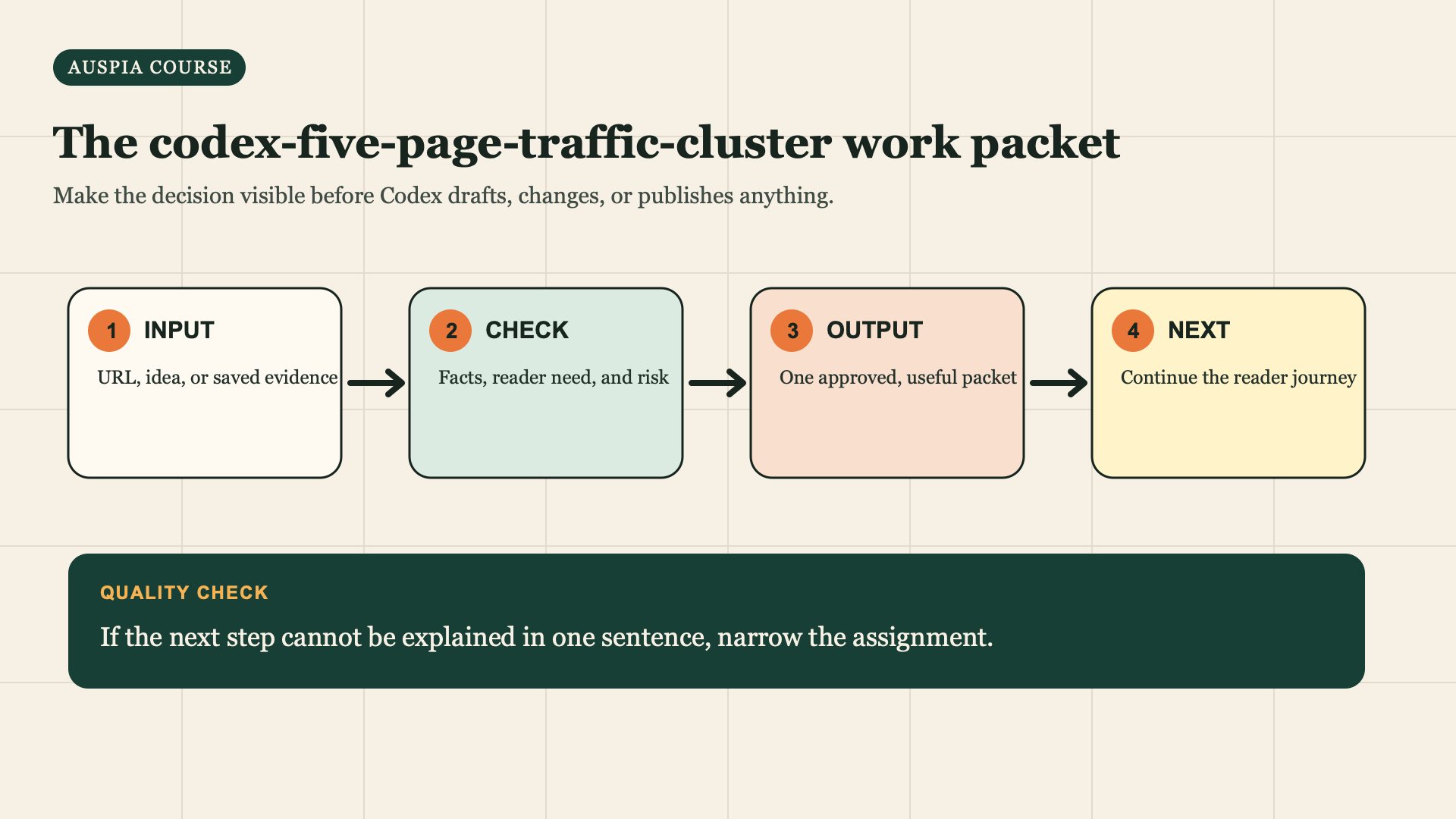
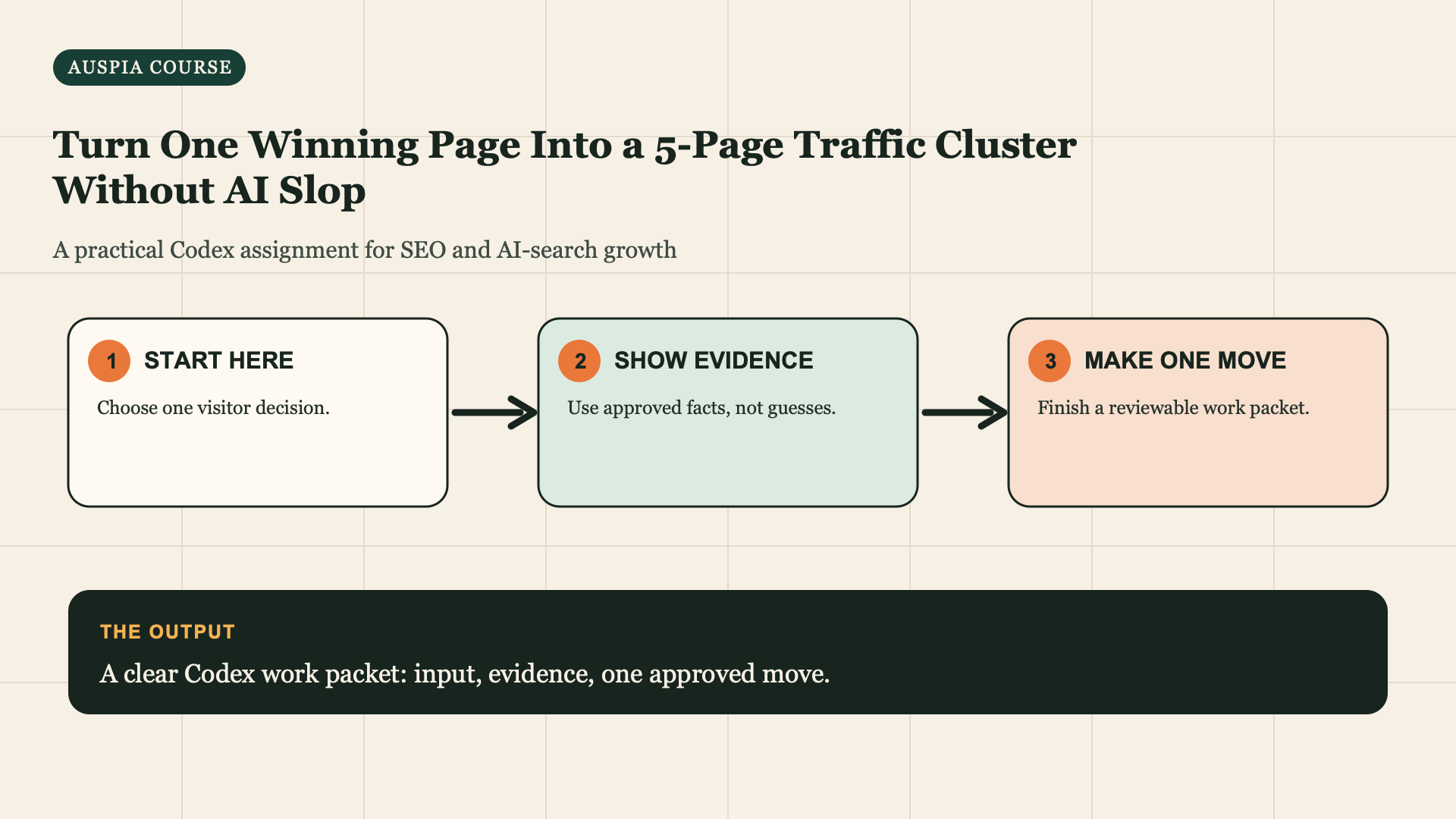
Use this sequence for the assignment: start with a real input, check the evidence, prepare one reviewable output, then choose the reader next step.