Find questions before you find keywords
Keywords are useful labels. Questions reveal the job a visitor is trying to complete. When you give Codex real customer language, it can group the work into pages people actually need instead of producing fifty versions of the same phrase.
Definition of done: You have 30 source-labelled customer questions, each marked as a likely page, supporting section, existing-page improvement, or not a fit.
Allow 45 to 60 minutes. Bring your Traffic Mission, Fact Pack, and whatever real customer language you can use safely. Ten good source-labelled questions are better than thirty polished phrases that nobody actually asked.
Bring three kinds of language
Use whatever you have. You do not need paid software for the first run.
- Customer language: support tickets, sales calls, reviews, emails, on-site search, or questions your team hears repeatedly. Remove personal data.
- Search evidence: approved Search Console export, keyword tool export, Google suggestions you recorded manually, or competitor/SERP notes.
- Your Fact Pack: it tells Codex which questions you can answer honestly.
Create a simple file called question-inputs.md with three headings and paste the material underneath. Label each source. A question without a source can still be an idea, but it is not evidence.
Make the input file safe and legible
Remove names, email addresses, order numbers, phone numbers, and private case details before pasting anything into Codex. Preserve the wording that reveals a decision. A safe input file might look like this:
## Sales-call notes
- "I have a bag of receipts. Is it too late to get help before self-assessment?"
- "Do you work with designers who invoice through more than one platform?"

## Support and email themes
- "What happens after I book a discovery call?"
- "Do I need to be based in Bristol?"

## Search evidence
- Query: bookkeeping checklist self assessment | page: NONE | source: GSC export,
  completed 28-day range
- Query: freelance designer bookkeeping | page: /bookkeeping-for-designers |
  source: GSC export, completed 28-day range
This input is intentionally uneven. A real map combines exact language, broad search labels, and business questions. The job is to sort it, not to make it sound like a keyword research report.
Quality check: Every line carries a source label. If you have only internal memory, write owner observation with a date. That is still more honest than pretending it is search demand.
Use this Codex Standard
You are my customer-question mapper.

Read:
- Traffic Mission: [path]
- Fact Pack: [path]
- Customer/search inputs: [path]

Create customer-question-map.csv with exactly these columns:
question,source,customer_job,intent,page_fit,proof_available,priority,notes

Rules:
- Produce 30 distinct questions only when the supplied evidence supports them.
- Keep the customer's language where possible.
- Set page_fit to NEW PAGE, EXISTING PAGE, SECTION, NOT A FIT, or NEEDS FACT.
- Do not invent search volume, rankings, customer quotes, or product claims.
- Flag near-duplicate questions instead of presenting them as separate ideas.
- Prioritize questions that fit the Traffic Mission and have usable proof.

After the CSV, write a five-line summary: the three strongest customer jobs,
the biggest evidence gap, and the one question most likely to become the first
traffic page. Do not write content or edit my site.
Read the CSV one row at a time
For the bookkeeping example, the first useful rows could look like this:
Question | Source | Customer job | Page fit | Proof available | Priority |
|---|---|---|---|---|---|
What records should I gather before self-assessment? | sales-call note + GSC query | Prepare before a deadline | NEW PAGE | Partial: checklist and scope | High |
Can a freelance designer use a remote bookkeeper? | support theme | Check service fit | SECTION on service page | Service area unknown | NEEDS FACT |
What happens after a discovery call? | support theme | Reduce risk before contacting | EXISTING PAGE | Onboarding checklist | Medium |
Best accounting software for creatives | no supplied source | Compare tools | NOT A FIT for current mission | No comparison method | Low |
The CSV is not a publishing plan. It is a sorting board. A SECTION row may be more valuable than a new article because it fixes a question on the page a buyer already needs.
Force Codex to group duplicates before counting to 30
Thirty questions do not mean thirty pages. Ask for a duplicate pass immediately after the first map:
Read customer-question-map.csv. Group rows that have the same customer decision
even when the wording differs. For every group, choose one canonical question,
list the source rows, and recommend NEW PAGE, EXISTING PAGE, SECTION, NOT A
FIT, or NEEDS FACT. Do not add new questions, infer volume, or write content.
For example, "What records do I need?", "What receipts should I save?", and "How do I prepare my books before self-assessment?" may belong under one decision guide with several supporting sections. Publishing three near-identical articles is not coverage. It is duplication.
Know what a real question looks like
Input | Treat it as | Example action |
|---|---|---|
| Customer decision question | Candidate page or substantial section |
| Broad topic label | Find the specific decision behind it |
| Unverified idea | Do not prioritize without evidence and proof |
| Fit question | Candidate FAQ or first page section |
If Codex gives you 30 polished keyword phrases but cannot show a source or customer job, ask it to start again. Your first question map should feel slightly messy and specific. That is a sign it came from real customer language.
Review the first ten rows before you trust the map
Sort the CSV by priority and reject a row when it is a different customer job from your Traffic Mission, the Fact Pack cannot support a useful answer, it duplicates an existing page, or it is merely a keyword variation. Keep rejected rows with the note not now; do not delete them. Later evidence may make them useful.
Prefer a real customer question over a generic list. Prefer a Search Console query tied to one of your pages over a speculative volume number. Prefer a page you can support with evidence over a phrase that only sounds commercial.
Score the strongest candidates with a simple decision sheet
Take the first ten rows or groups and score only four things. Use 0, 1, or 2; do not pretend this is precise forecasting.
Check | 0 | 1 | 2 |
|---|---|---|---|
Evidence | AI-invented or no source | one weak source | repeated customer or search evidence |
Mission fit | Different audience or action | adjacent problem | directly helps the Traffic Mission person decide |
Proof | No usable answer | some facts missing | can answer with confirmed facts or a small owner request |
Page leverage | Isolated answer | helps one section | can improve an entry page and lead to a next action |
The total does not decide for you. It makes the conversation with Codex concrete. A question with a lower score may still win if it is urgent and you can answer it honestly. The score mainly stops an attractive, unsupported topic from outranking a useful customer problem.
Use this prompt to create the short list:
Read the grouped Customer Question Map, Traffic Mission, and Fact Pack. Score
the top ten groups for evidence, mission fit, proof, and page leverage using
0, 1, or 2. Explain every score in one sentence. Recommend one first-page
candidate, two secondary candidates, and one question to park until an owner
fact exists. Do not create content or edit a website.
Fix three common bad maps
Every row says NEW PAGE. Ask Codex to identify which questions a buyer would want answered on the same page. Require a SECTION recommendation where the answer is short or part of one larger decision.
The questions sound like SEO copy. Go back to question-inputs.md and ask the model to quote the closest original wording beside each rewritten question. Delete rows it cannot trace to a source.
The map has good questions but no proof. Mark them NEEDS FACT, then add the exact missing fact to owner-questions.md. A promising question is not a license to write an answer you cannot support.
Save the final files together:
question-map/
  question-inputs.md
  customer-question-map.csv
  grouped-question-map.md
  question-shortlist.md
The map is finished when another person can trace the winning question back to real language and see why it belongs on a page rather than in an endless list of ideas.
Turn a parked question into a future reviewable decision
Do not delete a question just because it cannot become a page today. In the shortlist, add a one-line reactivation rule: Revisit when [specific fact, repeated customer wording, completed period, or new page exists]. For example, the question "Can designers use the service outside the UK?" stays parked until the owner approves a service-area statement. It should not reappear as a page title each time you ask Codex for ideas.
At the next review, use this prompt:
Read question-shortlist.md, the current Traffic Mission, and new evidence:
[paths]. Review only parked questions. For each, state whether its reactivation
rule has been met, what Fact Pack row supports an answer, and whether it is a
new page, existing-page section, or still NOT NOW. Do not create content or
promote a question because it sounds searchable.
This gives an existing site a disciplined backlog and gives a new site a way to grow from evidence rather than from a generic 100-keyword sheet.
Course map
Next: Pick the One Page Most Likely to Earn Your First New Organic Visits. It turns thirty possibilities into one page decision.
Completion check
- [ ] Every question has a source or is clearly marked as an unverified idea.
- [ ] Similar questions are grouped instead of duplicated.
- [ ] Each row has a customer job and a page-fit decision.
- [ ] I can name the strongest candidate for the first traffic page.
- [ ] I removed personal data and preserved a source label for every useful question.
- [ ] I grouped near-duplicates before treating them as page opportunities.
- [ ] I created a short list with one first-page candidate, not a 30-page calendar.
Author: Elena Shaw, Prompt Library Strategist, 3,000+ Buyer Prompts Mapped at Auspia. Elena writes about turning real customer language into useful search and AI-answer coverage.
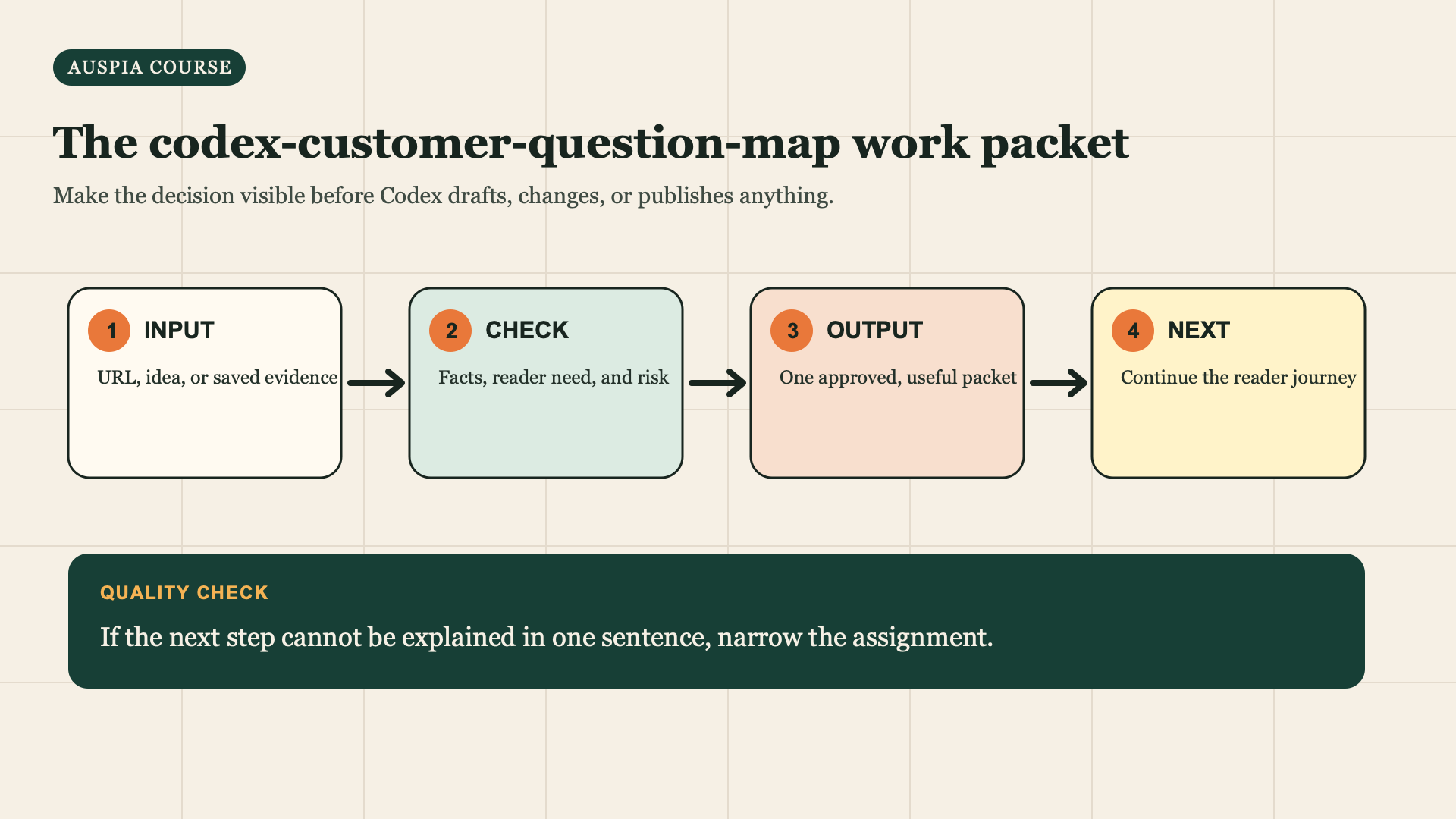
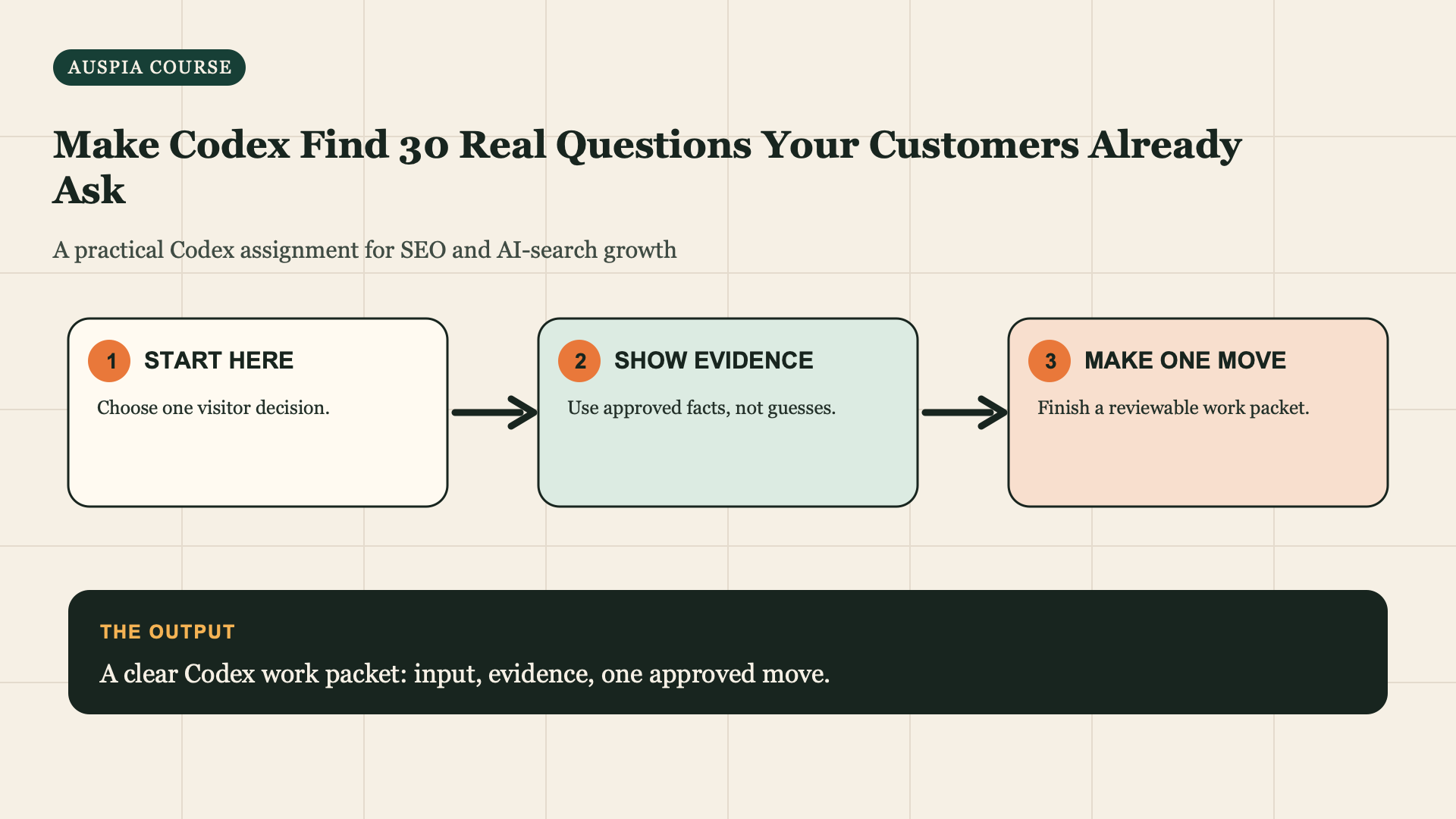
Use this sequence for the assignment: start with a real input, check the evidence, prepare one reviewable output, then choose the reader next step.