Your first traffic page is not the biggest keyword
The right first page is the page you can make unusually useful today. It answers a real question, contains proof competitors may not have, leads to a sensible next action, and does not duplicate a page you already own.
This lesson turns your 30-question map into a First Traffic Page Decision. You will select one page, not a cluster, not a calendar, and not a batch of drafts.
Definition of done: You can explain in one paragraph why this page is first, what it must prove, what page type it should be, and what visitor action it should lead to.
Allow 30 to 45 minutes. Bring the question shortlist from Lesson 8, your Traffic Mission, and Fact Pack. This is a decision exercise, so do not open a blank document and start drafting yet.
Score five candidates, not thirty
Ask Codex to shortlist five questions from your map. Then score each from 1 to 3 for four factors:
Factor | Score 1 | Score 3 |
|---|---|---|
Customer decision value | Mild curiosity | A decision that affects money, time, risk, or outcome |
Proof you own | Mostly generic explanation | Specific process, product, policy, data, or experience |
Page fit | Existing page already answers it | Clear new page or strong improvement opportunity |
Visitor action | No relevant next step | Natural demo, purchase, booking, signup, or onward guide |
High volume is not a fifth factor until you have reliable, comparable data. A smaller question with strong proof and conversion fit is usually a better first page than a broad phrase that every large site already covers.
Build a five-row candidate sheet yourself
Copy the five strongest grouped questions from question-shortlist.md into a new file called first-page-candidates.md. The bookkeeping example might look like this:
Candidate | Customer decision | Evidence | Proof available | Natural next action |
|---|---|---|---|---|
Self-assessment records checklist | What should I prepare before asking for help? | Sales-call question + GSC query | Onboarding checklist and service scope | Check whether monthly support fits |
Remote-bookkeeper fit | Can I work with this service outside Bristol? | Support question | Service area still unknown | Needs owner fact first |
Discovery-call process | What happens after I enquire? | Repeated support question | Onboarding checklist | Book or contact |
Software comparison | Which app is best? | No sourced question | No fair comparison method | None |
Invoice-platform records | What do I keep when I invoice from two platforms? | Sales-call note | Partial process knowledge | Ask for a discovery call |
The candidate sheet prevents an attractive keyword from replacing the problem that your actual customers describe. A candidate may be useful and still not be first. The remote-fit question is important but waits because the service-area fact is not confirmed.
Use this decision prompt
You are my First Traffic Page selector.

Read my Traffic Mission, Fact Pack, and customer-question map:
[paths]

Choose five candidates. Score each 1-3 for customer decision value, proof we
own, page fit, and visitor action. Explain each score in one sentence.

Then choose one First Traffic Page and create this decision:
1. PAGE TITLE IN PLAIN ENGLISH.
2. CUSTOMER QUESTION IT ANSWERS.
3. PAGE TYPE: guide, comparison, use-case, service page, product page,
   checklist, tool, or FAQ section.
4. UNIQUE PROOF OR EXPERIENCE IT MUST INCLUDE.
5. PAGE WE MUST LINK TO OR IMPROVE ALONGSIDE IT.
6. VISITOR ACTION.
7. WHY THE OTHER FOUR CANDIDATES WAIT.

Do not claim traffic potential, search volume, or rankings without supplied
data. Do not draft the page yet.
Compare the result as if you had to defend it
For the bookkeeping example, the winning decision may be:
PAGE: What records should freelance designers prepare before self-assessment?
CUSTOMER QUESTION: I have overdue receipts and invoices. What should I gather
before deciding whether monthly bookkeeping help fits?
PAGE TYPE: Decision checklist linked to the service-fit page.
UNIQUE PROOF: Confirmed onboarding checklist and clear exclusion for personal
tax-return filing.
VISITOR ACTION: Check whether monthly bookkeeping is the right next step.
WHY OTHERS WAIT: Remote eligibility needs an owner fact; call process is a
supporting section; software comparison lacks a fair, supported method.
That page wins because it has a real moment, available proof, and a useful next action. It does not win because it is the largest phrase in a tool.
If Codex picks a broad or unsupported option, reply:
Re-score the candidates. A score of 3 for proof requires a CONFIRMED Fact Pack
row. A score of 3 for visitor action requires a relevant page or approved
conversion path. Reject broad comparison topics without an explicit comparison
method. Choose one winner and show why the runner-up waits.
Catch the two most common bad choices
Bad choice one: the broad vanity page. Best project management software sounds attractive, but it is too broad unless you have a real comparison methodology and unusual evidence.
Bad choice two: the isolated helpful page. A page might answer a question perfectly but lead nowhere useful. If a visitor cannot buy, book, compare, subscribe, or continue learning, add an appropriate next route before you publish.
Write the decision in one sentence
We will create or improve [page] for [person] who needs to [decision]. It
will use [proof] and lead to [next action]. We are not doing [broader page]
yet because [reason].
If you cannot finish this sentence, return to the question map or Fact Pack. If all candidates look weak, choose the clearest customer question and make the next task collect proof or ask customers how they describe this problem. Do not force a page with no evidence.
Create the page decision file and a proof request
Save the final choice as first-traffic-page-decision.md. Then ask Codex to prepare the smallest missing-evidence list for it:
Read first-traffic-page-decision.md and fact-pack.md. Create a First Page Proof
Request with: required confirmed facts, optional evidence, missing owner facts,
existing pages to inspect, and the one visitor action that must be available.
Do not draft copy, edit a page, create a file, or publish.
This creates a clean handoff to Lesson 10. If the proof request has five blocking owner questions, the page is not ready. Work through the questions or choose the next-best candidate that you can support now.
The final ownership test
Ask one plain question: if this page earns a visitor tomorrow, can I honestly help them take the next step? If the answer is no, it is probably a useful research note, not your first traffic page. Link the page to a real service, product, signup, tool, or next guide only when the connection helps the reader.
Work through a full example before you decide
Here is a five-candidate scorecard for the bookkeeping example. The scores are not a prediction of visits. They make the trade-off visible.
Candidate | Decision value | Proof | Page fit | Action | Total | Decision |
|---|---|---|---|---|---|---|
Records checklist | 3 | 3 | 3 | 3 | 12 | Build first |
Remote-fit question | 3 | 1 | 2 | 2 | 8 | Wait for owner fact |
Discovery-call process | 2 | 3 | 2 | 3 | 10 | Add as a service-page section |
Software comparison | 2 | 0 | 1 | 1 | 4 | Park |
Invoice-platform records | 3 | 2 | 2 | 2 | 9 | Secondary page or section later |
The discovery-call question scores well, but it is not the first independent page. It belongs near the conversion action on an existing page. This is why the page-fit score exists: it stops you from treating every useful answer as a new URL.
When you should improve an existing page instead
Choose IMPROVE EXISTING PAGE when the named question belongs on a page that already helps the same visitor decide. A discovery-call question belongs on a service-fit page. A compatibility question may belong on a product page. Choose a new page only when the question needs a substantial, distinct answer and can link naturally to the existing offer or next step.
Do not treat URL count as progress. A new page has a maintenance cost: it needs facts, links, review, future updates, and a clear reason not to overlap another page. A strong first decision often reduces the number of pages you plan to build, which is exactly the point.
When you have to choose between two equally plausible candidates, prefer the one whose answer will still be useful six months from now after a routine fact review. A fragile page based on a temporary price, rumor, or unverified product comparison can wait. The first page should teach you a repeatable way to build the second one.
Ask Codex to make the distinction clear:
For the selected question, compare NEW PAGE versus EXISTING PAGE IMPROVEMENT.
Show the current page's visitor job, the new question's visitor job, any
overlap, the evidence each option needs, and the safest recommendation. Do not
write a draft or change the website.
If it cannot name a distinct job for the new URL, do not create it. Put the answer in a section, collect more evidence, or keep it parked.
Course map
Next: Build Your First Traffic Page With Codex, From Brief to Publish-Ready Draft.
Completion check
- [ ] I scored five candidates using evidence rather than instinct.
- [ ] One page has a named customer question, proof requirement, and action.
- [ ] I know why the other candidates wait.
- [ ] Codex did not draft or publish the page yet.
- [ ] I saved a five-row candidate sheet before choosing a winner.
- [ ] The winner has confirmed proof and a real next action, not just an appealing phrase.
- [ ] I saved
first-traffic-page-decision.mdand a proof request for the next lesson. - [ ] I decided explicitly between a new page and an existing-page improvement.
- [ ] I can show why the winning page helps the customer before it helps a metric.
Author: Nina Patel, Organic Growth Strategist for 250+ Content Programs at Auspia. Nina writes about choosing smaller, stronger page bets that compound into growth.
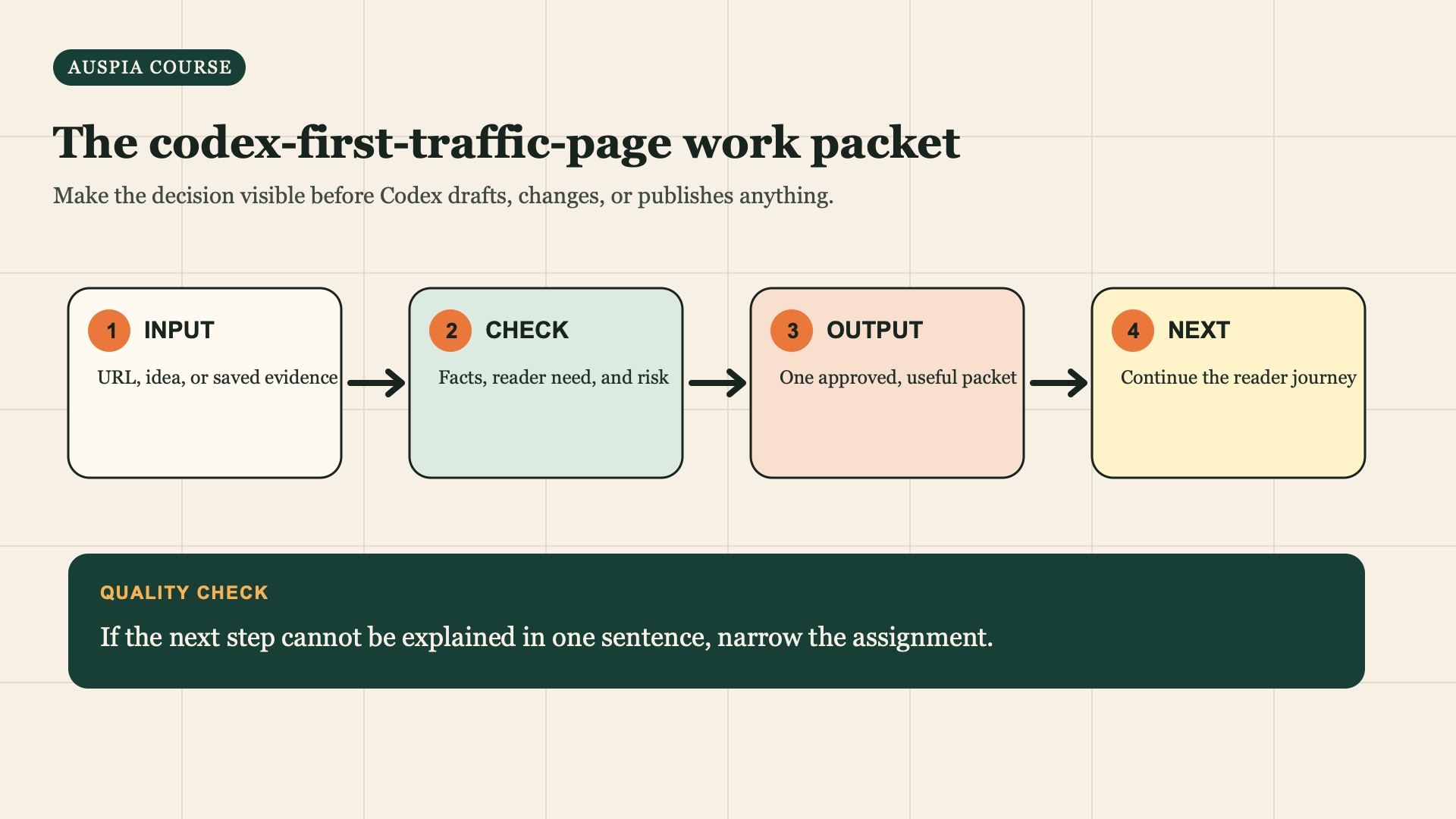
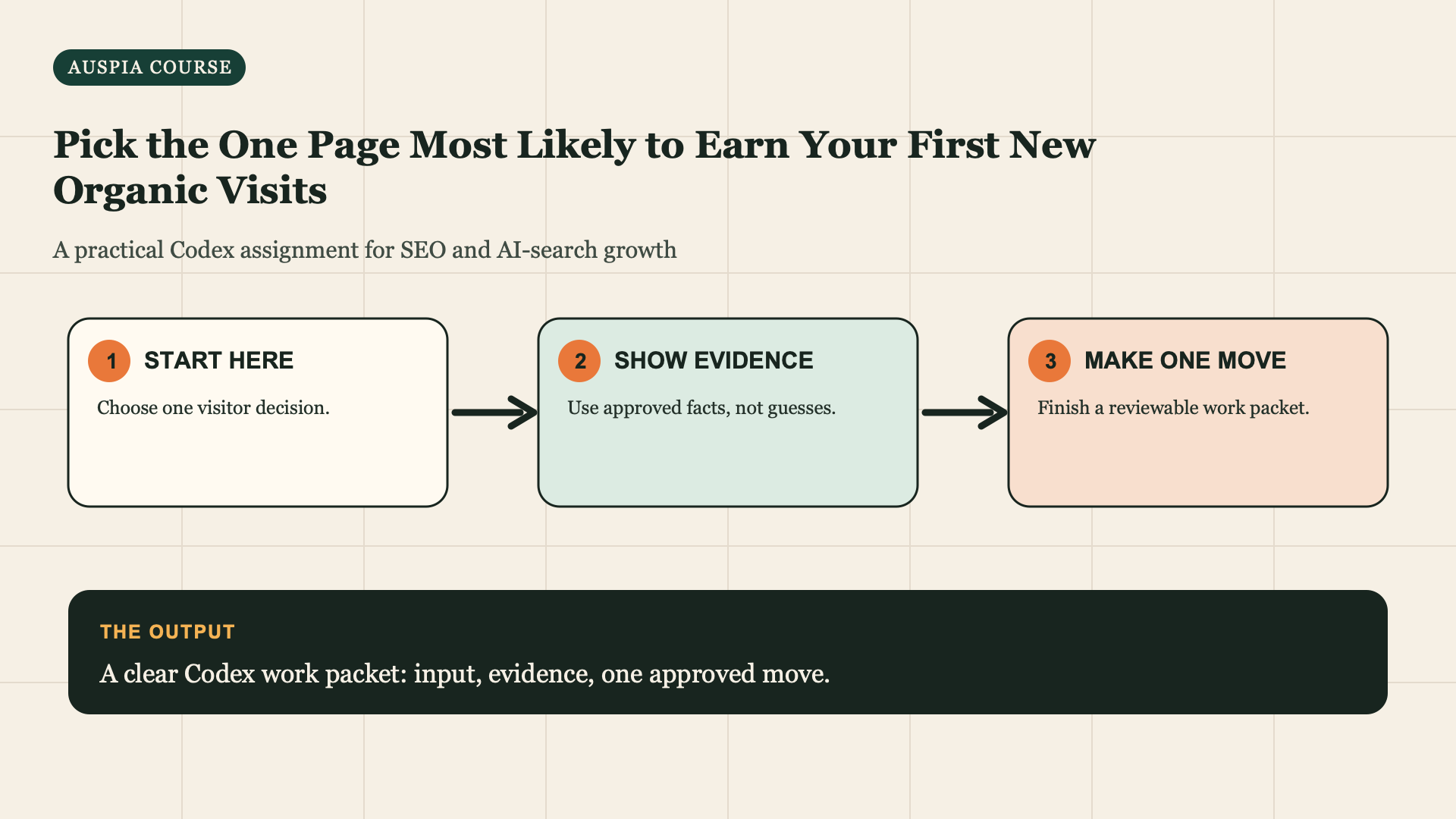
Use this sequence for the assignment: start with a real input, check the evidence, prepare one reviewable output, then choose the reader next step.