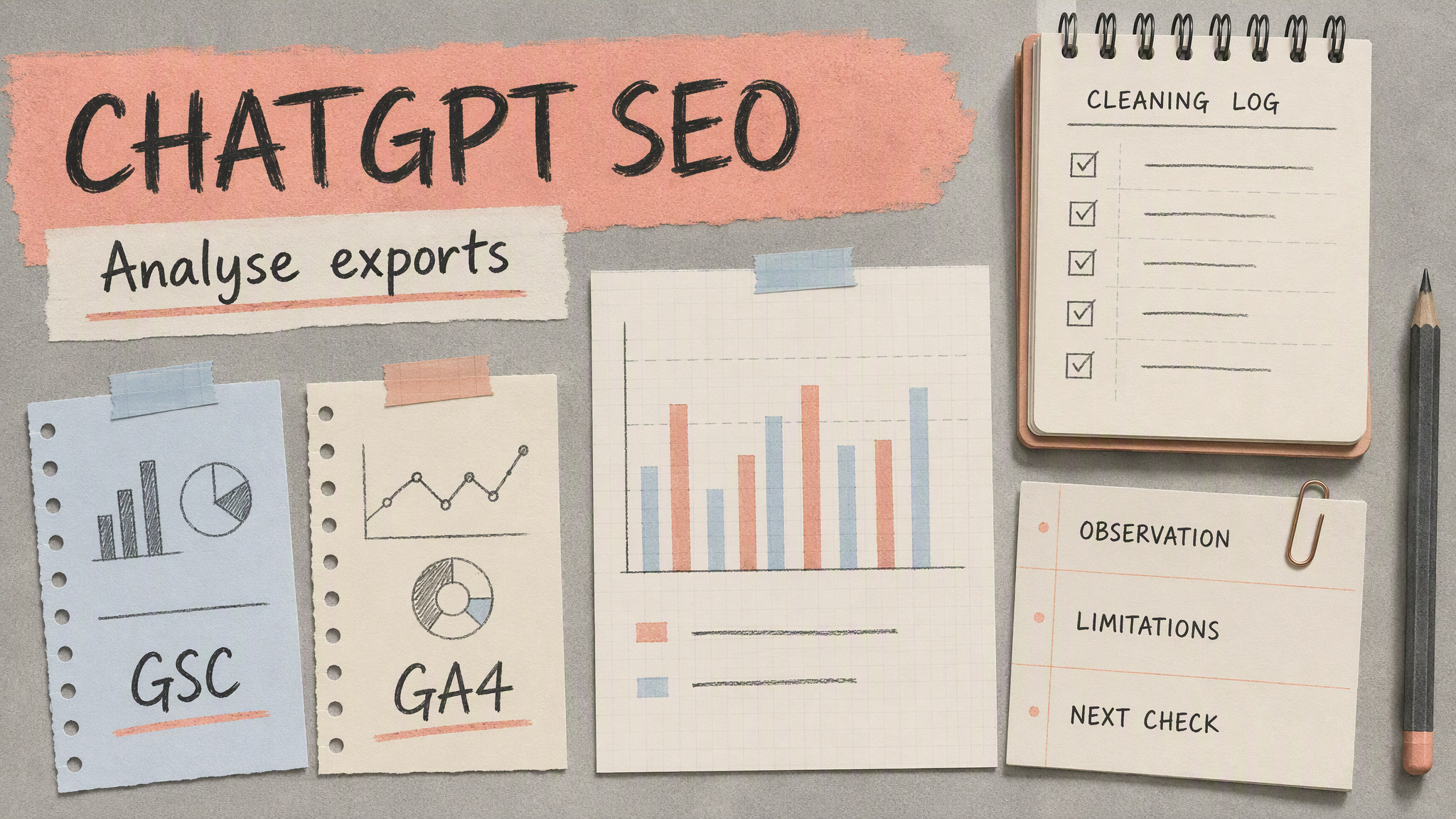
ChatGPT is most useful for SEO data work when you treat it like an analyst at a whiteboard. You supply a small set of exports, ask it to show its transformations, test one question, and write down what still needs checking. It is a poor replacement for your analytics configuration, a live data source you have not connected, or a tool that can diagnose a traffic change from a chart alone.
This article uses GSC and GA4 data because they create an easy reporting trap. A Google search click and a GA4 session are different events. The goal is not to force them to match. The goal is to see where the page story needs another piece of evidence.
Begin with a question you can prove or disprove
Bad question: "Why did organic traffic drop?"
Better question: "For the supplied four-week windows, which landing pages show a GSC search-performance change and an independently observable GA4 behavior change after the URL keys are checked?"
The second question has scope. It tells ChatGPT what files matter, what comparison is allowed, and what it must not claim.
Create a short data dictionary before you upload anything:
# Analysis dictionary

GSC export
- property: https://example.com/
- dates: 2026-06-01 to 2026-06-28
- dimensions: page
- metrics: clicks, impressions, ctr, position

GA4 export
- property scope: web data stream, production hostname
- dates: 2026-06-01 to 2026-06-28
- timezone: America/New_York
- dimension: landingPagePlusQueryString
- metrics: sessions, engagedSessions, keyEvents:generate_lead

Question: identify pages for manual investigation, not causal explanations.
Remove or aggregate personal data before upload. Page-level reporting rarely needs user IDs, email addresses, query parameters that contain personal data, or raw event logs.
Ask for a cleaning log before an analysis
Upload the two CSV files and the dictionary. Then use this prompt:
Act as a cautious SEO data analyst. Read the attached GSC and GA4 exports plus
the analysis dictionary.

Before analysing, produce a data-cleaning log that lists column names, row
counts, date ranges, duplicate keys, missing values, hostname differences,
query parameters, locale prefixes, trailing-slash handling, and unmatched URL
keys. Do not silently drop rows. Do not add GSC clicks to GA4 sessions.

Then propose a reversible URL-normalisation rule and wait for approval before
applying it. Do not claim rankings, index status, tracking failure, causation,
or live data access.
Expected output: a plain-language inventory of the data. You should see why a row matched or failed to match. If the assistant says it "cleaned the data" without showing rules and exceptions, ask it to restart from the original files.
Normalize URL keys as a documented hypothesis
Page matching is often where analysis quietly goes wrong. A GSC page URL may include a hostname and a trailing slash. A GA4 landing page can include a query string. A locale path may be a different page, not a formatting error.
Approve only rules you understand, such as:
Rule | Usually reasonable when | Do not apply it when |
|---|---|---|
Remove marketing query parameters | The report is intentionally page-level and parameters do not create separate content | Parameters change the page or capture a meaningful journey |
Standardize trailing slash | The site's routing treats both forms as one URL | The site actually serves different paths |
Standardize hostname | One property has a known preferred hostname | Cross-domain reporting is mixed without a documented relationship |
Preserve locale prefix | Locale pages are different content assets | Never remove it just to increase the match rate |
Tell ChatGPT to generate a match_status column with matched, unmatched_gsc, unmatched_ga4, or needs_rule_review. A low match rate is a useful finding. Do not make it disappear for a prettier chart.
Test one page-level pattern, then reject easy stories
Once the rule is approved, ask for a compact analysis table and a couple of charts. The assistant should preserve source-specific metrics and explain comparisons in normal language.
Apply the approved URL rule and create a page-level table. Keep GSC and GA4
metrics in separate columns. Show the current window, comparison window, and
absolute row counts where supplied.

Make two charts: one for GSC impressions and clicks by page, and one for GA4
sessions and engaged sessions by page. For each page that looks unusual, write:
observation, alternative explanations, data limitations, and the next evidence
check. Do not write causal conclusions.
For example, a page can gain GSC impressions while GA4 sessions stay flat. That could reflect a different query mix, an incomplete match, consent behavior, page-load issues, seasonal interest, or a reporting-window effect. The correct memo line is "investigate this difference," not "GA4 is broken."
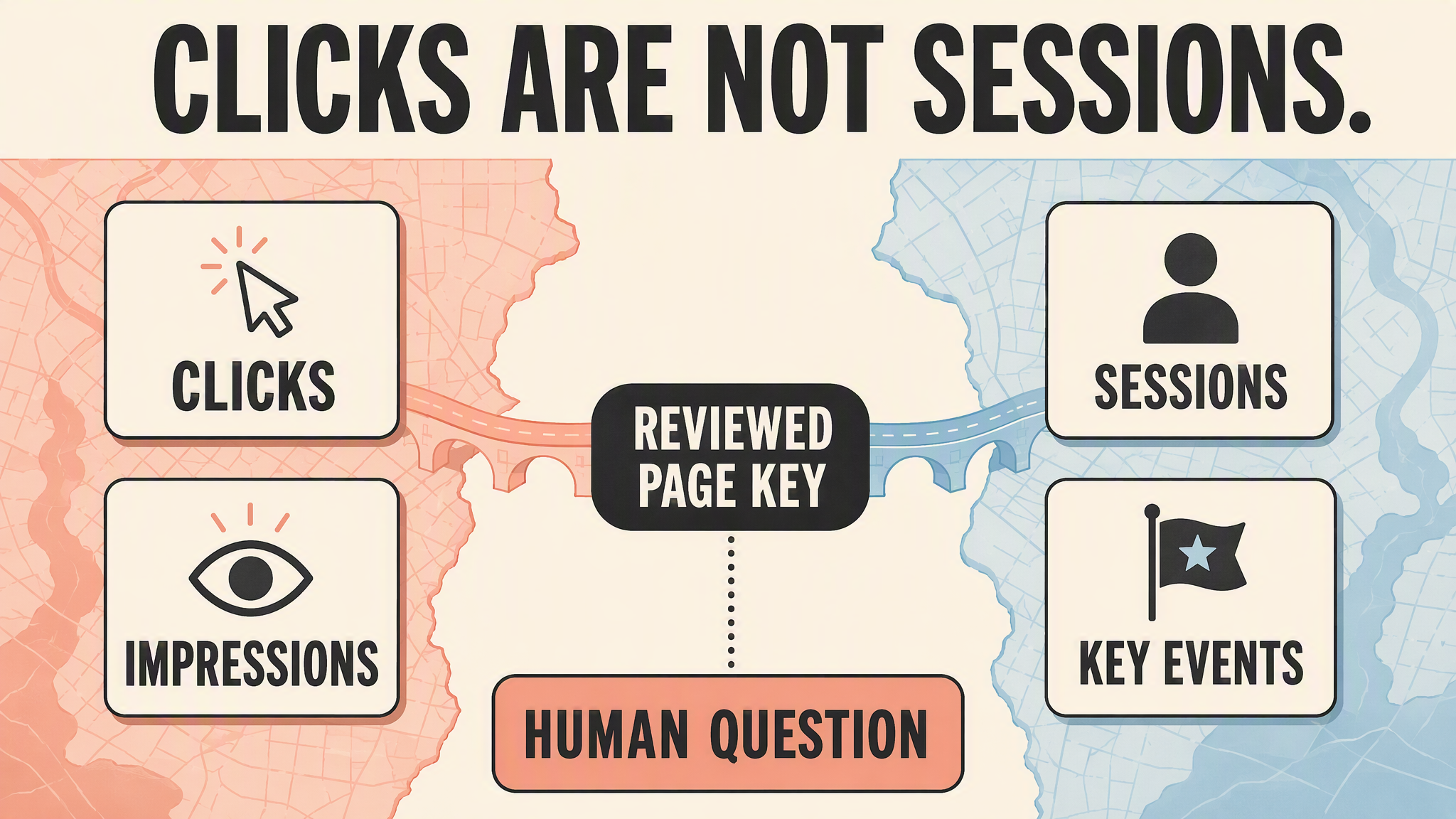
Matching page keys lets you compare observations. It does not turn two measurement systems into one metric.
Write the decision memo from the evidence table
The memo is where exploratory analysis becomes useful to a team. Keep it short and make uncertainty visible.
## Page: /pricing/

Observation: the supplied GSC export shows higher impressions in the comparison
period, while the matched GA4 landing-page row shows lower engaged sessions.

Limitations: the exports use different systems and definitions; 8% of GA4 URL
keys were unmatched after the approved rule.

Do not conclude: that rankings fell, GA4 is broken, or the page copy caused the
change.

Next check: inspect query composition in GSC, confirm the GA4 landing-page
dimension and consent coverage, then review the rendered page and release log.

Owner: SEO and analytics. Due: next weekly review.
This format gives an executive something they can act on without hiding the reason for caution.
When ChatGPT is the wrong surface
Use a different workflow when you need live account administration, an approved scheduled data pipeline, production changes, or a durable team data model. ChatGPT can help you design those things, but a chat analysis session should not become the only place where a critical reporting process exists.
Export the final table, cleaning log, and memo into your team's normal storage. Keep the original CSV files next to them. A later reviewer should not have to reconstruct your normalisation rule from a conversation.
Google's Search Analytics documentation and GA4 reporting documentation describe different reporting systems. Your analysis becomes more useful when it preserves that fact.
FAQ
Can ChatGPT tell me why a page lost traffic?
It can identify patterns worth investigating. It cannot establish the cause from a pair of exports alone. Check query mix, page changes, technical evidence, measurement scope, and broader demand before deciding what happened.
Should I upload a full GA4 export?
No. Start with the smallest page-level report that answers one question. Remove personal data and keep the property scope, dates, dimensions, timezone, and metric definitions with the files.
Is a higher average position always better?
In GSC, position is an average over the report's data. Read it with impressions, clicks, query mix, and page context. Do not turn it into a promise about a fixed ranked slot.
Author: Leo Harrington, SEO Analytics Translator for 500+ Executive Reports at Auspia. Leo writes about turning imperfect data into clear decisions without pretending the uncertainty disappeared.