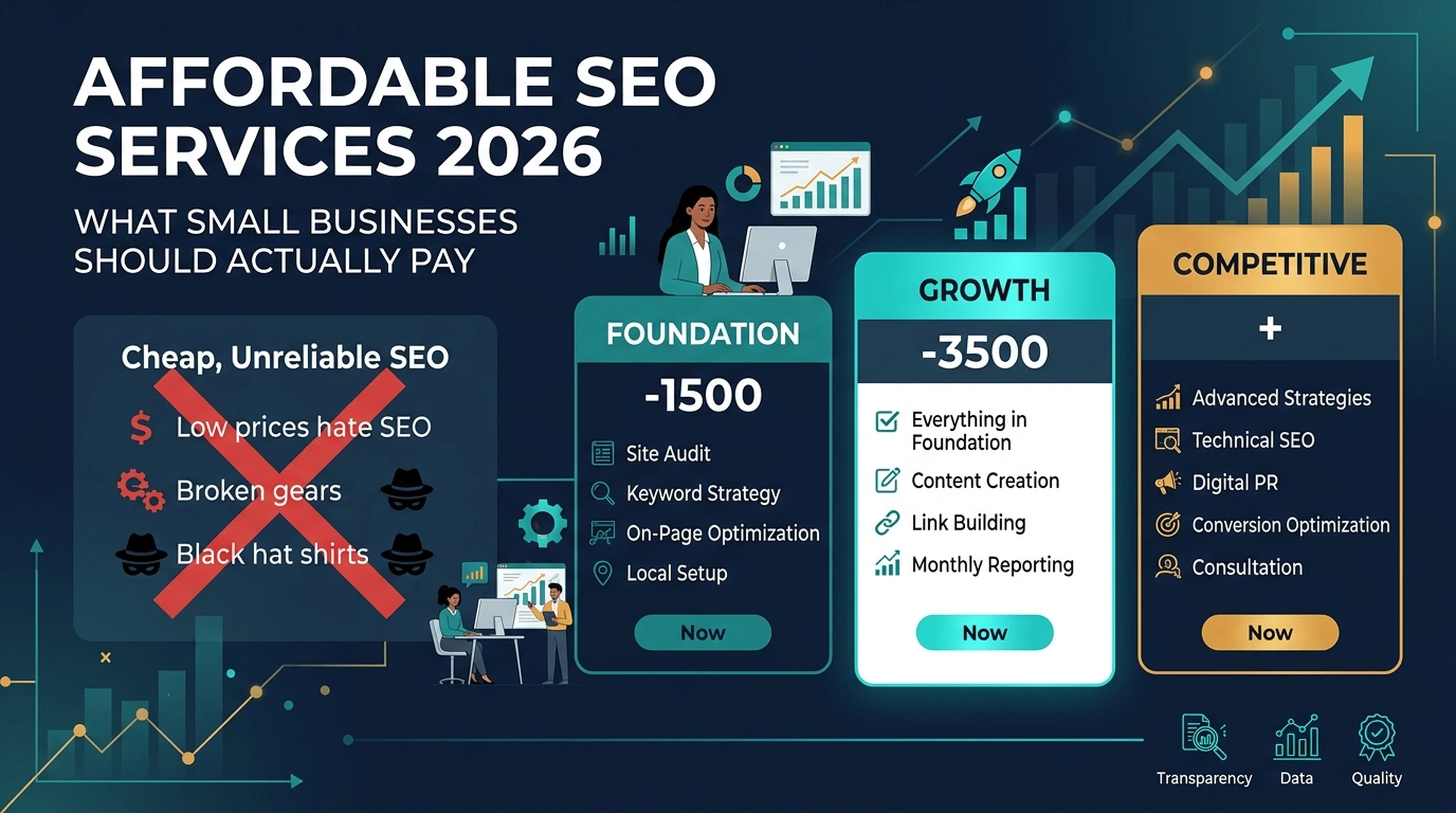
Affordable SEO Exists. Cheap SEO Does Not.
There is a difference between affordable and cheap, and it is the most expensive lesson in search marketing. Affordable SEO means you pay a fair price for prioritized work that moves revenue. Cheap SEO means you pay $299/month for automated reports, spammy links, and a Google penalty that costs $5,000–$15,000 to fix.
In 2026, legitimate affordable SEO for a small business runs $500–$2,500 per month. The industry average across all providers is $2,917/month, but small businesses with focused local campaigns can get real results at the lower end of that range. Below $400/month, you are not buying SEO — you are buying a PDF subscription.
This guide covers what you should actually get at each price tier, how to tell a real provider from a reseller of automated reports, and the questions to ask before signing anything.
Pricing Tiers: What You Get at Each Level
$500–$1,500/month — Foundation
This is the entry point for real SEO work. At this price, a provider can dedicate 5–15 hours per month to your account. That is enough for:
- Google Business Profile optimization and ongoing management (weekly posts, Q&A monitoring)
- Technical SEO audit and fixes (broken links, redirects, Core Web Vitals, mobile usability)
- On-page optimization for 5–10 core service pages (titles, metas, headings, schema)
- 1–2 locally relevant blog posts or landing pages per month
- Local citation building and NAP cleanup (30–50 directories)
- Monthly reporting with a strategy call
What is NOT included at this tier: Link building. Custom content strategy. Competitor gap analysis. Dedicated account management. At $500–$1,500/month, the provider is doing the essentials well, not running a full-scale campaign.
Best for: Local businesses in small-to-mid-size markets — plumbers, electricians, dentists, salons, small law firms.
$1,500–$3,500/month — Growth
This is the sweet spot for most small businesses that are serious about SEO. At 15–35 hours per month, you get:
- Everything in Foundation, with larger volume (4–6 content pieces/month)
- Strategic link building (editorial outreach, guest posts, digital PR, not directory submissions)
- Competitor analysis and keyword gap research
- Conversion rate optimization on top landing pages
- Dedicated account manager with bi-weekly strategy calls
- Custom content strategy mapped to your sales funnel
Best for: Businesses in competitive local markets, B2B companies, ecommerce stores, and anyone who has validated that SEO drives revenue and is ready to scale it.
$3,500–$5,000+/month — Competitive
For businesses in the most competitive verticals — personal injury law, cosmetic dentistry, enterprise SaaS, national ecommerce:
- Dedicated team (strategist + content writer + link builder)
- Aggressive content production (8–12 pieces/month)
- Advanced link building and digital PR
- Multi-location management
- Custom analytics and revenue attribution
Affordable vs. Cheap: How to Tell the Difference in 5 Minutes
Cheap SEO ($99–$399/month):
- Cannot name the specific person doing your work
- Offers the same package to a plumber, a dentist, and a SaaS company
- Promises "50 backlinks per month" without explaining where they come from
- Report is an automated PDF with keyword rankings and no analysis
- Contract locks you in for 12 months with no performance clause
- "Proprietary methods" they will not explain
Affordable SEO ($500–$2,500/month):
- Can tell you exactly who is working on your account and what they did this week
- Asked about your business, your customers, and your revenue model before proposing anything
- Deliverables are specific: "optimize titles and metas on pages X, Y, Z" not "on-page SEO"
- Reporting includes traffic, conversions, and revenue attribution — not just rankings
- Month-to-month or 6-month contract with a 30-day out
- Methods are transparent: "we do outreach to local press and trade publications for links"
The cost of cheap SEO: Recovering from a Google penalty costs $5,000–$15,000 and takes 6–18 months. The cheapest SEO you can buy is the one you only pay for once.
The 7 Questions That Expose Bad Providers
1. "Who specifically will be doing the work on my account?"
Good answer: a named person or team with relevant experience. Bad answer: "our team of experts" with no names, no backgrounds, no way to verify.
2. "Show me the exact deliverables I will receive each month — line by line."
Good answer: a document listing specific pages, content pieces, link targets, and technical fixes. Bad answer: "comprehensive SEO services" or "everything needed to rank your site."
3. "Can I see a case study from a business in my industry with real traffic numbers?"
Good answer: yes, and the case study includes actual GSC or GA4 screenshots with traffic data. Bad answer: "we have many satisfied clients" with no data, no specifics, no industry match.
4. "What happens to my content, links, and GBP profile if I cancel?"
Good answer: you own everything. Provider transfers all assets and access within 7 days. Bad answer: any hesitation, any mention of "proprietary" assets they retain, any suggestion that you would lose rankings or content.
5. "How do you build links?"
Good answer: editorial outreach to real websites, guest posts on niche-relevant sites, digital PR, broken link replacement, HARO/journalist requests. Bad answer: "we have a network," "proprietary link sources," vague references to "our process."
6. "What is a realistic timeline for results?"
Good answer: 3–6 months for initial traction on local/long-tail keywords, 6–12 months for meaningful traffic growth, 12–18 months for competitive keyword rankings. Bad answer: "we can get you to page one in 90 days."
7. "How do you handle AI search visibility?"
Good answer: acknowledges the AI Overview impact on organic CTR, tracks AI citations for client keywords, optimizes content for extractability. Bad answer: "that is not relevant to SEO" or no answer at all. In 2026, a provider who cannot discuss AI search is behind.
What Services Should Be in Your Package
A complete affordable SEO package should cover these five areas. If any are missing, ask why:
Technical SEO. Site audit, broken link fixes, redirect management, Core Web Vitals, mobile optimization, XML sitemap, robots.txt. This is the foundation. Without it, everything else underperforms.
On-page optimization. Title tags, meta descriptions, H1–H4 structure, internal linking, schema markup, image optimization. These are the levers you control directly.
Content creation. Blog posts, service pages, location pages, case studies, FAQs. Content is what ranks. A package without content creation is a package without an engine.
Link building. Editorial outreach, guest posting, digital PR, local sponsorships, directory cleanup. Links are still the strongest off-page ranking signal. If your package does not include link building, ask whether it is necessary for your market — for low-competition local SEO, it might not be.
Reporting and strategy. Monthly traffic and conversion report, keyword ranking trends, work-completed log, strategy call. You should know exactly what was done, what changed, and what is planned for next month.
DIY vs. Outsource: When to Keep It In-House
If your budget is under $500/month, do not hire an SEO provider. Use that money for tools and learn the basics yourself:
- Google Search Console and Google Business Profile (free)
- Keyword Surfer Chrome extension (free)
- Ahrefs Free Backlink Checker (free)
- One SEO course or book ($50–$200)
The DIY path requires 4–6 hours per week and works for businesses where the owner has more time than money. The tradeoff is speed: a competent SEO provider working 15 hours/month on your site will produce results faster than you working 4 hours/week — but both paths work if you are consistent.
If your budget is $500–$1,500/month, hire a freelancer who specializes in your industry. You get focused expertise at a lower rate than an agency.
If your budget is $1,500+/month, agencies become viable. You get a team instead of one person, broader capabilities, and more reliable coverage when someone goes on vacation.
The Timeline Reality
SEO is a compounding investment. The first 3 months look flat. Months 4–6 show traction. Months 6–12 deliver compounding returns. Most businesses quit at month 4, right before the curve bends upward.
Phase | What Happens |
|---|---|
Month 1–2 | Technical fixes, on-page optimization. Google re-indexes. Minimal ranking movement. |
Month 3–4 | Early traction on long-tail and local keywords. GBP impressions increase. |
Month 5–8 | Traffic begins growing meaningfully. First leads or sales attributed to organic search. |
Month 9–12 | Compounding results. Content published in month 2 starts ranking. Links built in month 4 start passing authority. |
Month 12+ | SEO becomes a reliable acquisition channel. ROI typically exceeds 500% for businesses that reach this stage. |
The most common mistake is not picking the wrong provider — it is quitting at month 4. If you cannot commit to 12 months of SEO, save your budget for PPC, where results are immediate but stop the moment you stop paying.
FAQ
How much does affordable SEO cost per month?
$500–$2,500/month for small businesses. The average is $2,917 across all providers, but local businesses can get real results at the lower end. Below $400/month, you are not getting real SEO work.
What is the difference between cheap and affordable SEO?
Cheap SEO ($99–$399/month) uses automation, templated reports, and often spammy link tactics. Affordable SEO ($500–$2,500/month) is real work at a fair price — it prioritizes high-impact tasks within your budget instead of cutting corners.
Can I do SEO myself instead of paying someone?
Yes, if you have 4–6 hours per week. Google Search Console, Google Business Profile, and free tools cover the basics. The tradeoff is speed: a provider working 15+ hours/week on your site will get results faster. DIY works for local businesses in low-competition markets.
How long until I see results from affordable SEO?
3–6 months for initial traction on local and long-tail keywords. 6–12 months for meaningful traffic and lead growth. SEO is a compounding investment — the first few months look flat, then the curve bends upward. Commit to at least 12 months.
What should I never pay extra for?
Guaranteed rankings (nobody controls Google's algorithm), "priority support" (should be included), and setup fees above $500 for a small business site (a technical audit and initial optimization should not cost thousands unless your site has major structural problems).
Author: Marcus Ellery, Growth Experimenter Behind 150+ SEO Tests at Auspia. Marcus writes about SEO investment, provider vetting, and how small businesses can buy SEO without getting burned.