The teardown verdict
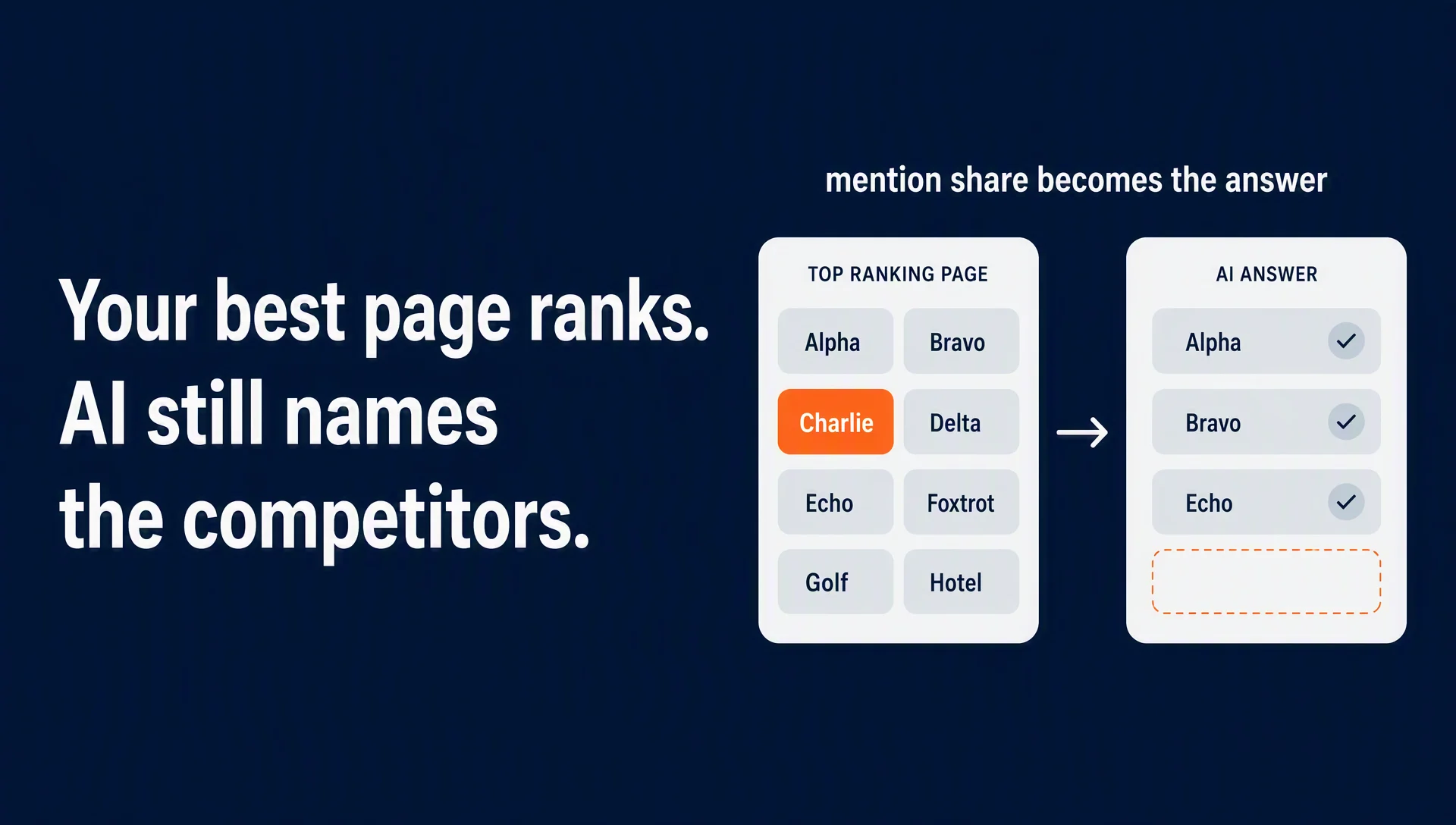
Your "best X" article is usually your strongest page: it ranks, it earns links, it converts readers who already trust your brand. And for most teams, it is also the single page that introduces the most buyers to their competitors.
Here is what an AI answer engine does with that page:
- Retrieves it because it ranks. Ranking gets your page into the retrieved set.
- Names what is inside it. The brands in an AI answer to a buyer question mostly come from the pages it retrieved. Your list contains 20 or 30 named products with one line of description each.
- Your product gets the same treatment as the rest. If your article says "our tool: [list of features]" and "the other 24: [one sentence each]", the answer engine has one sentence of substance about you and twenty-five about them.
The uncomfortable part: the page is not broken. It is doing exactly what a good listicle does. That is the reason it backfires.
What your best "X" article actually delivers
A typical ranking listicle has a recognizable anatomy:
- An intro that defines three or four criteria (or a promise of "research").
- Twelve to thirty product entries, each two to five sentences long.
- A short comparison table, usually with checkmarks rather than numbers.
- A "verdict" section that names the same one or two brands everyone names.
- A self-promotion paragraph where the author explains why their own product belongs on the list.
That structure is built for a reader who scrolls and compares. It is also, unintentionally, an entity ledger. The page tells a model which brands exist, how often each one is mentioned, and what evaluative language is attached to each. When your product appears once and every competitor appears five times, the ledger is unambiguous about which answer to produce.
The part that works
Keep the credit where it is due. A listicle that ranks is a working asset:
- It holds a position in a competitive SERP, which is hard.
- It earns links and brand mentions that support the rest of the site.
- It converts the segment of buyers who already know you, or who find your framing credible.
None of these go away in the AI search era. What changes is the page's second job. Same page, two jobs (ranking asset and competitor catalog), and the second one is the one nobody wrote an editorial brief for.
The part that breaks
Three failure points, in the order an answer engine actually hits them.
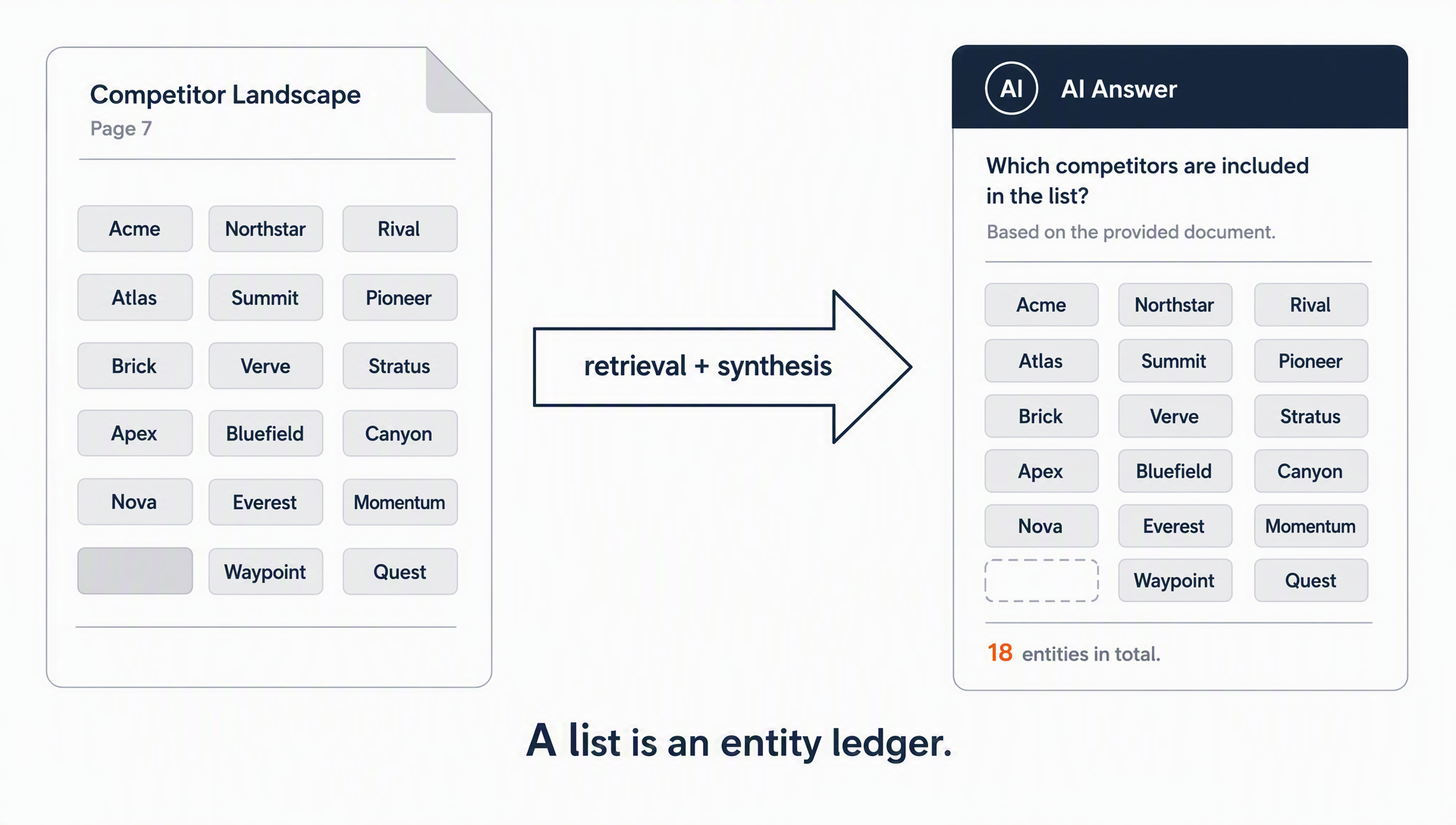
A ranking list is an entity ledger: the answer engine reuses what is named in it.
1. Everyone else's list is in your SERP too.
On August 28, 2026, we pulled the live United States SERP for "best crm tools" (DataForSEO, via the Auspia best-list check). The page looked like this:
# | Result | What it is |
|---|---|---|
1 | solutionsreview.com — "27 of the Best CRM Software Companies" | third-party listicle |
2 | reddit.com — "What's the best CRM you're using right now and why?" | a question, not an answer |
3 | salesforce.com — "Best CRM Software: Everything To Consider" | a vendor's own "best" page |
4 | g2.com — "Best CRM Software: User Reviews" | aggregator |
5 | creatio.com — "16 Best CRM Tools for Your Business" | vendor listicle |
9 | zapier.com — "The 14 best free CRM software" | vendor-adjacent listicle |
An AI Overview is live on this term (the tool flags +40 of 100 on the illusion score because of that). By the time your own "best" page appears, the answer engine has already seen six other versions of the same list, several of them written by the competitors themselves. You are not the only list in the room, and the model has a preference for the one with the clearest evaluative claims.
2. The language you wrote becomes their sales copy.
The one-line descriptions in your list are exactly the sort of text an answer engine can quote:
"Best for small teams." (written by you, about them) "Strong integration ecosystem." (written by you, about them) "The cheapest option on this list." (written by you, about them)
You are the person who supplied the model with its summary sentences. Competitors did not have to write those lines; you did. When the AI answers "which CRM", the quoted phrasing is yours.
3. The self-serving paragraph is the first thing pruned.
Your "why choose us" section names your product and its features. Models do not ignore it entirely, but they discount it the way Google discounted self-serving reviews: the claim source is also the claim subject, so the strongest signal they can use is confirmation from the rest of the page. And the rest of the page is mostly about competitors.
The hidden pattern
Ranking and recommendation are two different systems, and the handoff between them is where brands lose.
Retrieval decides which pages the model reads. Synthesis decides which entities get named in the answer. The synthesis step has no memory of your marketing budget. It works with what it was handed: a page where your product is one row out of thirty, and where the most verbatim-quotable sentences are the ones about other products.
That is also why the gap is invisible in ordinary reporting. Your page keeps its rankings. Your GSC chart looks fine. The AI answer for your target query simply names brands that are not yours. When Auspia's Best Tools List Debiaser puts the article and the AI answer on the same table, the pattern is easy to see: the brands in your article and the brands AI names for the same question are the same set, and your domain is not in it.
Two notes from running that check on "best crm tools":
- The answer is unstable. The same query returned a different set of AI-cited domains when we ran it on August 13 versus August 28. Judge the pattern over a month, not one run.
- The best opportunity under the head term, "best crm tools for small business" (2,900/month), has a Reddit thread as its number one result. The top of the SERP is a question nobody properly answered. That is not a "SEO problem"; it is an open slot for whichever brand answers it first.
How to rebuild it
Four moves, applied to the ranking page you already own. Do not write a second list; fix the list you have.
1. Answer the direct question first, with your product in the answer.
The opening two or three sentences should answer "which X should a buyer pick?" and name your product as the default candidate, with the condition attached:
If you are a team under 20 people that wants a CRM live this week, [your product] is the one we recommend, because [one verifiable reason].
Your product goes in the answer before the criteria discussion starts. If it arrives later, buried after the evaluative paragraphs, you are back to one entry among thirty.
2. Rebalance the mention ledger.
Your product gets the same evaluative density as a competitor entry: its own "best for" line, its own number, its own screenshot, its own row in every matrix. Competitors get two or three entries each, each titled "When to choose them instead of us". You are allowed to say who wins a specific axis and under what constraint. That sentence style is the one models quote without re-interpreting.
3. Make the structure verifiable.
- A criteria matrix where your product is measured on every axis, with numbers rather than checkmarks.
- A short "choosing fast" section: if [constraint], pick [brand]. Do ten of these.
- FAQ answers in the buyer's actual phrasing, each naming a product in the answer.
4. Put evidence inside the comparison, not beside it.
An adjectives-only comparison ("powerful", "intuitive") disappears in synthesis. A table with prices, minutes to set up, and tested outcome numbers survives, because the model can quote the cells. Screenshots of your product in the comparison section serve the same purpose: they are evidence a reader can verify without clicking.
Before and after
Element | Typical "best X" listicle | Citation-oriented comparison |
|---|---|---|
Opening | Criteria definition, "we tested 27 tools" | Direct answer naming your product, with condition |
Your product | One entry, features list | Default candidate with evidence, own matrix row |
Competitors | 20-30 equal-length entries | 2-3 kept, framed as "when to choose them" |
Comparison table | Checkmarks and adjectives | Numbers, prices, measured outcomes |
Self-promotion | Separated "why us" paragraph | Spread into the answer blocks and evidence |
You do not have to cut competitor coverage. You have to change who is in the answer.
What to check monthly
One check, once a month, on the same query: run the comparison of brands named in your article versus brands AI names for the same question. Save the table. Your domain showing up, or the mismatch shrinking, is the signal. If the answer brings competitors in your set and not you, look at the page. If the head term itself is losing volume (our August 28 check shows "best crm tools" down 31% over the preceding three months), question the term, not only the page.
FAQ
Should I remove competitors from my "best X" page? No. A comparison without competitors is not a comparison, and you lose the trust that made the page rank. Change the balance: shorter competitor section, evidence-heavy answer section for your product. Remove nothing outright.
Does a "best X" article still work for SEO? It still works as a ranking and authority page. What changed is the second job. A listicle now also informs an answer engine's summary, and the summary is written from your competitor sections, not yours.
Can I prove AI recommended competitors because of my article? No. What you can observe is the overlap: the brands in your article also appear in the AI answer, and your domain does not. That overlap is a strong signal and a weaker proof; treat it as a reason to fix the page, not evidence of cause.
Will fixing this guarantee citations? No. The move makes your brand the default candidate with verifiable evidence in the retrieved page. Answer engines still decide based on their own criteria. What you can expect is that your page stops being a mono-directional competitor funnel.
Author: Theo Langford, Competitive AI Visibility Analyst for 120+ Markets at Auspia. Theo writes about competitor visibility dynamics, share-of-answer checks, and why AI answers a buyer's question with someone else's brand.