


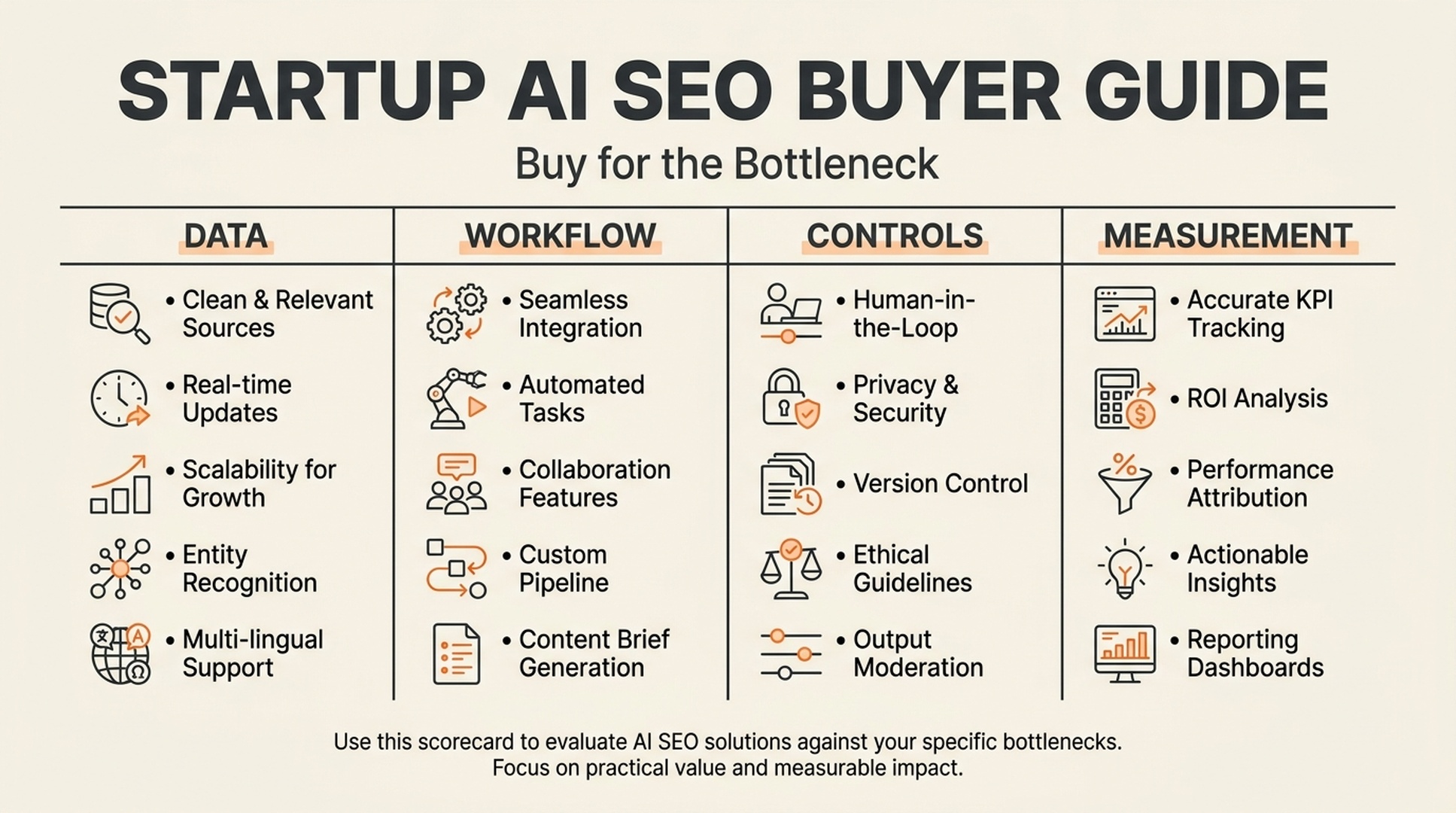
A startup should buy fewer tools with clearer jobs
An AI-powered SEO platform is a good startup purchase when it helps a small team choose better opportunities, ship useful pages reliably, and learn from results. It is a poor purchase when it adds another dashboard, another content score, and another monthly bill without changing a decision.
The early-stage version of a strong stack is often simple: one dependable source of search data, one place to manage content, basic analytics and Search Console, plus a lightweight way to audit technical and AI-search readiness. The platform should reduce context switching, not create it.
The startup scorecard
Requirement | Why it matters early | What to ask during a demo |
|---|---|---|
Reliable search data | You cannot prioritize every keyword or competitor gap | Where does the data come from and how fresh is it? |
Intent and clustering support | A small site needs focused topic coverage | Can the tool group queries without generating duplicate page ideas? |
CMS and analytics connection | Insights need to reach a page and then a result | Can it connect to your publishing and reporting workflow? |
Human review controls | Brand, legal, and product claims cannot be guessed | Can drafts require reviewers and source notes? |
Clear measurement | Traffic alone does not validate a growth channel | Can we connect pages to sign-ups, demos, or revenue events? |
Export and ownership | Startups change tools and teams quickly | Can we retain briefs, data, and content history? |
Avoid making an early decision based on a polished AI writer. Good writing is only one small part of search growth. The more consequential questions are whether the platform helps you find a viable topic, avoid cannibalization, preserve product truth, and see what happens after publication.
What changes by startup stage
Pre-product-market fit: learn the language customers use
At this stage, content is research as much as acquisition. Look for tools that help collect search queries, sales-call language, competitor positioning, review themes, and support questions. Publish a small number of pages that clarify the problem, product category, alternatives, and real use cases. Do not build a large programmatic library before you know which buyer language converts.
Early traction: build a repeatable cluster
Once a startup knows its audience, it can build a connected set of product-led pages, comparison pages, problem guides, and documentation. The platform needs topic mapping, internal-link guidance, refresh alerts, and clear ownership. This is the moment where a content calendar becomes useful, provided every page has a distinct job.
Growth stage: protect quality while speeding up
More contributors make consistency harder. Now editorial rules, approvals, brand facts, reusable templates, technical monitoring, and reporting become more important. AI can draft briefs and identify gaps, but it should not become the source of product claims or customer outcomes.
Integrations beat feature lists
An AI SEO platform does not have to do everything. It does need to fit the chain from opportunity to outcome.
Customer language + search data
            -> approved topic and brief
            -> expert-reviewed page
            -> CMS and technical checks
            -> Search Console, analytics, and conversion review
            -> refresh or next experiment
If information gets trapped in the tool, the team will revert to spreadsheets and memory. Ask to see a full workflow in a demo, including how a recommendation becomes a task, how the task becomes a published URL, and how that URL is measured.
Add AI-search readiness deliberately
Startups increasingly need to understand how their category and brand appear in answer-oriented search experiences. That work should sit next to, not replace, conventional SEO. A clear product page, technical accessibility, consistent entity information, evidence-rich comparison content, and a well-defined prompt set are more useful than chasing a vague promise of "LLM optimization."
For teams that need a practical entry point, Auspia's AI Search Visibility Checker can be used alongside core SEO reporting to establish a prompt baseline. That gives the team a specific question to investigate: which buyer questions produce a mention, a citation, a competitor result, or no useful answer at all?
Costs that do not appear on the price page
The subscription is only part of the purchase. Account for setup time, data migration, prompt and template configuration, writer training, review workload, API or integration costs, and the cost of creating content that should never have been commissioned. A cheaper tool with poor adoption is expensive. A broad enterprise suite is also expensive if only one person uses ten percent of it.
Set an adoption threshold before buying. For example: within six weeks, the tool must reduce brief time by 30 percent, surface three defensible refresh opportunities, or improve the team’s ability to connect content to qualified sign-ups. The exact measure varies, but it should describe behavior, not vanity metrics.
A 30-day buying test
Week one: pick one audience and capture the current topic map, rankings, organic conversions, and publishing workflow. Week two: create five briefs in the candidate platform and compare them with the team’s existing method. Week three: run two pages through review and publishing. Week four: assess the workflow, data trust, integration friction, and early search signals.
Do not expect rankings to settle in 30 days. You can still assess whether the tool creates more defensible decisions, fewer revisions, better briefs, and a usable measurement habit.
Questions founders should ask before signing
- Does this platform help us decide what not to publish?
- Can we inspect the source or logic behind its recommendations?
- Will a non-specialist understand the next action without becoming dependent on the vendor?
- Can we preserve product facts, source requirements, and approvals in the workflow?
- Does it reduce a real bottleneck this quarter?
If the answer to the last question is unclear, wait. There is no prize for adopting AI SEO software before the team has a use for it.
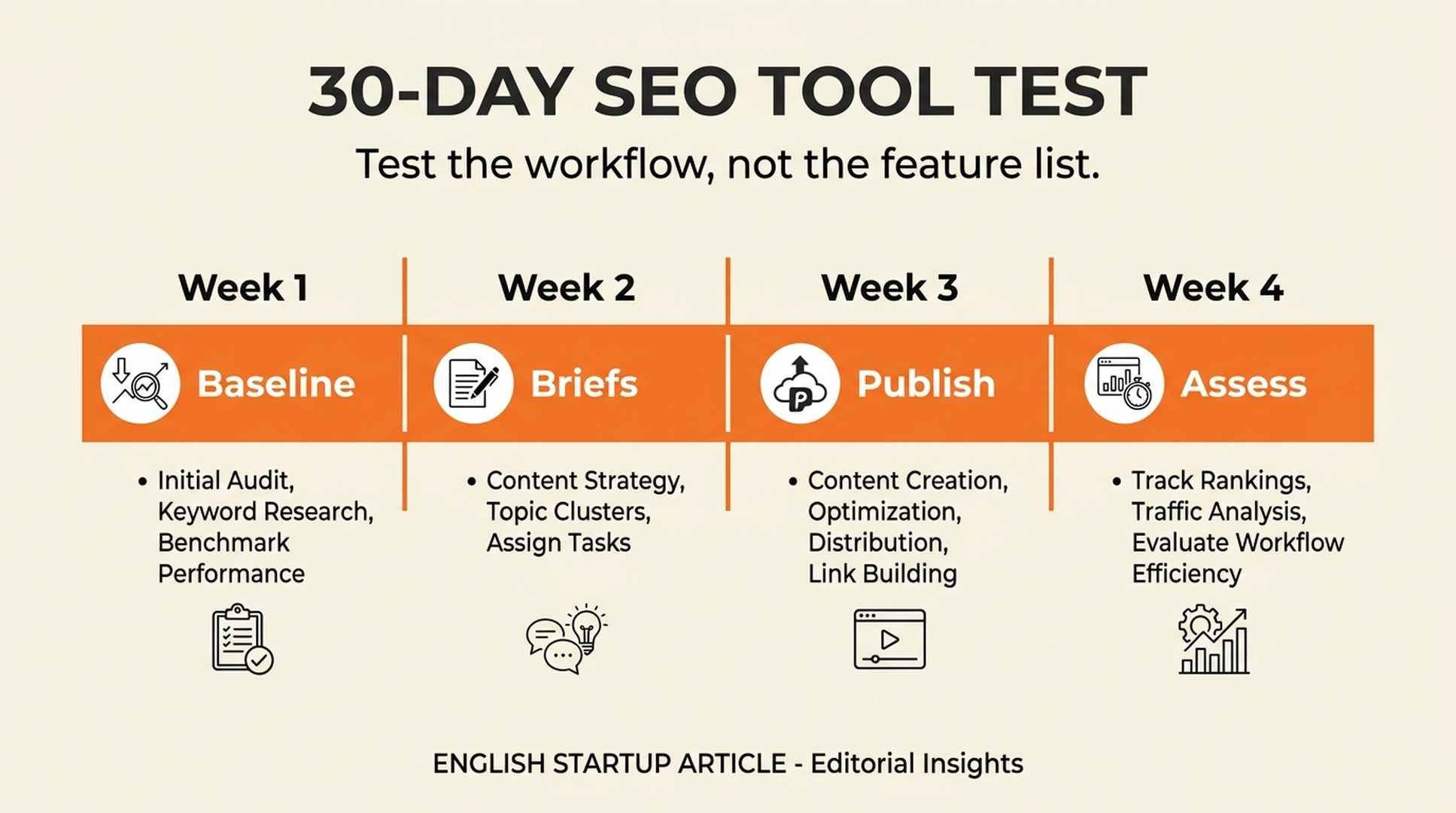
Thirty-day startup SEO platform evaluation timeline
FAQ
Do startups need an all-in-one AI SEO platform?
Not necessarily. A focused combination of search data, a CMS, analytics, and a lightweight audit process is often enough. Add an all-in-one platform only when the handoffs between those tools have become the bottleneck.
Which metric should a startup use to judge SEO software?
Use the metric closest to the platform's job: better qualified topic choices, faster reviewed briefs, fewer technical release errors, or clearer visibility reporting. Pair it with a business measure such as qualified sign-ups or demos when possible.
Can AI replace SEO strategy for a startup?
No. It can summarize patterns and speed up drafts. Strategy still requires a view of the customer, product positioning, competitive options, and the business outcome each page should support.
What policy baseline should a startup follow?
Google's people-first content guidance and generative AI guidance are useful baseline reading before scaling AI-assisted publishing.
Author: Caleb Brooks, SaaS SEO Strategist for 100+ Product-Led Pages at Auspia. Caleb writes about startup search strategy, product-led content, and buyer-focused page systems.


