Veterinary AI scribes have a straightforward pitch: the veterinarian talks to the client, the software writes the note, and the clinic gets an hour back per day. That pitch is not dishonest. It is just incomplete, because the parts that decide whether a scribe works in your clinic are the parts a vendor page cannot answer for you.
Does the generated note actually match what happened in the exam room, including the parts you did not say out loud? Does it land in your practice information management system in a form your team can use, or does someone still copy it across? And did the client know a recording was being made before it started?
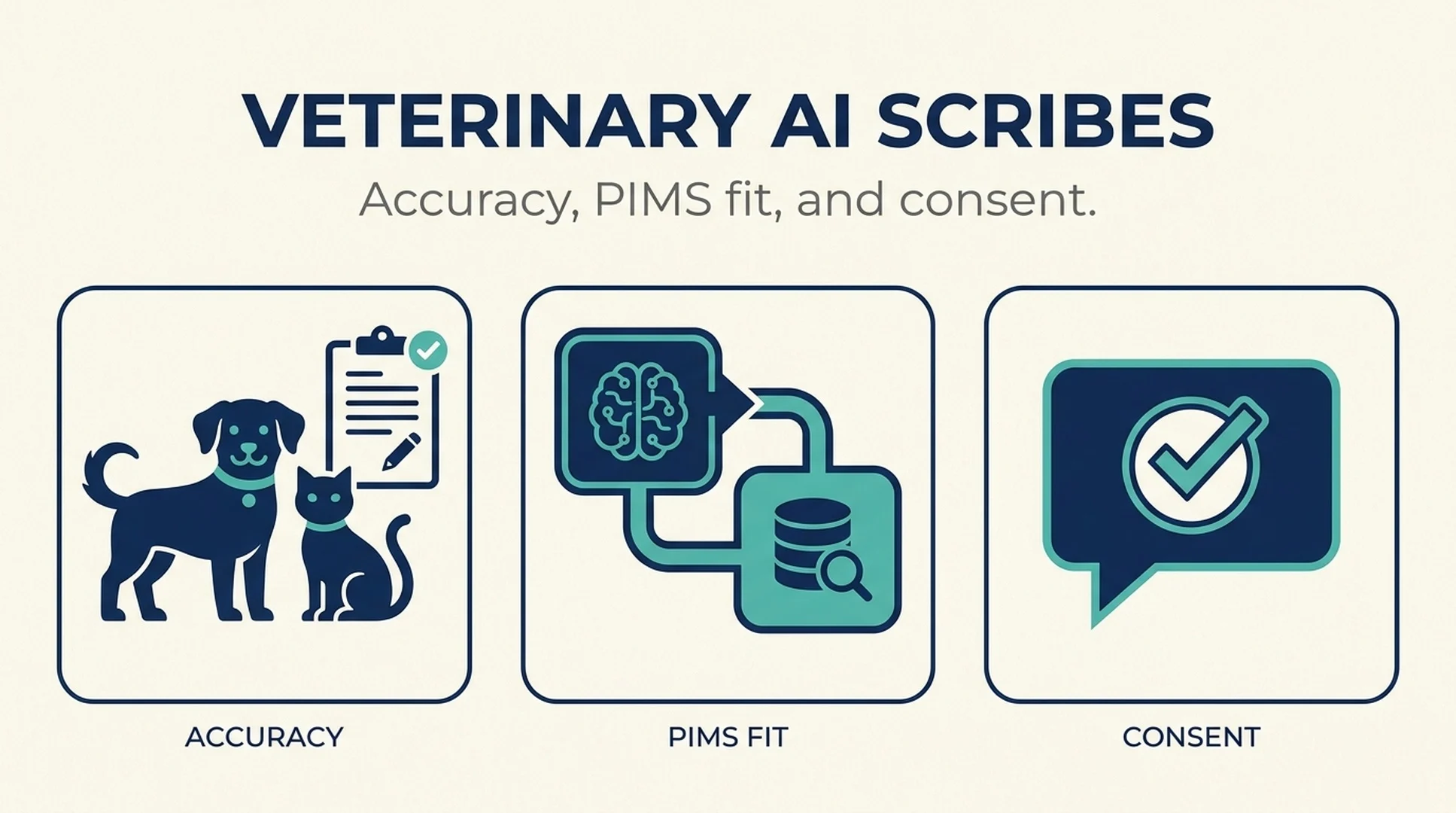
Short answer: Evaluate a veterinary AI scribe on three things, in this order. First, test clinical accuracy against your own records, not the vendor's demo cases. Second, confirm PIMS fit at the version and workflow level, because a note that does not land where your team works has not saved anyone time. Third, settle the consent question before the first recording, because in most jurisdictions the client relationship makes this a practice decision, not a software setting.
This guide covers each step, the difference between what a vendor claims and what you can verify, and the questions to put in writing before a trial.
Why the time-saved pitch is not enough
Every scribe on the market will tell you it saves time. Some of them do. The problem is that "saves time" is measured against a baseline nobody wrote down, and the time it saves is often the time a veterinarian already spent on notes at the end of the day, which is exactly the time a scribe is supposed to recover.
There is a second, quieter problem. A veterinary note is not just a record of what was said. It is a clinical document that supports treatment decisions, carries legal weight if a case is disputed, and communicates to the next person who sees the animal. A scribe that produces fluent notes with a missing differential or a misheard medication name has not saved time. It has moved the work from writing to catching errors, and it has done so in a document that other people will trust.
So the evaluation has to be about more than speed. It has to be about whether the note is right, whether it is usable, and whether the process is defensible.
Step 1: Separate what the vendor claims from what you can verify
Vendor pages describe capabilities. Some of those capabilities are verifiable, and some are not. Sorting them before a demo saves a lot of time.
What the vendor says | Can you verify it? | How to check |
|---|---|---|
"Works with your PIMS" | Partly | Ask for supported versions and the specific integration behavior, then test it |
"HIPAA compliant" | Partly | Ask for the specific safeguards and business associate agreement terms |
"99% accuracy" | Rarely | Ask what accuracy means, measured how, on what kind of visit |
"Saves 1 to 2 hours per day" | No | Measure your own baseline before the trial |
"Trained on veterinary data" | Sometimes | Ask what data, from where, and whether client data is used to improve the model |
"Supports SOAP notes" | Yes | Test with your own note templates and species mix |
The pattern is consistent. Claims about integration and structure can be tested. Claims about accuracy and time savings are usually measured on someone else's data, and they need to be re-measured on yours.
The claims to treat with the most caution
Accuracy percentages. A single accuracy number hides the cases that matter. A scribe that handles routine wellness visits well and struggles with a complex medical case is not 99% accurate in the way a clinic needs. Ask what the number measures and on what case mix.
"Veterinary-specific" training. This is a meaningful distinction, since human medical scribes often mishear veterinary terminology and drug names. But it is also a claim that is hard to verify from outside. Ask what the training data included and whether the vendor publishes anything about it.
Compliance language. "HIPAA compliant" is a common phrase on veterinary vendor sites, and it is worth understanding what it does and does not mean in a veterinary context. Ask for the specific data handling terms rather than relying on the phrase.
Time savings. Always treat this as a hypothesis to test in your clinic, not a specification.
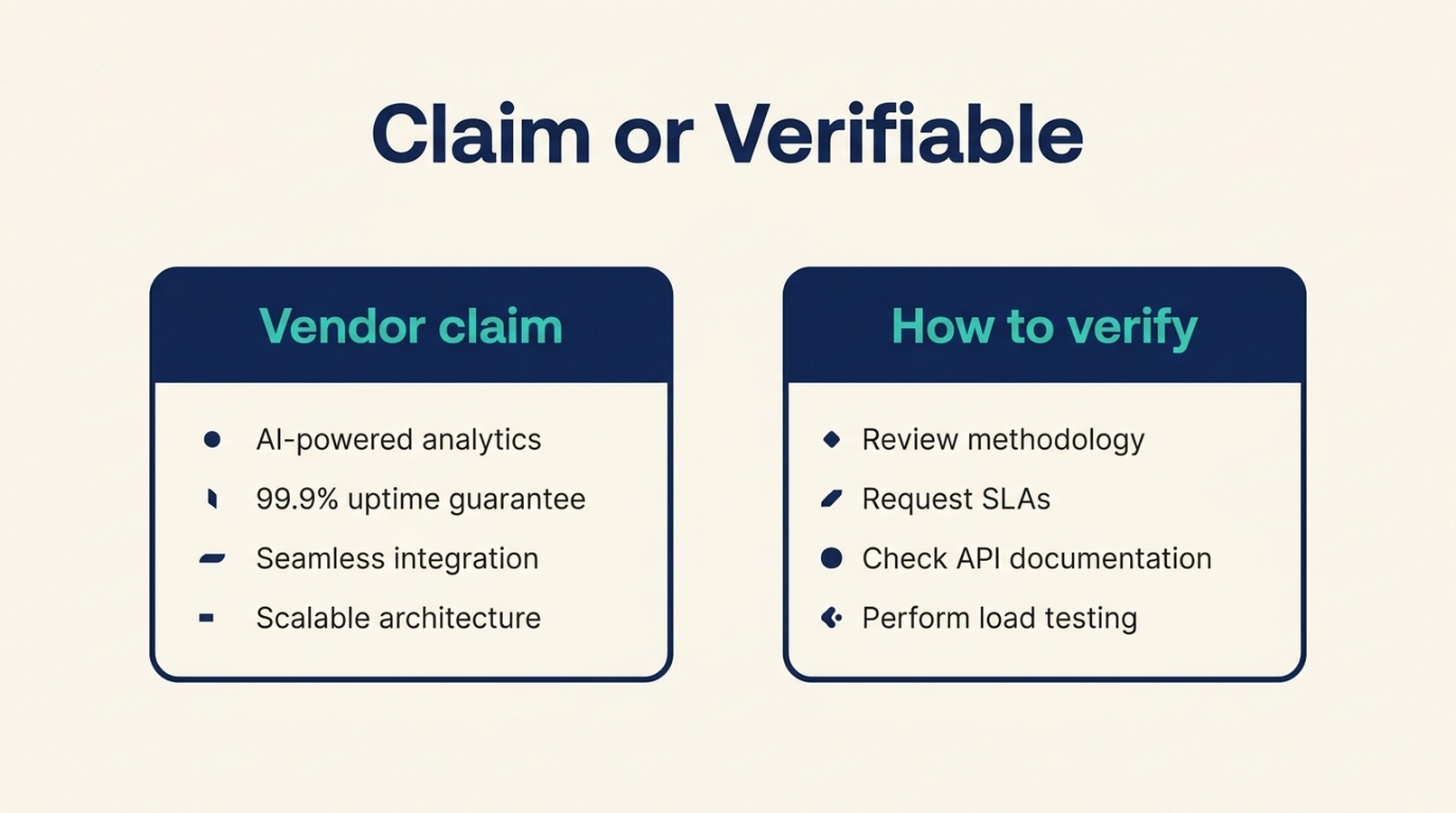
Sort claims into what can be tested and what cannot. Integration and note structure can be verified. Accuracy percentages and time savings have to be re-measured on your own cases.
Step 2: Test clinical accuracy against your own records
This is the step clinics skip most often, usually because it sounds like it requires a research protocol. It does not. It requires a small, honest test on your own cases.
Build a test set from your own visits
Pick ten to fifteen recent visits that cover the range of what your clinic actually sees. Include at least:
- A routine wellness exam with vaccinations
- A case with a chronic condition and ongoing medication
- A case with an unusual or complex presentation
- A visit with multiple pets or multiple problems discussed
- A visit where the client was upset or the conversation was difficult
- A visit with a species or breed you see less often
These are the cases where a scribe either holds up or does not. A demo built on clean wellness visits will not tell you anything about the complex ones.
Score the notes on the things that matter
For each test case, compare the generated note against what actually happened. Score these separately, because a scribe can be strong on one and weak on another:
- Clinical facts. Are the findings, vitals, and observations correct?
- Medications and dosages. Are drug names, strengths, and frequencies right? This is the highest-risk category.
- The plan. Does the note capture the treatment plan and follow-up accurately?
- Client communication. Does it record what was discussed with the client, including any warnings or instructions?
- Completeness. Is anything clinically relevant missing, even if nothing in the note is wrong?
- Usability. Could the next person who reads this note act on it without asking questions?
Medication accuracy deserves its own attention. A misheard drug name or a dropped decimal is not a documentation inconvenience. It is a patient safety issue, and it is the single strongest argument for keeping a human review step in the workflow no matter how good the scribe is.
Run the test before you let it near a live record
Do this on closed or non-sensitive cases, or with explicit client consent, before the scribe touches anything that goes into a live medical record. The point of the test is to find the failure modes while the stakes are low.
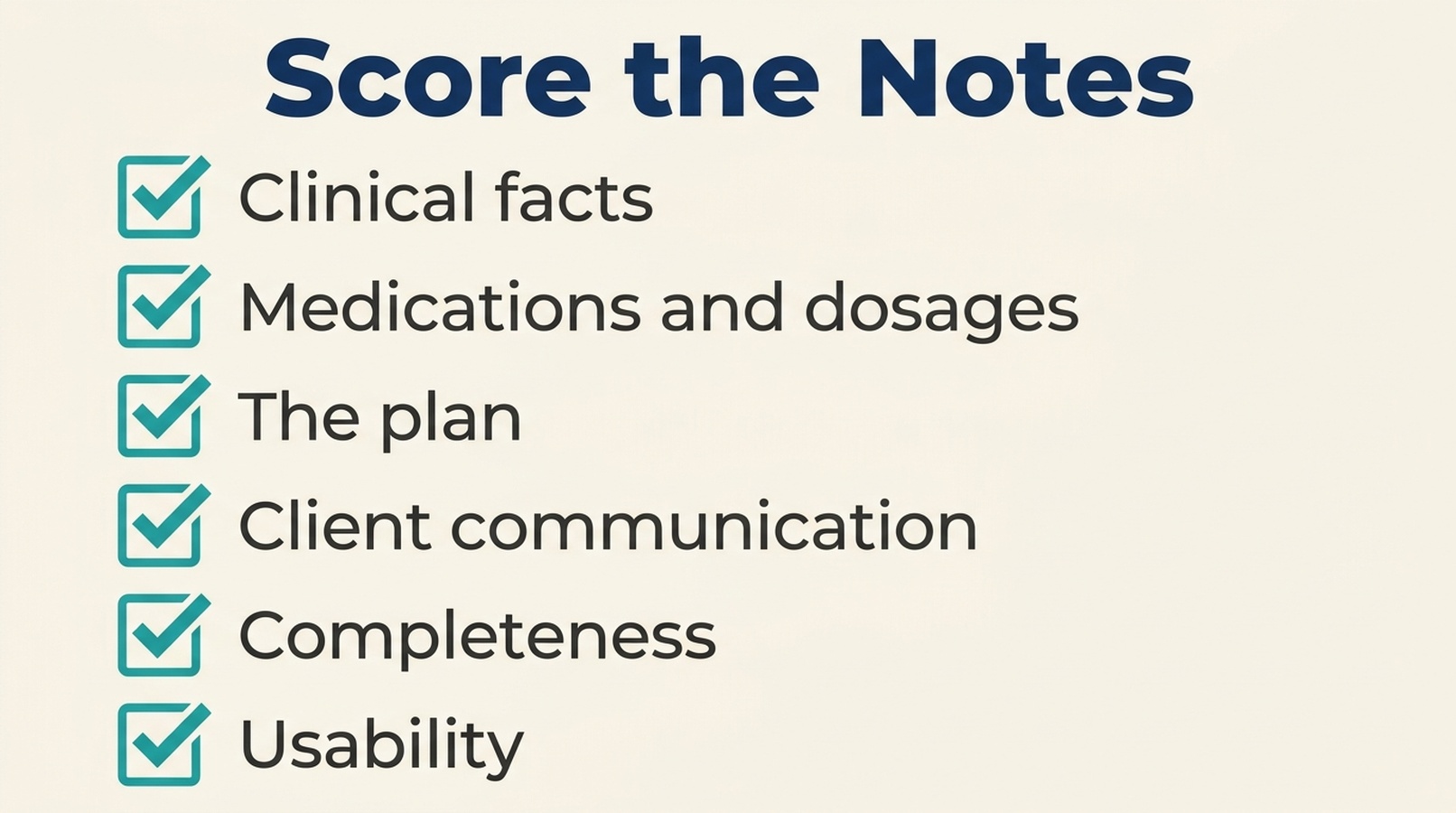
Score each dimension separately. A scribe can be strong on clinical facts and weak on medications, and that difference is what decides whether the workflow is safe.
Step 3: Confirm PIMS fit at the version and workflow level
A veterinary AI scribe is only useful if the note ends up where your team already works. That means the practice information management system, and it means the specific version and workflow your clinic runs.
What to ask about integration
- Which PIMS versions are supported? Veterinary PIMS platforms vary by version and by whether the clinic runs on-premise or cloud. A supported integration on one version may not exist on another.
- What does the integration actually do? Does it create a draft note, append to an existing record, or require a copy-paste step? The difference determines whether the scribe saves time or adds a step.
- Where does the note land in the record? In the right section, or in a generic notes field that nobody reads?
- What happens when the PIMS updates? Ask how the integration is maintained and what the failure looks like.
- Can you export the notes if you leave? Ask before you adopt, not after.
A vendor that cannot answer these clearly is asking your clinic to be the integration test.
Test the workflow, not just the integration
An integration can work technically and still fail operationally. Watch what the workflow actually looks like:
- Who starts the recording, and when?
- Where does the draft note appear, and who reviews it?
- How long does review take compared to writing the note from scratch?
- What happens if the recording fails or the note is unusable?
That last question matters more than clinics expect. Every scribe will occasionally produce a note that needs to be rewritten. The workflow needs a path for that, and the path should not be "start over at 6pm."
Step 4: Settle the consent question before the first recording
This is the step that is easiest to defer and hardest to fix later. Recording a veterinary consultation captures the client's voice, and often their personal circumstances along with the animal's medical information.
What to decide
- How will clients be told? A sign at the front desk, a line in the intake form, a verbal notice at the start of the visit, or some combination.
- What happens if a client objects? There needs to be a clear alternative, and staff need to know it exists.
- Who is responsible for the notice? If it is everyone's job, it is nobody's job.
- How long are recordings kept, and who can access them? Ask the vendor for the retention terms and confirm they match your practice policy.
- Does the vendor use recordings to improve the model? Get the answer in writing.
Why this is a practice decision, not a software setting
Veterinary regulation varies by jurisdiction, and the requirements for recording a consultation are not the same everywhere. That is exactly why the decision belongs to the practice, with whatever professional or legal input is appropriate for your location, rather than to a default setting in a tool.
The practical version: decide your notice and consent approach before the trial starts, write it down, and make sure every staff member who starts a recording knows it. A scribe that produces excellent notes but creates an unresolved consent question has not solved a problem. It has traded one for another.
A trial that answers the real questions
Run the trial in one clinic, with one or two veterinarians, for two to four weeks.
Before the trial: record your baseline. Minutes per visit spent on notes, and how often notes are finished after hours.
During the trial: use the test set from Step 2 in the first week. Score the notes. Then move to live visits with the consent process in place.
At the end: compare against the baseline, and review the test set scores again. If the note quality is not acceptable on your complex cases, the time savings do not matter, because someone will be spending that time fixing notes.
Where clinics get this wrong
Evaluating on demo cases instead of their own. A scribe tested on routine wellness visits tells you nothing about how it handles your complex medical cases.
Skipping the baseline. Without a before number, the trial becomes a preference test and the time-savings claim goes unchallenged.
Ignoring medication accuracy. This is the highest-risk category and deserves its own scoring, not a general "accuracy looks good" verdict.
Assuming the integration works because the logo is on the website. Test it with your PIMS version and your workflow.
Deferring the consent question. Decide the notice and consent approach before the first recording, not after a client asks.
Removing human review because the notes look good. The review step is what makes the workflow defensible. A scribe that removes it is increasing risk, not reducing work.
A note on where to look
The hard part of this process is that vendor pages describe capabilities and leave the verifiable details in places that are hard to compare. Accuracy claims are measured differently by every vendor, and integration statements rarely specify versions.
GetVetAtlas is a directory of AI tools for veterinary practices where every listing carries a dated evidence record: what the vendor claims, what is publicly verifiable, and when it was last checked. If you are building a shortlist of scribes, it is a faster starting point than opening vendor sites one at a time, and it separates the claims from the facts.
FAQ
Are veterinary AI scribes accurate enough to use without review?
No. Even a strong scribe should have a human review step, particularly for medications, dosages, and the treatment plan. The review is what makes the note defensible.
Do veterinary AI scribes work with my PIMS?
It depends on the specific PIMS, version, and integration. Ask for supported versions and the exact integration behavior, then test it with your own configuration before committing.
Do I need client consent to record a veterinary consultation?
Requirements vary by jurisdiction, and the decision belongs to the practice with appropriate professional or legal input. Decide your notice and consent approach before the first recording and make sure staff know it.
How long should a veterinary AI scribe trial run?
Two to four weeks, in one clinic, with one or two veterinarians. Test complex cases in the first week, then move to live visits once the consent process is in place.
What should I measure during the trial?
Minutes per visit spent on notes, how often notes are finished after hours, and note quality on your own complex cases. Measure the first two before the trial starts.
What is the biggest risk with a veterinary AI scribe?
Medication and dosage errors, because they are the hardest to catch and the most consequential. Score them separately from general note quality.
Can a small clinic use an AI scribe, or is it only for large practices?
Small clinics often benefit most, because the documentation load is concentrated in fewer people. The constraints are usually budget, PIMS compatibility, and the time to run a proper trial.
Author: Iris Campbell, Editorial Evidence Analyst, 2,500+ Sources Reviewed at Auspia. Iris writes about source analysis, evidence quality, and how teams separate vendor claims from verifiable facts.