

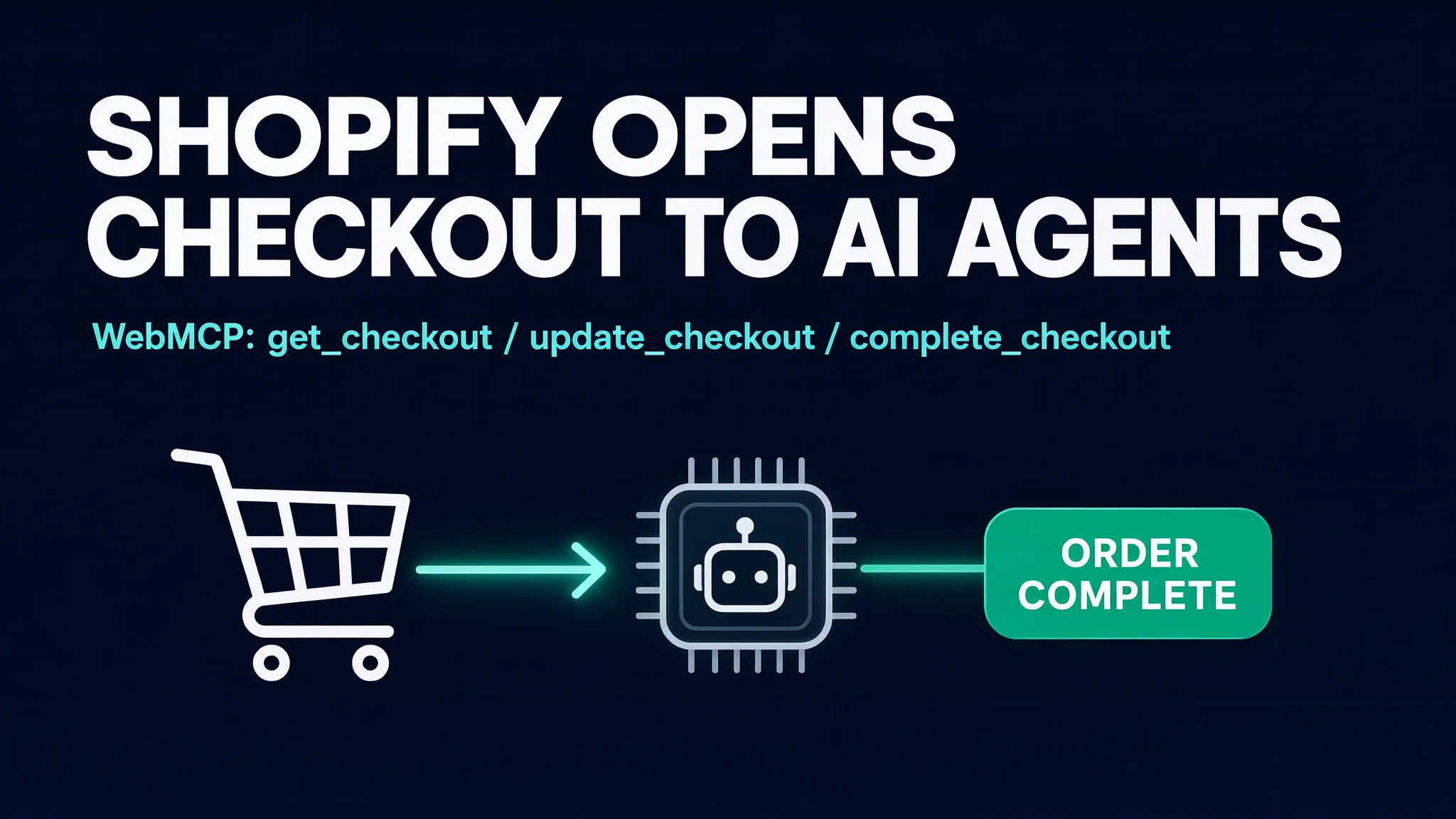
On September 28, 2026, Shopify expanded its WebMCP support to checkout. Browser-based AI agents can now read an active checkout, update permitted order details, and complete a purchase once the buyer authorizes it. TechCrunch reported the change the same day, and it moves agentic commerce past the point most retailers were preparing for: an agent can now finish the transaction, not just recommend the product.
That single shift changes what "ecommerce SEO" has to deliver. If an agent can read your product data, compare it, and complete a purchase on your store, then the question is no longer only whether you rank or get recommended. It is whether your store gives an agent enough machine-readable, unambiguous information to choose you and close the order without a human stepping in to interpret a marketing page.
What changed
Shopify's WebMCP support previously let compatible agents search a merchant's inventory, identify products, and add items to a cart. The September 28 update extends that to the checkout itself. According to TechCrunch and Shopify's developer documentation, the new capability exposes three checkout tools to browser-based agents:
Tool | What the agent can do | Human still controls |
|---|---|---|
| Read the current checkout state: line items, totals, shipping options, and buyer details already entered | Nothing is changed; this is read-only |
| Change permitted order details, such as the shipping address or delivery option | The buyer set the permission scope |
| Submit the order once the buyer authorizes it | Final authorization is required before the purchase goes through |
The important design choice is the interface. Instead of forcing an agent to interpret screenshots or scrape a rendered page, WebMCP gives compatible agents structured access to actions the store makes available. That is a meaningful difference for reliability: an agent calling get_checkout gets a defined response, while an agent guessing at a checkout page can misread a total or miss a shipping option.
Shop Pay is included in the supported flow, which matters because it is the payment method most likely to already be saved for a returning buyer. The capability is rolling out to eligible merchants rather than every store at once, so availability depends on your setup.
What the evidence shows
Three things are well established from the launch, and worth separating from speculation.
First, the buyer stays in the loop. Every account of the update, including TechCrunch's, describes authorization as a required step before the purchase completes. This is not an agent spending money unsupervised; it is an agent doing the mechanical work of checkout and stopping for a human yes.
Second, the tools are explicit and named. get_checkout, update_checkout, and complete_checkout are documented capabilities, not a general "let the agent browse" permission. That specificity is what makes the feature auditable, and it is the pattern other platforms are likely to copy.
Third, this is a direction, not a finished standard. WebMCP is an emerging interface, Shopify is one of several commerce platforms experimenting with agent access, and the rollout is limited to eligible merchants. Treat the launch as a clear signal of where checkout is heading rather than a feature every store can switch on today.
Why this matters for visibility
For years, ecommerce SEO optimized for a human scanning a results page and a product page. Agentic commerce adds a second reader: a program that needs facts, not persuasion. When that program can complete a purchase, the cost of ambiguous data goes up sharply.
Consider what an agent has to resolve before it buys. It needs a price that is current, not a "from $X" teaser. It needs availability it can trust, not a badge that may be stale. It needs shipping cost and delivery time in a form it can compare against a competitor. It needs a returns policy it can quote back to the buyer. If any of those live only inside an image, a video, or a paragraph of brand copy, the agent either works harder or moves to a store where the answer is machine-readable.
This is the same logic that already governs AI answer visibility, applied to transactions. Structured product data stops being a rich-result enhancement and becomes purchase infrastructure. A page that an agent can read cleanly is a page an agent can buy from.
What is still uncertain
Be careful not to overstate what shipped.
The rollout is limited to eligible merchants, and Shopify has not published a universal availability date. The exact permission model — what an agent may change without a fresh confirmation, and how a buyer revokes access — will matter as much as the tools themselves, and it is still settling. WebMCP is not yet a cross-platform standard, so an agent that works with Shopify checkout may behave differently on another commerce stack.
There is also an open question about measurement. Most analytics stacks attribute a sale to a session, a click, or a channel. An agent-completed purchase may not look like any of those, which means the traffic and conversion reports retailers trust today may undercount or misattribute agent-driven revenue. Until attribution catches up, expect a gap between what happened and what your dashboard shows.
What teams should do this week
You do not need to wait for full availability to get ready. The work that makes a store agent-ready is the same work that improves AI answer visibility, so it pays off either way.
Audit where your critical facts live. Walk your top product and checkout pages and list every fact an agent needs to complete a purchase: price, currency, availability, shipping cost and speed, taxes, returns, and warranty. Mark each one as "machine-readable" or "buried." The buried list is your backlog.
Complete your structured product data. Make sure Product and Offer markup carries current price, currency, availability, and condition, and that it matches what the page shows. Mismatched structured data is worse than none, because it teaches an agent to distrust you.
Check entity consistency across surfaces. An agent resolving "which store is this?" compares your product page, your listings, and third-party profiles. Same name, same facts, same claims everywhere, or the agent hedges toward a store it can verify.
Instrument the new path. Add a way to detect agent-driven sessions and completed orders, even crudely, so you can see the trend before your standard attribution catches up. A simple server-side marker on the checkout tools is a reasonable start.
Write for the agent and the human. Keep the persuasive copy that converts people, and add the clean, structured facts that let a program act. The two are not in conflict; the stores that win will do both.
Metrics to watch
Track four numbers over the next quarter. The share of product-page sessions that look non-human or agent-like. The rate at which those sessions reach checkout. The completion rate of agent-initiated checkouts versus human ones. And the gap between orders recorded in your commerce backend and orders attributed in analytics — that gap is your first, rough measure of agent-driven revenue.
If you sell on Shopify and want the broader picture of how AI surfaces are reshaping product discovery, the same evidence base shows up in how AI search citation sources differ by industry and in the agent content audit routine that checks what agents can read on your site.
Auspia view
Shopify's checkout update is the clearest signal yet that agentic commerce has moved from a demo to a transaction. The retailers who benefit will not be the ones with the loudest product pages. They will be the ones whose facts are so clean, current, and consistent that an agent can act on them without a human in the middle. That is a data-quality problem wearing an SEO costume, and it is worth starting on this week.
FAQ
Can an AI agent buy from my Shopify store without my customer approving?
No. Every description of the update, including TechCrunch's, states that the buyer must authorize the purchase before complete_checkout submits the order. The agent handles the mechanical steps; the human gives the final yes.
Does this replace my product page copy?
No. Human-readable copy still converts human buyers. WebMCP adds a machine-readable layer so agents can read the same facts. The stores that do well will keep both.
Is WebMCP available on every Shopify store now?
No. The checkout capability is rolling out to eligible merchants. Check your store's setup and Shopify's developer documentation for current availability.
What is the single highest-impact fix?
Make sure your price, availability, shipping, and returns facts exist as structured data and match the visible page. That is the data an agent needs to complete a purchase, and it is the most common gap.
Author: Eva Laurent, Ecommerce Search Strategist for 10k+ Product Pages at Auspia. Eva writes about ecommerce SEO, product discovery, and how AI agents change the way stores get chosen.