

On October 15, 2026, Google announced the most significant redesign of links inside AI Overviews and AI Mode to date. In a post titled "More ways to connect with the web from Search," Hema Budaraju, VP of Product Management for Search, laid out five changes that together push more links into AI answers, place them higher on the screen, and make them visually more clickable. Nick Fox followed up on X with a headline number: the number of people using Preferred Sources to choose the sites they want to hear from has grown 7x since the beginning of the year.
The announcement reads as good news for publishers. But there is a catch that Search Engine Roundtable's Barry Schwartz flagged the same day: Google is redesigning the exit doors of AI answers while still refusing to show anyone the exit counts. AI performance reports in Search Console still report impressions only, no click data, roughly five months after they launched.
Here is what changed, the pattern behind it, and what it rewards.
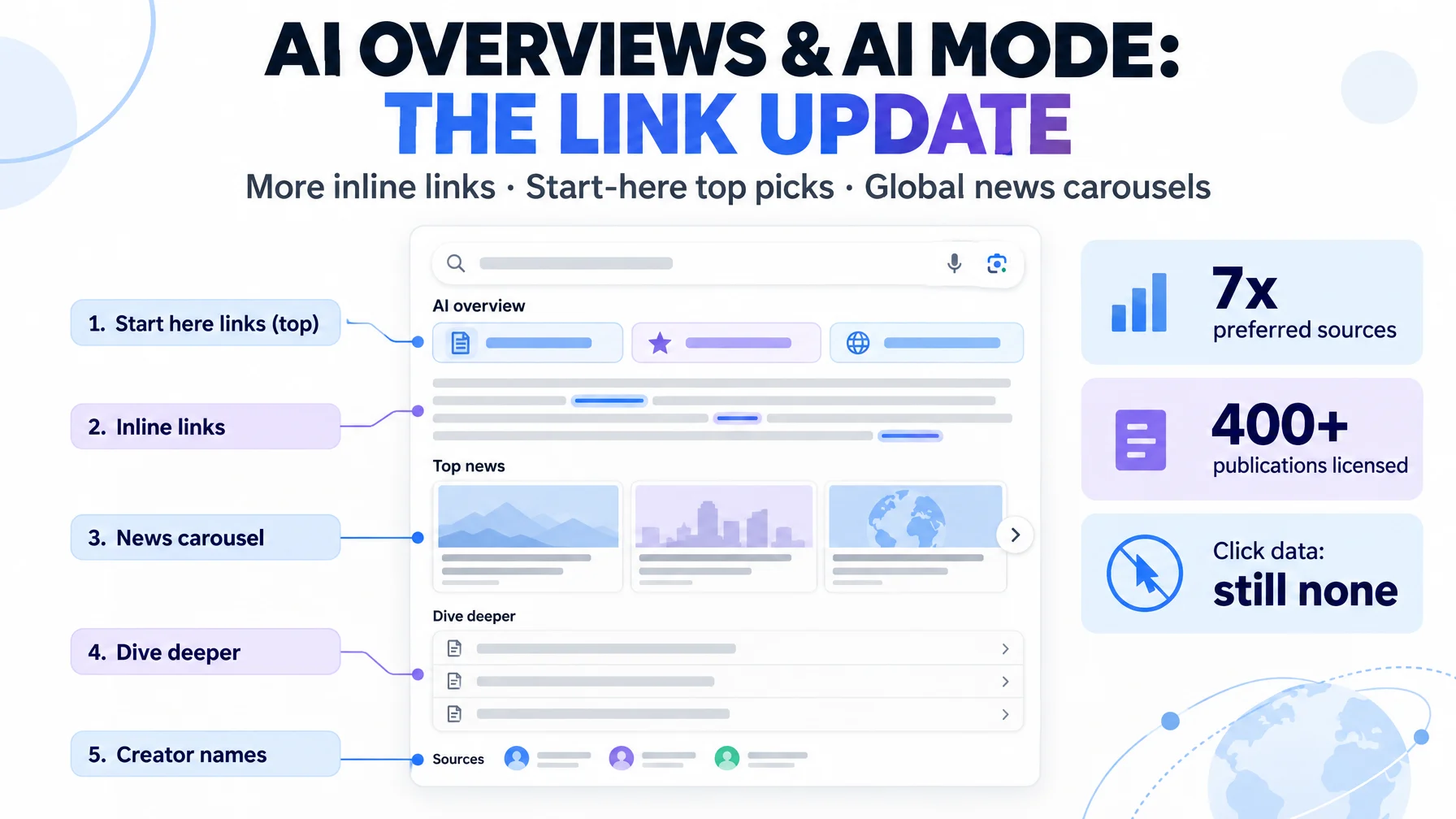
An AI response now has up to five link zones
Reading the update top to bottom, an AI Overviews or AI Mode response now contains up to five distinct places a link can appear:
Link zone | What it looks like | Status |
|---|---|---|
"Start here" top section | One or two links to "the right web page" for a task, with a note on why each link is useful | New, in test |
Inline links | Links embedded on phrases inside the answer text, now shown higher up more frequently | Expanded |
News carousel | A horizontal strip of timely articles, including your Preferred Sources | Expanding globally |
"Dive deeper" related links | Related articles at the end of the response, now with image thumbnails and a more clickable design | Redesigned |
Creator and publisher names | Video results where the creator's name is clickable and routes to their Search profile | New, in test |
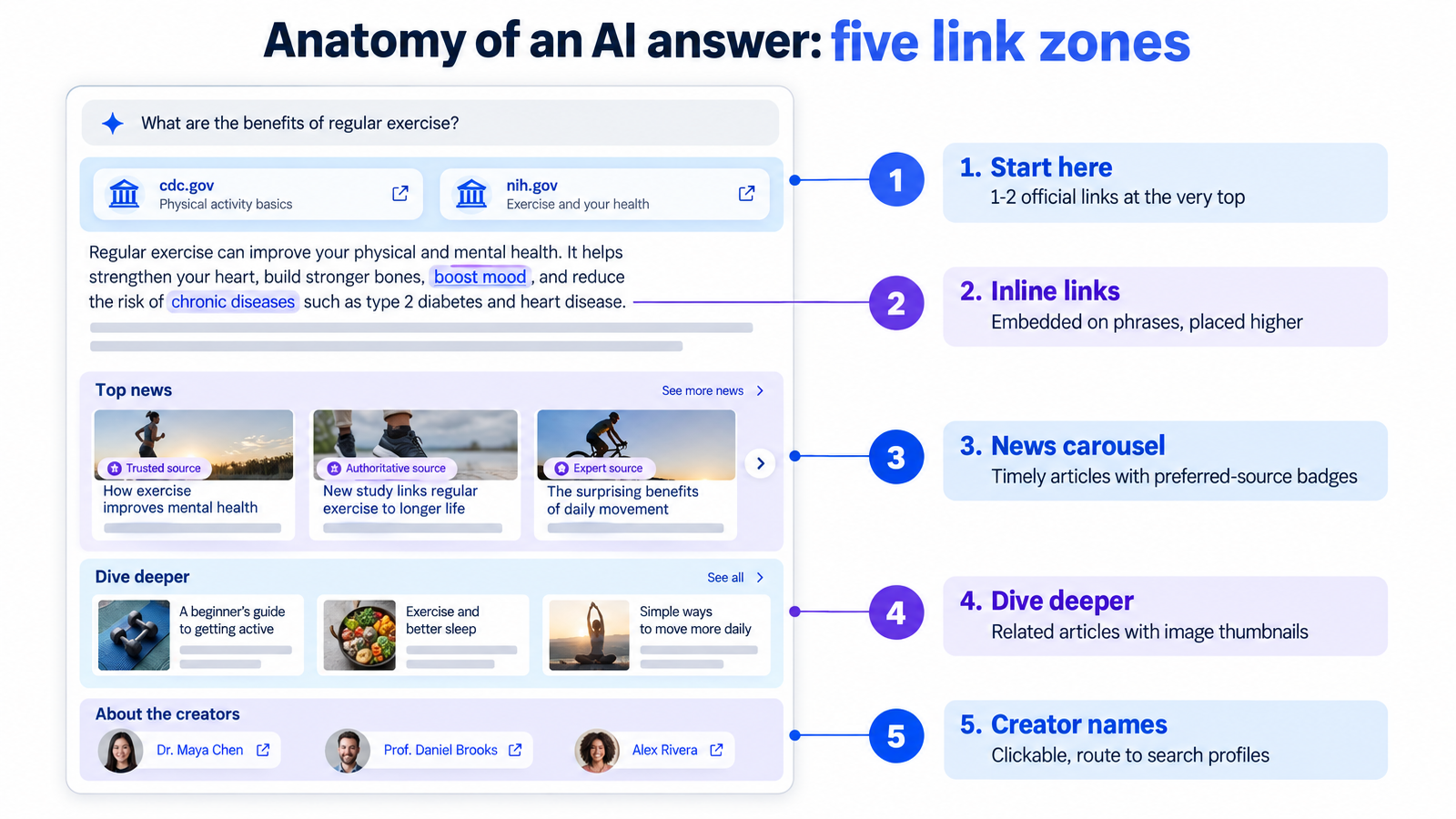
The five link zones of an AI Overviews or AI Mode response after the October 15 update.
Two of these deserve the most attention. The top "start here" section is the boldest: for queries where Google judges that one or two "official places on the web" are enough to complete a task, those links now sit above the AI summary itself. That is position zero of an AI answer. There are only one or two slots, and Google decides who fills them.
The inline link expansion matters because of volume. Google says it has seen "continued and substantial increases to the presence of inline links" and will now place them higher in responses more frequently. Inline links are the hardest to earn and the hardest to track, because the citation is attached to a single passage rather than a whole page.
This is the third link redesign of 2026, not the first
The October 15 update did not arrive in a vacuum. Through 2026, Google has been running a slow arc of pulling links back into AI answers after a year of complaints that AI Mode and AI Overviews were link deserts.
Date | Change |
|---|---|
March 2026 | Industry analysis reports that links inside AI surfaces drive less than 1% of search traffic |
May 6, 2026 | Google makes links in AI Mode and AI Overviews "more direct," adding link cards |
May 18, 2026 | Data collection begins for Search Console's generative AI performance reports |
June 3, 2026 | AI performance reports launch: impressions, pages, countries. No clicks |
June 2026 | Google gives publishers an opt-out from AI Mode and AI Overviews |
September 30, 2026 | Reporting on a Google pilot paying roughly 100 publishers for content used in AI answers |
October 15, 2026 | This update: more inline links, higher placement, "start here" section, global carousels |
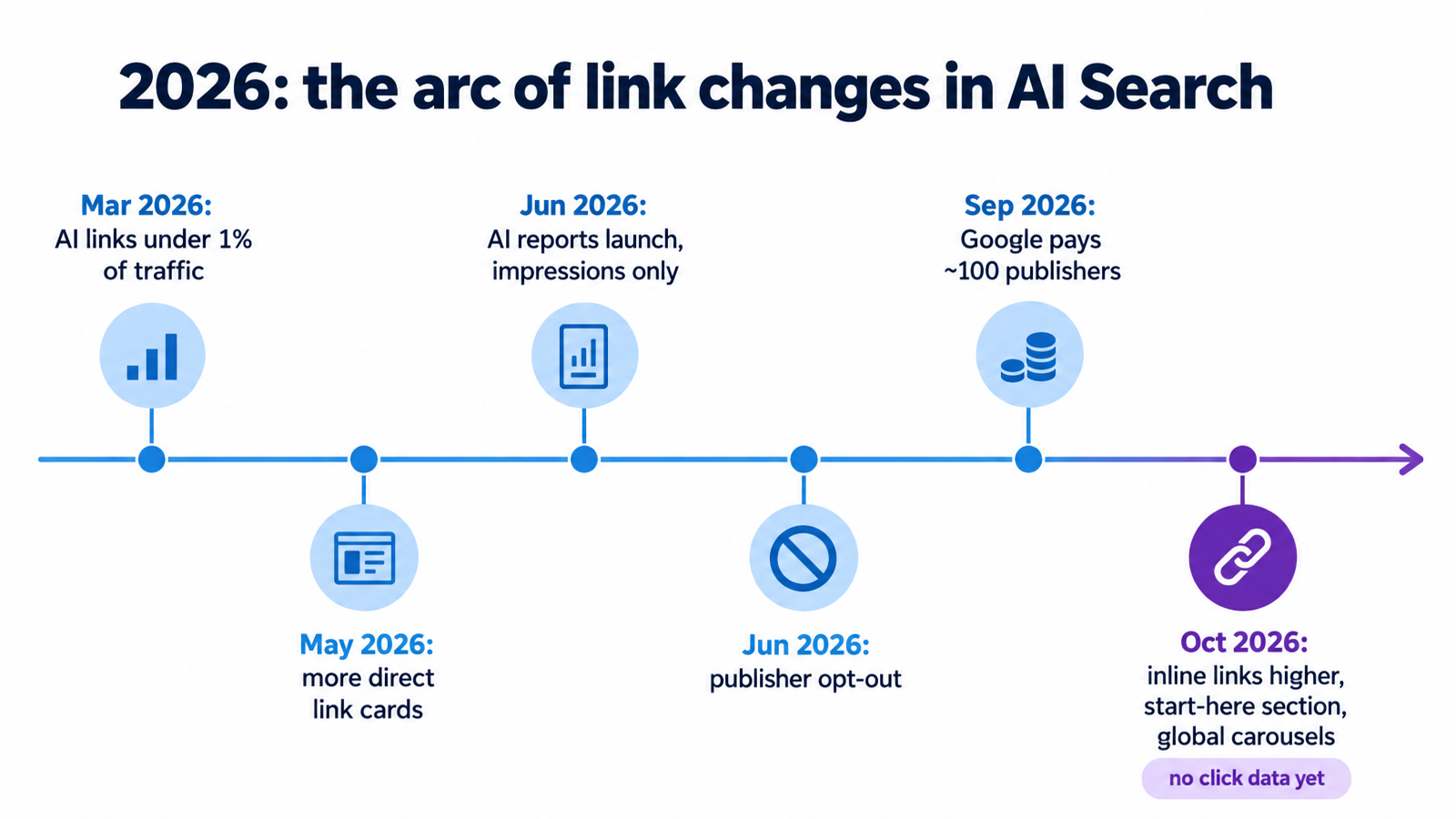
The 2026 arc: Google has been re-inserting links into AI answers all year, with click data still missing.
Two other numbers from Fox's post give the arc its context. Preferred Sources, the feature that lets users pin the sites they trust, has grown 7x this year, and Google's News AI pilot licensing program, where Google pays publishers for enhanced content used in AI features, now covers more than 400 publications worldwide. Links, licensing, and user-curated source preference are converging into one system: Google is rebuilding the economics of being cited, on its own terms.
What the update actually rewards
Each of the five zones has a different selection logic, so the update does not reward one kind of site. It rewards four different kinds of visibility at once.
The one or two "official" destinations. The new top section is a navigational judgment call, not a content quality score. Google is asking which web page is the single most direct place to complete the task, the way it already surfaces official site links for navigational queries. The winners are pages that are unambiguous about what they do: a task-completion page that needs no interpretation, backed by clear entity signals about who operates it. This is winner-take-most. Being the second-best source is a cliff, not a podium.
Passage-level citability. More inline links higher up means Google is attaching individual passages to individual phrases in the answer. Pages written so that a specific, self-contained claim can be lifted with its named entities, numbers, and dates attached have a better chance of being the phrase that gets linked. Whole-page authority helps you get into the answer; passage clarity helps you get the link inside it.
Freshness with a source badge. The news carousels going global, and surfacing Preferred Sources inside them, extend a pattern from earlier in the year: Google has reported that sources selected as preferred get clicked roughly twice as often. Timely coverage in your niche, a valid news sitemap, and giving readers a reason to pin you are the inputs. The 7x growth in Preferred Sources usage says users actually use the curation layer once they discover it.
Identity, not just URLs. Clickable creator names in video results route to Search Profiles first, not to the creator's site. That detail did not escape publishers: one widely shared reaction noted that "publishers create the information, Google summarizes it, keeps the user inside its own experience, and then decides when the original source deserves a click." Whatever the criticism, the direction is clear. Google is treating the person or brand behind the content as a first-class search entity, and a profile that presents your broader work is now part of the citation surface. We covered how Google Search Profiles work in more depth earlier this year.
The catch: Google still won't show you the clicks
The structural problem is measurement. When Search Console's AI performance reports launched in June 2026, they shipped with impressions, pages, countries, and devices, but no clicks. Asked about click data again after this update, Google gave the same answer it has given all year: "We're continuing to work with website owners to understand what insights will be most helpful to inform their strategies, and we'll introduce additional metrics over time."
Schwartz's critique is blunt and, on the commercial logic, hard to argue with: clicks are the metric website owners want most, and it is "the number one metric for Google Ads." The asymmetry is the point. Google can measure exactly how many clicks this redesign produces and can tell us the answer is encouraging. Publishers cannot verify anything, because their reports stop at impressions. Until click data exists in AI performance reports, every claim about the update helping publishers is unauditable.
The surrounding numbers do not settle it either. Industry measurements through 2026 have put zero-click behavior on Google searches at roughly two-thirds of queries, and AI Overviews now trigger on around half of US queries, with organic click-through rates dropping sharply when they appear. A redesign that places more links higher in AI answers could claw some of that back. Nobody outside Google can currently prove or disprove it.
Practically, that leaves teams measuring by proxy. Since Search Console folds AI-generated surface clicks into regular web totals rather than reporting them separately, the workable proxies are before-and-after windows on the specific pages you expect to be cited, server-log referrer analysis, and third-party citation tracking on your highest-value prompts. It is imperfect, but an imperfect denominator beats a missing one.
What to do this week
Treat the update as a checklist of citation surfaces to audit, in priority order:
- Pick your "start here" pages. For each task-intent query you care about, identify the single most direct page on your site that completes it. If that page needs two clicks of navigation to reach the answer, fix that first. This section is a test now, but it defines the ceiling for the whole update.
- Rewrite your best passages as linkable claims. Take your top pages and check whether each key claim carries its own numbers, dates, and named entities in one or two sentences. Inline links attach to passages, not to titles.
- Check your news sitemap and freshness pipeline if you publish in any timely vertical. Global carousels expand the pool of queries that can surface your articles, and Preferred Sources get highlighted inside them.
- Put the Preferred Sources button in front of your audience. A 7x increase in usage means the selection behavior exists; your job is to be one of the selected. An embedded button on your site is the direct prompt.
- Claim your Search profile if you publish video or are an eligible creator or publisher, and make sure its linked work matches the topics you want to be cited for.
- Set your measurement window. Snapshot your citation presence and referral baselines now, before the rollout fully lands, so the before-and-after comparison is clean.
Auspia take
The real story of October 15 is not that Google added links. It is that links in AI answers are becoming a formal, layered currency: a curated top slot, paid placement through licensing, user-preference badges, and an identity layer, all with no click-level public accounting. Google is building the exchange while keeping the ledger private.
Our read for growth teams: stop thinking of AI Overviews and AI Mode as a traffic channel you optimize into, and start thinking of them as a citation market with four distinct instruments. Optimize for the instrument you can win. If you are the canonical way to complete a task, chase the top section. If you are a niche publisher, chase inline passages and Preferred Sources. And build your own measurement stack now, because the reporting layer is the last thing Google will fix.
FAQ
Are AI Overview and AI Mode clicks shown in Search Console? No. The AI performance reports that launched in June 2026 show impressions, pages, countries, and devices, but no click data. Clicks from AI surfaces have been folded into regular web search totals rather than reported separately, so there is currently no dedicated click count for AI Overviews or AI Mode.
How do I appear in the new "start here" section at the top of an AI response? Google is testing this for queries where it judges that one or two "official places on the web" are enough to complete the task. Your best shot is being the most direct, unambiguous task-completion page for that query, with clear entity signals identifying who you are. There are only one or two slots, so this is about being the obvious destination, not one option among many.
Does the global news carousel require anything special from my site? The carousels surface timely articles and highlight users' Preferred Sources. Eligibility mirrors Top Stories mechanics: a valid news sitemap, timely coverage, and the source-quality signals that already govern news surfaces. The new variable is source selection, since users who pinned you as a Preferred Source will see you highlighted inside carousels.
What are Preferred Sources, and is it worth promoting them? Preferred Sources is a Search setting that lets users pick sites they want to hear from; selected sites get a badge and heightened placement in AI Overviews, AI Mode, and now news carousels. Google says usage has grown 7x this year and that preferred sources get clicked roughly twice as often. An embeddable button exists for publishers, and adding it to your site is currently the only direct way to influence it.
Author: Adrian Cole, Analyst of 1,000+ AI Search Results at Auspia. Adrian studies how brands appear and get cited across Google AI Overviews, AI Mode, ChatGPT, Perplexity, and Gemini, and writes about the measurement gaps in between.