


On October 13, 2026, Shopify published developer tools that open its catalog of more than a billion product listings to any AI agent. Agents can now search the catalog, complete authenticated purchases through Shop Pay, and manage orders without a negotiated partnership with Shopify. Shoppers configure their agents with rules such as budget guardrails and shipping filters, and the buyer approves each individual purchase. That takes agentic commerce from a pile of one-off deals to something closer to default infrastructure. Product discovery inside an AI chat is now a catalog-data problem, and every merchant owns it.
What Shopify shipped on October 13
The Verge reported the launch on Tuesday. Shopify's developer documentation lists three capabilities now open to any agent builder:
Capability | What it means in practice |
|---|---|
Catalog search | Any agent can query Shopify's product catalog, covering over a billion listings, and return results inside its own interface |
Shop Pay checkout | The agent completes an authenticated purchase without sending the shopper to the merchant's storefront |
Order management | The agent can handle post-purchase actions such as order lookup |
Shopper-side rules | Shoppers give agents budget guardrails and filters, for example only showing results that ship fast |
Per-purchase approval | Shopify will not let agents buy without what it calls final human review: the buyer confirms every purchase |
Two things did not change, and both matter. First, agents still cannot buy on their own. The approval step is built in, not optional. Second, the developer documentation does not say how agent-driven orders show up in merchant analytics, so a sale that starts inside an agent chat may simply land in your direct traffic.
The access model is the real shift. Until now, agent distribution was negotiated one partnership at a time. Meta's Muse agent reached Shopify merchants by default in September; the OpenAI and Perplexity integrations came through individual deals. Amazon has taken the opposite path, blocking outside agents while building its own. Shopify is now making its merchant catalog reachable by anything that implements the protocol.
How a shopper-configured agent purchase works
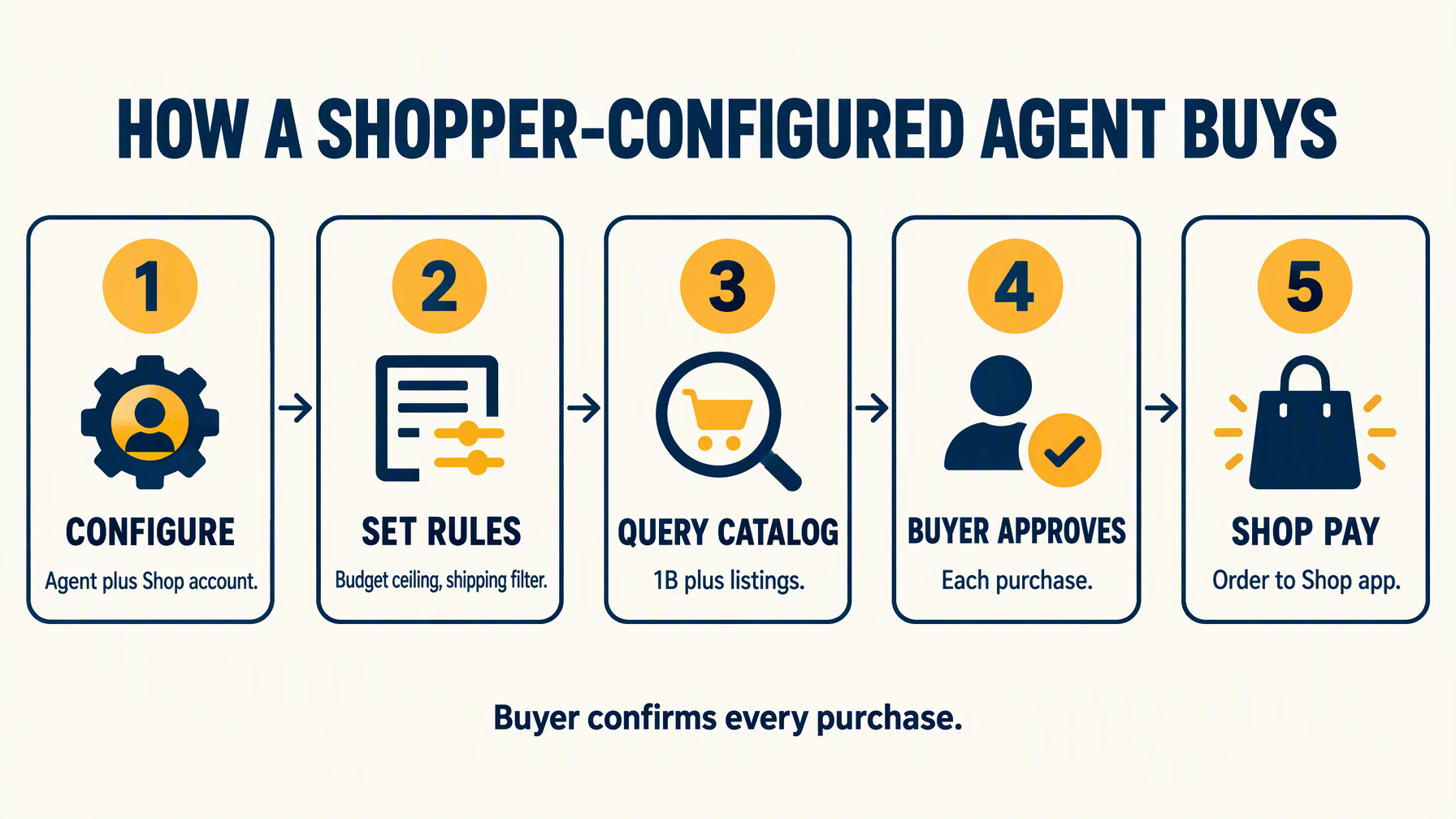
The flow Shopify published puts the shopper, not the platform, in charge of the agent's instructions:
- The shopper connects an AI agent to their Shop account.
- The shopper sets the rules: a budget ceiling, a shipping-speed filter, or both.
- The agent queries the catalog and presents results in its own interface.
- The shopper approves the specific purchase.
- Checkout completes through one-tap Shop Pay, and the order flows back to the shopper's Shop app and the merchant's admin.
Shopify frames this as a personal shopping assistant: an agent that knows your budget, your delivery window, and your taste, then shops a catalog of a billion-plus listings. The merchant never chose this channel. The shopper did.
The three controls that decide which products agents sell
The guardrails look like shopper protections, and they are. Read them from the merchant side, though: each one turns a marketing variable into a filter the agent can apply before a product ever appears.
Budget guardrails turn price into a hard gate. Tell an agent to stay under a ceiling, and products priced above it never make the list. Price stops being persuasion. It becomes eligibility.
Shipping filters turn delivery speed into a listing field. If a shopper's agent is set to show only fast-shipping results, a product whose feed never states shipping speed is invisible to that query, no matter how good the product page looks.
Per-purchase approval sets where the competition actually happens. Because the buyer confirms every order, the agent's job is to build a shortlist, not to close a deal. Winning the shortlist is the whole game. A product that never makes the agent's top results has no conversion problem, because it has no traffic.
Why this is a distribution change, not a feature drop
The March 2026 Agentic Storefronts launch put Shopify merchants into specific destinations: ChatGPT, Microsoft Copilot, AI Mode in Google Search, and the Gemini app. That was distribution by agreement, channel by channel. The September browser-agent checkout work extended it to agents running inside a browser. October 13 removes the agreement layer. Any agent builder can now query the catalog, process a Shop Pay transaction, and handle order management.
Channel selection now sits with individual shoppers configuring their own agents, not with Shopify's business development team. Merchants no longer pick which AI surfaces to opt into. Surfaces pick merchants, and the sorting mechanism is catalog data: accurate prices, live inventory, correct variants, and shipping attributes a machine can read.
There is a measurement catch. Ecom Crew's analysis of the launch pointed out that an order completed inside an agent's interface may be recorded as direct traffic, or attributed to no acquisition source at all. If you have not recorded a baseline for agent-driven demand, the shift will look like noise when it starts.
Optimizing for humans and agents is becoming the same problem
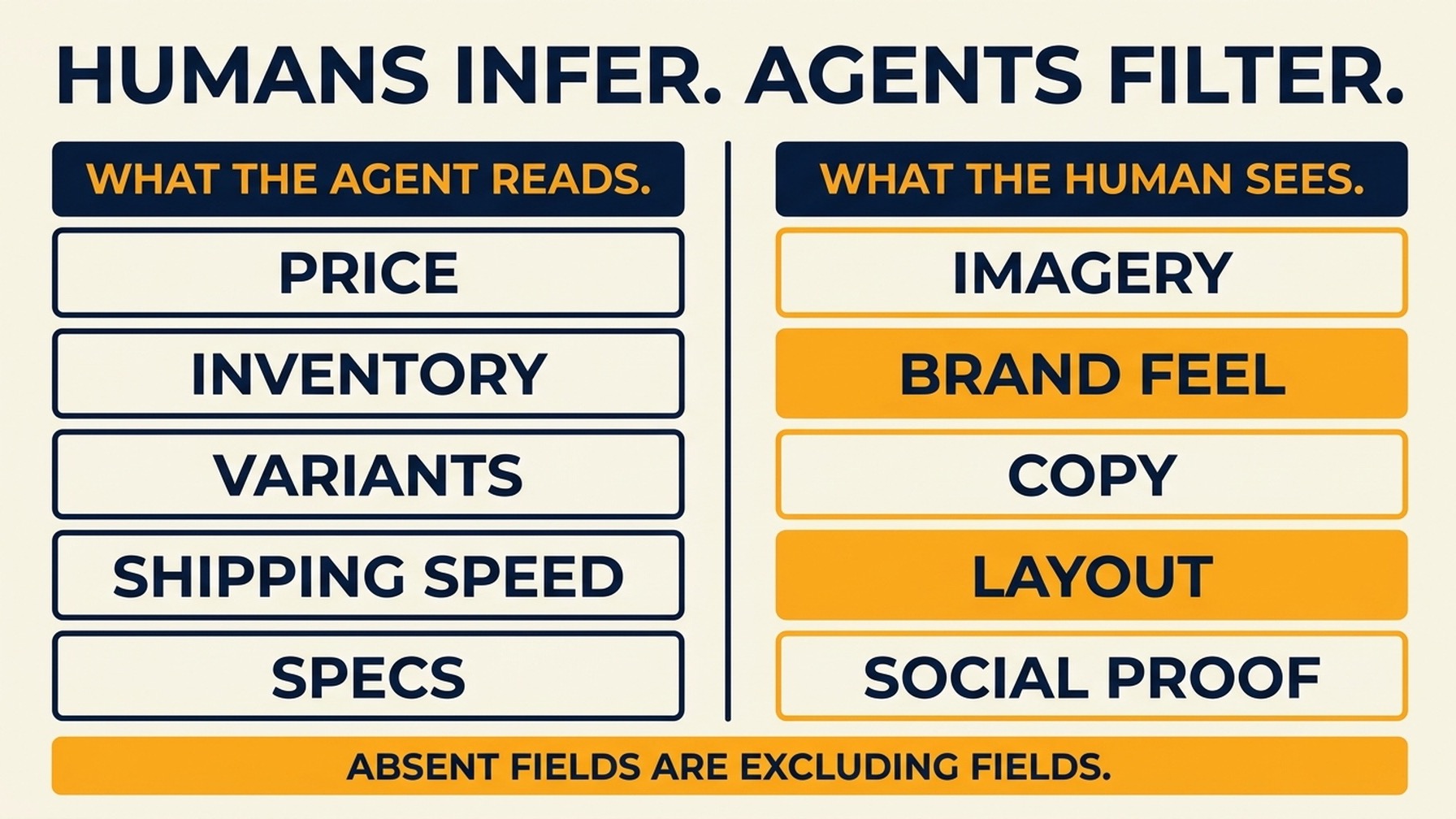
Here is the Auspia take. The guardrails are the tell. Budget ceilings and shipping filters show exactly what an agent can read, and what it can read is structured listing data. Variant accuracy is where agent shopping most commonly breaks, according to the Ecom Crew teardown. Prices need to be current. Inventory needs to be real. Shipping promises need to exist as fields, not as copy on a landing page.
None of that is a new discipline. It is the same work that made product pages convert for humans: honest pricing, accurate specs, clear availability, fast delivery. The difference is mechanical. A human visitor forgives a missing field and infers from your imagery and brand feel. An agent cannot infer. It reads fields, and absent fields are excluding fields.
That is why optimizing for humans and optimizing for agents are becoming the same job. The teams that win the agent shortlist will not be the ones running a separate "AI SEO" track. They will be the ones whose product data survives a machine audit, because that same data is what makes their human-facing pages trustworthy. The numbers already point that way: orders from AI-powered search on Shopify grew nearly 13 times in the first quarter of 2026, faster than any other channel Shopify tracks, according to PYMNTS coverage of the company's figures.
What to do this week
- Export your catalog feed and audit the fields an agent can filter on: price, inventory status, variant data, and shipping speed. Missing fields are the new 404s.
- Fix variant-level data first. It is the most commonly reported break point for agent shopping, and it corrupts everything downstream: price, availability, and the specific SKU the agent orders.
- Record a baseline of your direct-traffic orders now, so that agent-driven sales landing as "direct" later are visible as a shift rather than invisible as noise.
- Run one real agent query against your own category. Configure a budget ceiling and a shipping filter in an agent that supports Shopify catalog search, and check whether your products survive the shortlist.
- Score your site's agent readiness with the Agent Readiness Score, then fix the failures that affect transaction data before the ones that affect copy.
FAQ
Can an AI agent now buy from Shopify stores without the shopper's approval?
No. Shopify's position is that agents and bots cannot purchase on a user's behalf without final human review. The buyer approves each purchase before checkout completes through Shop Pay.
Which AI agents have access to the Shopify catalog?
Any builder that implements the developer tools published on October 13 can query the catalog and process Shop Pay transactions. Major surfaces already integrate through earlier arrangements: ChatGPT, Microsoft Copilot, AI Mode in Google Search, and the Gemini app since the March Agentic Storefronts launch, and Meta's Muse agent by default since September.
How is this different from what Shopify launched in March 2026?
March's Agentic Storefronts put merchants into specific AI destinations through negotiated integrations. The October launch opens the catalog to any agent without a partnership, and adds shopper-side controls: budget guardrails, shipping filters, and per-purchase approval. March was about which channels merchants reach. October is about who gets to shop them.
Author: Sophie Renard, AI Search Briefing Analyst at Auspia. Sophie tracks 30+ AI platforms and writes timely briefs on how search and discovery shifts affect growth teams.