The Goal Problem
Most SEO goals fail for the same reason: they target what is easy to measure instead of what actually matters. "Get to position 1 for [keyword]" is measurable. It is also irrelevant if that keyword does not convert, or if AI Overviews are intercepting the click even when you rank first.
In 2026, SEO goal-setting needs a rewrite. Rankings are less predictive of traffic than they were two years ago. Traffic is less predictive of revenue. And a new variable — AI visibility — has entered the equation without a standard way to measure it.
This framework moves from vanity metrics to business outcomes, with timelines, KPIs, and the AI dimension built in from the start.
Start Here: The Three Questions Every SEO Goal Must Answer
Before writing a single KPI, answer these:
- If this goal succeeds, what changes for the business? Not "traffic goes up." Revenue, leads, demos, patients, clients. Name the business outcome.
- How will we know it was SEO that did it? If you cannot attribute the outcome to SEO specifically, the goal is not an SEO goal — it is a business goal you hope SEO contributes to.
- What is the realistic timeline? Only 5.7% of new pages reach the top 10 within a year. If your goal assumes you will rank for competitive terms in 3 months, you have a timeline problem, not an SEO problem.
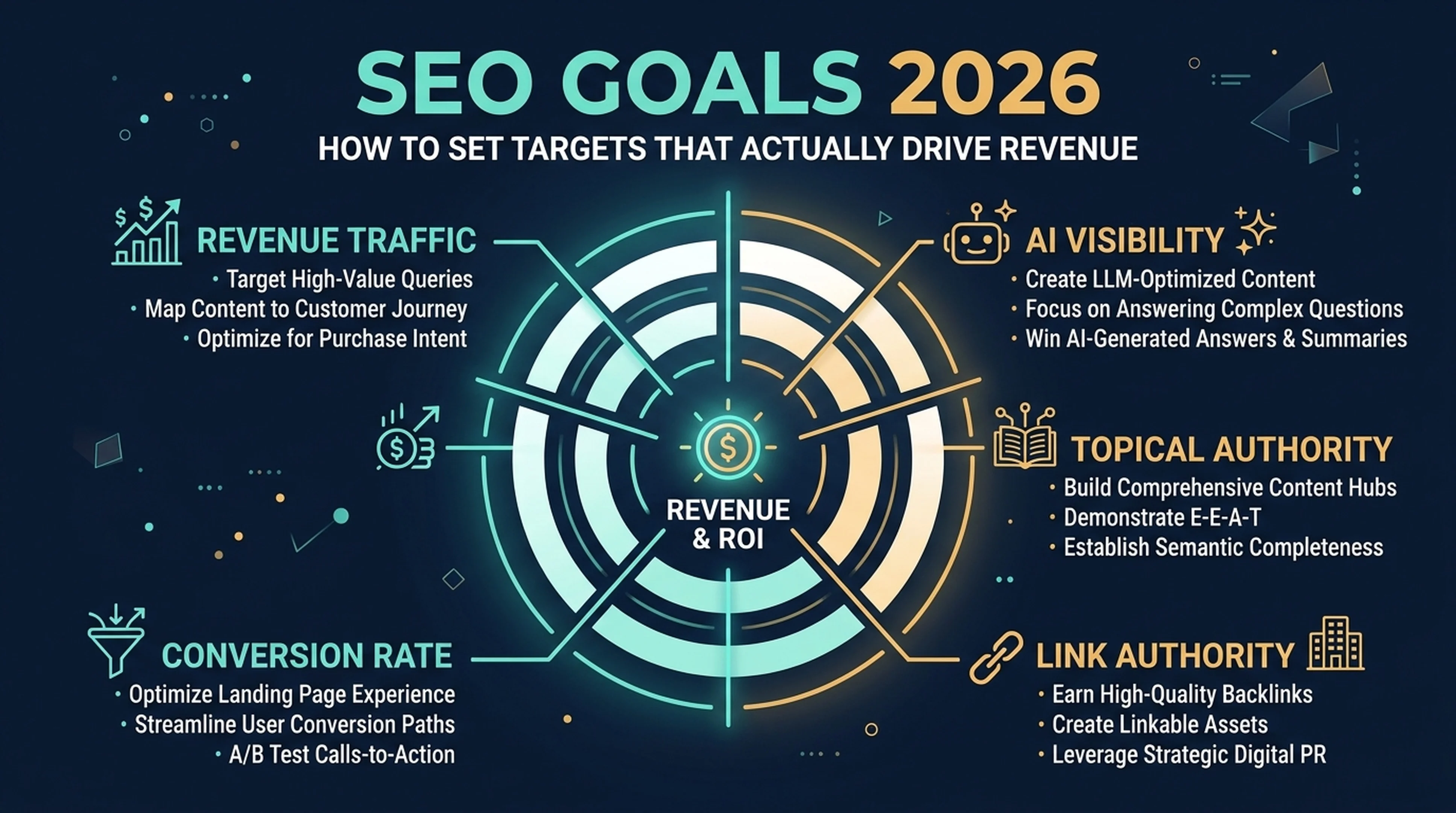
The 2026 SEO Goal Framework
Goal Type 1: Revenue-Attributed Organic Traffic
The old goal: "Increase organic traffic by 30%."
The 2026 version: "Increase organic traffic that converts into [demo requests / purchases / booked calls] by 25% in 12 months, measured by GA4 conversion paths with organic as the initiating channel."
Why the old version fails: Traffic without conversion is a cost center. In 2026, with AI Overviews absorbing informational clicks, raw traffic growth is harder and less meaningful. Traffic that converts is harder to grow but worth 10× more.
KPIs to track:
- Organic sessions → conversion event rate (by page type)
- Revenue per organic session (ecommerce) or pipeline value per session (B2B)
- Non-branded organic traffic share (should be 75%+ for healthy sites)
Realistic timeline: 6–12 months for meaningful conversion-attributed growth. 3–6 months for early signals.
Goal Type 2: AI Search Visibility
The new goal for 2026: "Appear as a cited source in AI Overviews, ChatGPT, or Perplexity for 10 priority buyer-intent queries within 6 months."
Why this matters now: AI Overviews appear on 15.69% of keywords — and 57.9% of question queries. Commercial keyword AIO presence surged 128% YoY. If your target keywords trigger AI Overviews, your traffic depends on being cited in them, not just ranking beneath them.
KPIs to track:
- AI Overview citation rate for target keywords (tracked via SEOquake or Minorank)
- Brand mention count in LLM answers (tracked via Respona or manual spot-checks)
- Referral traffic from chat.openai.com, perplexity.ai, gemini.google.com
Realistic timeline: 6–12 months. AI citation is slower to build than rankings and harder to measure. Start tracking now; expect results in 2026 Q3–Q4.
Goal Type 3: Topical Authority Coverage
The goal: "Achieve 90% content coverage of the [industry] topic cluster — every question a buyer asks during their evaluation is answered by a page on our site."
Why this works: The average top-10 page ranks for roughly 1,000 other keywords. Sites using topical clusters see 31% more organic sessions than those publishing isolated articles. Depth beats breadth.
KPIs to track:
- Number of keywords in positions 1–10 within the topic cluster (Ahrefs/Semrush)
- Number of cluster pages with ≥100 monthly organic clicks
- Internal link density within the cluster
Realistic timeline: 12–18 months for full cluster coverage. 6 months for initial cluster building with early ranking signals.
Goal Type 4: Conversion Rate from Organic Landing Pages
The goal: "Increase organic landing page conversion rate from 1.5% to 3% within 6 months by testing CTAs, social proof placement, and page structure on the 10 highest-traffic pages."
Why this is underrated: Doubling conversion rate has the same revenue impact as doubling traffic — but costs far less and is not dependent on Google. Most SEO teams obsess over traffic and ignore what happens after the click.
KPIs to track:
- Landing page conversion rate (organic segment, GA4)
- Bounce rate by landing page (below 60% is healthy for most content)
- Scroll depth / engagement time on top-10 organic landing pages
Realistic timeline: 3–6 months. CRO cycles faster than SEO — you can test and iterate monthly.
Goal Type 5: Link Authority Threshold
The goal: "Increase Domain Rating from 30 to 50 within 18 months by earning 15–20 editorial links per quarter from sites with DR 50+ in our industry."
Why DR matters (with a caveat): DR correlates with traffic but does not cause it. A DR 30 site with exceptional content can outrank a DR 70 site on specific topics. But crossing authority thresholds — DR 30 → 50, DR 50 → 70 — unlocks ranking potential for competitive terms that are inaccessible at lower authority levels.
KPIs to track:
- Referring domains (total and DR 50+)
- Links earned per quarter (not bought, not exchanged)
- DR trend (6-month view, not month-to-month)
Realistic timeline: 12–24 months. Authority building is the slowest SEO lever and the most durable.
How to Set Goals in the Right Order
You cannot do all five at once. Prioritize based on where your site is:
If your site is new (DR <20, <1 year old):
- Topical authority coverage (pick one cluster, go deep)
- Link authority threshold (start earning, don't buy)
- Revenue-attributed traffic (measure what you have)
If your site is established but underperforming (DR 20–50, inconsistent traffic):
- Conversion rate optimization (fix what is already getting traffic)
- Revenue-attributed traffic (connect existing traffic to revenue data)
- AI search visibility (start tracking, build for extractability)
If your site is mature (DR 50+, steady traffic):
- AI search visibility (you have the authority; now earn the citations)
- Revenue-attributed traffic (optimize the conversion path)
- Link authority threshold (push from 50 → 70)
The KPIs to Stop Tracking in 2026
Some metrics are still widely used but no longer useful for decision-making:
"Keyword rankings" as a primary KPI. Rankings fluctuate. A page can rank #1 and get zero clicks if an AI Overview sits above it. Track rankings as a diagnostic, not a goal.
"Total backlinks." One editorial link from a DR 70 site in your industry is worth more than 1,000 directory submissions. Track referring domains and link quality, not raw link count.
"Domain Authority" as a standalone target. DA is a third-party estimate, not a Google metric. It is useful for competitive benchmarking, not as a goal. "Increase DA from 30 to 50" is a vanity goal. "Earn 60 editorial links from industry-relevant DR 50+ sites" is a real one.
"Time on page." High time on page can mean deep engagement or deep confusion. Track conversions and scroll depth instead.
The 90-Day Goal-Setting Sprint
Use this sequence to set and validate goals without spending weeks in planning meetings:
Week 1: Audit. Pull 12 months of GSC data. Identify: which pages get traffic, which pages convert, which keywords trigger AI Overviews, and where your DR sits relative to competitors ranking above you.
Week 2: Set 3 goals maximum. One traffic/revenue goal, one authority/coverage goal, one AI visibility goal. More than three goals means nothing gets done.
Week 3: Assign ownership and build the measurement dashboard. Each goal gets one owner, one dashboard (Looker Studio or equivalent), and one check-in cadence (weekly for CRO, monthly for authority, quarterly for AI visibility).
Weeks 4–12: Execute. Review monthly. Do not change goals mid-quarter unless the data shows the goal was wrong. Changing goals every month is the fastest way to achieve none of them.
FAQ
How do I set realistic SEO goals?
Start with your current data, not aspirational benchmarks. If your site gets 5,000 organic clicks/month, a realistic 12-month goal is 7,500–10,000 (50–100% growth), not 50,000. Match your goal to your DR, industry, and timeline — the benchmarks in the tables above give you a starting point.
How long does it take to achieve SEO goals?
Short-term (CRO, technical fixes): 3–6 months. Medium-term (content-driven traffic growth, topical authority): 6–18 months. Long-term (link authority, competitive keyword rankings): 12–24 months. If a provider promises faster, ask for case studies with real traffic data.
Should I include AI visibility in my SEO goals?
Yes, starting now — even if you only track it without optimizing for it yet. AI Overview presence on commercial keywords grew 128% YoY. If your target keywords are informational or question-based, AI visibility will directly affect your organic traffic. Start tracking. Optimize when you have 3 months of baseline data.
What is a good SEO goal for a small business?
For a local business: "Increase Google Business Profile-driven calls/directions by 30% in 12 months." For a B2B company: "Generate 20 qualified demo requests per month from organic search within 9 months." Tie the goal to revenue, not rankings.
Author: Marcus Ellery, Growth Experimenter Behind 150+ SEO Tests at Auspia. Marcus writes about SEO strategy, measurement frameworks, and how to set goals that survive contact with real data.