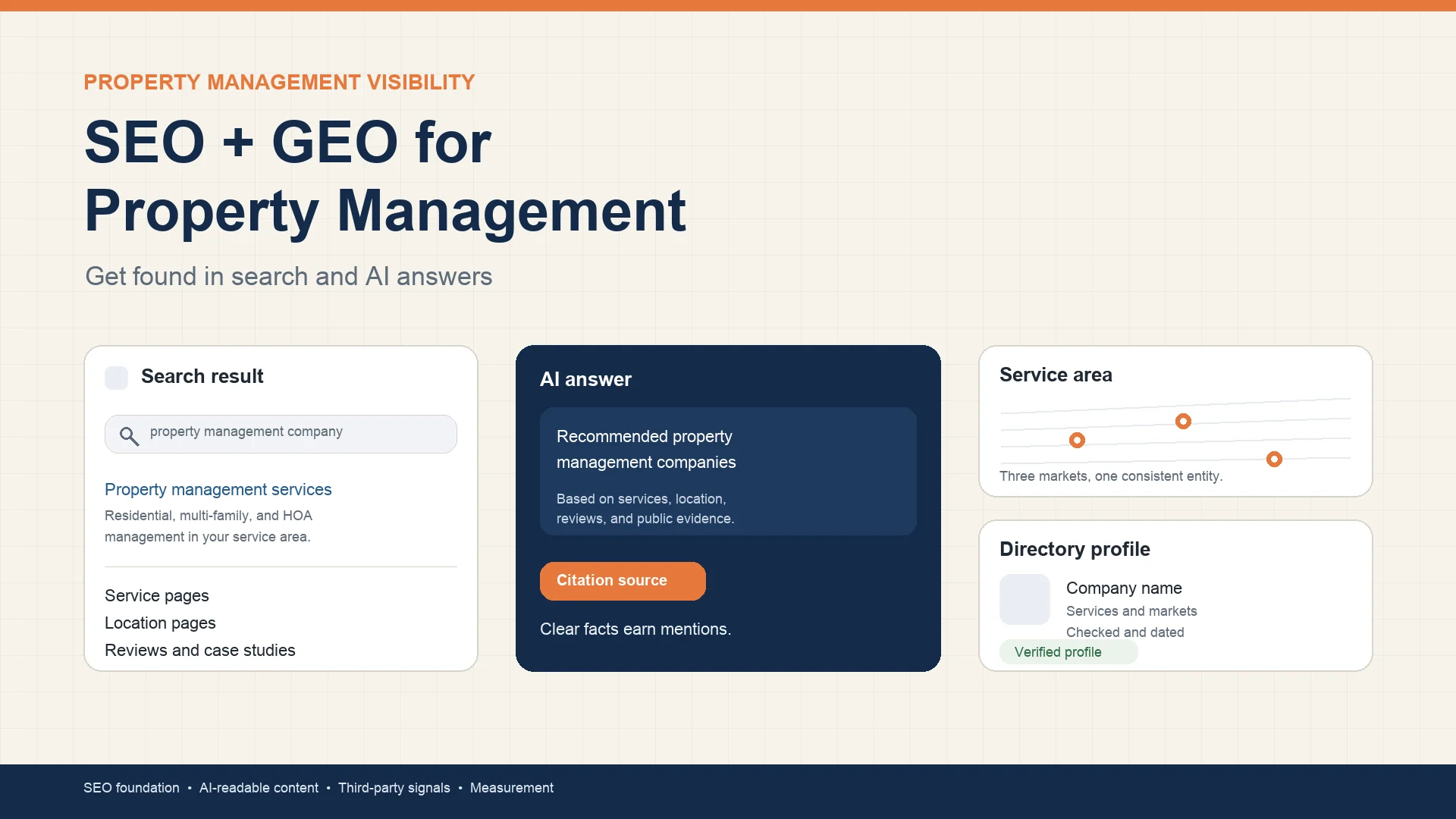
Property management companies improve SEO and GEO by making three things clear: what they manage, where they operate, and why they are credible. Traditional search engines reward that clarity through relevant pages, links, and local signals. AI systems use much of the same evidence, but they also look for consistent facts across the web before they repeat a company name in an answer.
That difference matters because a property management company can rank well on Google and still be absent from an AI-generated recommendation. The website may be technically sound. The problem is usually that the company's services, service areas, and proof points are scattered across pages, profiles, and directories that do not tell the same story.
Short answer: Build clear service, location, and property-type pages. Keep the company's name, service area, and credentials consistent everywhere. Add direct answers to the questions owners and boards ask. Then support those claims with reviews, case studies, association profiles, and relevant directories.
This guide covers the practical work: the pages to build, the entity signals to clean up, the third-party references that support trust, and a simple way to measure whether the effort is working.
Why property management SEO is different
Property management is not a single service with a single audience. A company may manage single-family rentals for out-of-state investors, handle maintenance for a small apartment portfolio, support an HOA board, and market commercial space. Each of those services attracts a different search query and a different decision process.
The search intent is also more local than it first appears. Someone searching for "property management services" may be comparing national companies, but someone searching for "property management company in Scottsdale for single-family rentals" is much closer to a decision. AI systems tend to break that second query into smaller questions: Does the company operate in Scottsdale? Does it manage single-family homes? Does it handle maintenance? Does it have reviews or case evidence that support those claims?
A generic services page rarely answers those questions well. It may mention property management, leasing, and maintenance, but it does not give a search engine or an AI system enough structure to confirm the company's actual scope.
The practical response is to organize the site around the way people search:
- Service intent: what the company does
- Property type: what it manages
- Location: where it operates
- Operating model: how it handles leasing, maintenance, accounting, and communication
- Evidence: reviews, case studies, licenses, and third-party references
When those five areas are clear, both traditional search and AI search have less work to do.
Build the SEO foundation first
GEO does not replace SEO. If the site is difficult to crawl, slow, or thin on useful information, AI visibility work will not fix the underlying problem. Start with the pages that answer the most important commercial questions.
Service pages
Create a dedicated page for each service the company actually sells. Common examples include:
- Residential property management
- Commercial property management
- HOA management
- Multi-family property management
- Short-term rental management
- Maintenance coordination
- Leasing and tenant placement
- Property accounting and reporting
Each page should explain who the service is for, what is included, what is not included, how pricing works, and what the owner or board should expect. A page that only lists features gives the reader no reason to trust the company and gives an AI system little to quote.
Location pages
Location pages should not be copies of the same text with a different city name. They should explain the local operating reality: the property types common in that market, local regulations, typical maintenance issues, seasonal demand, and the company's actual coverage area.
A useful location page might answer:
- Which cities and neighborhoods does the company serve?
- What property types does it manage there?
- Are there local licensing or HOA requirements?
- How does the company handle maintenance in that area?
- Are there local case studies or owner testimonials?
If the company serves several markets, each page should have a reason to exist. Thin location pages can create more problems than they solve.
Property type pages
Property type pages help match the company to specific searches. A single-family rental owner, an HOA board, and a commercial property investor do not evaluate property management the same way.
Useful property type pages include:
- Single-family rental management
- Condo and townhome management
- Apartment and multi-family management
- HOA and community association management
- Commercial property management
- Short-term rental management
These pages should connect back to the relevant service pages and location pages. Internal links help readers move through the site and help search systems understand the relationship between the topics.
Trust pages
Trust pages are often treated as an afterthought, but they carry a disproportionate amount of weight in property management. The decision involves someone's property, income, tenants, and legal obligations.
The core trust pages include:
- About the company
- Team and leadership
- Licenses and credentials
- Service areas
- Reviews and testimonials
- Case studies
- Contact information
- Privacy and data handling policies
The goal is not to claim expertise. The goal is to make the company's expertise verifiable.
Content that answers real owner questions
A property management blog should not exist just to publish keyword-focused articles. It should answer the questions owners, investors, and boards ask before, during, and after a management agreement.
Examples include:
- How much should a property management company charge?
- What should an owner look for in a management agreement?
- How are maintenance requests handled after hours?
- How does a property manager handle evictions?
- What reports should an owner receive each month?
- How does property management work for out-of-state investors?
- What should an HOA board expect from a management company?
These articles create useful entry points for search and give AI systems clear, quotable explanations.
Make the website easier for AI to understand
GEO is often described as a new set of tricks. In practice, most of the work is clearer communication. AI systems need to identify the company, understand what it offers, and find enough corroborating information to treat those claims as reliable.
Clarify the company entity
Every page should reinforce the same basic facts:
- Legal company name
- Brand name
- Service areas
- Property types managed
- Contact information
- Licenses and credentials
- Key people
Inconsistencies create uncertainty. If the website says the company serves the Phoenix metro area, a directory lists only Scottsdale, and a social profile says Arizona and Nevada, an AI system has to guess which version is correct. That guessing reduces the chance of a confident recommendation.
An entity page or a well-structured About page can help. It should state the company's scope in plain language rather than relying on marketing phrases such as "full-service solutions."
Write answer blocks, not just paragraphs
AI answers tend to pull from passages that answer a question directly. Property management websites can make that easier by adding short, clear answer blocks near the top of relevant pages.
For example:
What does a property management company do?
A property management company handles the day-to-day operation of a rental property on behalf of the owner. That typically includes tenant screening, leasing, rent collection, maintenance coordination, accounting, and compliance with local regulations.
How much do property management companies charge?
Most property management companies charge a percentage of monthly rent, often between 8% and 12%, plus leasing or renewal fees. Some companies also charge a setup fee, maintenance markup, or additional fee for project coordination.
What property types do you manage?
This company manages single-family rentals, small multi-family properties, and HOAs in the Phoenix metropolitan area.
These blocks are not a replacement for detailed content. They give readers a fast answer and give AI systems a clean passage to work with.
Use structure that matches the question
Clear headings, tables, lists, and FAQs make content easier to scan and easier to extract. A page that explains fee structures should use a table. A page that compares property types should use a comparison section. A page that explains a process should use numbered steps.
Structure is not decoration. It is part of how the information is understood.
Explain the operating model
Property management companies often compete on the same generic promises: communication, technology, and results. Those words do not differentiate one company from another, and they do not give an AI system much to work with.
A stronger approach is to explain how the company actually operates:
- How are maintenance requests triaged?
- Who handles after-hours emergencies?
- How often are owner statements issued?
- How are tenants screened?
- How are lease renewals handled?
- What software does the company use?
- How does the company communicate with owners and residents?
Specific operating details make the company easier to evaluate and easier to describe accurately in an AI answer.
Strengthen third-party signals
Search engines and AI systems rarely rely on a company's website alone. They look for independent evidence that supports the company's claims. For property management companies, that evidence often comes from directories, association pages, reviews, partner sites, and industry publications.
A consistent third-party presence helps confirm:
- The company's legal and brand name
- The services it provides
- The markets it serves
- The property types it manages
- The software and systems it works with
- The experience of its clients
This is also where a relevant industry directory can help. If your company also provides property management technology or AI-enabled services, a directory such as PropAtlas can help clarify how your product fits specific property management systems and portfolio sizes.
Directory submission is not a shortcut to rankings. It is part of a broader effort to make the company's public record consistent and verifiable. The same principle applies to association memberships, vendor profiles, local business listings, and partner pages.
A few practical rules:
- Use the same company name, address, and phone number everywhere.
- Write a specific description instead of copying a generic tagline.
- Choose directories that are relevant to property management or the company's local market.
- Keep profiles updated when services or service areas change.
- Avoid low-quality directories that exist only to sell links.
The goal is not to appear everywhere. The goal is to appear accurately in the places that matter.
Measure visibility in search and AI answers
SEO measurement is familiar: rankings, impressions, clicks, and conversions. GEO measurement is less standardized, but it is still possible to track whether the company is being mentioned and cited in AI-generated answers.
Start with a small set of prompts that reflect real buyer questions:
- Best property management companies in [city]
- Property management companies for HOAs in [city]
- Multi-family property management services in [state]
- Property management company for single-family rentals
- Commercial property management companies near me
- How much do property management companies charge in [city]
Run those prompts across the platforms that matter to the company's audience. Depending on the market, that may include ChatGPT, Perplexity, Gemini, Google AI Overviews, and Bing Copilot.
For each prompt, record:
- Whether the company is mentioned
- Whether the company is linked or cited
- Which competitors appear
- Which sources the AI system relies on
- Whether the answer contains incorrect information
Repeat the process monthly. AI answers change, and a single check is not enough to show a trend.
Traditional search data still matters. Google Search Console and Bing Webmaster Tools can show which queries and pages are earning impressions. If a page has impressions but few clicks, the issue may be the title or description. If a service page gets no impressions at all, the problem may be targeting, internal linking, or indexation.
A practical 30-day plan
A property management company does not need to rebuild its entire website to improve search and AI visibility. It needs to fix the highest-impact gaps first.
Week 1: Audit the basics
- List every service the company offers.
- List every market and property type it serves.
- Check whether each service has a dedicated page.
- Check whether each location page contains genuinely local information.
- Confirm that the company name, address, phone number, and service areas are consistent across the site.
Week 2: Improve the content
- Add a short answer block to each core service page.
- Add an FAQ section to the pages that attract the most questions.
- Explain pricing, maintenance, communication, and reporting in plain language.
- Add internal links between service, location, and property type pages.
- Replace generic claims with specific operating details.
Week 3: Strengthen third-party signals
- Update the company's Google Business Profile.
- Review relevant industry and local directories.
- Check association and partner profiles for outdated information.
- Ask satisfied owners or boards for reviews.
- Publish a case study that explains the problem, the work, and the outcome.
Week 4: Measure and refine
- Run the AI prompt set across the relevant platforms.
- Record mentions, citations, and missing information.
- Review Search Console and Bing Webmaster Tools for query and page performance.
- Identify the pages that need stronger evidence or clearer answers.
- Set a monthly review cadence.
What to avoid
Property management SEO and GEO attract a lot of bad advice. A few common mistakes are worth avoiding.
Do not create dozens of near-duplicate city pages. Do not stuff service keywords into every paragraph. Do not publish AI-generated articles that repeat the same generic advice without adding local or operational knowledge. Do not assume that a directory listing or a schema tag will automatically produce AI visibility.
The strongest signal is still a clear, useful website supported by consistent public evidence.
Frequently asked questions
How long does property management SEO take?
Most companies see early improvements in impressions and local visibility within a few months, but competitive service and location terms can take longer. AI visibility tends to move more slowly because it depends on third-party evidence as well as the website.
Does GEO replace SEO for property management companies?
No. GEO builds on the same foundation. If the site is not crawlable, useful, and well structured, AI systems are less likely to understand or cite it. SEO and GEO should be treated as one visibility program with different measurement layers.
Do property management companies need a blog?
A blog can help if it answers real owner, investor, or board questions. It is less useful when it publishes generic articles that do not connect to the company's services or markets. A smaller library of useful guides is usually better than a large library of thin posts.
How do I check whether AI systems mention my company?
Run a consistent set of buyer-intent prompts across the AI platforms your audience uses. Record whether your company appears, which competitors appear, and which sources are cited. Repeat the checks monthly and look for patterns rather than reacting to a single answer.
Are directories still useful for SEO?
Relevant, well-maintained directories can support entity clarity and discovery. Low-quality directories that exist only to sell links are not worth the effort. The most useful directories are the ones that accurately describe the company and are relevant to its industry or market.
Author: Hannah Pierce, 12-Year B2B SEO Growth Practitioner at Auspia. Hannah writes about B2B search strategy, buyer journeys, and practical growth systems for service companies.