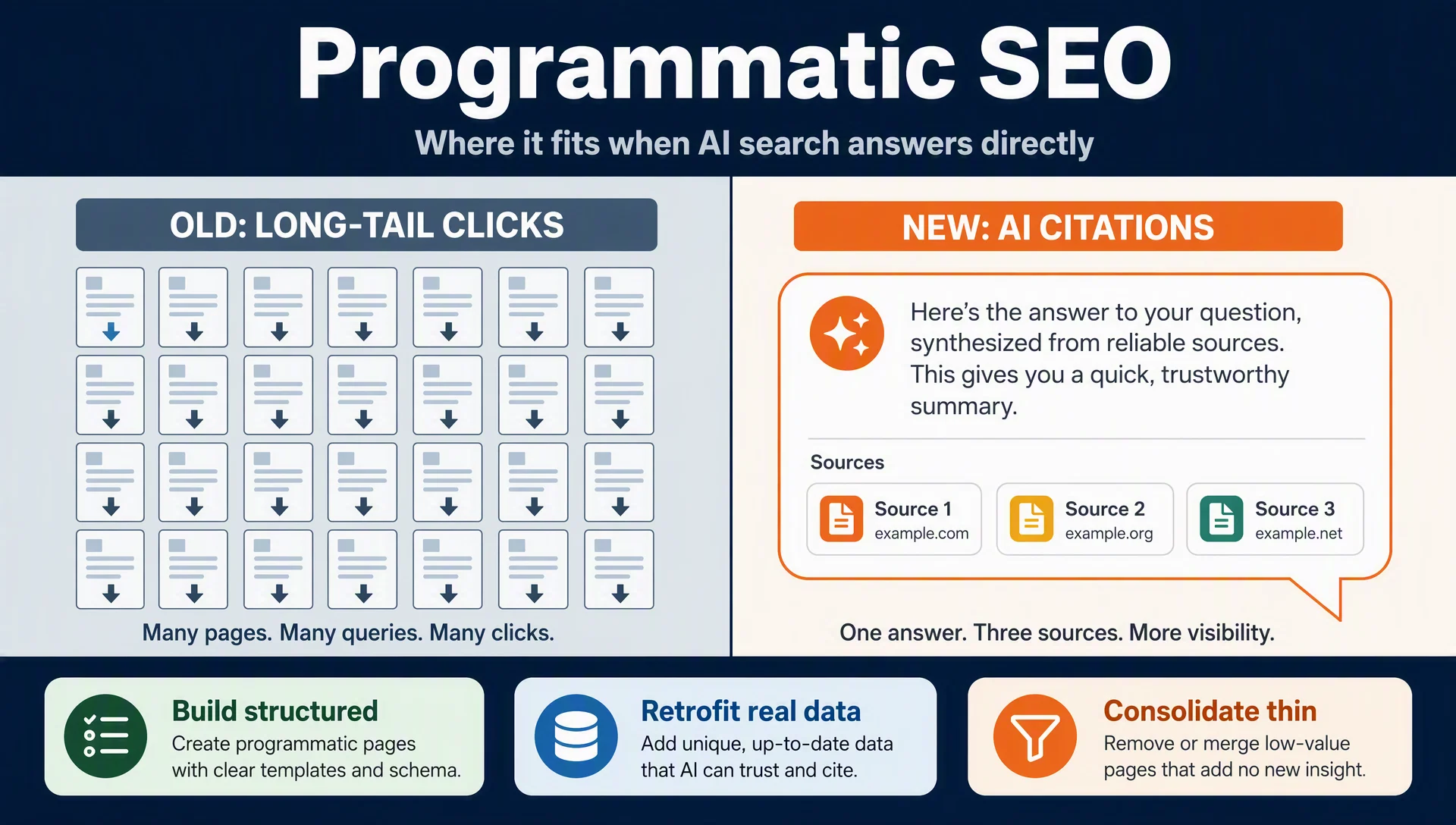
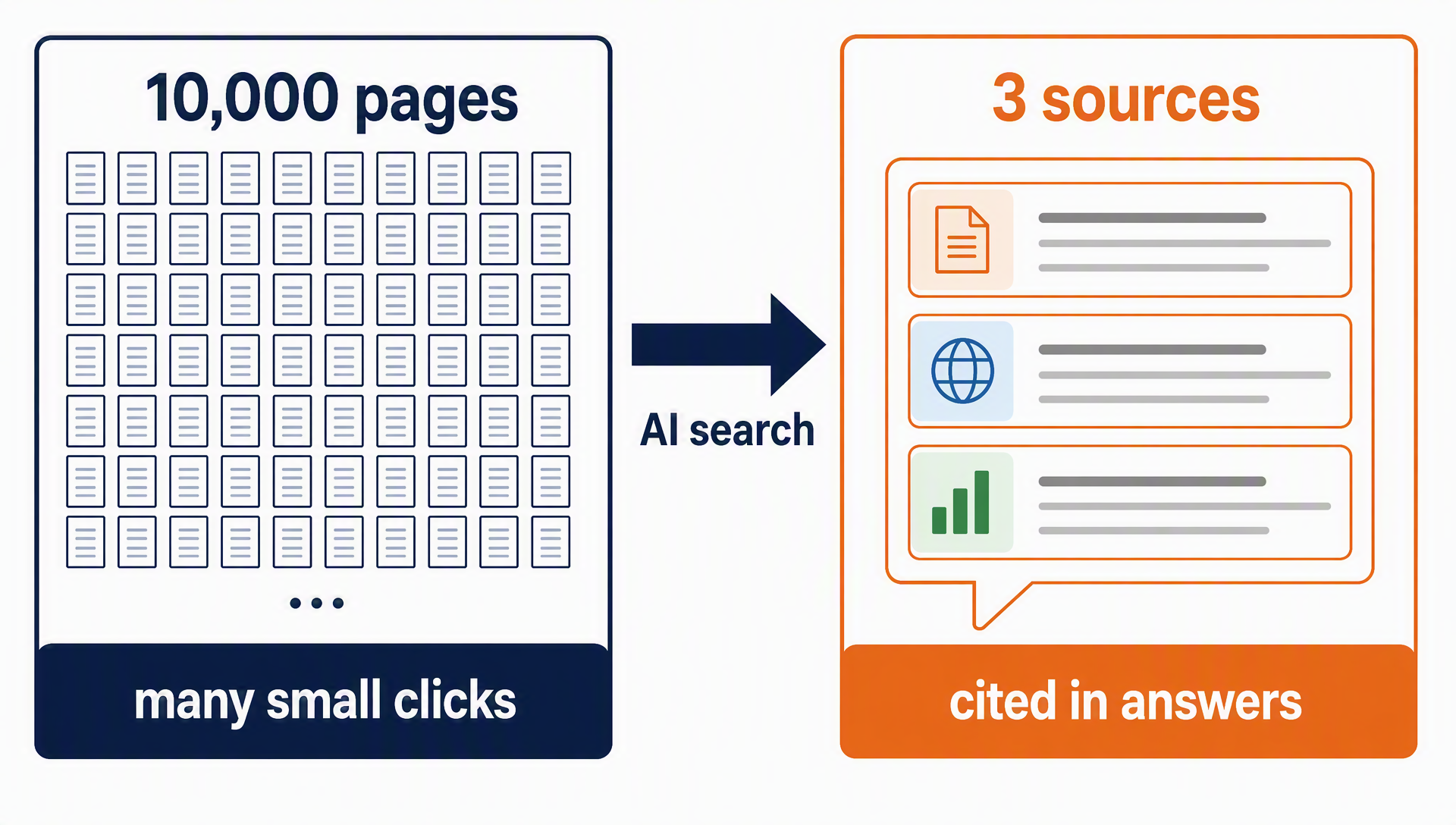
Programmatic SEO is not dead, but its operating model changed. The old math — generate 10,000 template pages, each capturing a small slice of long-tail clicks — breaks down when AI assistants answer the query directly and the click never happens. The new math is citation math: a programmatic page now competes to be one of the few sources an assistant names in its answer. That changes when you should build, what a page must contain, and which existing pages you should keep. The short version: keep building for structured, data-rich, entity-heavy query families; retrofit the ones where your data depth is real; consolidate or remove the thin ones. Build as citation infrastructure, not ranking infrastructure.
Recommendation at a glance
Your situation | Verdict | Why |
|---|---|---|
Structured data, thousands of distinct entities (products, properties, jobs, locations, templates) | Build | AI assistants need per-entity facts; a well-built page is the cheapest reliable source at scale |
A programmatic site with real data but low AI visibility | Retrofit | The pages already exist; they need answer blocks, tables, and stats to become citable |
Template pages with no unique data per page | Consolidate or remove | Thin pages win neither clicks nor citations, and they carry scaled-content abuse risk |
Building purely to "rank for 10,000 keywords" | Stop | That traffic model is being answered away at the source |
The keyword itself is still winnable ground: "programmatic seo" averages about 590 searches a month with low difficulty (14/100) and commercial intent (DataForSEO overview, Aug 2026 pull). Its related queries cluster around exactly the questions this article answers — examples, tools, strategy, and "how does programmatic seo work."
The click model versus the citation model
Classic programmatic SEO runs on a volume bet: rank for 10,000 low-volume queries, each at 0.5–2% CTR, and the clicks add up. AI search changes the payoff in two ways.
First, the answer absorbs the click. When an assistant or AI Overview answers "best X for Y" from a synthesized answer, the user's intent is satisfied before any page is visited. Your page may still gain impressions — retrieval does not require clicks — but the revenue path through clicks thins out.
Second, retrieval consolidates the field. An assistant does not cite ten variant pages; it cites the one page that cleanly answers. Where Google might have shown twenty long-tail results, an AI answer names three to five sources. The programmatic portfolio's job stops being "own the long tail" and becomes "be among the named sources" — a smaller, higher-stakes game.
This is why the old failure signals are now the opposite: zero clicks on a programmatic page used to mean the template failed. Today a page with rising impressions, zero clicks, and a stable position is a page being retrieved by assistants. That is the citation-eligible pattern, not a bug.
The part of programmatic SEO that AI search makes stronger
Three page types survive — and benefit from — the shift:
- Data-dense entity pages. Product pages with real specs, property pages with real numbers, job pages with real requirements. Assistants need per-entity facts and will cite the page that states them cleanly. This is what programmatic templates already produce when they are built from a real data source instead of invented text.
- Comparison and decision matrices. "X vs Y", "best X for Z", "alternatives to X" are the query shapes assistants answer constantly, and they need a source that lays out the dimensions. A programmatic comparison matrix, built from structured data, is a natural citation target.
- Definition and glossary pages. Assistants cite definitions before they cite commentary. A programmatic glossary — one entity, one definition, one consistent schema — outperforms a hand-written explainer on retrieval efficiency.
What all three have in common: the page's value is the data, not the prose. Programmatic SEO's classic weakness — templated text — is irrelevant when the page's job is to deliver structured facts.
When programmatic SEO still wins
Run the query family through this demand-shape test before building anything:
Question about the query family | Yes means | No means |
|---|---|---|
Is the demand repetitive and data-driven (same question, different entity)? | Build — templates fit | Do not template; write per page |
Can every page contain genuinely distinct data from a source? | Build — AI can verify the page's uniqueness | Thin pages; consolidate instead |
Does the answer need a named source (specs, prices, locations, steps)? | Build — citation target exists | The assistant can answer without citing; weaker case |
Is there a canonical entity per page (product ID, address, role, tool)? | Build — entity coverage compounds | Generic page, weak retrieval identity |
Would a human find the page useful beyond the keyword? | Build — survives quality filters | Ranks but gets filtered; do not build |
When at least four answers are "yes", the family is a programmatic candidate in the citation era. Product catalogs, service-area pages, job boards, real estate feeds, template libraries, and tool directories typically pass. Broad informational clusters — "what is X" variations without distinct data per page — typically fail.
When it loses
Three failure modes repeat across the sites we see:
- Invented text at scale. Pages that fill template gaps with generated prose, no source data. They lose both clicks (nothing unique) and citations (nothing citable), and they brush against Google's scaled content abuse policy, which treats content produced at scale to manipulate rankings — including generative-AI-produced variants — as spam.
- Duplicate variants of one answer. Ten pages answering the same question with a swapped keyword. Assistants consolidate these into one citation; the other nine become dead weight, and you pay the crawl and maintenance cost for them.
- Keyword-stuffing templates. The page title changes, the body does not. Quality filters — both Google's and AI crawlers' — learn to skip the pattern.
The expensive version of this failure is subtle: the family had real data, but the build flattened it into identical pages. Retrofit or consolidation usually beats adding more variants.
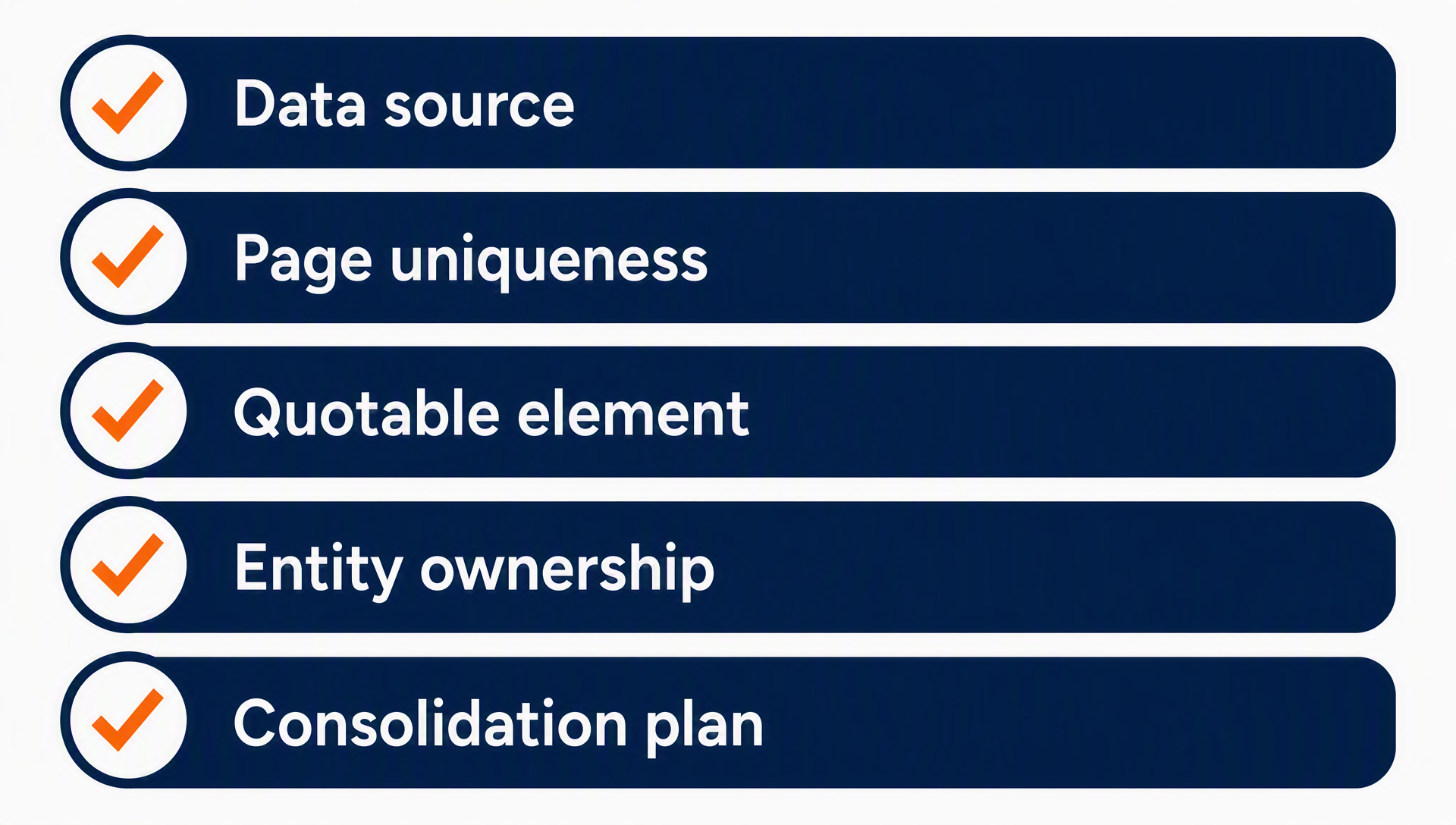
The five questions to answer before you build
Use this as a gate, not a form:
- Where does the data come from? A live source (catalog, API, spreadsheet) that updates, or a one-time export that will rot? Rotten data is the fastest way for a programmatic site to lose both rankings and citations.
- What does the page say that no other page says? Write it down per page type before generating one template. If you cannot answer, you do not have page differentiation — you have a template.
- What will the assistant quote? Identify the one table, stat, or step list per page. If the page has nothing quotable, it has nothing to be cited for.
- Which entity does the page own? The page should own exactly one thing: one product, one location, one role, one comparison pair. Entity ownership is what makes ten thousand pages coherent instead of cannibalizing.
- What happens to the 80% of pages that never rank? If your answer is "nothing", the build is too big. Plan consolidation thresholds and a data-quality review before launch, not after.
How to retrofit an existing programmatic site
Most teams do not need to start over. The retrofit order that works:
- Audit by cluster, not by page. Group your programmatic pages by template. Check each cluster's citations and clicks separately — some clusters are already being retrieved, others are invisible.
- Add the answer block to the cluster's template. One template change propagates to every page: direct answer, one paragraph, first section.
- Add one quotable element per page type. A spec table on product pages, a cost band on service pages, a criteria list on comparison pages.
- Consolidate duplicate clusters. Where five templates answer one question, keep the strongest data source and 301 the rest.
- Check policy compliance. Scaled-content-abuse rules apply to AI-generated and template content alike; the removal mechanics and recovery path are documented in our spam update recovery guide if a cluster takes a hit.
Costs, risks, and blind spots
Risk | What it actually costs | Blind spot |
|---|---|---|
Click revenue declines as assistants answer directly | The traffic model erodes before the citation model matures | Teams judge pSEO purely by clicks and abandon it at the worst moment |
Scaled content abuse action | Core rankings exposure, not just the programmatic pages | Google's policy covers AI-generated and templated content; "we wrote a template" is not a defense |
Data rot | Pages stay indexed with wrong facts; assistants confidently cite them | Citations make stale data worse than no data — a cited wrong spec is visible in every answer |
Crawl and maintenance overhead of the long tail | Engineering time on pages that win nothing | Measure the tail quarterly; consolidate by threshold, not by hope |
Auspia recommendation
Treat programmatic SEO as citation infrastructure with a click side effect, not the reverse. Concretely: build for query families that pass the demand-shape test, put the answer block and the quotable element in the template itself, own one entity per page, and measure the portfolio on citations plus clicks — not clicks alone. Keep the portfolio small enough that every page can be verified for freshness, because in the citation era an assistant will repeat your stale page to more people than Google ever sent you.
When you have passed the gate and decided to build, our buy-intent programmatic SEO playbook walks the execution: the intent filter, the page-distinctness test, and a 90-minute pilot that proves the template before the build scales.
FAQ
Is programmatic SEO dead?
No — the click-based justification for it is dying, and the citation-based one is growing. Query families with real per-page data still win. The build changes from "a page for every keyword" to "a page for every entity, built to be cited."
Do programmatic pages actually get cited by AI assistants?
Yes, when they contain quotable data — tables, stats, specs, steps — and a clear answer block. The pages assistants skip are the ones with no data to quote. Retrieval favors the structured source, which is what a well-built programmatic page is.
What about Google's scaled content policy?
Scaled content abuse covers content produced at scale to manipulate search rankings, including generative-AI-produced variants. Compliance is about substance, not method: pages must have real value beyond the keyword. A data-driven programmatic build from a real source is defensible; a template that varies one word is not.
How many programmatic pages is too many?
As many as your data genuinely differentiates, and no more. Ten thousand entity pages with distinct data are fine; fifty variant pages of one answer are not. The limit is per-cluster differentiation, not a total number.
Can AI-generated pages work in a programmatic build?
As the prose layer over real data, yes. As the data itself, no. The page's uniqueness must come from a source — a catalog, an API, a dataset — that the template renders. If the AI is the only thing making pages different, the difference is invented, and both Google and AI crawlers are getting good at detecting exactly that.
Author: Daniel Cross, Programmatic SEO Architect for 50k+ Page Systems at Auspia. Daniel writes about scaled SEO pages, templates, and data-led content systems.