🎬 Watch the Video Summary
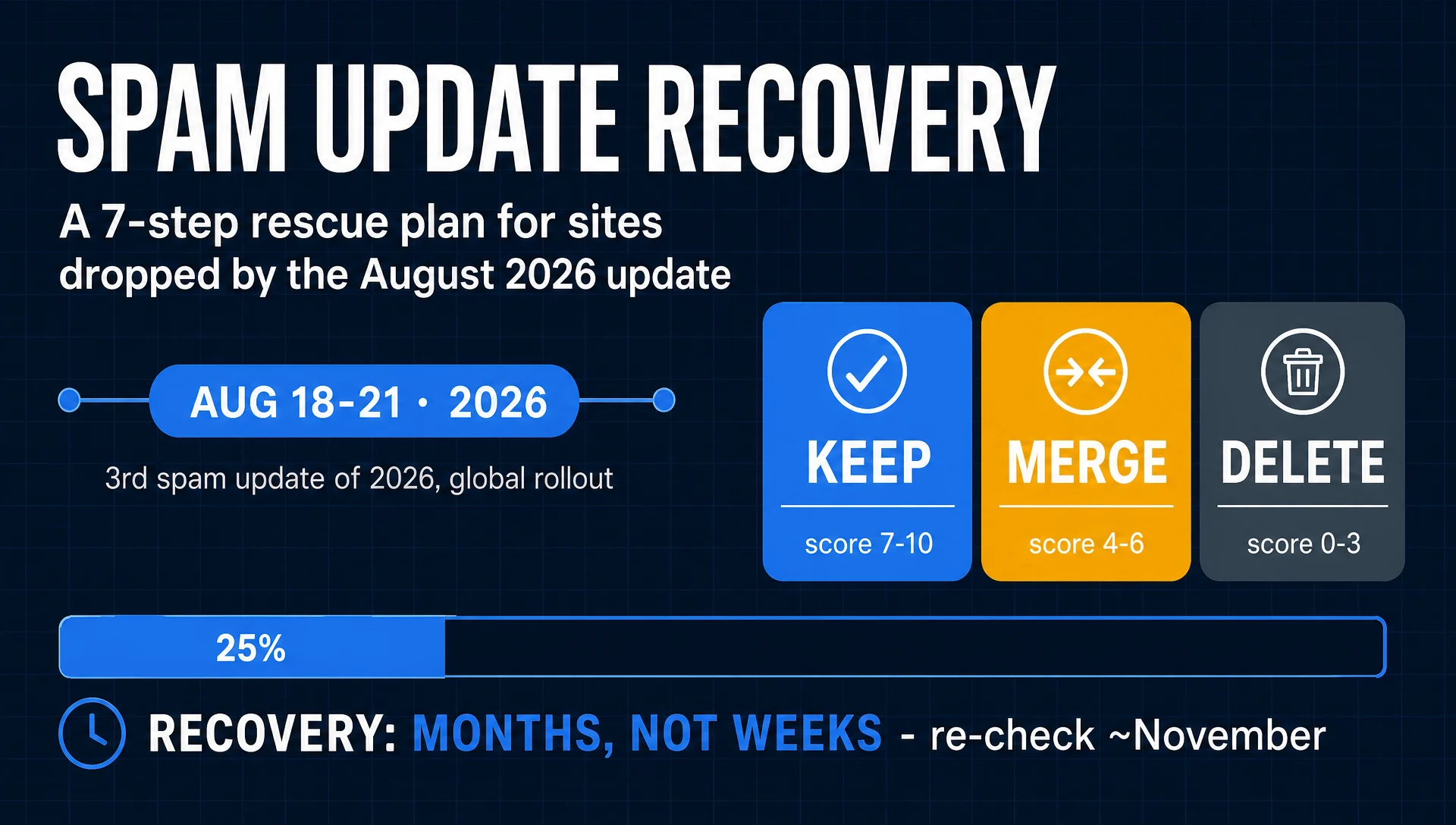
Prefer to watch? We made a narrated explainer of this guide — the five facts, the culling math, and the recovery plan — in about ninety seconds.
Quick check: was this update what hit you?
The August 2026 spam update started rolling out on August 18, 2026 at 09:28 PDT and was fully live on August 21, 2026 at 01:49 PDT. It applied globally and in all languages, and Google recorded it as an incident affecting ranking on the Search Status Dashboard. It was the third spam update of 2026, after the March and June rollouts.
Run these four checks in this order. They take about 10 minutes and decide which plan you need.
Check | If true | Verdict |
|---|---|---|
Impressions/traffic collapsed inside Aug 18-21 (not before) | Yes | Likely this spam update. Continue. |
GSC Manual Actions report is empty | Empty | Algorithmic demotion, not a manual action. No reconsideration request exists for this. |
Drop shows up in one content family ("best X for Y" pages, competitor reviews, city pages) rather than evenly across the site | Yes | Textbook scaled-content pattern. You are in the right article. |
Your pages list in AI Overviews also thinned out on the same days | Yes | Normal now. Since May 15, 2026 Google widens spam policy enforcement to its generative surfaces (AI Overviews, AI Mode), so a spam classification can empty out both at once. |
If the drop started before August 14 or after August 22, or GSC shows a manual action, stop: this rescue plan does not apply. A manual action needs the reconsideration flow instead.
What this guide gives you
Who this is for | Site owners, SEO leads, and content operators running a scaled content system: programmatic sections, templated "best/alternatives/review" pages, local-service variants, or mass-authored pages turned out with AI help. |
What you end up with | Every affected URL decided, the junk gone with a real 410, the surviving pages materially different from each other in both content and structure, and a dated re-check roughly 10-12 weeks out (early November) instead of a daily panic refresh. |
What you need | Search Console access; server access or a CMS that can return 410s and edit sitemaps; your URL list; an agent-capable AI assistant (Claude is the example used here). Budget 4-8 hours of human review time to get through a few hundred affected pages, after which the agent does most of the lifting. |
Definition of done | A decisions table (every URL: keep, rewrite, merge-into, or delete), 410s live and removed from sitemap and internal links, each surviving page carrying a third or more of content none of its siblings have, baseline snapshots saved, and a re-check on the calendar. |
The five facts that change what you do next
These come straight from Google's own documentation and the people who test its updates for a living, and they all cut against the usual "fix it this weekend" playbook.
- Scale is the violation, AI is not the trigger. Scaled content abuse is defined as many pages built "for the primary purpose of manipulating search rankings and not helping users," and Google was explicit that this covers content "no matter how it's created." AI-written pages that answer a real query are fine. Two thousand pages where the only difference is an entity swap are not. The policy wording is unchanged from the March 2024 update; the policy page itself is pinned at "Last updated 2026-05-15".
- The update hits batches, not sites. If one template family survived, it is because the demotion runs on patterns. Your site was not lost; that generation of pages was. A subset still ranks, and that subset is your best clue about what to keep.
- Recovery is measured in months, not weeks. Google's spam-update documentation says violated sites "may rank lower in results or not appear in results at all," and that for sites that clean up, Google's automated systems learn that compliance "over a period of months." John Mueller said essentially the same thing in a search office-hours session: after cleaning up spammy content, "it can take us several months to reevaluate your site again to determine that it's no longer spammy."
- Small edits do not clear the pattern. Mueller phrased it more colorfully: going from something seen as spam to something celebrated "takes a lot more than removing some duplicate content & rewriting a few pages." The update is a pattern detector. Change the pattern, not the wording.
- It is not a link problem. This demotion runs on page content, not backlinks. Your automated link layers are not why you are down, so removing or disavowing them will not bring you back. If those links are spammy, Google already devalues them permanently and the benefit is gone either way: a link clean-up is hygiene for another day, not a recovery move.
There is also no appeal for this one. Algorithmic spam demotions have no reconsideration request. Your only lever is the fix itself, plus the wait.
Step 1: Baseline, export, freeze
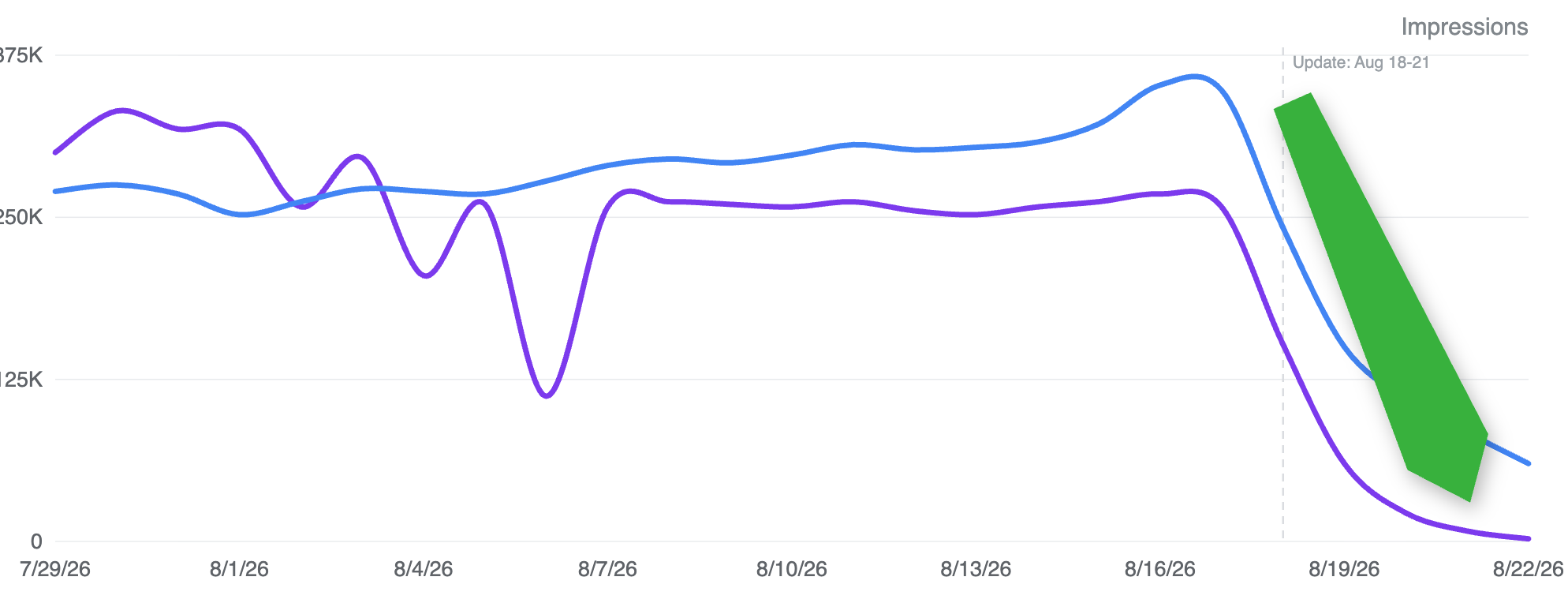
The signature of the hit: both clusters peak in the days before the update window (Aug 18-21), then the templated cluster drops to near zero while the untouched section settles lower. The dashed line marks when the update went live. If your chart looks like this, with a plateau that turns into a cliff at the update date, you are looking at this update.
Do this before touching a single page.
- In GSC open Performance > Pages, set the range to Aug 21 to today, then compare with the 90 days before Aug 18. Save the export. This becomes your Week 0 snapshot. Note: GSC's Generative AI performance report had a logging gap that suppressed impressions for Aug 13-17, so use the standard Performance report for your baseline, and do not panic-troubleshoot that gap.
- Export the URL list: sitemap.xml plus the Pages export, deduplicated.
- Write down the 10-20 queries where you remember being visible in an AI Overview, and save what those answers look like today (or yesterday). That is your AI-Overview baseline.
- Freeze publishing. Do not publish 30 new pages to "replace" the loss while the pattern is still in the index. An unchanged pattern plus fresh volume reads as doubled effort at the same violation.
A control cluster is worth defining here too. Pick a part of the site that lost nothing and track it alongside the hit clusters; it tells you whether later movement is site-wide noise or recovery.
Step 2: Bucket every URL
Score each cluster of similar pages from 0 to 10. A 0 is a pure template fill; a 10 is a page worth finding standing alone.
Give points for:
- +3 Original data or experience that no sibling page has: measured results, screenshots, first-hand walkthroughs, prices you collected, real cases.
- +3 A searcher would learn something different from this page than from its siblings, even with a new tab open in another browser.
- +2 A genuinely distinct query intent (different question, different job), not just an entity swap ("Best CRM for lawyers" vs "Best CRM for dentists" is a swap; lawyers-billing workflow vs dental-scheduling workflow are distinct intents).
- +1 Meaningful inbound links or historical traffic worth preserving.
- +1 The page is the natural pillar or category hub of the family.
Then apply the default decision set:
- 0-3: delete. Do not rewrite. A patched template page is still a template page.
- 4-6: rewrite or merge. Rewrite when the intent is distinct and the value is plausible; merge when it duplicates another page's intent.
- 7-10: keep. Add depth where thin, otherwise leave the structure alone.
Practitioners working through the last few spam updates commonly landed on a rule of thumb: prune, consolidate, or fully rebuild at least 60% of the flagged URLs before anything moves. That is not an official Google threshold, but it is a useful honesty check: if only 5 of your 300 templated pages get culled, the detector still has 295 clones it can identify on sight.
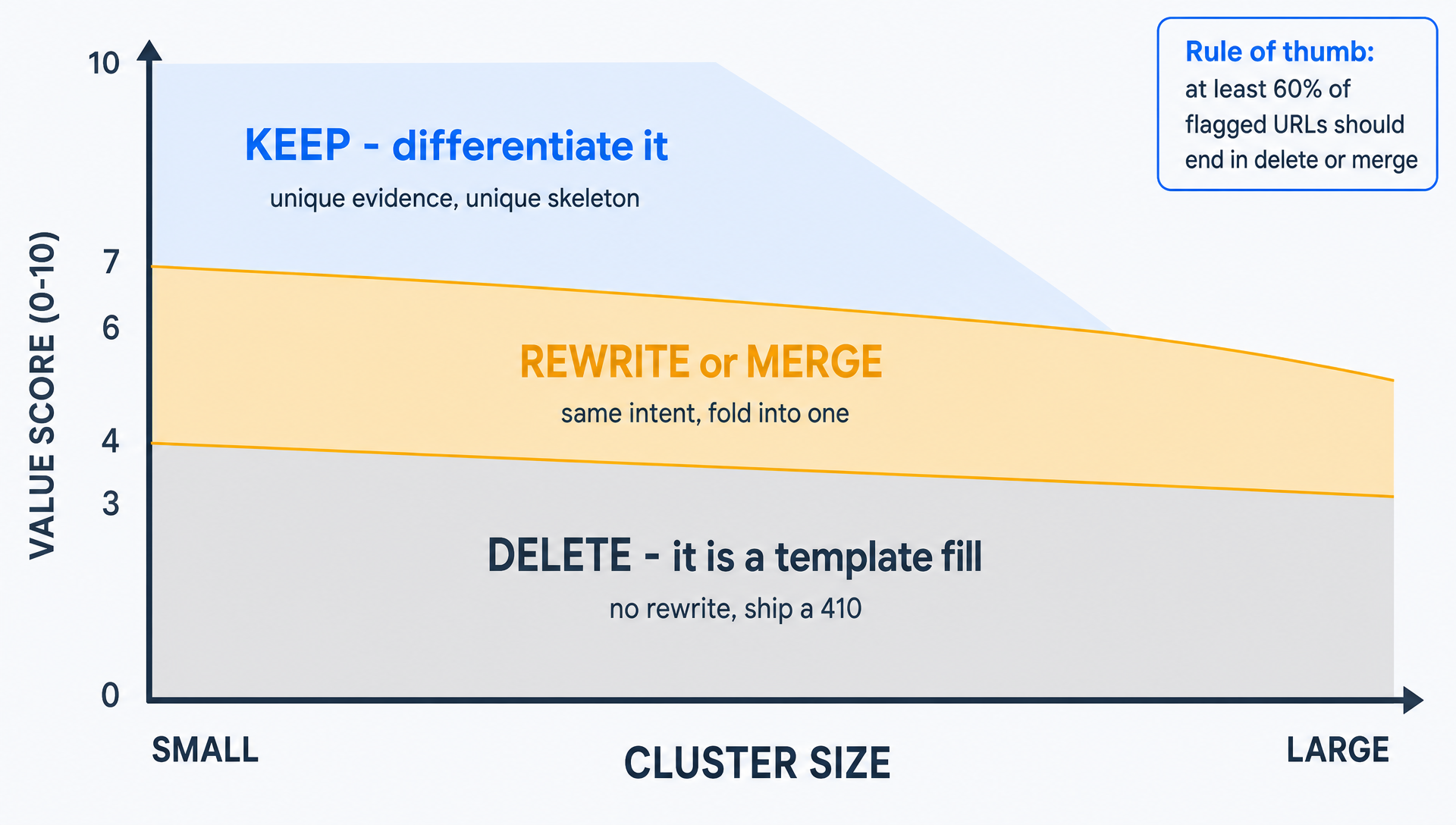
Cluster size against value score. The upper-left is worth keeping; the middle gets rewritten or merged; the bottom is template fill.
Step 3: Hand the remediation to an AI agent
The fixes below (clustering the duplicates, scoring them, rewriting the keepers, generating deletion lists) are exactly the kind of batch operation an AI assistant does well. The community playbook for this update has converged on the same idea: hand the agent a checklist built from Google's policies and let it execute the audit.
The skill below is self-contained. Save it as a skill file, for example ~/.claude/skills/google-spam-recovery/SKILL.md on your machine or .claude/skills/google-spam-recovery/SKILL.md in your repo (other agent platforms use their own skills folders, usually .agents/skills/), then point it at your export.
---
name: google-spam-update-recovery
description: Audit and fix a site demoted by a Google spam update (e.g. the August 2026 update). Detects scaled-content abuse patterns, classifies every affected URL as keep / rewrite / merge / delete, differentiates surviving pages, executes deletions, and verifies recovery. Use when Search Console impressions collapsed inside a confirmed spam-update window or pages dropped out of AI Overviews.
---

## Google Spam Update Recovery Skill

### When to use
- Search Console Performance dropped sharply inside a confirmed spam-update window (for example August 18-21, 2026).
- The Manual Actions report is empty, which means an algorithmic demotion and the case this skill handles. A listed manual action is a different workflow.
- The site publishes many templated pages: programmatic sections, review or "best X for Y" pages, local variants, competitor comparisons.

### Inputs to collect first
1. Full URL export: either the sitemap.xml or GSC Performance, Pages tab, range = update start to today (baseline range 90+ days before).
2. Page text: crawl the candidate URLs and save one text file per URL in a `pages/` folder (rendered HTML stripped of nav, footer, and boilerplate).
3. Manual Actions report (read-only check).
4. For AI Overview checks: the site's 10-20 priority queries plus a record of current AI-answer visibility.

### Definition of done
- Every affected URL carries a decision: keep, rewrite, merge-into (with target URL), or delete.
- All delete URLs return HTTP 410 and are removed from the sitemap and from internal links on kept pages.
- Every kept page has at least 30% substantive content unique within its cluster, not counting navigation, footer, CTAs, or template intros.
- Kept pages differ in skeleton too: H2/H3 structure, section order, question coverage.
- Baseline and verification snapshots exist, with the next check scheduled (10-12 weeks out, or the next spam update, whichever comes first).

### Phase 1: Scope the blast radius
- Confirm attribution: the drop started inside the update window and correlates with templated clusters, not a technical change (check the server logs for crawl errors, robots.txt changes, canonical mistakes, accidental noindex).
- Build the affected URL list. Include "Crawled - currently not indexed" pages inside the hit clusters; they are part of the same pattern.
- Process batches of 200 URLs maximum per pass so every output stays reviewable.

### Phase 2: Cluster near-duplicates
Requires the `pages/` folder with one text file per URL.
- Method A (no API needed): TF-IDF cosine similarity, or difflib SequenceMatcher on normalized text; cosine >= 0.85 means same cluster.
- Method B (better, if an embeddings API is available): embedding cosine >= 0.78.
- For each cluster record: size, representative URL, shared template signature (same H2 pattern or same sentence skeleton with entity swaps), and a guess at the intent.
- Output `clusters.json`: {cluster_id: {urls, size, template_name, intent_guess}}.

### Phase 3: Score and decide
Score each cluster 0-10 as described in the article (original evidence +3, differing information +3, distinct intent +2, inbound links or traffic +1, pillar role +1). Decision bands: 0-3 delete, 4-6 rewrite or merge, 7-10 keep. Target: at least 60% of clustered URLs end in delete or merge (a practitioner rule of thumb, not a Google threshold). Emit a decision table: URL, cluster, score, action, target URL where merging, and a one-line rationale. Flag humans any page with meaningful traffic or links: confirm the action before deleting it.

### Phase 4: Differentiate the keepers
Rewrite must change both substance and skeleton:
- Add evidence that exists only on this site: measured data, real screenshots or photos, named cases, workflow you actually ran, prices you collected.
- Replace the skeleton: different H2/H3 questions, different order, at least one table or example unique to this page.
- Add 300-800 words of original analysis or first-hand experience; never just lengthen the template.
- Add a named author byline and a "verified on" date.
- Delete the boilerplate intro/outro shared with the cluster.
- For local or review pages, local facts must be specific: regulations, providers, pricing, a case with details. No template swap strings ("[City]'s top [service] providers for families" is swap text, not content).
- Never add AI-bait: no hidden instructions, no planted citations, no keyword-stuffed anchor lists. Attempts to manipulate generative AI answers are themselves spam under Google's 2026 policy.

### Phase 5: Merge and delete
- Merge: consolidate duplicate-intent pages into one stronger page, 301 each removed URL to it, fold in the unique content, update inbound internal links, request indexing on the merged URL.
- Delete: return 410 (or 404 if platform constraints); remove from sitemap; remove internal links. Never blanket-redirect to the homepage and never rely on noindex or robots.txt, which do not remove pages.
- Optional accelerator: the Search Console Removals tool temporarily hides URLs (about six months) while crawlers catch up. It is a suppression tool, not a deletion.
- On deploy: fetch sample deleted URLs and confirm 410; request indexing on the kept URLs.

### Phase 6: Verify and schedule the wait
- Snapshot today, then re-check at week 4 and week 10-12 (or the next spam update, whichever is first).
- Track: GSC standard Performance report (the generative AI report had an Aug 13-17 logging gap, so use the standard report for August 2026 baselines), impressions in hit clusters against a control cluster, index status of deleted URLs, and AI Overview visibility for the priority queries.
- Interpreting results: recovery first appears on rewritten kept pages, not on anything you publish during the wait. Partial recovery is normal; some clusters may never come back, which is why they were deleted.
- If week 10-12 shows movement on kept pages, keep the freeze off, keep publishing differentiated content, and re-check at the next spam update.

### Guardrails, never do
- No new templated pages during the wait. The pattern must stay fixed.
- No bulk rewrites done as synonym swaps or sentence shuffles: that is the same pattern with other words. The agent must flag any rewrite whose skeleton did not change.
- No buying expired domains or redeploying deleted templates elsewhere.
- No backlink removal or disavow campaigns for this demotion. Link spam is a separate system; for content demotion the links were never the signal.
- No citation-poisoning or planted statements to win back AI Overviews; that is now explicitly covered by Google's spam policies.
- Human QA on every rewrite: one person reviews the skeleton uniqueness and evidence check before anything ships.
Once installed, a handoff prompt can be as short as:
Use the google-spam-update-recovery skill on our site. The URL export is at./urls.txtand the crawled page text is in./pages/. Produce the decision table. Then apply Phase 4 to URLs 12, 19, 33 and Phase 5 to the full delete list.
You will get back three artifacts: a decisions table you can approve row by row, rewritten drafts (with the skeleton change and evidence list stated explicitly so you can QA them), and an execution checklist covering 410s, sitemap, and internal links. Approve the table before anything is deleted; the agent should never delete or rewrite a page without your sign-off.
Step 4: Make the keepers genuinely different
The whole recovery hinges on one word: different. Not longer. Not differently worded. Different evidence, different structure, different answers.
A concrete contrast. The weak version of a "Best CRM for accounting firms" page clones the same H2s used for lawyers, dentists, and plumbers, with the industry noun swapped and one paragraph of generic praise. The version Google can distinguish shows the actual workflow differences: time entries batch-imported from a firm's billing system, multi-entity consolidation for a client with 12 LLCs, fiscal-year-close cleanup tasks. It has a screen of the reconciliation dashboard, a table of four products the author actually priced that year, one named deployment with days-saved per month, and a different section order than the "Best CRM for lawyers" page next to it.
The same rule holds for review pages ("alternatives to X product"), city pages, and comparison pages. When you audit a surviving page, ask five questions: does it hold at least one fact, screenshot, or figure that no sibling holds? Does it answer at least one question no sibling answers? Is its H2/H3 skeleton different from every sibling's? Does it carry a human byline and a verification date? Does it read like it was written for someone in that specific situation, not for the keyword?
Answer no to three or more and it is still a template. Merge it or delete it; do not publish it as a fixed page.
Step 5: Merge and delete like a cleanup, not a dance
Deletion is where sites usually trip. Correct order:
- Return 410 Gone where you can (404 is acceptable when the platform cannot do 410). This is the strong "gone for good" signal; 404 says "maybe back later."
- Remove the URLs from your sitemap. Keep stale dead links out of the crawl list.
- Strike the internal links from surviving pages, navs, and footers. Do not leave a web of links pointing at 410s.
- Do not redirect deleted pages to the homepage. A hundred 301s to
/is a doorway-shaped pattern and also dumps whatever equity the URL had into your homepage, which is not where it belongs. - Merge from the intent, not from convenience. When two pages genuinely target the same question, fold the better content into one, 301 the other, and fix internal links. When they answer different questions, keep both and differentiate.
- Use the Removals tool as an accelerator, not a substitute. It suppresses a URL in results for about six months; it does not deindex it. Use it for pages that keep re-appearing from caches, and pair it with a real 410.
Do not fall for noindex + redirect, robots.txt blocking, or 404-only deletes without sitemap updates. Google keeps crawling, the pattern remains discoverable, and the next spam update re-checks the whole thing.
Step 6: Win back AI Overviews
The same-day loss on both surfaces is explained by the policy, not a bug. On May 15, 2026 Google red-rewrote its spam definition to include "attempting to manipulate generative AI responses in Google Search," and stated plainly that the spam policies apply to all of Google Search, including generative AI responses. AI Overviews and AI Mode pull from the same systems. A site classified as scaled content abuse can therefore drop from both on the same rollouts: the June 2026 spam update was the first to run under the widened policy; August ran the same book of rules.
So AI-Overview recovery has no separate trick. It is downstream of the content fix:
- Fix and wait, then re-check. Sanitize the pages in Steps 4-5 first. AI Overviews select from sources the ranking systems trust, so the same pattern change is the fix.
- Verify per query, not per site. Pick the 10-20 queries you were once cited for, ask each one in a fresh session, and note whether you appear. The answer changes per query, so a site-level "back" is the wrong metric. This is where you will also catch the second-order effect: once your differentiated page is the best source in its niche, the AI answer has a reason to use it.
- Never poison. Planted recommendations and biased "best-of" listicles built to steer AI answers are now the named targets of the spam policy (people started calling it GEO spam: recommendation poisoning, citation injection, AI-bait). A Cornell Tech preprint showed how cheaply a planted 13-word statement can get a chosen brand into 38-51% of AI research-agent sessions in a test. That something works is precisely why Google calls it spam. If you want AI visibility, earn it: original facts, verifiable data, named expertise.
- Check your evidence, then your structure. When you retest, a citation usually goes to a page that states a specific, extractable answer with evidence nearby. Verify your kept pages answer the target question in the first section before you worry about anything else.
- Long game. The Preferred Sources feature (rolling out since August 20) lets readers grant your site a preferred badge in AI Overviews and AI Mode, which is a direct reader-signal channel. It does not override spam classification, so it is a strategy for after the cleanup, not a tool for it.
Step 7: Verify, then schedule the autumn check
After the work is on the server:
- Today: record the baseline. Confirm deleted URLs return 410 (fetch-as-Google or the Auspia Googlebot Spider Simulator); request indexing on kept URLs.
- Week 1: confirm the sitemap and internal links are clean; spot-check that no deleted page is still reachable.
- Week 4: compare hit clusters against your control cluster in the standard GSC Performance report. Small upward ticks on rewritten pages are the best early sign; flat is normal at four weeks, do not act.
- Week 10-12 (early November if you finish this week, or the next spam update, whichever comes first): the re-check. Compare impressions for cluster groups against the Week 0 baseline, re-run the AI-Overview query set, and inspect what recovered.
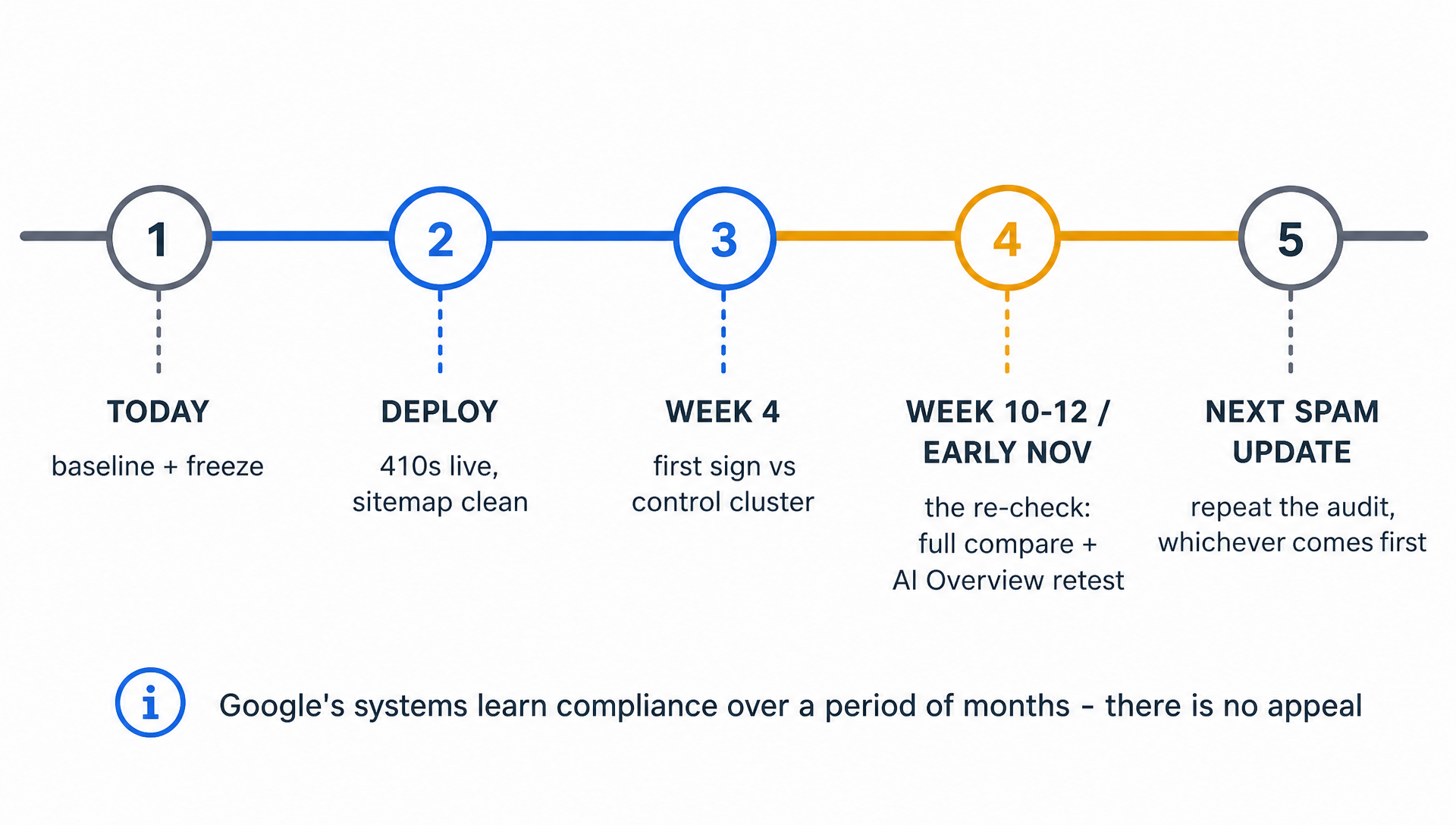
The wait is planned: baseline today, first movement check at week 4, the re-check in early November. Manage expectations with the honest version of the timeline: Google's documents say its systems need months to learn that you comply, and Sergey's office-hours quotes put site-wide re-evaluation at "a couple of months, a half a year, sometimes even longer." Bigger recoveries often land at the next update cycle, not between. There is no request to file, no validation request, no appeal for algorithm-only demotions.
If the re-check shows zero movement, the usual causes: another content family still carries the pattern (look again at clusters you left as "keep"), the rewritten pages are still templates with new paint (run the Step 4 checklist again), or the site went quiet in a way that stalls indexing (keep the crawl-log check from Phase 1 in mind).
Auspia's take: delete first, differentiate second
Most teams invert the order. They rewrite a few templates and feel productive, then wonder in November why nothing moved. The pattern detector is statistical: 250 pages sharing one skeleton is a strong signal, and 250 rewritten pages still sharing a skeleton is the same signal. Prioritize the deletion and merge math over the word count, and use the 60% rule of thumb as a floor before you consider the patch complete. And keep a brand and citation surface beyond Google: this update was hard to see coming and has no appeal, so a visibility mix (direct brand searches, other AI platforms, email or communities you own) argues for itself.
Checklist: the one-page rescue plan
- [ ] Confirm the drop window inside Aug 18-21 and an empty Manual Actions report
- [ ] Save baseline: URL export, GSC Performance snapshot, 10-20 AI-Overview queries with current state
- [ ] Freeze publishing
- [ ] Cluster near-duplicates and score each cluster 0-10
- [ ] Decision table: keep / rewrite / merge-into / delete for every URL, 60% minimum culled
- [ ] Install google-spam-update-recovery skill, hand over the export, review its decision table
- [ ] Differentiate keepers: unique evidence, unique skeleton, byline, verified date
- [ ] Execute: 410s live, sitemap updated, internal links removed, merges 301-redirected to the merged page
- [ ] Confirm deletion correctness, request indexing on kept pages
- [ ] Re-check at week 4 and week 10-12 (early November) or the next spam update
- [ ] Enforce a pattern gate on new content: no page ships without its own evidence and skeleton
FAQ
Was AI the reason my site got hit? No. Scaled content abuse does not care how content was created ("no matter how it's created" is the policy's own wording). AI production only becomes a problem when it is used to ship many pages that add nothing distinct.
My traffic fell 75% but my pages are still indexed. Is it still the update? Often yes. Spam demotions usually lower visibility rather than outright removing pages, and the update was recorded as one affecting ranking. Check your drop against the Aug 18-21 window and the pattern: templated clusters hit, controls calm.
Should I file a reconsideration request? Only if the Manual Actions report lists a manual action. Algorithmic spam demotions have no reconsideration flow, and Google's spam-updates documentation says nothing about one. Fixing and waiting is the route.
How long does recovery actually take? Google's state: systems learn to recognize compliance "over a period of months." Practitioners see the first movement at 4-10 weeks on rebuilt pages and full recovery at a later update cycle. Plan on months, re-check early November.
Can I just noindex the bad pages and keep them? No. Noindex stops them appearing, but the URL remains crawl-eligible and the pattern remains in your site's structure. Junk pages should be deleted with a 410, not hidden.
Will 301 redirects to merged pages preserve whatever equity my old pages had? Merges work best when the destination genuinely absorbs the unique content and answers the same intent. Blanket redirecting dozens of deleted topics to one homepage is how you make a doorway pattern, and it is precisely what this update's detectors are tuned to find.
Should I take down my whole programmatic section? No. Delete the clones; keep the pages that score 7-10. Some of the sites that recovered in the August volatility were precisely the ones that cut the middle of their scaled content instead of the entire class.
My backlinks are automated junk. Should I disavow them to recover? For this demotion, no. It is a content-pattern issue, not a link issue, and Google already permanently discounts the ranking benefit of spammy links. Deal with links as hygiene later if you like; they are not the recovery path.
How do I stop this from happening to the next batch? Add a gate to content production: a page ships only with its own skeleton and its own evidence. Then set a volume ceiling you actually believe (a few strong pages a week beats 200 clones a day) and review clusters quarterly before Google's systems do it for you.
Do AI Overviews come back before normal rankings? There is no reliable order; both surfaces pulled together in the August update. In practice, watch both on the same re-check dates rather than assuming one leads the other.
Author: Grace Miller, AI Search Risk Analyst Tracking 200+ Policy Shifts at Auspia. Grace writes about platform policy changes, content risk, and policy-aware recovery work for SEO and GEO teams.