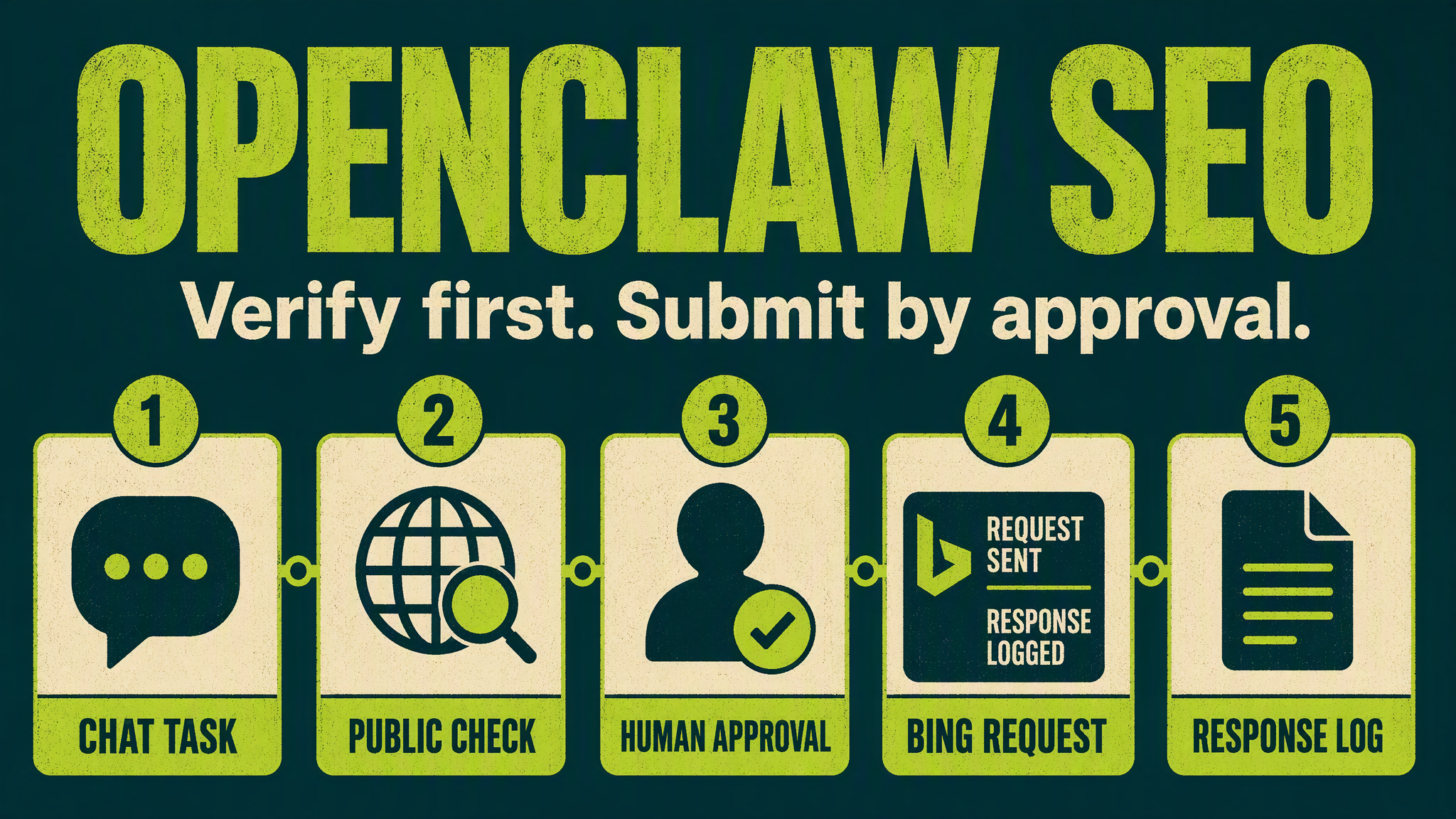
OpenClaw is a self-hosted assistant that can work through chat channels and local tools. For a release-day SEO task, that makes it useful as a message-sized evidence clerk: check a small list of public URLs, report what was observed, and prepare the next approval card. It should not silently submit a large URL list, sign into accounts from a chat request, or tell you that a URL is indexed because a fetch worked.
This workflow ends with three separate things: a public verification log, a Bing queue that still needs approval, and a Google Search Console checklist a person completes in the UI.
Start with a release message that has a boundary
Send OpenClaw a task file or message that says exactly what is in scope. Use only public URLs in the first pass.
# New URL verification request

Release: 2026-07-30 content update
Owner: Morgan, SEO lead
URLs: `input/new-canonicals.csv`

For each URL, record the requested URL, check time, observed final URL when
available, visible title, visible H1, and any fetch failure. Add a plain-language
note when the returned page differs from the release expectation.

Do not log in, open private dashboards, publish, edit files, submit any URL,
retry repeatedly, or infer index status, rankings, canonical selection, or
crawl frequency. Write only `reports/public-url-check.csv` and
`reports/release-exceptions.md`.
The first command is deliberately boring. It gives the person in chat a report they can sample, rather than a system that runs away with a release list.
Build public evidence cards before discussing submission
OpenClaw's documentation describes a personal assistant that runs on your devices and can work through supported chat channels. That local control is useful, but it does not make a public-page check infallible. Network conditions, rendering, bot handling, and timing can all affect what an agent observes.
Ask for evidence cards with fields you can inspect:
Field | Why it is useful | What it does not prove |
|---|---|---|
Requested URL | Confirms what the release list asked to check | The preferred canonical selected by Google |
Check time | Makes a transient failure traceable | When a crawler will revisit |
Final URL observed | Flags a visible redirect or rewrite | That every user or bot receives the same response |
Visible title and H1 | Gives a quick release sanity check | Full JavaScript rendering or search snippet behavior |
Exception note | Sends a mismatch to the right owner | The root cause of the mismatch |
Use a small batch, such as 10 to 25 URLs. Sample the report yourself. If a public page is protected or behaves differently for automation, record not_checked and escalate. Do not work around access controls.
Turn observed URLs into a Bing review queue
Bing provides URL submission for verified sites. That is an external write. The safe sequence is prepare, approve, submit, log.
Ask OpenClaw to create a candidate file only:
Read `reports/public-url-check.csv` and create
`reports/bing-submission-review.csv`.

Include only URLs that the release owner listed as canonical and that have a
successful public check. For each row add the evidence, release reason,
`review_required=yes`, and an empty `approved_by` field. Do not submit URLs.
Do not deduce a canonical URL from a redirect or page tag alone.
The approving person checks the exact URLs and verified Bing property. Only then should a separate, explicit instruction permit a submission, one URL at a time, through an already configured approved route.
The rows in `reports/bing-submission-review.csv` approved by [NAME] at [TIME]
may be submitted to the verified Bing property [PROPERTY]. Submit only those
rows once. Record requested URL, property, timestamp, response, and failure.
Do not retry automatically. Do not submit any other URL.
A Bing request is useful only when its approval trail is as clear as its response log.
Keep the Google path human-owned
For ordinary web pages, Google documents a Request Indexing flow in Search Console after URL inspection. Keep this as a human task. Your chat agent can prepare the checklist, but it should not claim a generic programmatic shortcut exists.
## Google Search Console checklist for each approved URL

- [ ] Sign into the verified property as the authorised owner.
- [ ] Inspect the exact live canonical URL.
- [ ] Resolve any visible page or canonical discrepancy before requesting action.
- [ ] Use the Request Indexing control only if it is available and appropriate.
- [ ] Record the URL, person, and time in `reports/google-request-log.md`.
- [ ] Treat the request as a request, not evidence of crawling, indexing, or ranking.
Google's recrawl guidance distinguishes routine URL inspection and request paths from the limited Indexing API use cases. Do not build a general content-page submission bot around the Indexing API.
Make exceptions more useful than "failed"
When the report finds a mismatch, route it to a human decision. The value is in the description, not the red status.
Observation | Route it to | First next check |
|---|---|---|
Expected URL returns a public error | Release owner | Reproduce in a normal browser and inspect the release record |
Final URL differs from release list | SEO and engineering owner | Compare intended canonical, redirect rules, and page purpose |
Title or H1 differs from approved copy | Content owner | Check source content, caching, and preview output |
Fetch is blocked or inconsistent | Platform owner | Record |
Bing request returns an error | Verified-property owner | Read the error and fix the approved scope before another explicit attempt |
The phrase "indexing failed" is usually too broad to help. Say what happened, what was observed, and what needs checking next.
A chat prompt that stays in bounds
Use this message as the opening for future releases:
Use the release verification workflow. Read only the supplied public URL list.
Create evidence cards and an exceptions report. Mark unobservable values as
not_checked. Do not access authenticated services, publish, edit production
files, submit URLs, retry failures, or make index-status claims. Stop and ask
for a separate approval if the next step would write to Bing Webmaster Tools or
requires a human action in Google Search Console.
That prompt is short enough to use in chat and specific enough to prevent a routine check from turning into an unreviewed action.
FAQ
Does a successful public check mean Google indexed the URL?
No. It means the check obtained an expected public response at that time. Indexing needs its own evidence, and a crawl request is still only a request.
Can OpenClaw submit every URL in a sitemap to Bing?
Do not make that the default. Submit only an explicitly approved, verified set. A new sitemap or sitewide release needs a separate review because the scope and risk are different.
Why not automate Google requests too?
For ordinary pages, Google documents a user-facing Search Console flow. Keep a human in that step. The Indexing API has limited supported content types and is not a general submission API for routine content pages.
Author: Julian Mercer, 14-Year Technical SEO Practitioner at Auspia. Julian writes about crawlability, release checks, and technical changes that stay verifiable under pressure.