Short answer
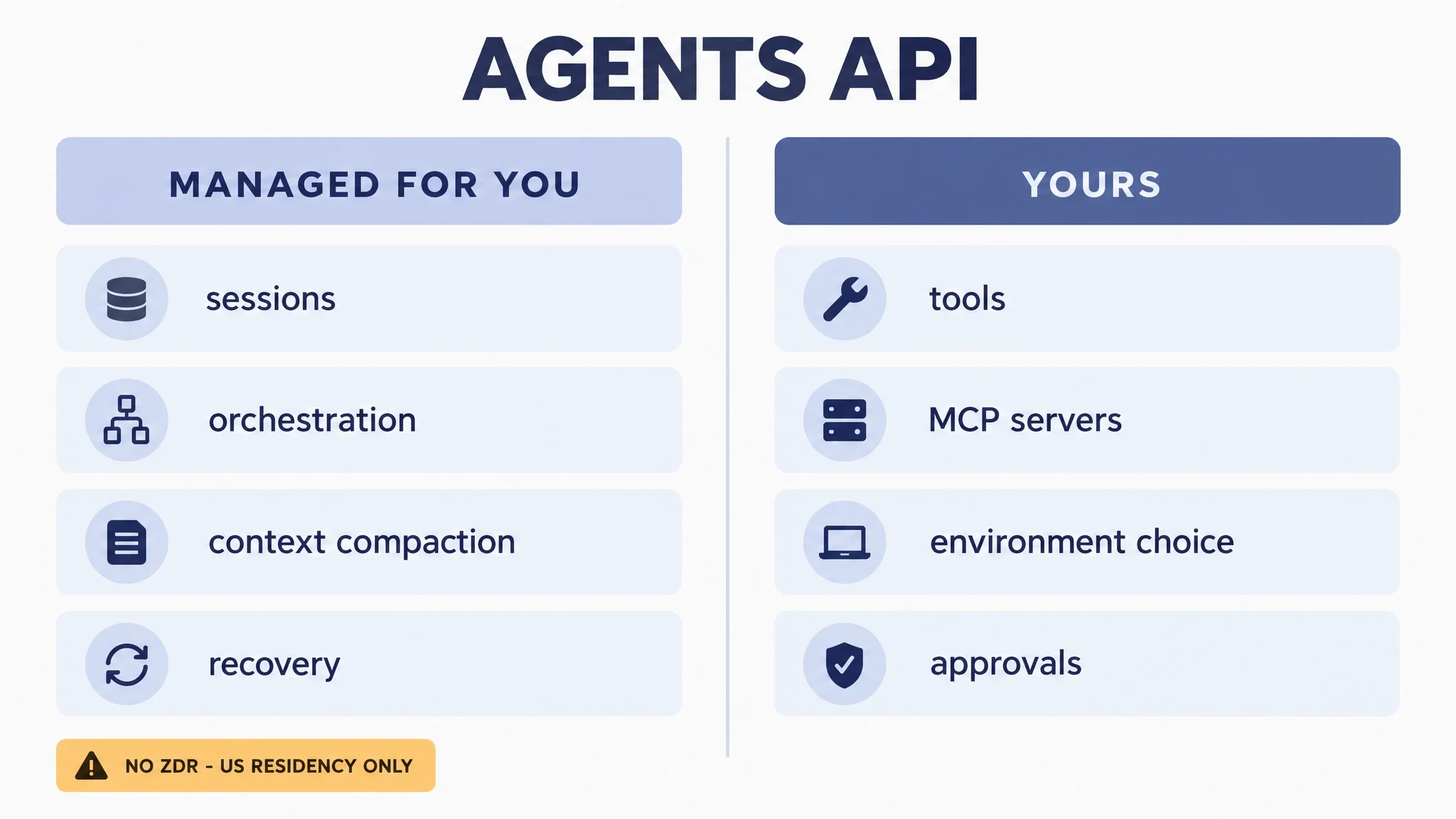
The Agents API exposes a managed agent runtime: you describe an agent and a task, and the platform handles sessions, orchestration, context compaction, and recovery while your application supplies tools and chooses where the agent runs. For content and SEO teams, the practical change is that long-running, multi-step content work stops being something you script yourself. Jobs that previously required you to build retry logic, state management, and context trimming can now be delegated to a managed session.
It is in public beta. It does not support Zero Data Retention, it is limited to United States data residency, and its usage reporting does not expose a cache-write count, which means you cannot always reconcile a bill precisely. Those three constraints, not the feature list, are what should drive your adoption decision.
What the API actually is
Four concepts carry the whole design.
Agent. The model, instructions, tools, and MCP servers. This is your configuration, not a running process.
Environment. Where the agent executes. Three options: no environment at all, an OpenAI-hosted sandbox, or your own infrastructure. Your choice here determines what the agent can touch.
Session. A durable instance that persists setup, conversation, and saved output across turns. A turn is one work cycle inside a session. Messaging an idle session starts a new turn; messaging an active one steers it.
Events and items. Events are the live stream of what is happening. Items are the saved record. After a stream disconnects, missed events are not replayed, so you retrieve saved items instead.
Two details matter more than they appear. First, an idle session does not mean the previous turn succeeded, and a completed turn does not guarantee every tool worked. Check the explicit completion, failure, and cancellation events rather than inferring from silence. Second, multi-agent delegation is a session setting: enabling it gives the harness tools for creating, messaging, waiting on, and interrupting subagents, with a default cap of six concurrent subagents that you can raise.
What changes for content and SEO teams
The shift is from prompt-shaped work to session-shaped work.
A prompt-shaped workflow is one request, one response. Use it for drafting a section, rewriting a title, or generating schema markup. A session-shaped workflow runs for a long time, accumulates state, recovers from failures, and produces artifacts. That second shape is what most content operations actually need and what teams have been assembling by hand.
Three capabilities map directly onto recurring content work.
Skills as versioned instruction bundles. A skill is a directory with a manifest file and supporting assets. You register the parent directory at session creation, and the platform surfaces each skill's name and description so the model can decide when to invoke it. This is how you encode editorial standards, brand rules, and repeatable procedures without repeating them in every prompt. Versioning is explicit: you can pin a version or track the latest.
Sandboxes that produce artifacts. An OpenAI-hosted sandbox gives the agent a Linux workspace with Python, Node, and standard tooling. Files written to the outputs directory are published as immutable artifacts when a turn completes, and they remain downloadable after the sandbox expires. For content teams, this is the mechanism that turns "the agent analyzed our pages" into "the agent produced a report you can attach to a ticket."
Multi-agent delegation for parallel review. A coordinator can dispatch independent workstreams to subagents, each with its own context, then merge the results. Content audits fit this shape well: different reviewers examining different page sets, or separate checks for structure, entity clarity, and citation readiness.
A concrete workflow worth building
Here is a shape that uses the API for something content teams already do manually: a quarterly content decay audit.
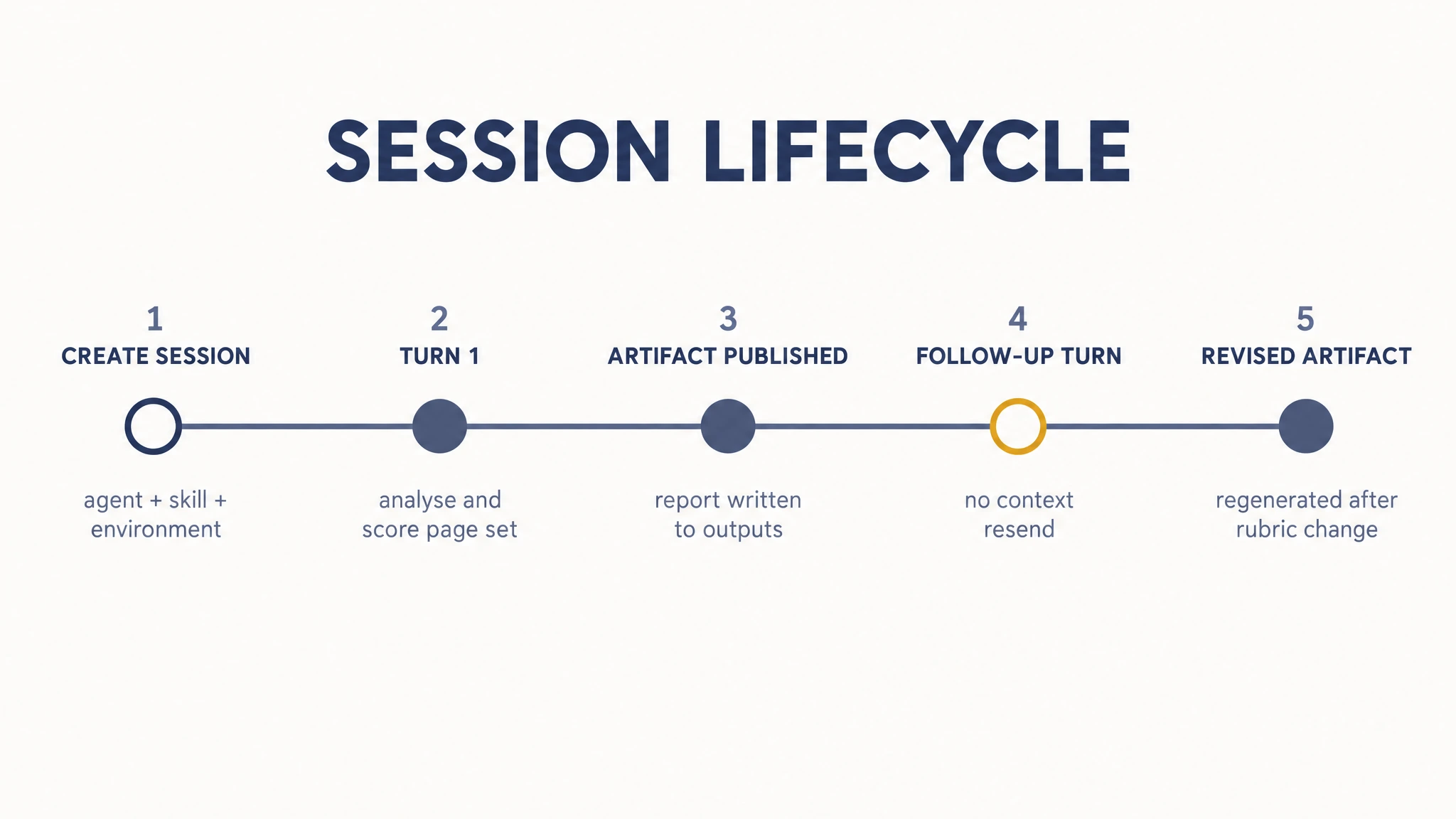
Configure an agent with instructions describing your decay criteria and a skill containing your scoring rubric. Use an OpenAI-hosted environment so the agent can run analysis rather than just describe it. Supply your page list as an input file. Enable multi-agent delegation so page clusters can be reviewed in parallel.
The session then runs one long turn: fetch and analyze the page set, score each page against the rubric, group findings by cluster, and write a prioritized report to the outputs directory. Because the session is durable, you can follow up in a later turn without resending context, asking it to expand a specific cluster or to re-run the scoring after you adjust the rubric.
The value is not that the agent does something a human could not. It is that the run is reproducible, the rubric is versioned as a skill rather than living in someone's prompt history, and the output lands as an artifact rather than a chat transcript.
What it costs, and where the billing is unclear
Model usage bills at the selected model's rates. OpenAI-hosted sandboxes bill at standard container rates. Tool usage bills at standard rates.
The complication: reasoning tokens are billed as output tokens, and cached tokens are included in the input count. More importantly, the usage fields do not expose a separate cache-write count. If cache-write pricing applies to your usage, you cannot derive an exact figure from the reported numbers. Usage is explicitly described as best-effort, and missing usage does not mean zero usage.
Practical consequence: budget with headroom rather than to the cent, and treat reported usage as directional. If you need precise per-job attribution, log your own task boundaries against session and turn identifiers so you can reconcile later.
Limits to design around
No Zero Data Retention, and self-hosting does not change that. Choosing a self-hosted sandbox does not make the API ZDR-eligible. If your content work touches anything under a retention commitment, this is a blocker rather than a tradeoff.
United States data residency only. Relevant if you operate under data-localization requirements.
Trace retrieval is not part of the public beta API. Turn traces can be inspected in the platform dashboard, but detailed trace retrieval is not available through an ordinary project API key. If your workflow requires programmatic access to reasoning traces, that is unavailable today.
Hosted sandboxes expire. Keep-alives are sent between turns, but if activity stops for about an hour the sandbox may be deleted, and that timeout is not configurable. Files in the outputs directory survive as published artifacts; other workspace state does not.
Function tools need a live handler. If no handler is available when the agent calls one, the agent waits. That is a silent stall rather than an error, so monitor for waiting states rather than assuming progress.
How to decide whether to adopt now
Adopt now if all of these hold: your content work does not touch data under a retention commitment, you operate in or can accept United States processing, and you have at least one genuinely long-running workflow that currently depends on hand-built state management.
Wait if any of these hold: you need Zero Data Retention, you require programmatic trace access for compliance or debugging, or your workflows are all short single-shot tasks. For short tasks, the Responses API is a better fit and the added session machinery is overhead.
Build a small pilot in either case. Pick one recurring job, run it as a session, and evaluate three things: whether the output artifact was usable without rework, whether the usage reporting was sufficient for your accounting, and whether a follow-up turn actually saved you context work. Those three answers are more informative than any feature comparison.
Quick checklist
- Confirm your data can be processed in the United States without a ZDR guarantee.
- Pick one long-running workflow, not a whole program.
- Encode your standards as a versioned skill before writing prompts.
- Verify that function tool handlers are available whenever the session is active.
- Define your own task-level usage logging before you depend on reported numbers.
- Test the follow-up turn, not just the first one. Durable sessions are the actual proposition.
FAQ
Is the Agents API the same as the Agents SDK? No. The SDK runs inside your application and gives you control over deployment, storage, and approvals. The API runs the agent loop on managed infrastructure and hands you sessions and artifacts.
Can I use it for short content tasks? You can, but the Responses API is usually a better fit. The session machinery pays off on long, stateful work.
Does a self-hosted sandbox give me data residency control? Not for retention. Choosing a self-hosted sandbox does not make the API Zero Data Retention eligible.
How do I handle credentials in agent workflows? Store reusable credentials in vaults and attach them by reference rather than inlining secrets into agent definitions, plugin archives, or logs.
Is it stable enough for production? It is in public beta and the documentation flags material constraints. Pilot rather than standardize, and keep a fallback path.
Author: Camille Rhodes, Architect of 300+ AI Content Workflows at Auspia. Camille writes about AI-assisted content workflows, publishing systems, and editorial quality control.