Meta Appears to Be Building a Web Search Engine to Power Its AI
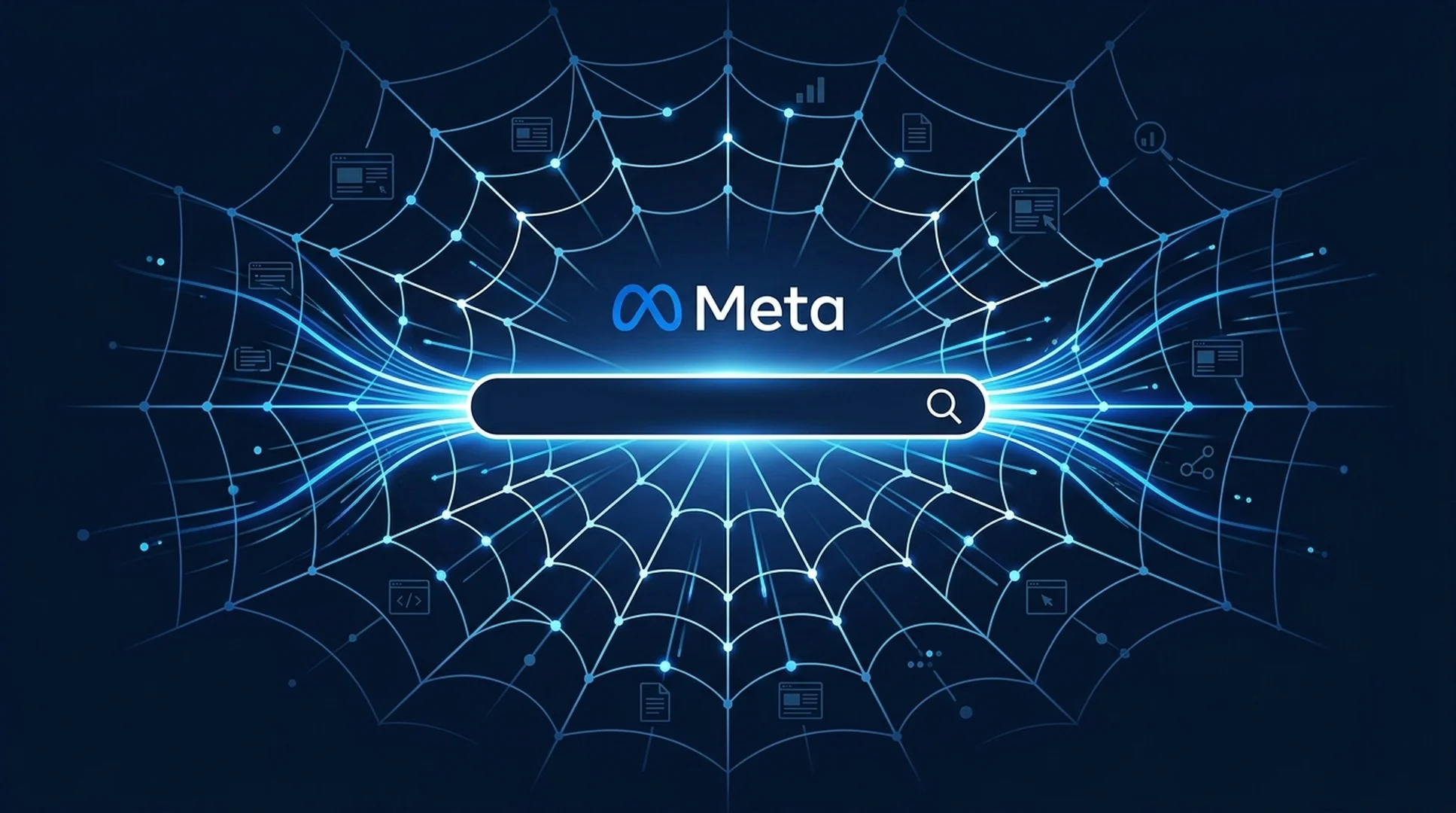
Meta is reportedly building its own web search engine, according to information shared by developer Pieter Levels on X. Levels, who operates several web properties including PhotoAI.com and InteriorAI.com, said Meta staff privately contacted him to say the company is constructing a web index to power its AI assistant, reducing its dependence on Google for web search results.
In a post on X on August 6, 2026, Levels wrote that Meta staff had direct-messaged him privately, and he was sharing the information with their permission. "Meta is ALLEGEDLY building their own Google search engine, so that if their AI does a web search it doesn't end up at Google, as Google could then use it for THEIR training, so they want their own web index that they will then use as their own Meta search engine for their AI," Levels wrote.
The details
Levels reported that Meta's web crawling activity has increased sharply. In a follow-up post, he said Meta was conducting "heavy heavy heavy scraping on all my sites this week too (and seemingly everyone else's sites now)." The crawling was aggressive enough to trigger server load alerts on one of his virtual private servers. Levels noted that Meta's crawlers were also hitting url2og, his screenshot service used across his web properties.
The post drew significant attention, accumulating over 6,900 likes and 315 replies on X.
Meta's own developer documentation, last updated May 21, 2026, corroborates the existence of multiple web crawlers that go well beyond traditional social media link previewing. The documentation lists five distinct crawler user agents, each serving different purposes:
- FacebookExternalHit: Crawls content shared on Meta's apps for link previews
- Meta-WebIndexer: "Navigates the web to improve Meta AI search result quality for users," according to the documentation, which adds that allowing the crawler in robots.txt "helps us cite and link to your content in Meta AI's responses"
- Meta-ExternalAgent: Crawls for "training foundation AI models or improving products by indexing content directly"
- Meta-ExternalFetcher: Fetches links at user request to support "agentic AI capabilities" and help AI "navigate websites to complete tasks for users"
- Meta-ExternalAds: Crawls for advertising-related purposes
The Meta-WebIndexer crawler stands out. Its stated purpose of improving "Meta AI search result quality" suggests Meta is already building a web index for AI-driven search, not merely collecting training data. The documentation explicitly frames allowing the crawler as a way for publishers to get cited and linked within Meta AI's responses.
Meta has not made an official announcement about building a standalone search engine. The company did not respond to requests for comment at the time of reporting.
Context
Facebook's interest in web search spans more than a decade. The company previously partnered with Bing to power web search results within Facebook, only to drop the partnership several years later. Meta also explored graph search, which allowed users to search for content within Facebook's social graph but never extended to comprehensive web search.
The current push appears driven by a different imperative. As AI assistants increasingly perform web searches on behalf of users, companies building those assistants need reliable access to a web index. Relying on a competitor for that access introduces strategic vulnerabilities. Google, which operates the dominant web search index, also competes in the AI assistant space with Gemini and AI Overviews. If Meta's AI routed searches through Google, Google could potentially use those query patterns to improve its own AI products.
This dynamic extends beyond Meta and Google. OpenAI entered a search partnership with Microsoft Bing before developing its own web crawling capabilities. The pattern across the industry suggests that any company building a consumer-facing AI assistant is moving toward owning its own search infrastructure rather than depending on a rival.
Meta's scale makes this worth watching. The company's family of apps, including Facebook, Instagram, WhatsApp, Messenger, and Threads, reaches more than three billion daily active users. If Meta AI becomes a primary way those users search for information, the underlying web index would be a substantial new search channel.
Why this matters for SEO and AI visibility
Meta's crawler documentation already frames Meta-WebIndexer as a way to get cited in AI responses, putting it alongside Google's AI Overviews and Bing's Copilot as a platform where content visibility matters. SEO and GEO teams that have been optimizing for Google's AI features may need to extend that work to Meta's ecosystem.
The robots.txt configuration is an immediate consideration. Sites that block Meta's crawlers, either intentionally or as a side effect of restrictive bot management policies, would be excluded from Meta AI's search results and citations. Teams should audit their robots.txt files to understand which Meta crawlers they currently allow or block, and make deliberate decisions about Meta-WebIndexer and Meta-ExternalAgent based on their AI visibility strategy.
The rivalry between Meta and Google also affects search traffic patterns. If Meta AI begins intercepting search queries that previously went to Google, the distribution of organic search traffic could shift. Publishers that rely heavily on Google for traffic may need to monitor referral patterns from Meta's platforms more closely.
What to watch next
Several signals will reveal whether Meta is building a full search engine or expanding its AI search capabilities step by step. Official announcements about Meta's web indexing strategy would clarify the scope and timeline. Changes in crawling intensity, especially from the Meta-WebIndexer user agent, will indicate how fast Meta is building its index. The evolution of Meta AI's search features within Facebook, Instagram, and WhatsApp will show how the company plans to surface web search results to users.
For SEO and GEO teams, the next steps are concrete: audit robots.txt for Meta crawler allowances, monitor server logs for Meta-WebIndexer and Meta-ExternalAgent activity, and track whether Meta AI begins citing your content in its responses.
Sources
- Pieter Levels (@levelsio), X post, August 6, 2026: https://x.com/levelsio
- Meta Web Crawlers documentation, Meta for Developers: https://developers.facebook.com/docs/sharing/webmasters/web-crawlers