Meet Auspia: Automated Organic Growth for What You've Built
You used AI to build something good. Getting it found shouldn't be a second full-time job.
Auspia is an AI-assisted SEO, Generative Engine Optimization (GEO), Answer Engine Optimization (AEO), and content-operations product from Felo Inc. It connects the work of getting discovered into one reviewable loop — so lean teams can grow their organic presence without a dedicated SEO department.
Watch the 50-second overview:
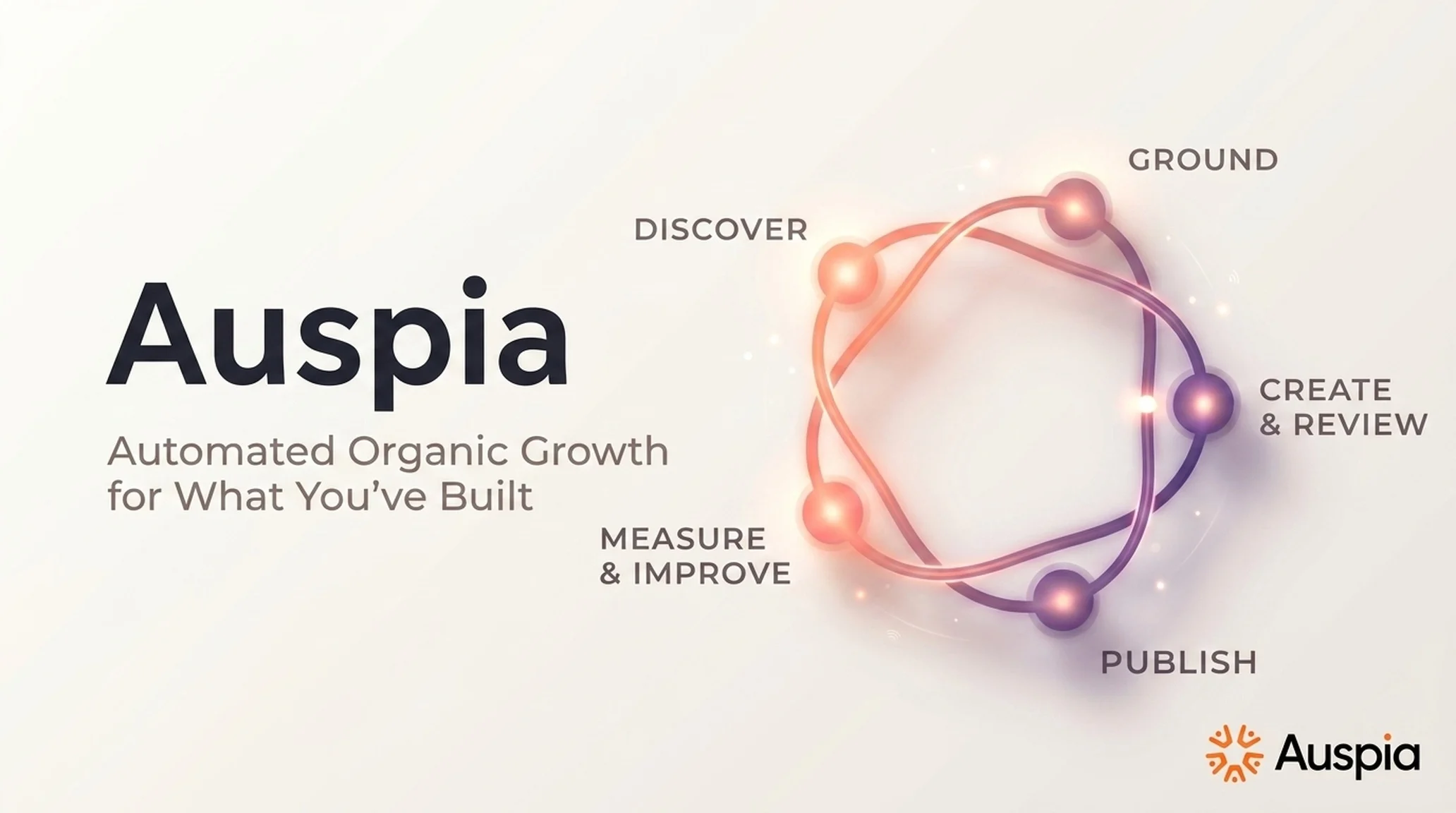
The product film walks through the connected loop: Discover → Ground → Create & review → Publish → Measure & improve.
The problem Auspia addresses
SEO and content operations commonly fragment across keyword exports, competitor reports, brand documents, writing tools, CMS interfaces, analytics products, and spreadsheets. That fragmentation makes it hard to answer basic questions:
- Which search or market opportunity should be worked on next, and why?
- Does a proposed topic fit the product, audience, existing content, and positioning?
- Which approved facts and source materials should guide a draft?
- Who reviewed a claim, a piece of content, or a publishing decision?
- What happened after publication, and what should be improved next?
For solo founders, early-stage startups, B2B SaaS teams, and small businesses, these questions compete with product development, sales, and support. Auspia provides a more structured, reviewable workflow for this work.
One connected loop
The product's operating model is five linked stages:
- Discover — identify keyword, market, site, or competitor signals worth investigating.
- Ground — add product facts, audience knowledge, site evidence, approved materials, competitor context, and brand guidance.
- Create and review — turn a defined action into editable content or an improvement task, then review it.
- Publish — release approved content to a configured CMS destination while retaining the final URL and release context.
- Measure and improve — inspect available site, content, search, event, and competitive signals; then select the next bounded action.
The sequence is deliberately cyclical. Measurement is not a retrospective dashboard alone; it feeds the next opportunity, content refresh, or investigation. AI assists repeatable research and production work; your team owns every decision.
Core capabilities
Opportunity discovery. Turn possible SEO work into a reviewable queue: keyword gaps, competitor activity, site observations, and recurring market signals. The output is not a ranked keyword list but a candidate opportunity with a stated signal, product fit, a recommended next action, and an accountable owner.
Brand and product context. Organize source material before it influences public-facing work — product info, positioning, audience needs, approved materials, site evidence, competitor context, and brand voice. This gives people and AI-assisted workflows a shared, inspectable basis for content decisions.
Content creation and editorial review. Content moves through drafting, editing, previewing, organization, and a release decision. A generated draft is an editable artifact, not an automatically publishable result. Writers improve the asset, subject-matter experts validate facts and claims, editors assess usefulness, structure, brand fit, and release readiness.
CMS publishing. Release reviewed content to a configured destination — the product identifies support for WordPress and Webflow among its integrations, plus authorized Google Search Console–related workflows. A published URL stays connected to the review that produced it.
Growth measurement. Connect observed signals to a named next action, reviewing available traffic, visitor, page, event, content, search, and competitive signals where connected sources allow. An observed metric does not establish causation, and metrics do not predict future traffic.
Competitive growth monitoring. Recurring, reviewable competitor review — traffic, keyword, rank, channel, endorsement, and content observations — turned into a disciplined weekly or regular planning process rather than an unqualified reason to copy another site's output.
Public diagnostic tools
Auspia also provides free public tools at https://auspia.ai/tools, useful as entry points before adopting a broader workflow:
- Website SEO Score Checker — a preview of core SEO signals, issues, and repair tasks for a site.
- On-Page SEO Checker — examines whether page content, metadata, links, schema, and crawl signals support a target topic; returns a health score, keyword evidence, and ordered fixes.
- AI Search Visibility Checker — reviews technical signals related to discovery and citation readiness in answer-engine contexts; reports an AI visibility score and blockers.
- GEO Score Checker — evaluates GEO readiness with a score based on 54 signals across 14 dimensions (AI crawler access, robots.txt, schema validity, llms.txt, headers, performance, content citability, E-E-A-T quality signals, and more); reports a 0–100 score and an A–F grade. 41 of the checks are mechanical and 13 are LLM-powered.
- Agent Readiness Scanner — evaluates 18+ agent-related standards across five categories (discoverability, content accessibility, bot access control, agent discovery, agent commerce), including robots.txt, XML sitemaps, Markdown content negotiation, AI crawler rules, MCP server cards, A2A agent cards, and more; reports a 0–100 score and Level 0 (Not Ready) to Level 5 (Agent-Native) readiness.
- LLMs.txt Generator / Checker — generates an
llms.txtdraft or inspects an existing file. - Robots.txt AI Crawler Checker — checks rules for major AI crawlers (OAI-SearchBot, GPTBot, ClaudeBot, Claude-SearchBot, Google-Extended, PerplexityBot, CCBot).
- Googlebot Smartphone Spider Simulator — a Googlebot Smartphone–style rendering report exposing visible text, metadata, and a deduplicated link inventory.
Who Auspia is for
Solo founders with a product and a market but no SEO department; early-stage startups that need steady content and discovery work; B2B SaaS teams that need product knowledge, content production, publishing, and measurement to stay connected; small and medium-sized businesses that want search visibility without agency-level overhead — plus the growth leads, product marketers, writers, editors, subject-matter experts, and agencies who operate inside the workflow. The product assumes these roles may be performed by one person or by several.
SEO, GEO, AEO, and agent readiness
Auspia treats conventional SEO, GEO, AEO, and agent readiness as related but distinct disciplines:
- SEO — visibility in conventional search systems: relevance, on-page structure, crawlability, and page quality.
- GEO — preparation for generative and answer-oriented search systems: whether AI systems can find, understand, trust, and potentially cite source content.
- AEO — making a site legible and actionable for AI answer engines and agents, not just for human visitors.
- Agent readiness — the technical and content conditions that help software agents discover a site, read machine-friendly content, understand access rules, and locate agent-facing interfaces.
This framing does not assume AI systems expose stable ranking rules, or that a website can control whether it is cited in a generated answer. Diagnostics identify concrete questions a team can review.
An honest note on results
No tool can guarantee rankings, indexing, citations in AI answers, traffic, revenue, or correctness. Auspia frames scores, signals, and generated materials as inputs to human review and prioritization. AI-assisted drafts are not automatically factual, legally compliant, brand-safe, or ready to publish. CMS publishing depends on configured destinations and authorization; measurement describes available activity in connected sources; and the Googlebot simulator is an approximation, not an official Google result.
Auspia is operated by Felo Inc. (Felo株式会社), Tokyo, Japan.
Get started
- Product website: https://auspia.ai
- Solutions: https://auspia.ai/solutions
- Product workflow: https://auspia.ai/product
- Public tools: https://auspia.ai/tools
- About: https://auspia.ai/about
- X (Twitter): https://x.com/Auspia_ai
- YouTube: https://www.youtube.com/@Auspia-ai