The short version
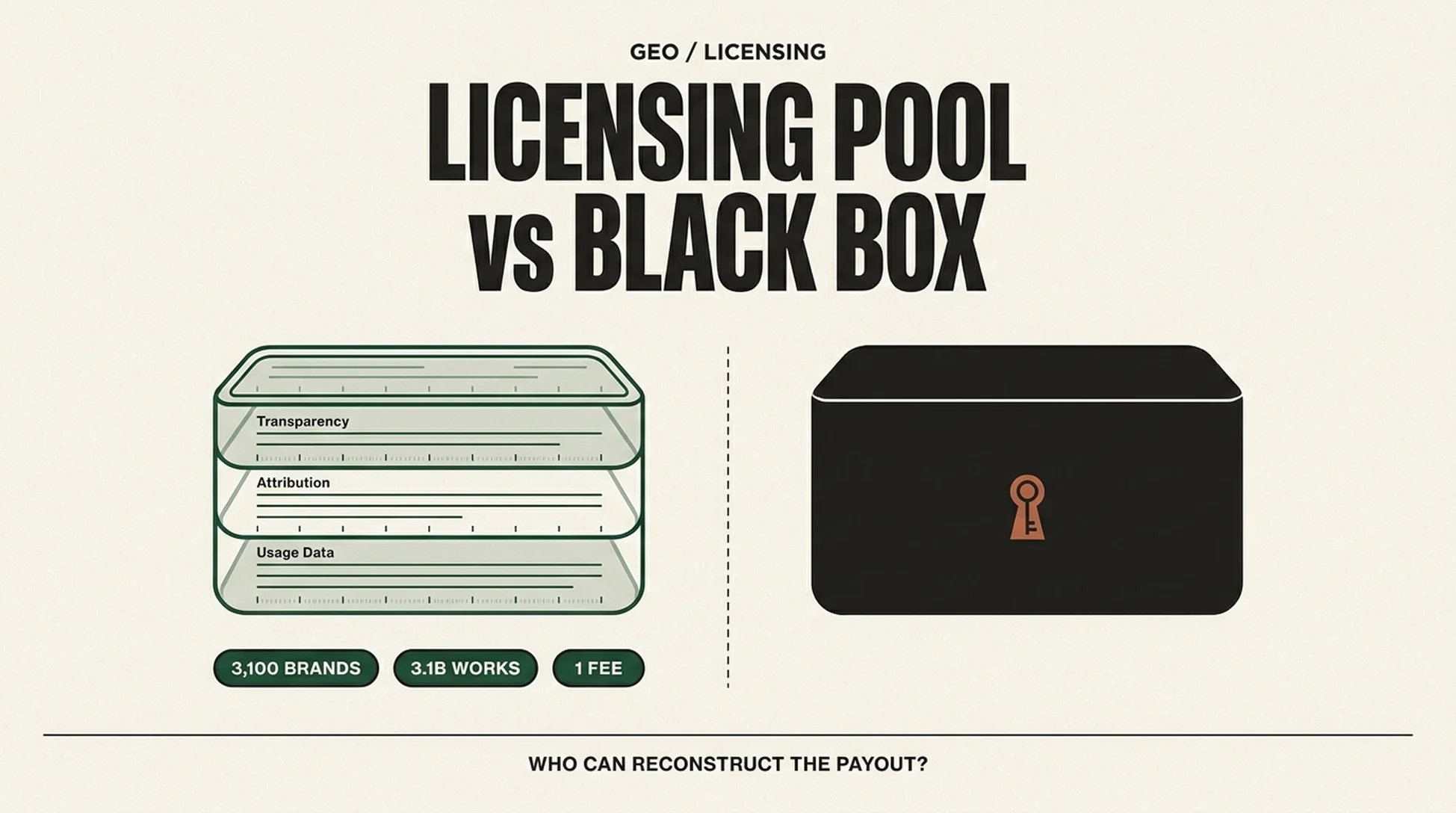
The Internet Licensing Collective (ILC) opened with more than 3,100 media brands and 3.1 billion licensable works, and named Yahoo Scout as its first commercial licensee. Publishers join for free, stay non-exclusive, and do not have to change how they publish.
The rate itself is not public. What is public is how the pool gets split: three stated factors, one of which rewards a work for shaping an answer, grounding an answer, or being cited as a source. That is the part worth your attention, because it turns a vague argument about "fair AI payments" into something you can audit against your own logs.
Google's AI contribution pilot has been running since earlier this year with roughly 100 participating publishers, and reporting on it has put several publishers below 0.1% of their ad revenue. The gap between those two designs is not the size of the check. It is whether you can tell why the number came out the way it did.
What launched, in plain terms
Item | What the collective states |
|---|---|
Name | The RSL Collective is now the Internet Licensing Collective (ILC) |
Coverage | 3,100+ publications and brands, 3.1B+ licensable works |
First licensee | Yahoo Scout, announced as the first commercial partner |
Publisher cost | Free to join |
Exclusivity | Non-exclusive |
Site changes required | None, beyond publishing an RSL declaration |
AI-side buying | One blanket license covers all participating works |
Pricing basis | Scales with the licensee's business |
Two things in that table are easy to skim past. First, "free to join" is doing real work: a licensing pool that charges publishers to participate has a chicken-and-egg problem, and this one avoided it. Second, "no changes to how you publish" is the difference between a program a two-person content team can join and one that requires an engineering sprint.
The names attached to the launch matter for the credibility of the pool. The collective's site lists a mix of regional newspapers, magazine groups, reference publishers, and consumer testing organizations. That mix is a reasonable early signal: it is not a single conglomerate testing a side project.
Yahoo's side of the announcement was carried by Eric Feng, SVP and GM of the Yahoo Research Group, with the line "AI answers are only as good as the sources behind them." ILC co-founder Doug Leeds framed the alternative directly: "The internet doesn't need another black-box payment experiment," adding that the collective is building a "transparent, durable licensing system with clear, incentive-aligned allocation rules."
That last phrase is the claim to test. So let's test it.
How a site actually opts in
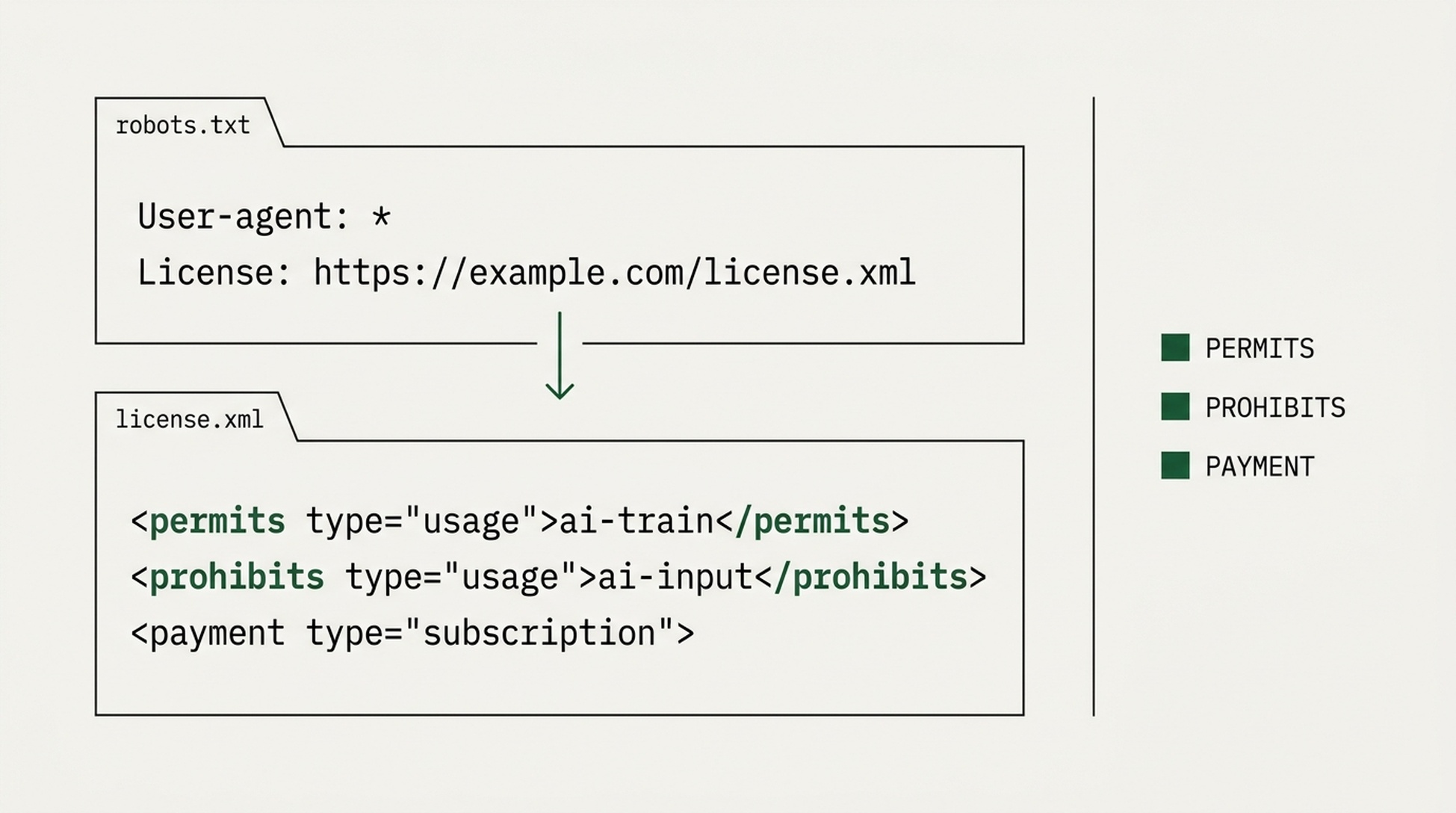
This is the part most coverage skipped. Opting in is two files, not an integration.
You publish a license declaration. The RSL standard, which the collective's parent effort published as an official industry standard in December 2025, is designed to live at a well-known location. In practice, a site adds a line to robots.txt pointing at a license document:
License: https://example.com/license.xmlThe license document then states what is permitted and what is not, in a form both humans and machines can read. The standard's vocabulary includes permits and prohibits entries for usage types such as AI training and AI input, and a payment element that can describe a subscription arrangement. It is deliberately small.
The consequence for a publisher is practical: you are not shipping an SDK, you are not uploading a corpus, and you are not negotiating one contract per AI company. You are stating terms in a place that crawlers already read.
The consequence for an AI company is equally practical: it can buy one license instead of a thousand, which is the entire economic argument for a collective.
Where the money goes: three factors, in writing
The collective's FAQ states that allocation tracks three things:
- How your work contributes. Work that shapes an answer, provides grounding, or is cited as a source is weighted more heavily than work that is merely available.
- How often AI relies on it. Frequency of use in generating responses.
- The value of the AI use. The commercial weight of the interaction the work supported.
Read those three together and you get a coherent incentive design. Factor one pays for being selected. Factor two pays for being selected repeatedly. Factor three pays for being selected in expensive contexts, which in most AI products means commercial ones.
Factor one is the one that should change how you plan content. A licensing pool that pays more for grounding and citation than for raw inclusion is, functionally, a citation-based revenue share. It rewards the same properties that make a page quotable in an AI answer: extractable claims, specific numbers, clear provenance, and structure that a retrieval system can lift without guessing.
The collective also says participants get a dashboard showing how their usage breaks down, which is the minimum requirement for anyone to verify a payout instead of accepting it.
The comparison that matters
Here is the same question asked of both designs: can a publisher reconstruct why they were paid what they were paid?
Question | Google's AI contribution pilot | A collective with published factors |
|---|---|---|
Is there a stated allocation formula? | Not publicly | Yes, three factors |
Can a publisher see per-surface usage? | Limited reporting | Usage dashboard by site |
Is participation exclusive? | Invitation-based | Non-exclusive, free to join |
Does a publisher have to change publishing? | No | No, beyond a license declaration |
What does reporting on payouts show? | Several publishers below 0.1% of ad revenue; one at roughly $50,000 to $60,000; one above $1 million a year | Payouts not yet public at scale |
Who sets the price? | The buyer | Negotiated with licensees, price scales with their business |
The reporting on Google's AI contribution pilot, from The Information at the end of September, described an invitation-only program with around 100 publishers where several participants earned less than a tenth of a percent of their advertising revenue, one earned in the $50,000 to $60,000 range, another more than $1 million a year, and small publishers received under $1,000 after months of participation. The spread is the story. A wide spread can mean the program is genuinely value-based, or it can mean the inputs are opaque enough that nobody can tell. Without a published formula, both readings survive.
The ILC has the opposite risk. A published formula does not guarantee a large pool. If the total collected is small, a fair split of a small number is still a small number. The collective's own framing leans on scale: it cites a Mather Economics report projecting that collective AI licensing revenue could surpass digital display advertising within three years, alongside an estimate of AI revenue reaching $500 billion or more by 2030, with licensing in a $75 billion to $170 billion band. Those are projections attached to an advocacy position, so treat them as the ceiling of a range, not a forecast.
What this changes about measurement
If citing and grounding get paid, then the metric that matters stops being "did an AI mention us" and becomes "did an AI rely on us, and can we prove it." Three things follow.
Your referrer logs are now a revenue input, not just a traffic report. If a licensing pool allocates on usage frequency and citation, the same evidence you use to argue for a payout is the evidence you should be collecting now, before any dispute exists.
Citation quality beats citation volume. Being the source an answer rests on is worth more than being one of nine links under it. That is an editorial decision, not a technical one: it means publishing claims other people cannot easily restate without you.
Licensing terms belong in the same review as robots and crawler policy. The RSL declaration sits in the same file as your crawl directives. If one team owns robots.txt and another owns commercial strategy, this is the moment to put them in one room, because a stray directive can now cost revenue in two ways at once.
A 30-day sequence you can actually run
This is deliberately small. It assumes no engineering project and no legal budget beyond a review.
Days 1 to 5: baseline the evidence you already have. Pull 90 days of server logs and referrer data. Separate hits that are retrieval fetches from hits that are user clicks. Record which URLs get fetched repeatedly, because repeat fetching is the closest available proxy for "how often AI relies on it."
Check: you can name your ten most-fetched URLs and your ten most-cited URLs, and the lists are not identical. If they are identical, your sample is too small.
Days 6 to 12: read your own terms. Find every place your site states what automated systems may do: robots.txt, terms of service, any AI-specific policy page. Note where they contradict each other. Contradictions are normal after two years of patching.
Check: a colleague who has never read these files can answer "can an AI company train on us, and can it quote us in an answer?" in under a minute.
Days 13 to 20: decide your position, then write it down. Opting in to a collective and blocking AI crawlers are not morally opposed, but doing both by accident is expensive. Pick a stance, write one paragraph explaining it, and date it. The explanation is what you will need in six months when someone asks why the policy changed.
Check: the paragraph names a revenue assumption, not only a principle.
Days 21 to 30: publish the declaration and re-verify. Add the license declaration, then confirm that crawlers can actually read it. Check that your license document returns a 200, is not blocked by the same rules it is meant to communicate, and is not hidden behind a bot challenge.
Check: fetch the declaration the way a crawler would, from outside your network, and read the raw response.
The failure mode here is publishing a license file in a location your own crawler rules block. It happens more often than you would think, and it is the kind of error that quietly voids a whole program.
Where this can still go wrong
Three honest caveats.
The first licensee is a single partner. One license does not make a market, and the collective's revenue depends on signing AI companies that currently have every incentive to keep negotiating privately. Yahoo Scout is a credible start, not a proven floor.
The allocation factors are directional, not numerical. "Shapes an answer" is weighted more than "available," but by how much? Until splits are published, publishers can verify their own usage but not the fairness of the conversion from usage to dollars.
And a licensing pool changes the negotiation, not the underlying competition for citations. You still have to be the source worth citing. The pool pays better for the work that already wins.
What I would watch next
Three signals, in order of how much they would tell you:
- A second and third licensee. One AI company can be a pilot. Three starts to look like a market with a price.
- Published split ratios. If the collective publishes the weights behind its three factors, the "transparent" claim becomes checkable, and competitors will be measured against it.
- Whether participants publish payout ranges. Even a rough band per publisher size would let the rest of the industry sanity-check the projections.
Until then, the useful move is unglamorous: collect the usage evidence now, so that whichever payment model wins, you are arguing from data instead of from principle.
FAQ
Does joining the ILC mean I have to license training data? No. The collective describes participation as non-exclusive, and the RSL declaration is where you state which uses you permit and which you prohibit. Licensing for AI input and licensing for model training are separate entries in the standard's vocabulary, so they can be decided separately.
Is this the same as Google's publisher payments? No, and the difference is structural rather than a matter of size. Google's pilot pays selected publishers directly under terms that have not been published in formula form. A collective pools licensee fees and allocates them across participants using stated factors.
Do I need to change my site to participate? According to the collective, no. Participation requires publishing an RSL declaration rather than uploading content or integrating an API. The work is in writing clear terms, not in changing your stack.
Will this replace display advertising revenue? Not on current evidence. The projection that collective licensing could surpass display advertising within three years comes from a report the collective cites, and it depends on licensees signing at scale. Treat it as a scenario, not a plan.
What should a small publisher do this month? Start logging. Record which URLs AI systems fetch and how often, keep the raw logs, and write down your policy position. The logging costs nothing and is the one input every payment model has in common.
Author: Vivian Brooks, B2B Case Study Strategist at Auspia. She writes about evidence narratives, outcome framing, and how publishers turn usage data into commercial arguments.