How to Use AI for Research: Workflows for Literature Reviews, Competitive Analysis, and Fact-Checking
AI research tools can compress hours of searching, screening, and drafting into minutes. They can also invent citations, flatten nuance, and make weak sources look confident. The difference is not the model brand. It is whether you treat AI as a research operator with a repeatable workflow, checkpoints, and a human sign-off standard.
This guide shows how to use AI for research as an end-to-end process: frame the question, find sources, synthesize findings, verify claims, and cite accurately. It covers three high-value workflows—literature reviews, competitive analysis, and fact-checking—plus quality controls that keep speed from becoming sloppy output.
What “good” AI-assisted research looks like
Before opening any tool, define the completion standard. A useful AI research run ends with:
- A scoped question you can answer or disprove.
- A source set with links, dates, and provenance you can reopen.
- A synthesis that separates evidence, interpretation, and open questions.
- Verified claims that survived contradiction checks.
- Citations tied to pages you actually read—not titles the model guessed.
If any of those five are missing, the run is incomplete. Speed only counts when the output is audit-ready.
The benefits of AI in research show up when the tool handles breadth and first-pass structure, while you keep ownership of relevance, methodology, and final judgment. That division of labor is the core of every workflow below.
End-to-end AI research workflow
Use this sequence for almost any research job, then specialize it for literature review, competitive analysis, or fact-checking.
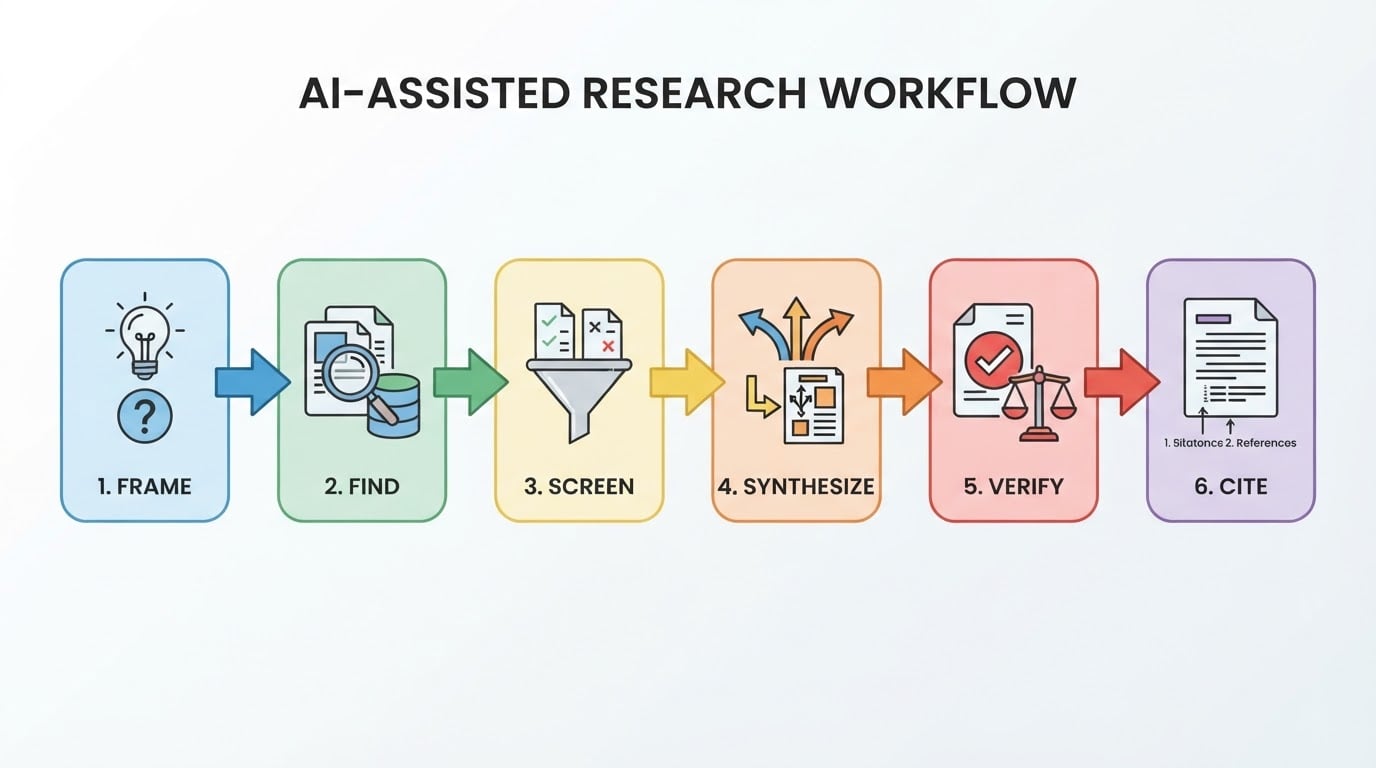
1. Frame the question tightly
Give the model a research brief, not a vague topic.
Include:
- Decision or deliverable: brief, memo, lit review section, competitor map, claim check
- Scope: industry, geography, time window, population, product category
- Must-include sources: primary papers, filings, official docs, first-party data
- Exclusions: outdated years, marketing blogs, paywalled pages you cannot verify
- Output format: table, annotated bibliography, claim ledger, synthesis memo
Example prompt skeleton:
Research question: one sentence. Audience: who decides. Time window: dates. Include only sources with URLs I can open. Return: (1) key claims with source URLs, (2) agreements/disagreements across sources, (3) unknowns, (4) recommended next searches. Do not invent citations.
2. Find sources before you ask for answers
The highest-leverage habit is discovery first, synthesis second.
- Ask AI for search queries, synonyms, authors, datasets, and adjacent terms.
- Run those queries in scholarly indexes, web search, company docs, and news archives.
- Save candidate sources with title, URL, date, publisher, and why they matter.
- Only then ask the model to summarize or compare the materials you collected.
If you reverse the order—answer first, sources later—you invite confident fiction.
3. Screen fast, then read deeper
Have AI produce a screening matrix:
Source | Type | Date | Relevance (1–5) | Method quality | Bias risk | Keep? | Why |
|---|
Keep the “why” column human-owned. Models are good at pattern matching titles and abstracts. They are weaker at judging study design, conflicts of interest, or whether a source actually supports the claim you need.
4. Synthesize by claim, not by document
Document-by-document summaries create long notes and weak insight. Claim-level synthesis is better:
- Extract candidate claims.
- Attach supporting sources to each claim.
- Mark confidence: strong / mixed / weak / contested.
- Write the synthesis from the claim map.
This is also how you prepare accurate citations later: every sentence that carries weight already has a source trail.
5. Verify, then cite
Verification is not optional polish. It is the quality gate.

For every material claim:
- Open the source.
- Confirm the passage supports the claim in context.
- Check date, jurisdiction, sample, and definitions.
- Look for contradictions in equally strong sources.
- Only then draft the sentence and attach the citation.
Purdue OWL’s guidance on quoting, paraphrasing, and summarizing still applies when AI helps you draft: read the source, restate ideas in your own words, quote sparingly, and always credit the original work. AI does not change the citation obligation; it only changes how easy it is to lose track of provenance.
6. Produce the deliverable with an audit trail
Final output should include:
- answer or recommendation
- evidence table or claim ledger
- open questions
- source list with stable URLs
- assumptions and limits
That package lets a teammate, advisor, or future you rebuild the reasoning without redoing the whole search.
Literature review workflow with AI
A literature review is not a pile of paper summaries. It is a structured account of what is known, disputed, and missing on a question.
Workflow
- Lock the review question and inclusion rules
Population, intervention/topic, outcomes, years, languages, study types. - Expand the search vocabulary with AI
Ask for synonyms, related constructs, common abbreviations, seminal authors, and adjacent fields. Keep a living keyword list. - Build a candidate corpus
Pull results from databases and trusted repositories. Export titles, abstracts, DOIs/URLs, and years into a sheet or reference manager. - Screen in two passes
- Pass A: title/abstract relevance with AI assist.
- Pass B: full-text keep/drop with human criteria (methods, population fit, outcome quality).
- Extract data fields consistently
Study aim, sample, method, key findings, limitations, relevance to your question. AI can draft extraction rows; you accept or rewrite them after reading the paper. - Synthesize themes and contradictions
Group by mechanism, population, method quality, or chronology—not by the order you found the PDFs. - Write the review from the matrix
Start from agreements, disagreements, and gaps. Attach citations only to papers you opened.
Completion check for literature reviews
You are done when:
- inclusion/exclusion rules are explicit
- every cited paper was opened and extracted
- themes cover both consensus and conflict
- gaps are stated as researchable unknowns
- no citation exists without a recoverable source
Prompt patterns that help
- “Generate Boolean search strings for databases covering constructs. Flag overly broad terms.”
- “From these abstracts, score relevance to question and list likely false positives.”
- “Build a theme map: shared findings, conflicting findings, methodological weaknesses, open questions.”
- “Draft an annotated bibliography entry only from the abstract and methods text I paste. Mark any missing details as unknown.”
Competitive analysis workflow with AI
Competitive analysis fails when AI turns marketing language into “facts.” Treat competitor claims as claims to verify.
Workflow
- Define the decision
Positioning, pricing response, feature prioritization, market entry, sales battlecard. - Build a competitor set and dimensions
Direct/indirect competitors, substitutes, and evaluation criteria: ICP, pricing model, core features, integrations, proof points, distribution, limitations. - Collect primary evidence first
Product pages, docs, pricing pages, release notes, filings, case studies, app listings, job posts, customer reviews. Ask AI to suggest source types, then gather the pages yourself. - Extract comparable fields into one table
Force every competitor through the same columns. If a cell lacks evidence, leave it blank or mark “unverified.” - Separate observed fact from inference
“Page lists SSO” is observation. “Enterprise-ready security” is interpretation unless evidence supports it. - Generate insight questions, not just summaries
Where are they strong for your ICP? Where is messaging ahead of product? What whitespace exists? What would change your recommendation? - Produce a decision memo
Recommendation, supporting evidence, risks if wrong, watchlist signals.
Completion check for competitive analysis
Done means:
- every comparison cell has a source or an explicit unknown
- claims from vendor pages are labeled as vendor claims
- the memo answers the original decision
- next monitoring signals are listed
Useful AI roles here
AI tools for research shine in competitive work when they:
- normalize messy notes into a matrix
- cluster feature language into comparable categories
- draft objection-handling from verified differences
- surface missing evidence (“no public pricing found”)
They should not invent feature parity, customer counts, or roadmap items.
Fact-checking workflow with AI
Fact-checking is the workflow that protects every other research use case. Use it on AI output, human drafts, and third-party claims.
Workflow
- Extract atomic claims
Break prose into checkable statements: who/what/when/where/how much. - Classify each claim
Factual / definitional / causal / predictive / opinion. Only the first three are fact-checkable in a strict sense. - Find independent sources
Prefer primary documents, official statistics, peer-reviewed work, and contemporaneous reporting over secondary roundups. - Verify in context
Read surrounding text. Numbers can be accurate and still misleading if the denominator, date, or population changed. - Run a contradiction pass
Ask AI: “What would falsify this claim? What reputable sources disagree?” Then check those sources yourself. - Assign a verdict
Supported / partially supported / unsupported / false / unverifiable. Record the reason in one line. - Rewrite the sentence to match the evidence
Downgrade language when evidence is thin. Remove decorative precision.
Completion check for fact-checking
A claim is cleared only when:
- the supporting source is openable
- the exact scope matches the sentence
- contradictions were checked
- the citation points to the page that carries the evidence
Trustworthy AI use depends on human oversight, validity checks, and transparent limits. Frameworks such as the NIST AI Risk Management Framework emphasize managing risk through governance, measurement, and ongoing oversight rather than treating model output as automatically reliable. In research practice, that means you remain accountable for what gets published or decided.
How to find, synthesize, and cite information accurately
Find
- Start with the question and source types you trust.
- Use AI to expand queries, not to replace retrieval.
- Capture metadata immediately: URL, title, author/org, date accessed.
- Prefer primary over secondary when stakes are high.
Synthesize
- Work claim-by-claim.
- Distinguish evidence, inference, and recommendation in separate layers.
- Keep disagreements visible; forced consensus is a research failure mode.
- Write unknowns as first-class output.
Cite
- Cite only sources you read.
- Paraphrase by default; quote when wording itself matters.
- Match citation detail to the claim’s precision.
- If AI drafts a reference list, validate every entry against the live page or database record before keeping it.
A practical rule: no orphan citations, no orphan claims. Every citation maps to a sentence, and every important sentence maps to a source.
Prompt patterns and quality controls that reduce hallucinations
Use these controls on every serious research run.
Prompt patterns
- Source-bound answering
“Use only the sources below. If the answer is not supported, say ‘not in sources.’” - Claim ledger mode
“Return rows: claim | support quote or paraphrase | source URL | confidence | missing info.” - Adversarial review
“Attack this draft. List weakest claims, likely hallucinations, and missing counter-evidence.” - Definition lock
“Define key terms first. Keep those definitions stable across the memo.” - Unknowns first
“List what cannot be answered from available evidence before writing conclusions.”
Process controls
- Cap first drafts; invest time in verification.
- Separate generation chats from verification chats when possible.
- Keep a source folder the model cannot silently rewrite.
- Require URLs for any statistic, ranking, pricing, or capability claim.
- Re-run key claims after major edits; rewriting introduces new errors.
Human override moments
Override AI immediately when:
- a citation cannot be opened or does not contain the claim
- legal, medical, safety, or financial stakes are high and sources are thin
- the model collapses competing findings into false certainty
- primary data contradicts a fluent summary
- the deliverable will be published, graded, regulated, or used for a material decision
In those cases, slow down, widen the source set, or conclude “unverifiable.”
Choosing AI tools for research without turning this into a listicle
You do not need the “best free AI for research” ranking to build a strong workflow. You need role coverage:
Research role | What good looks like |
|---|---|
Discovery | strong query expansion, web/scholar retrieval, source links |
Reading assist | faithful summarization of text you provide |
Synthesis | claim maps, comparison tables, gap analysis |
Deep multi-source analysis | longer research runs across many documents with citations |
Knowledge reuse | saving corpora, notes, and prior answers for later projects |
Drafting | structured memos that remain editable and citeable |
Free AI tools for research can handle many discovery and drafting steps. Paid or specialized tools matter more when you need deeper multi-source runs, team workflows, or tighter source handling. Evaluate tools by whether they preserve links, expose uncertainty, and fit your verification process—not by feature count alone.
If you need a dedicated deep-research pass after quick search, some platforms position a separate deep research mode for multi-source synthesis. Felo’s Fable Research, for example, is described as a deep research product intended for comprehensive analysis rather than quick answers, including use cases such as literature review with citation analysis and multi-source market research. Treat any product claim as a starting point: confirm current capabilities in the product itself, and still apply the verification workflow above.
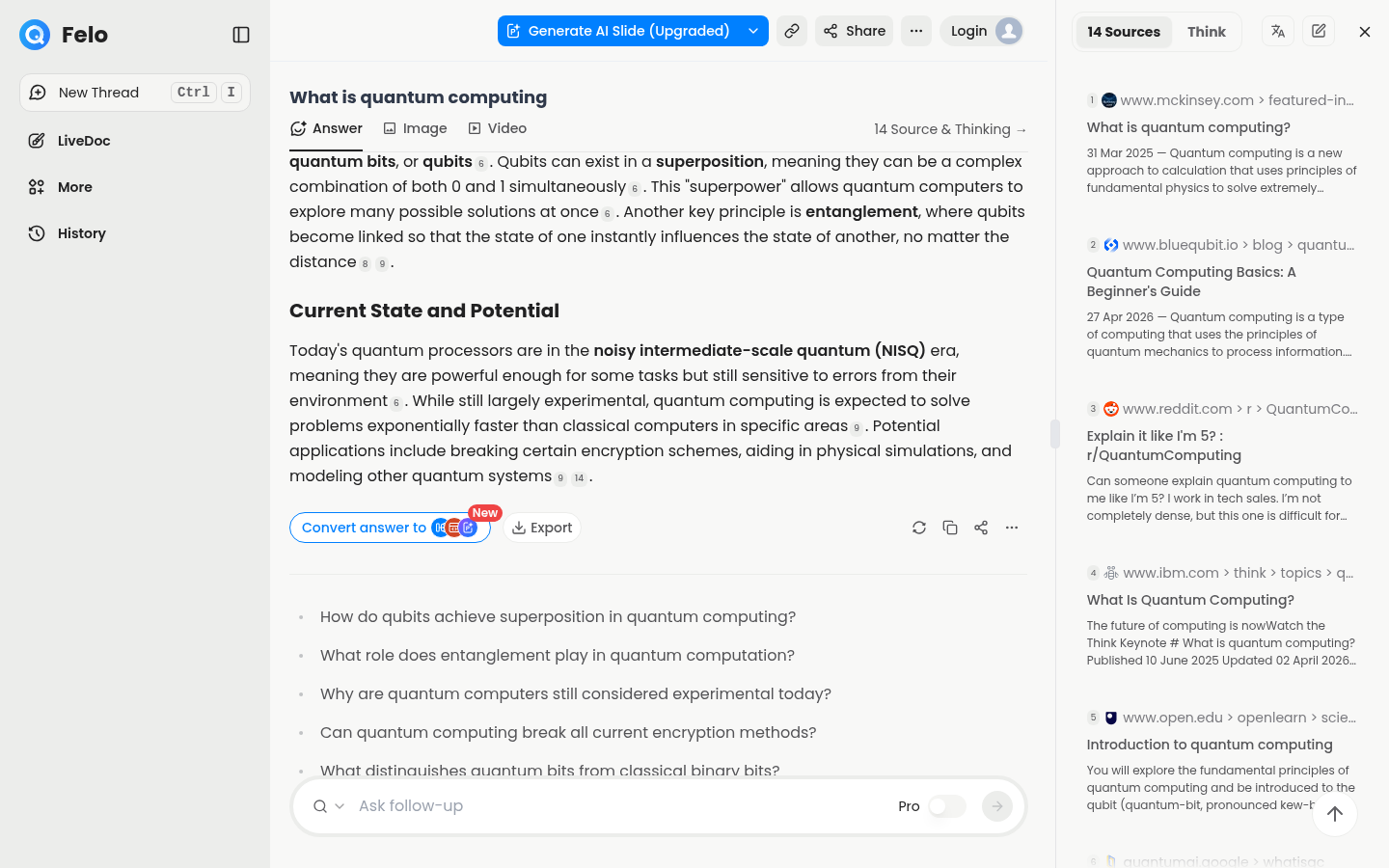
Search result page with the '14 Sources' panel open on the right side. The panel lists 14 numbered source references with website favicons, URLs/domains (mckinsey.com, bluequbit.io
A one-page operating checklist
Copy this into your next project:
- Write the research question and decision.
- Set inclusion rules and time window.
- Generate search terms with AI; collect sources yourself.
- Screen into a keep list with reasons.
- Extract claims into a ledger with URLs.
- Synthesize agreements, conflicts, and gaps.
- Fact-check every material claim in context.
- Draft the deliverable from verified claims only.
- Validate every citation against the live source.
- Record assumptions, limits, and watchlist items.
If steps 7 and 9 are skipped, you used AI to write faster—not to research better.
Final takeaway
Learning how to use AI for research is less about clever prompts and more about operational discipline. Use AI to expand discovery, structure notes, and accelerate first drafts. Keep humans responsible for relevance, contradiction checks, and citation integrity. With that split, literature reviews move faster without losing rigor, competitive analysis stays evidence-based, and fact-checking becomes a habit instead of an afterthought.
Start your next project with a claim ledger and a completion standard. The tools will change. The workflow that keeps findings true should not.