Make the keyword decision visible before you make it final
Keyword research usually disappears into tabs, spreadsheets, and a few messages that nobody can reconstruct later. Google Antigravity offers a more useful pattern for this task: ask agents to produce reviewable artifacts at the moments where judgment matters.
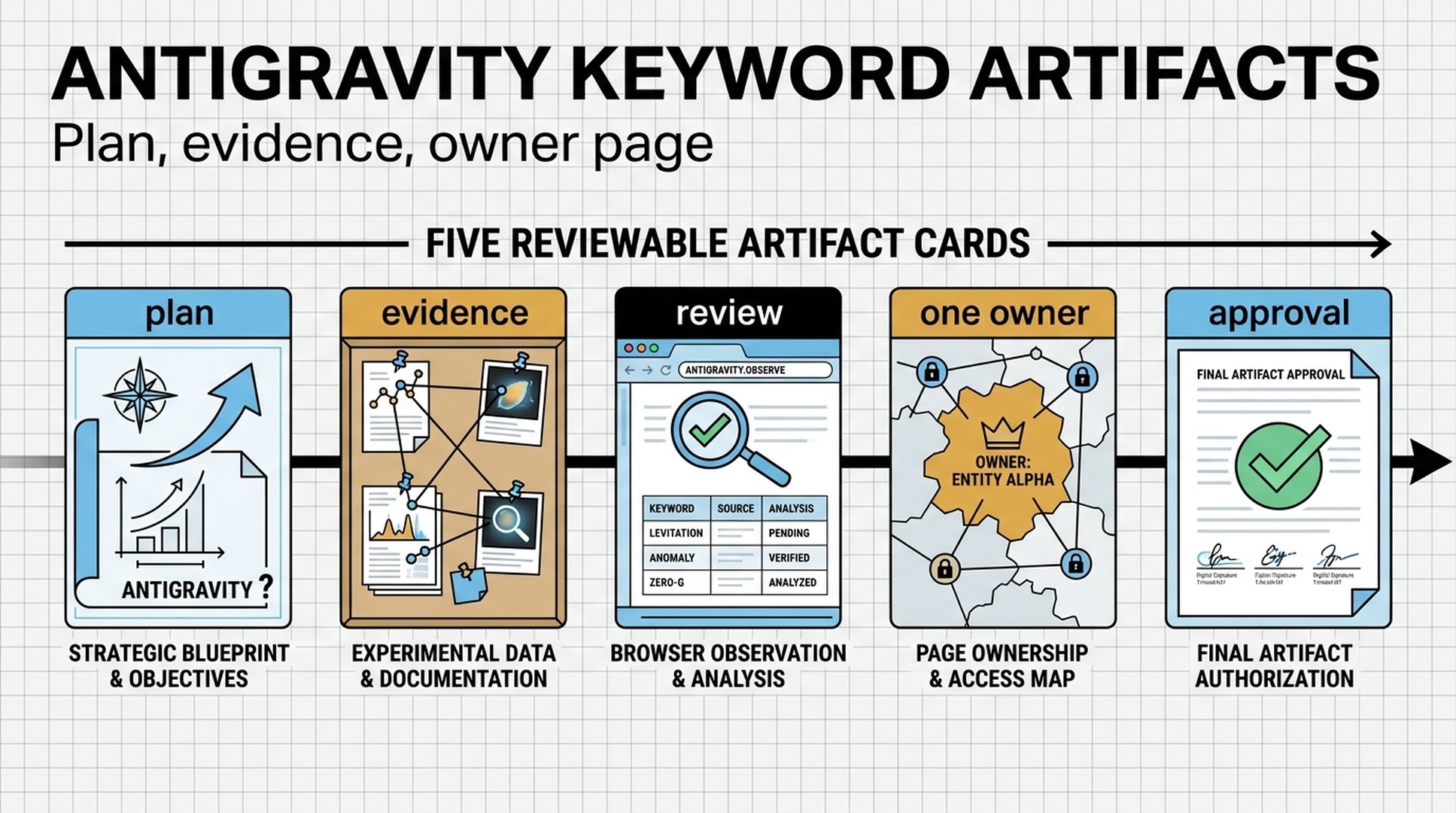
Instead of requesting a single answer, build a chain of artifacts: a research plan, an evidence board, a page-ownership map, a candidate brief, and a final approval note. The keyword is chosen only after a reviewer sees the route from evidence to recommendation.
Use this workflow if: you work with a project or workspace that can keep research artifacts visible for review.
You will finish with: a chosen primary keyword, a page decision, a recorded evidence trail, and an approved content brief or implementation request.
You need: authorized keyword data, a current content inventory, approved product facts, and permission for any browser or local-workspace actions you enable.
Done means: the team can review the artifacts without replaying every agent action or relying on a chat memory.
Start in planning mode with a one-question brief
Do not ask an agent to "research SEO keywords" in an empty project. Begin with one decision question:
We need to decide whether [audience] should be served by an existing page,
a refreshed page, a consolidated page, or one new page.

Market and language: [...]
Business conversion: [...]
Claims we can support: [...]
Candidate source files: [...]
Existing content inventory: [...]
Research boundary: use only supplied data and explicitly approved browser checks.

Create a plan artifact. Do not browse, edit, publish, or choose a winner yet.
The plan artifact should name the questions to answer, the sources needed, the tools that may be used, the expected deliverables, and the review point. If the plan assumes access you have not granted, revise it before execution.
Quality check: the plan distinguishes supplied data from work that still requires a browser observation or human input.
Create an evidence board with provenance attached
Once the plan is accepted, prepare a structured artifact with four lanes:
Lane | Evidence to place there | Decision it informs |
|---|---|---|
Demand | Dated provider export and exact query wording | Is the phrase worth evaluating? |
Need | Customer language and searcher context | What job is the visitor trying to complete? |
Feasibility | Current result-page observations | What format must the page compete with? |
Ownership | Existing URL and content inventory | Where should the topic live? |
Each item needs a source label, date, market, and confidence marker. The point is not visual polish. It is to stop an agent summary from making a metric look current when it came from an old export, or making an inference look like a customer fact.
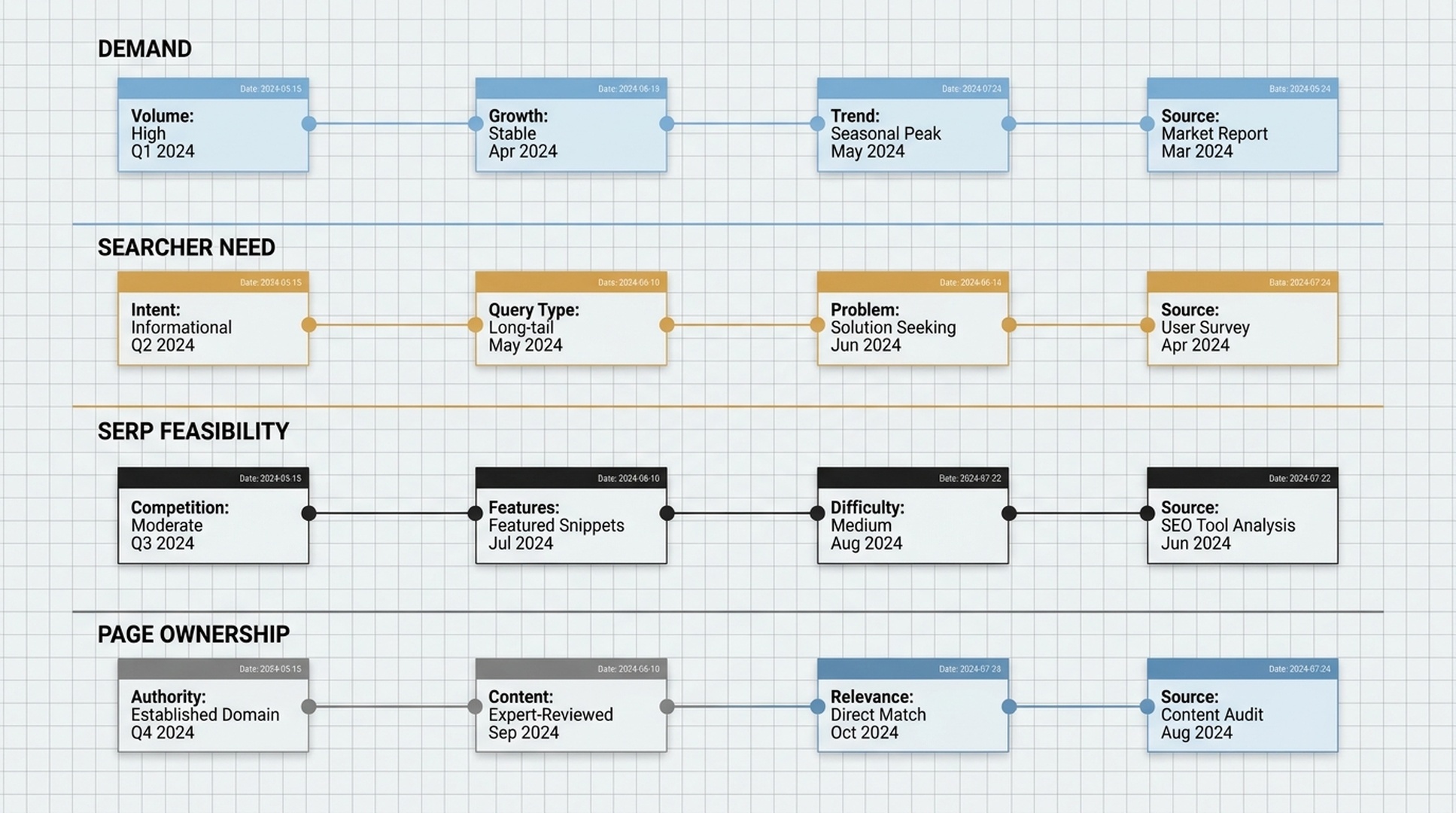
Caption: A four-lane evidence board keeps different kinds of proof from being blended into one vague recommendation.
Use browser evidence carefully
An Antigravity browser-capable environment can help collect observable SERP details or inspect public pages, but browser activity should be scoped and reviewable. Enable only the tabs and actions the research plan needs.
For each search query, capture an artifact with:
- market, language, and query text;
- date and approximate time;
- visible result formats and dominant page types;
- recurring entities or brands;
- notes about the apparent searcher task;
- any ambiguity that requires a person to interpret it.
Do not treat a screenshot or recording as a ranking guarantee. It is a point-in-time observation. Also do not use the browser to enter private accounts or change a website unless that access and action are separately authorized.
Ask agents for competing interpretations
The strongest candidate is often the one that survives a serious alternative explanation. Assign separate review tasks that produce artifacts, not one blended response:
- Intent analyst: explains what the query likely means in this market.
- Content cartographer: maps candidates to existing URLs and flags overlap.
- SERP format reviewer: compares the proposed page type with the observed results.
- Business-evidence reviewer: identifies claims the business can and cannot support.
- Dissent reviewer: argues for the best alternative candidate or no-action outcome.
The final recommendation should quote the disagreements. Consensus that has no visible dissent is usually a sign the task was too narrow or the sources were too thin.
Produce a page-ownership artifact
This is the decision artifact most teams skip. Map the finalist query family to one content surface:
Primary query:
Searcher job:
Current owner URL:
Decision: refresh / expand / consolidate / create / defer

Why this surface:
- existing coverage
- observed SERP format
- approved business evidence
- conversion path

Overlap risks:
Files or pages involved:
What must not be changed:
If no existing page is suitable, the artifact should propose a route or page type and list the evidence needed before writing starts. If two pages compete, make consolidation or differentiation explicit instead of treating both as supporting pages.
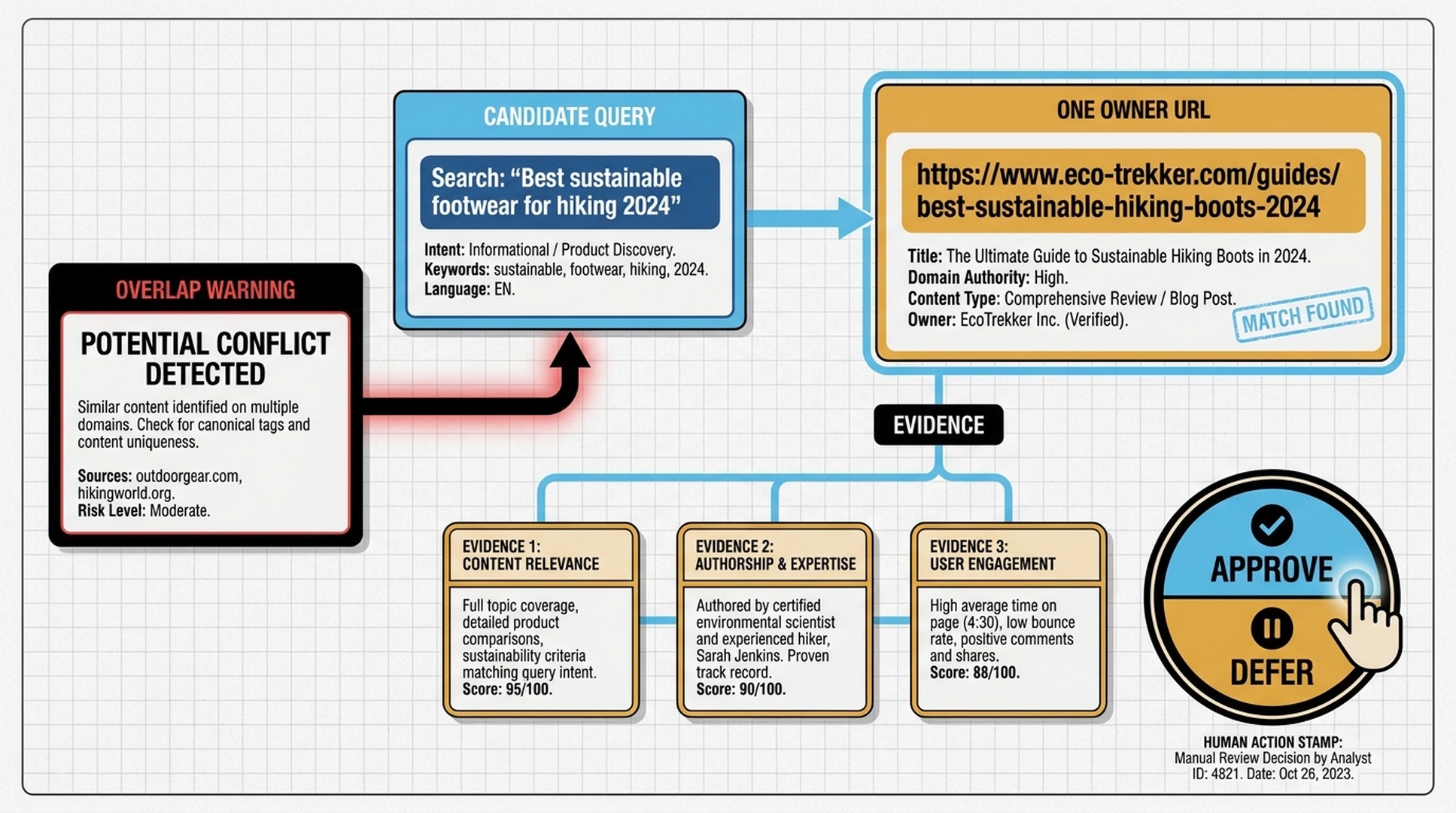
Caption: Page ownership is the bridge between keyword research and a change the site can actually support.
Hold the artifact review at the right boundary
Review happens before any edit, not after a long chain of autonomous work. The approver should see:
- the original research plan;
- the evidence board;
- the browser observation artifacts, where used;
- competing interpretations;
- the page-ownership decision;
- open unknowns and proposed next action.
Choose one state: approve, revise, defer, or reject. If you approve implementation, start a new bounded task with a fresh plan. Keep research and publishing separate.
Turn an approved decision into a small next task
The next task depends on the route:
Route | Appropriate next artifact |
|---|---|
Refresh | Outline and evidence requirements for one existing URL |
Expand | Section plan that protects the current page focus |
Consolidate | Redirect and content migration proposal for technical review |
Create | Page brief with approved facts, format, and internal-link plan |
Defer | Research gap list and next review date |
This is where Antigravity's artifact model earns its keep. A reviewer can approve a specific plan or diff without granting an agent a blank check to modify the project.
Verify the research chain
- [ ] A plan artifact existed before research actions began.
- [ ] Each evidence item retains source, date, market, and confidence.
- [ ] Browser artifacts contain observations, not ranking promises.
- [ ] At least one competing interpretation was reviewed.
- [ ] One URL or planned route owns the chosen query family.
- [ ] A human selected the final decision state.
- [ ] Implementation, publication, and external actions remain separate tasks.
FAQ
Do I need browser access for every keyword decision?
No. A manual SERP worksheet can be enough. Browser access is useful when the authorized environment can capture a clear, reviewable observation.
Can multiple agents choose the keyword by vote?
They can provide competing interpretations, but voting does not replace the business owner's judgment. Evidence and page ownership matter more than a majority response.
What are artifacts in this workflow?
They are the reviewable outputs that make the work inspectable: plans, evidence boards, page maps, notes, diagrams, and any approved browser recordings.
Should the agent update a page after the artifact review?
Only as a new, explicitly scoped task. Approval of the keyword decision is not automatically approval to edit or publish.
Author: Freya Collins, AI Answer UX Researcher, 900+ Answer Blocks Studied at Auspia. Freya writes about reviewable AI workflows, evidence design, and content that helps people make clear decisions.