Turn keyword research into a team decision, not a chat transcript
ChatGPT Work can help an SEO team turn scattered inputs into one decision people can review: customer language from sales, query data from Search Console, an existing-page inventory, provider exports, and notes from a live result-page check.
The useful output is not a long list of keywords. It is a shared keyword decision brief that records the searcher job, the evidence, the proposed page route, the unresolved questions, and the person who approves the choice. That makes it easier for a strategist, writer, and subject-matter owner to work from the same facts instead of passing a chat summary around after the details have disappeared.
Who this is for: a marketing or SEO team using ChatGPT Work to organize research and align on the next page, refresh, or content brief.
What you will finish with: one approved primary keyword, supporting queries, a page route, a writer-ready brief, and a visible list of facts that still need an owner.
You need: access to ChatGPT Work, permission to use the files or connected work sources you share, a brand brief, an existing-page inventory, and either performance data or honest unknown fields.
Allow: 45 to 75 minutes for a focused decision. Done means: a teammate can open the shared conversation or project material and explain why the team chose this keyword over the alternatives.
ChatGPT Work should organize and compare supplied evidence. It should not invent search metrics, browse private sources without authorization, write product claims without a source, or decide that a page is ready to publish on its own.
Create a one-page decision frame before you upload anything
Start a dedicated ChatGPT Work conversation or project for one keyword decision. Keep the task narrow. Mixing a quarterly strategy, a complete content calendar, and a one-page refresh decision in the same thread makes the evidence harder to audit.
Paste this decision frame before you add research files:
We are choosing one SEO content opportunity.

Business and audience:
[who we help, what we offer, and the conversion that matters]

Target market and language:
[country or market] / [language]

Decision to make:
[new page, existing-page refresh, consolidation, or no page yet]

What we can prove:
[approved product facts, customer evidence, documented process, owned data]

What is out of scope:
[claims, audiences, regions, regulated topics, or competitor assertions]

Rules for this work:
- Use only the materials I provide or sources I explicitly authorize.
- Label missing metrics and unverified claims as UNKNOWN.
- Keep the original source name beside every important claim or number.
- Do not draft, edit, publish, or delete a web page.
This looks simple, but it prevents the most common failure in AI-assisted keyword research: the model identifies a plausible phrase, then quietly assumes the business has the proof, product fit, and approval to target it.
Quality check: A teammate who was not in the planning meeting can identify the market, audience, conversion, and boundaries from this one block.
Recovery path: If the frame reads like "find high-volume keywords for our site," stop. Add the audience, the decision the visitor is trying to make, and the topics that the business can substantiate.
Build an evidence packet that a team can inspect
ChatGPT Work is most useful when the inputs are small, named, and easy to trace. Use a short source pack, not a dump of every spreadsheet the team owns.
Input | Minimum useful contents | Why the team needs it |
|---|---|---|
Brand brief | Audience, offer, conversion, evidence boundaries | Stops off-brand ideas from winning on volume alone |
Existing-page inventory | URL, title, page purpose, owner, last updated date | Reveals whether a query needs a refresh rather than a new URL |
Customer-language list | Exact question, source, searcher context | Preserves the problem behind the query |
Search or provider export | Query, market, language, date, original metric fields | Keeps numbers attributable instead of assumed |
SERP notes | Result formats, brand presence, gaps, and page types | Tests whether the proposed page fits the live search result |
Attach files only if the workspace and your team's data policy permit it. If a source is unavailable, put UNKNOWN in the evidence packet rather than asking ChatGPT Work to estimate it. A smaller, honest packet is much better than a polished report based on guessed numbers.
For a compact customer-language sheet, use this structure:
phrase,source,searcher_context,possible_next_action
can customers exchange instead of return,support request,Merchant configuring returns,Read exchange setup guide
shopify return exchange rules,sales conversation,Merchant comparing workflow options,Start trial
how to reduce return emails,site search,Support manager seeking a process,Read operations guide
When you add a provider export, state its market, language, and retrieval date in the filename or first row. Metrics without that context should not decide a page priority.
Ask ChatGPT Work to make a candidate board first
Do not begin by asking for "the best keyword." First ask ChatGPT Work to identify distinct searcher jobs and preserve the evidence that supports each one.
Read the decision frame and all attached research materials.

Create a candidate board with one row per distinct searcher job, not one row
per wording variation. For each row, include:

1. Candidate primary query.
2. Supporting queries that the same page could answer.
3. Searcher job in one plain sentence.
4. Likely intent: learn, solve, compare, buy, or navigate.
5. Evidence sources, named exactly as provided.
6. Existing page that may already serve this job, or NONE.
7. Proposed route: new page, refresh, consolidate, or no page yet.
8. Missing evidence or unknown fields.

Do not score, rank, or select a winner yet. Do not invent demand, difficulty,
rankings, conversion data, competitor coverage, or product capabilities.
The first output should feel a little boring. That is a good sign. It means the team has a stable list of decisions to discuss rather than a list of keywords that all sound promising in isolation.
Quality check: Variants such as Shopify return exchange rules and exchange rules for Shopify returns belong together if the same page can satisfy both. If they need different answers, write down why.
Recovery path: If the board has more than 30 candidates from a small source pack, ask ChatGPT Work to merge only queries that share the same searcher job, intended page, and evidence base. Keep the original phrases as supporting queries.
Run a structured SERP and page-fit review
Keyword difficulty is not a verdict. A score can be useful, but the team still needs to see what kind of pages occupy the search result and whether the site can add something that is genuinely useful.
For the five to ten strongest candidates, add a short manual SERP note. Record the current result pattern in your target market, rather than copying competitor text:
Candidate: shopify return exchange rules
Market/language: United States / English
Result pattern: implementation guides and product-category pages
Result composition: mostly internal pages, not homepages
Brand lock: low; no single official brand dominates the result
Missing answer: exchange eligibility rules and setup constraints are thin
Existing-page fit: our returns guide already covers setup, but not exchange rules
Then use this review prompt:
For every candidate with a SERP note, evaluate page fit using only the
materials in this conversation.

Return:
- The searcher's real decision or task.
- The page format most likely to satisfy it now.
- Whether an existing page should be refreshed, consolidated, or left alone.
- The one verified information advantage we could add.
- A hard-stop warning if the query is brand-locked, outside scope, duplicate,
  or cannot be improved with truthful first-party information.

For each conclusion, name the evidence source or write UNKNOWN. Do not turn a
difficulty metric into a ranking prediction.
The shared conversation is useful here because a product owner can challenge a proposed "information advantage" immediately. If ChatGPT Work says the page should explain a feature that does not exist, the owner can mark it unsupported before the idea reaches a writer.
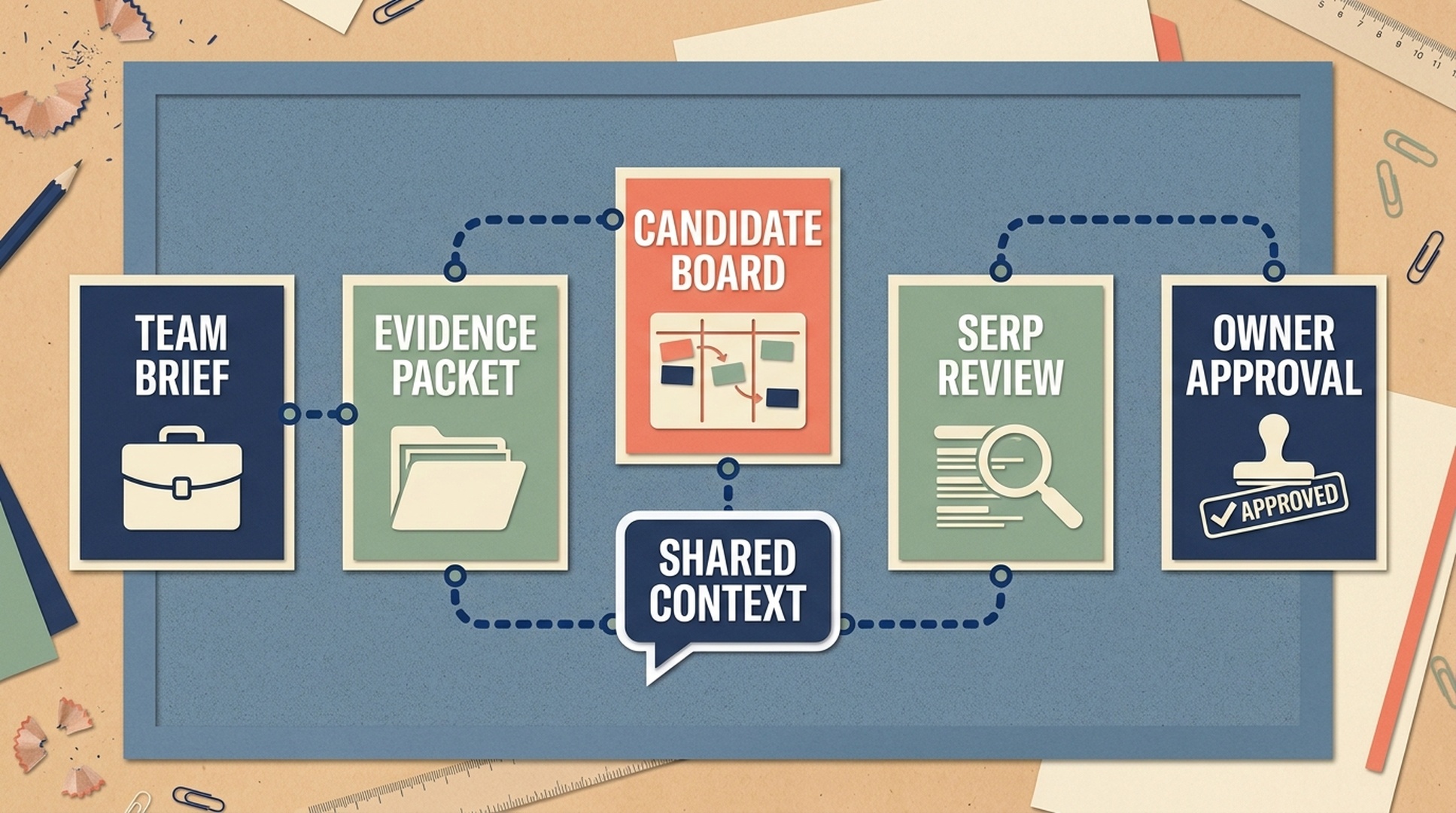
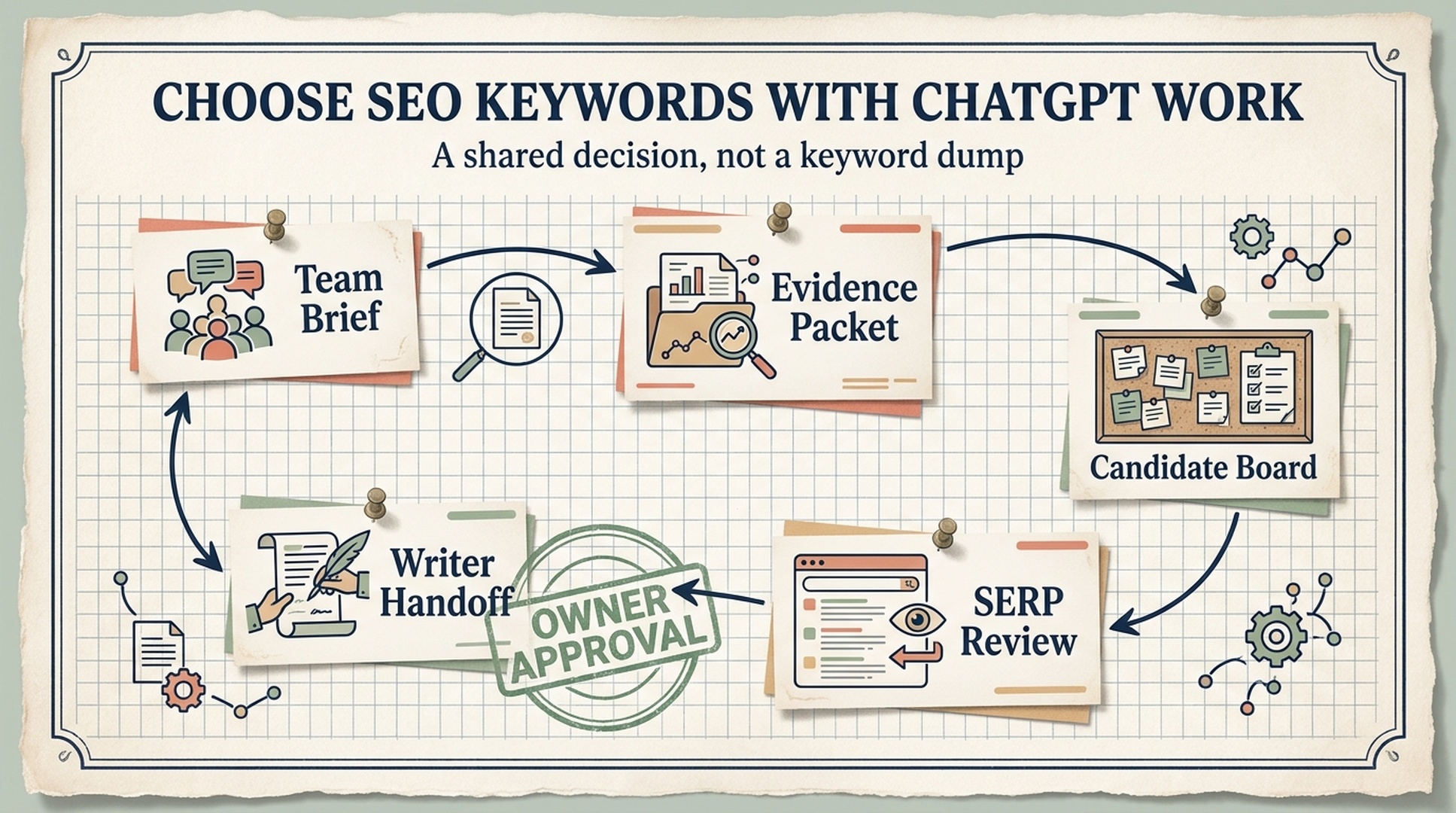
A shared research flow gives each team member a place to add evidence or challenge an unsupported conclusion before a page is assigned.
Move candidates through a four-gate decision
Ask ChatGPT Work to use hard stops before scoring. This avoids a familiar mistake: a high-demand query earns a strong average even though it is brand-locked, outside the business scope, or already covered by an existing URL.
Gate | Pass condition | Stop or hold condition |
|---|---|---|
Searcher job | The visitor's task can be described clearly | The query is ambiguous or purely navigational |
Business boundary | The page can lead to an appropriate next action | The topic needs unsupported claims or attracts the wrong audience |
Page route | A new page or refresh has a clear role | The topic would duplicate an existing page |
Information advantage | The team can add verified detail, a template, or a better process | The page would merely restate what already ranks |
After the gates, use a short scorecard. Require reasons beside each number:
Apply the four hard-stop gates to the candidate board. Do not average away a
failed gate.

For every candidate that passes, score these criteria from 1 to 5 and give a
one-sentence, evidence-linked rationale:
- Business fit
- Intent and page-format fit
- Evidence strength
- Relative feasibility in the current SERP
- Information advantage

Return three groups:
1. APPROVE FOR BRIEF
2. RESEARCH MORE
3. REJECT OR CONSOLIDATE

For the top approved candidate, name one primary query, supporting queries,
the page route, the human owner, and the evidence that still needs approval.
Use UNKNOWN where the record is incomplete.
Example: the best answer may be a refresh
This fictional table shows why the largest apparent opportunity is not always the first one to build.
Candidate | Proposed route | Why the team chooses it |
|---|---|---|
Shopify exchange policy template | New template page | Worth building only if approved policy language and a reusable download are available |
Shopify return exchange rules | Refresh the returns guide | The existing guide has the right audience and a specific missing section |
Shopify returns software | Hold | The query is broad; the current evidence does not show a distinctive page angle |
The middle candidate can win because it is faster to make useful, has a natural home, and reduces the risk of two pages competing for the same visitor job.
Convert the approved decision into a writer handoff
Once an owner approves the candidate, keep ChatGPT Work in its strongest role: turning the decision record into a brief that a writer and reviewer can use without reopening every source.
Create a writer handoff from the approved candidate only.

Include:
1. Primary query and supporting queries.
2. Searcher job and intended reader.
3. Page route: new, refresh, or consolidation.
4. Page promise in one sentence.
5. Recommended page format and section outline.
6. Verified facts and source names to retain.
7. Open questions labeled NEEDS OWNER.
8. Existing content to preserve, remove, or update.
9. One relevant conversion action that does not distort the answer.
10. A post-release measurement note using the same market, language, and
    comparable time period.

Do not write final page copy. Do not fabricate facts to fill NEEDS OWNER gaps.
Before assigning the article, ask the owner to review the handoff in the shared work area. The review is not ceremonial. It is where a product lead confirms feature language, a content lead checks cannibalization risk, and an SEO lead confirms that the promised format matches the result set.
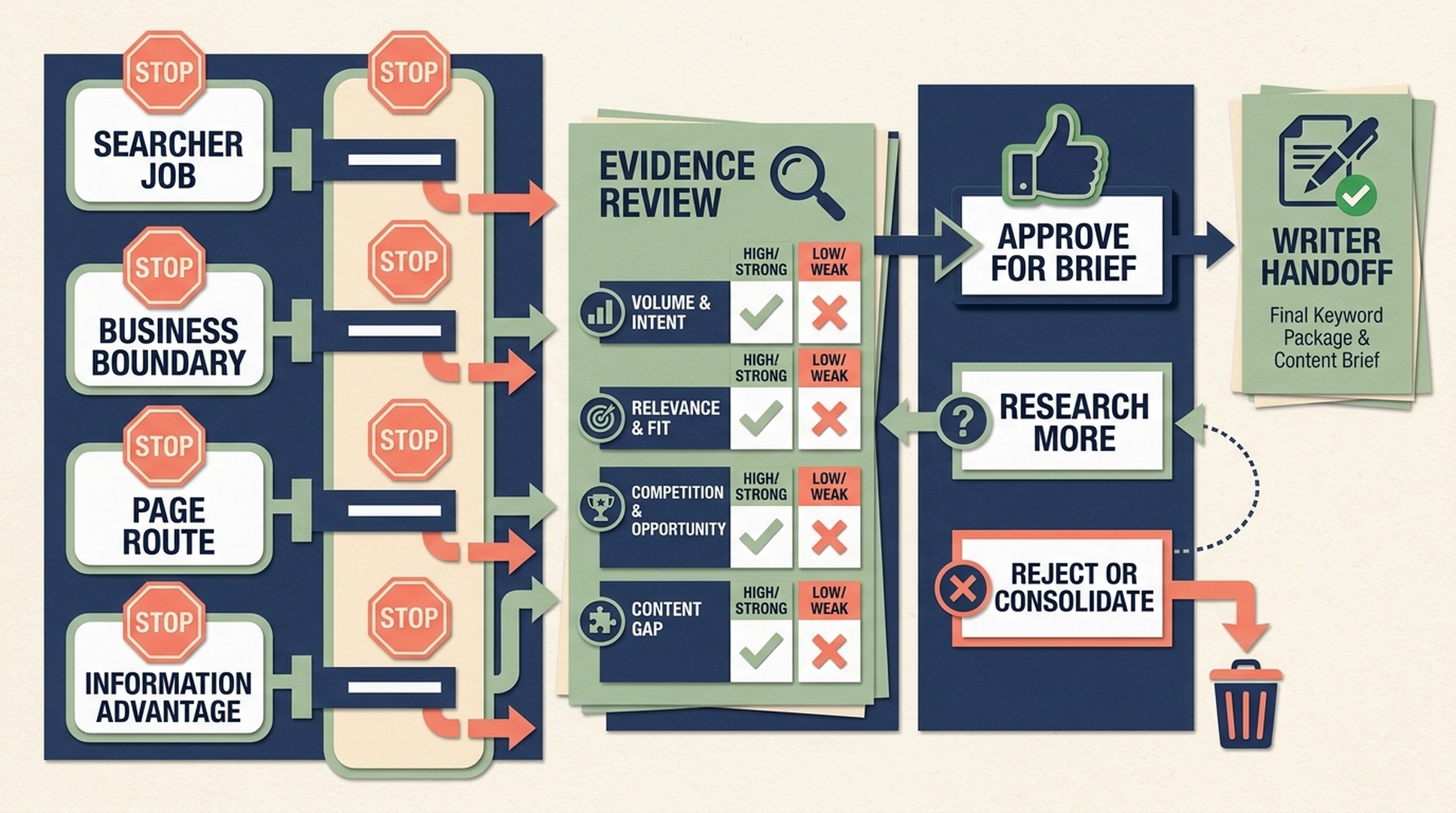
Hard stops come before scoring, so a strong-looking metric cannot hide a weak page decision.
Make the process repeatable without making it automatic
If your ChatGPT Work environment offers approved skills, you can turn the prompts above into a focused team workflow. Keep the skill narrow: it should prepare a keyword decision brief from supplied evidence, not connect to unapproved sources or publish pages. Availability and enabled tools can vary by workspace, so keep a plain-language prompt version alongside any reusable skill.
Use these rules every time:
- Keep one decision per conversation or project workstream.
- State the data sources, market, language, and retrieval date for each important metric.
- Ask the model to show uncertainty instead of filling gaps with estimates.
- Invite the appropriate owner to verify product facts and page route.
- Save the final approved brief with the release date and measurement plan.
After publishing, return to the same decision record after a comparable period. Review page-query impressions, clicks, position, qualified actions, and feedback. If a related query appears, ask whether it needs a new page, a new section, or no action at all. A model can organize that comparison, but the team should still make the trade-off.
Completion check
- [ ] The team agreed on a single searcher job before choosing a primary keyword.
- [ ] Every important metric names its source, market, language, and date.
- [ ] The candidate board identifies existing URLs before recommending a new page.
- [ ] The SERP review describes format and page type, not only a difficulty score.
- [ ] Any missing proof is visibly labeled
UNKNOWNorNEEDS OWNER. - [ ] A human owner approved the page route and factual boundaries.
- [ ] The writer handoff contains a page promise, outline, evidence list, and measurement note.
FAQ
Can ChatGPT Work choose the final keyword for my team?
It can compare supplied evidence and recommend a choice under rules you define. Keep final approval with a person who owns the business fit, claims, content budget, and page decision.
What if our team cannot attach Search Console or SEO-tool data?
Start with customer language, an existing-page inventory, and manual SERP notes. ChatGPT Work can still create a candidate board and show what evidence is missing. It should mark volume, rankings, and difficulty as unknown rather than inventing them.
Should every keyword decision become a new article?
No. Many of the strongest decisions are a targeted refresh, a consolidation, an FAQ addition, or a conscious decision to wait. Create a new URL only when it serves a distinct visitor task.
Do we need a custom ChatGPT Work skill for this workflow?
No. The prompts in this article work in a normal conversation with authorized materials. A focused reusable skill can help a team apply the same decision rules repeatedly, provided it does not expand data access or bypass human review.
Author: Olivia Stone, SERP Intelligence Researcher Across 25k+ Queries at Auspia. Olivia writes about search-result patterns, query evidence, and content decisions that teams can defend.