Quick Answer
Healthcare GEO starts with the questions patients, caregivers, and healthcare buyers ask AI systems before they choose a provider. Those questions are usually more specific than traditional SEO keywords: they ask about symptoms, service fit, safety, insurance, cost, credentials, location, and whether a clinic or healthcare brand is trustworthy.
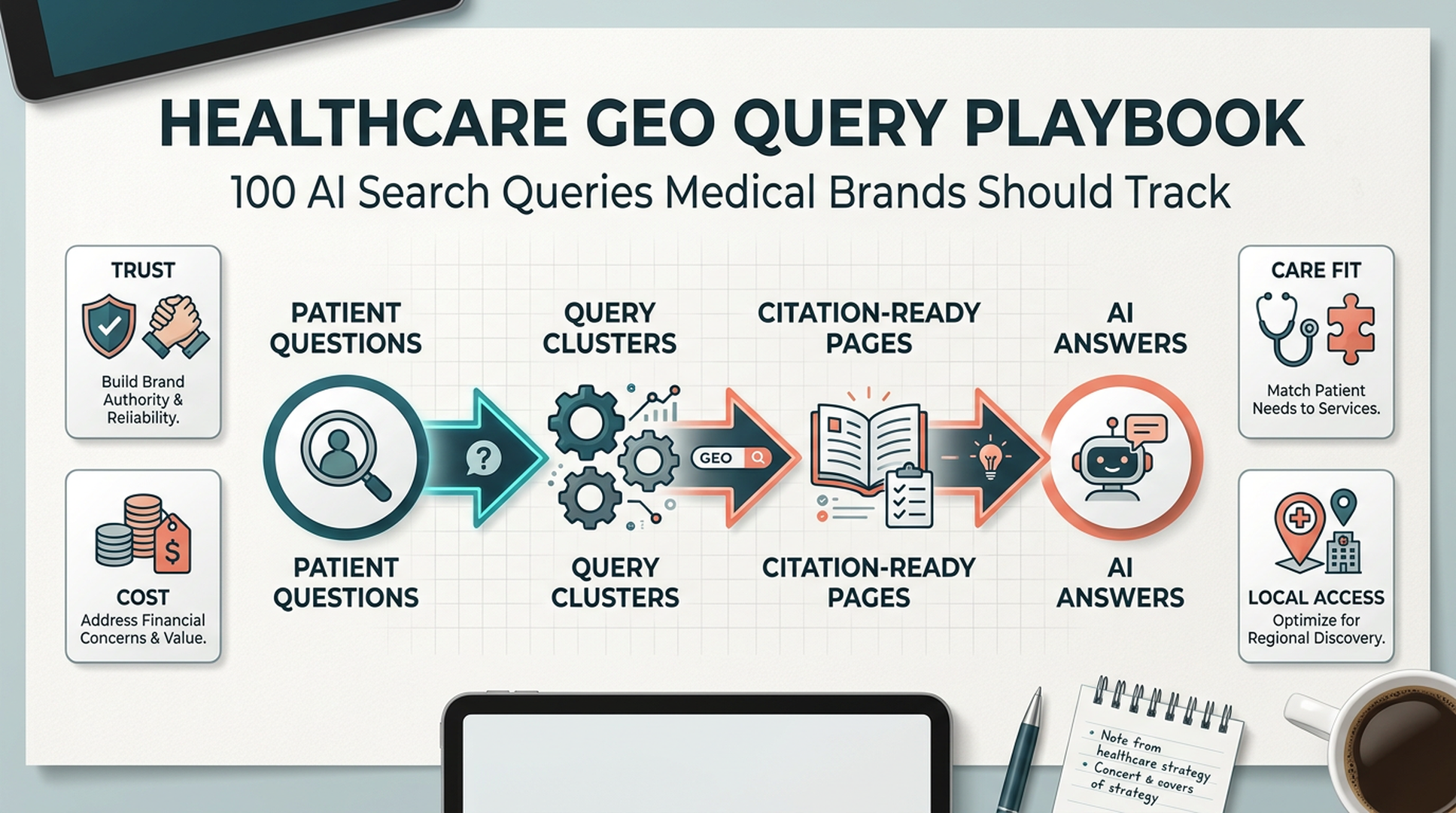
The practical move is not to turn every question into a separate blog post. A healthcare team should collect 100 AI Search queries, group them into 10-20 query clusters, assign each cluster to one strong owner page, and rewrite those pages so they give direct, verifiable, medically responsible answers.
For healthcare brands, the best GEO queries usually share six traits:
- they influence a patient decision, booking, referral, or consultation;
- they can be answered with visible facts, not marketing claims;
- they map to a specific service, location, doctor, insurance, or care-process page;
- they include trust signals such as credentials, review summaries, policies, and limitations;
- they avoid diagnosis or treatment promises unless reviewed by qualified medical professionals;
- they are easy for AI systems to summarize, compare, and cite.
This playbook gives you 100 healthcare AI Search queries to start with, a prioritization model, a query-to-page map, and a 30-day workflow for turning those questions into GEO-ready content assets.
Why Healthcare GEO Starts With Queries, Not Blog Topics
Traditional healthcare SEO often begins with keyword lists: primary care doctor, urgent care near me, telehealth appointment, or annual physical exam. Those still matter. But AI Search behavior is more conversational and decision-driven.
A patient might ask:
Should I choose urgent care or the emergency room for chest pain?What should I prepare before a telehealth appointment?How do I know whether a clinic is trustworthy?Can a primary care doctor help manage diabetes?What questions should I ask before choosing a mental health provider?
These are not just keywords. They are decision prompts.
That is why GEO, or Generative Engine Optimization, should start with a prompt library. The goal is to understand which questions AI systems may answer on behalf of patients and which pages on your site should be eligible to support those answers.
For healthcare, this matters because the buyer journey is rarely linear. A patient might discover a clinic through a local search, compare options in Google, ask ChatGPT for a plain-English explanation, check reviews, verify insurance, and then book. If your site does not clearly answer the questions that appear during that journey, AI systems have little reason to mention or cite you.
A helpful starting point is to measure how your brand appears across answer surfaces with an AI Search Visibility Checker, then use the query library below to decide which pages need stronger answers.
How AI Search Queries Differ From Traditional SEO Keywords
Healthcare SEO keywords are often short and location-heavy. Healthcare AI Search queries are longer, more conditional, and more trust-sensitive.
Traditional SEO Keyword | AI Search Query | What Changed |
|---|---|---|
|
| The user wants fit, safety, and limits. |
|
| The user wants decision support. |
|
| The user wants selection criteria. |
|
| The user wants trust evaluation. |
|
| The user wants pricing context and constraints. |
A healthcare website built only for short keywords often misses the pages and modules AI systems need. A GEO-ready healthcare site needs direct answers, service boundaries, clinician credentials, review evidence, pricing or insurance explanations, medical review notes, and clear disclaimers where appropriate.
This does not mean replacing SEO. It means making SEO pages more answerable, factual, and citation-ready.
The 10 Query Types Healthcare Teams Should Map
Use this taxonomy before deciding what to write. It keeps the article plan from becoming a random list of blog ideas.
Query Type | What The User Wants | Best Healthcare Content Asset |
|---|---|---|
Definition | Understand a service, condition category, visit type, or care model | Explainer, glossary, service FAQ |
Problem / Need | Decide what to do about a symptom, concern, or care need | Service guide, triage explainer, medically reviewed FAQ |
Recommendation | Find a provider, service type, or care option for a situation | Best-for guide, service category page |
Comparison | Compare care options, providers, or visit types | Comparison page, decision table |
Cost / Insurance | Understand price, coverage, billing, or payment options | Insurance page, cost guide, billing FAQ |
Provider Selection | Choose a clinic, doctor, specialist, or care team | Selection checklist, doctor profile hub |
Risk / Safety | Understand limits, privacy, side effects, or when not to use a service | Safety page, policy page, limitation block |
Process | Understand steps, timelines, appointment flow, or records transfer | How-it-works page, appointment guide |
Trust / Reputation | Verify credibility, reviews, credentials, and content quality | About page, credentials page, reviews page |
Local / Scenario | Match location, hours, language, age group, or care situation | Location page, service-area page, scenario page |
The key is page ownership. Each important query cluster should have one clear page that answers it better than every other page on your site.
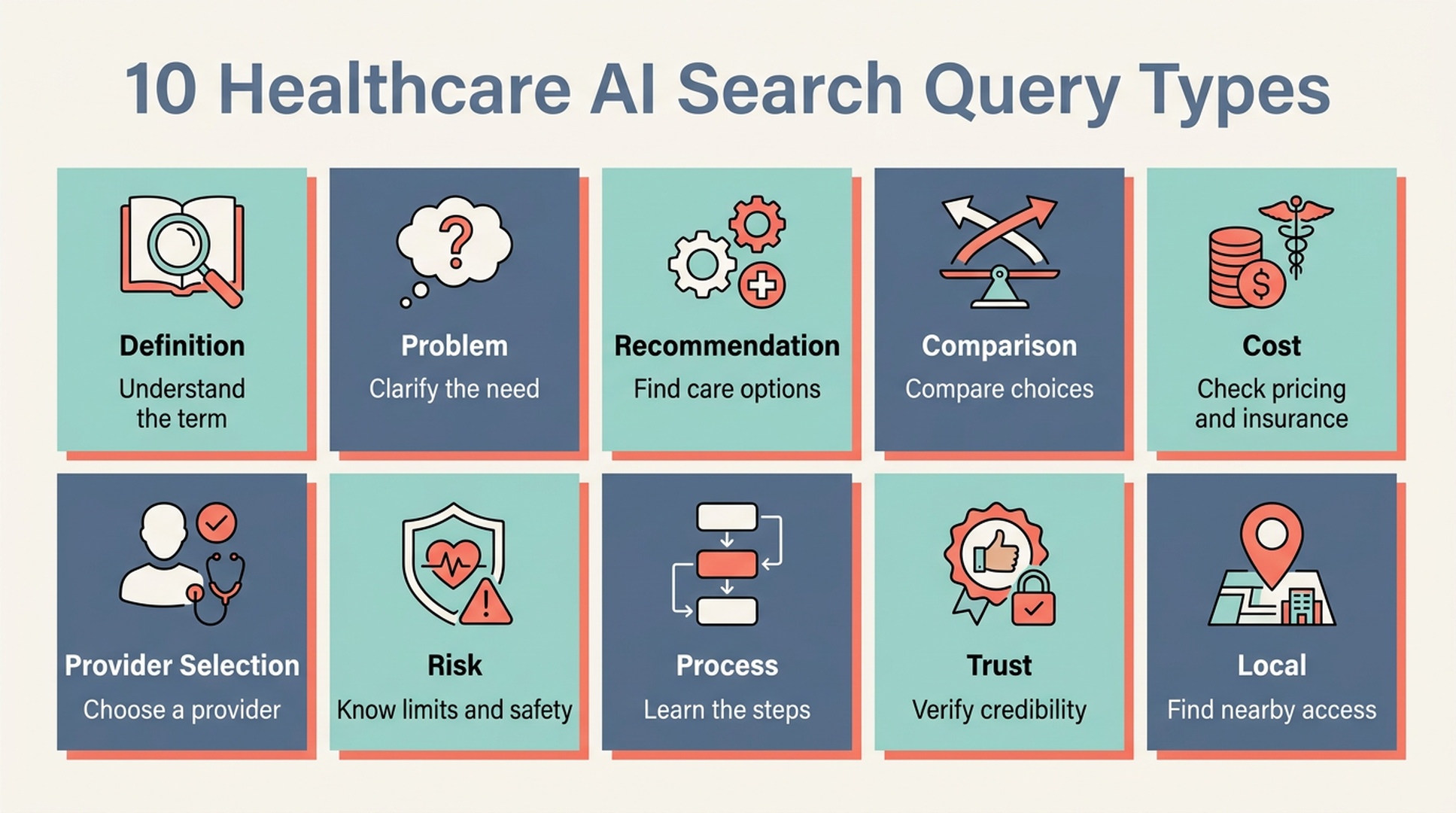
The 10 query types healthcare teams should classify before building a GEO content backlog.
How To Prioritize Healthcare GEO Queries
Not all queries deserve the same effort. In healthcare, the highest-value GEO queries are not always the highest-volume keywords. They are the questions that influence patient choice and can be answered safely with evidence.
Use this scoring model:
Priority = Commercial Intent + Decision Impact + AI Answer Probability + Verifiable Evidence - Compliance Risk - Competition Difficulty
Factor | How To Evaluate It |
|---|---|
Commercial Intent | Could this query influence a booking, call, consultation, referral, or patient portal signup? |
Decision Impact | Would the answer help the patient choose a provider, service, visit type, or next step? |
AI Answer Probability | Is the query likely to trigger a summarized answer, comparison, or recommendation? |
Verifiable Evidence | Do you have visible facts: credentials, hours, insurance, process, reviews, medical review notes, or policies? |
Compliance Risk | Could the answer become unsafe if it sounds like diagnosis, treatment advice, or a universal medical rule? |
Competition Difficulty | Are national health sites, large hospitals, insurers, or directories already dominating the topic? |
For most healthcare brands, the first GEO backlog should favor queries that are close to patient decisions but low enough in medical risk to answer responsibly. Examples include appointment preparation, service differences, insurance coverage, care-team selection, clinic credentials, review interpretation, and service limitations.
100 Healthcare GEO Query Examples
Use these as a starting prompt library. Adapt them to your specialty, geography, regulatory environment, and medical review process before publishing patient-facing content.
# | AI Search Query | Query Type | Search Intent | Best Content Asset |
|---|---|---|---|---|
1 | What is telehealth and when should patients use it? | Definition | Understand the care model | Telehealth service page |
2 | What is primary care and what does a primary care doctor do? | Definition | Understand provider role | Primary care explainer |
3 | What is preventive care in healthcare? | Definition | Understand service category | Preventive care guide |
4 | What is chronic care management? | Definition | Understand ongoing care | Chronic care page |
5 | What is coordinated care? | Definition | Understand care-team model | Care coordination page |
6 | What is a patient portal? | Definition | Understand digital access | Patient portal guide |
7 | What is urgent care used for? | Definition | Understand visit type | Urgent care page |
8 | What is a wellness visit? | Definition | Understand appointment type | Wellness visit FAQ |
9 | What is behavioral health care? | Definition | Understand care category | Behavioral health page |
10 | What is a referral in healthcare? | Definition | Understand system process | Referral guide |
11 | What symptoms should make someone seek emergency care? | Problem / Need | Decide urgency | Emergency guidance page |
12 | How do I know if I should go to urgent care? | Problem / Need | Choose next step | Urgent care decision guide |
13 | Can primary care doctors help manage diabetes? | Problem / Need | Evaluate service fit | Diabetes care page |
14 | Can primary care doctors help manage high blood pressure? | Problem / Need | Evaluate service fit | Hypertension care page |
15 | What should I do if my lab results are abnormal? | Problem / Need | Understand next step | Lab results FAQ |
16 | When should I see a specialist? | Problem / Need | Decide referral need | Specialist referral page |
17 | Can a primary care doctor help with anxiety? | Problem / Need | Understand starting point | Mental health primary care FAQ |
18 | Can a primary care doctor help with depression? | Problem / Need | Understand starting point | Mental health primary care FAQ |
19 | How often should adults get a health checkup? | Problem / Need | Plan preventive care | Annual checkup guide |
20 | What screenings are recommended by age? | Problem / Need | Plan preventive screening | Age-based screening page |
21 | Best healthcare provider for chronic disease management | Recommendation | Find provider fit | Chronic care service page |
22 | Best clinics for preventive health checkups | Recommendation | Compare options | Preventive care landing page |
23 | Best telehealth service for non-emergency visits | Recommendation | Choose care option | Telehealth use-case page |
24 | Best clinic for same-day appointments | Recommendation | Find fast access | Same-day appointment page |
25 | Best healthcare provider for diabetes care | Recommendation | Find specialty support | Diabetes care page |
26 | Best clinic for blood pressure management | Recommendation | Find condition support | Hypertension care page |
27 | Best provider for medical weight management | Recommendation | Compare care options | Weight management page |
28 | Best clinic for annual physical exams | Recommendation | Choose preventive care | Annual physical page |
29 | Best healthcare provider for seniors | Recommendation | Find age-fit care | Senior care page |
30 | Best clinic for multilingual patients | Recommendation | Find access fit | Language access page |
31 | Urgent care vs emergency room: which should I choose? | Comparison | Compare visit types | Urgent care vs ER page |
32 | Telehealth vs in-person doctor visit: what is the difference? | Comparison | Compare care channels | Telehealth comparison page |
33 | Primary care vs specialist care: what is the difference? | Comparison | Compare provider roles | Primary vs specialist page |
34 | Physical exam vs wellness visit: what is the difference? | Comparison | Compare appointment types | Checkup comparison FAQ |
35 | Walk-in clinic vs appointment clinic: which is better? | Comparison | Compare access models | Walk-in comparison page |
36 | Family medicine vs internal medicine: what is the difference? | Comparison | Choose provider type | Provider type guide |
37 | Medical weight loss vs regular dieting: what is different? | Comparison | Compare approaches | Weight management comparison |
38 | Therapy vs psychiatry: what is the difference? | Comparison | Compare mental health options | Behavioral health guide |
39 | Online medical records vs paper records: what changes for patients? | Comparison | Understand record access | Medical records guide |
40 | Retail clinic vs urgent care: where should I go? | Comparison | Choose care setting | Care setting comparison |
41 | How much does a primary care visit usually cost? | Cost / Insurance | Estimate cost | Primary care cost guide |
42 | Does insurance cover telehealth visits? | Cost / Insurance | Verify coverage | Telehealth insurance FAQ |
43 | How much does urgent care cost without insurance? | Cost / Insurance | Estimate self-pay cost | Urgent care cost page |
44 | Does insurance cover annual physical exams? | Cost / Insurance | Verify preventive coverage | Insurance FAQ |
45 | How much does a lab test usually cost? | Cost / Insurance | Estimate testing cost | Lab billing FAQ |
46 | Does insurance cover mental health care? | Cost / Insurance | Verify coverage | Behavioral health insurance FAQ |
47 | How much does therapy usually cost? | Cost / Insurance | Estimate cost | Therapy cost guide |
48 | What payment options do clinics usually offer? | Cost / Insurance | Understand billing choices | Billing page |
49 | What does self-pay mean in healthcare? | Cost / Insurance | Understand payment type | Self-pay explainer |
50 | Why did I receive a medical bill after insurance? | Cost / Insurance | Understand billing process | Billing FAQ |
51 | How do I choose a primary care doctor? | Provider Selection | Select provider | Primary care selection guide |
52 | What questions should I ask before choosing a clinic? | Provider Selection | Compare providers | Clinic selection checklist |
53 | How do I choose a mental health provider? | Provider Selection | Select care type | Mental health provider guide |
54 | How do I find a doctor who speaks my language? | Provider Selection | Find access fit | Language access page |
55 | How do I compare healthcare providers online? | Provider Selection | Evaluate options | Provider comparison guide |
56 | What should I look for in a doctor profile? | Provider Selection | Validate fit | Doctor profile guide |
57 | How important are doctor credentials when choosing care? | Provider Selection | Assess trust | Credentials page |
58 | What makes a clinic good for families? | Provider Selection | Match family needs | Family care page |
59 | How do I switch primary care doctors? | Provider Selection | Change provider | Doctor transfer guide |
60 | How do I choose a clinic for long-term care needs? | Provider Selection | Evaluate continuity | Long-term care selection page |
61 | Is telemedicine safe for first-time patients? | Risk / Safety | Understand limits | Telehealth safety page |
62 | When is telehealth not appropriate? | Risk / Safety | Know care boundaries | Telehealth limitations page |
63 | Can telehealth doctors prescribe medication? | Risk / Safety | Understand prescribing rules | Telehealth prescribing FAQ |
64 | What medications cannot be prescribed through telehealth? | Risk / Safety | Understand restrictions | Prescribing policy page |
65 | Is my health data safe with online clinics? | Risk / Safety | Verify privacy | Privacy and security page |
66 | What privacy rules apply to telehealth? | Risk / Safety | Understand compliance | Telehealth privacy page |
67 | Is medical weight loss safe? | Risk / Safety | Evaluate risk | Weight management safety page |
68 | Should patients trust ChatGPT for medical advice? | Risk / Safety | Evaluate AI advice | AI medical information guide |
69 | How should patients verify medical advice found online? | Risk / Safety | Validate information | Medical content quality guide |
70 | What are the limits of online symptom checkers? | Risk / Safety | Understand tool limits | Symptom checker safety FAQ |
71 | What should I prepare before a virtual doctor visit? | Process | Prepare for appointment | Telehealth preparation guide |
72 | How long does a typical telehealth appointment take? | Process | Set expectations | Appointment process page |
73 | What happens during an annual physical exam? | Process | Understand visit flow | Annual physical guide |
74 | How do referrals work in healthcare? | Process | Understand next steps | Referral process page |
75 | How do I transfer medical records to a new doctor? | Process | Move records | Records transfer guide |
76 | How long do lab test results usually take? | Process | Set timing expectations | Lab results FAQ |
77 | Can I get lab results through a patient portal? | Process | Access records | Patient portal FAQ |
78 | How do online medical records work? | Process | Understand digital records | Medical records page |
79 | What happens after a telehealth visit? | Process | Understand follow-up | Telehealth follow-up FAQ |
80 | How do I book a same-day doctor appointment? | Process | Complete booking | Appointment booking page |
81 | How do I know if a clinic is trustworthy? | Trust / Reputation | Validate provider | Trust and credentials page |
82 | What certifications should a medical clinic have? | Trust / Reputation | Check credibility | Credentials explainer |
83 | Are online doctor reviews reliable? | Trust / Reputation | Interpret reviews | Reviews guide |
84 | How important is hospital affiliation? | Trust / Reputation | Assess credibility | Affiliation explainer |
85 | What makes a healthcare website trustworthy? | Trust / Reputation | Evaluate content quality | Medical content standards page |
86 | What should patients look for in clinic reviews? | Trust / Reputation | Interpret reputation | Reviews page |
87 | How do patient testimonials affect healthcare decisions? | Trust / Reputation | Understand social proof | Testimonials page |
88 | What should a clinic disclose on its website? | Trust / Reputation | Check transparency | About and policies page |
89 | How can patients verify a doctor's credentials? | Trust / Reputation | Validate provider | Doctor credentials guide |
90 | What makes medical content reliable? | Trust / Reputation | Assess information quality | Editorial standards page |
91 | Healthcare provider near me with online booking | Local / Scenario | Find local access | Location page |
92 | Clinic near me open after work hours | Local / Scenario | Find convenient hours | Hours and location page |
93 | Same-day doctor appointment near me | Local / Scenario | Book quickly | Same-day appointment page |
94 | Family medicine clinic near me | Local / Scenario | Find local provider | Family medicine location page |
95 | Pediatric clinic near me | Local / Scenario | Find child care | Pediatric location page |
96 | Women's health clinic near me | Local / Scenario | Find specialty access | Women's health location page |
97 | Senior healthcare clinic near me | Local / Scenario | Find age-fit care | Senior care location page |
98 | Telehealth doctor for rural patients | Local / Scenario | Solve access gap | Rural telehealth page |
99 | Clinic that offers appointments in Spanish | Local / Scenario | Match language access | Spanish-language care page |
100 | Medical clinic with weekend appointments near me | Local / Scenario | Find schedule fit | Weekend appointment page |
How To Turn These Queries Into Citation-Ready Pages
The wrong way to use this list is to publish 100 thin articles. That creates overlap, weak pages, and a confusing site structure.
The better approach is to group the queries into a smaller set of durable content assets.
Query Cluster | Owner Page | Page Type | Required Proof |
|---|---|---|---|
Telehealth safety, prescribing, privacy, preparation |
| Service page + FAQ | Licensed provider notes, prescribing limits, privacy policy, appointment process |
Urgent care vs ER, cost, conditions treated |
| Service comparison page | Conditions treated, emergency exclusions, hours, pricing notes |
Primary care selection and annual checkups |
| Service page | Provider credentials, preventive services, booking steps |
Chronic care for diabetes and hypertension |
| Condition-support page | Care model, follow-up process, monitoring expectations, clinician review |
Cost, insurance, self-pay, billing |
| Pricing and policy page | Accepted insurance, self-pay policy, billing FAQ, update date |
Doctor credentials and clinic trust |
| Entity and provider pages | Credentials, specialties, review links, leadership, locations |
Medical records, portal, lab results |
| Patient resource hub | Portal instructions, records policy, privacy language |
Local access, hours, language, same-day appointments |
| Location pages | Address, hours, languages, booking URL, local reviews |
AI medical advice and content reliability |
| Trust page | Editorial policy, medical review process, disclaimer, source standards |
This structure gives AI systems a cleaner retrieval path. Instead of deciding between many overlapping posts, each cluster has one strong page that owns the answer.
For technical readiness, healthcare teams should also make sure important pages are crawlable, indexable, and not accidentally blocking AI or search crawlers. A quick check with a Website SEO Score Checker can reveal basic issues before the team spends time rewriting pages.
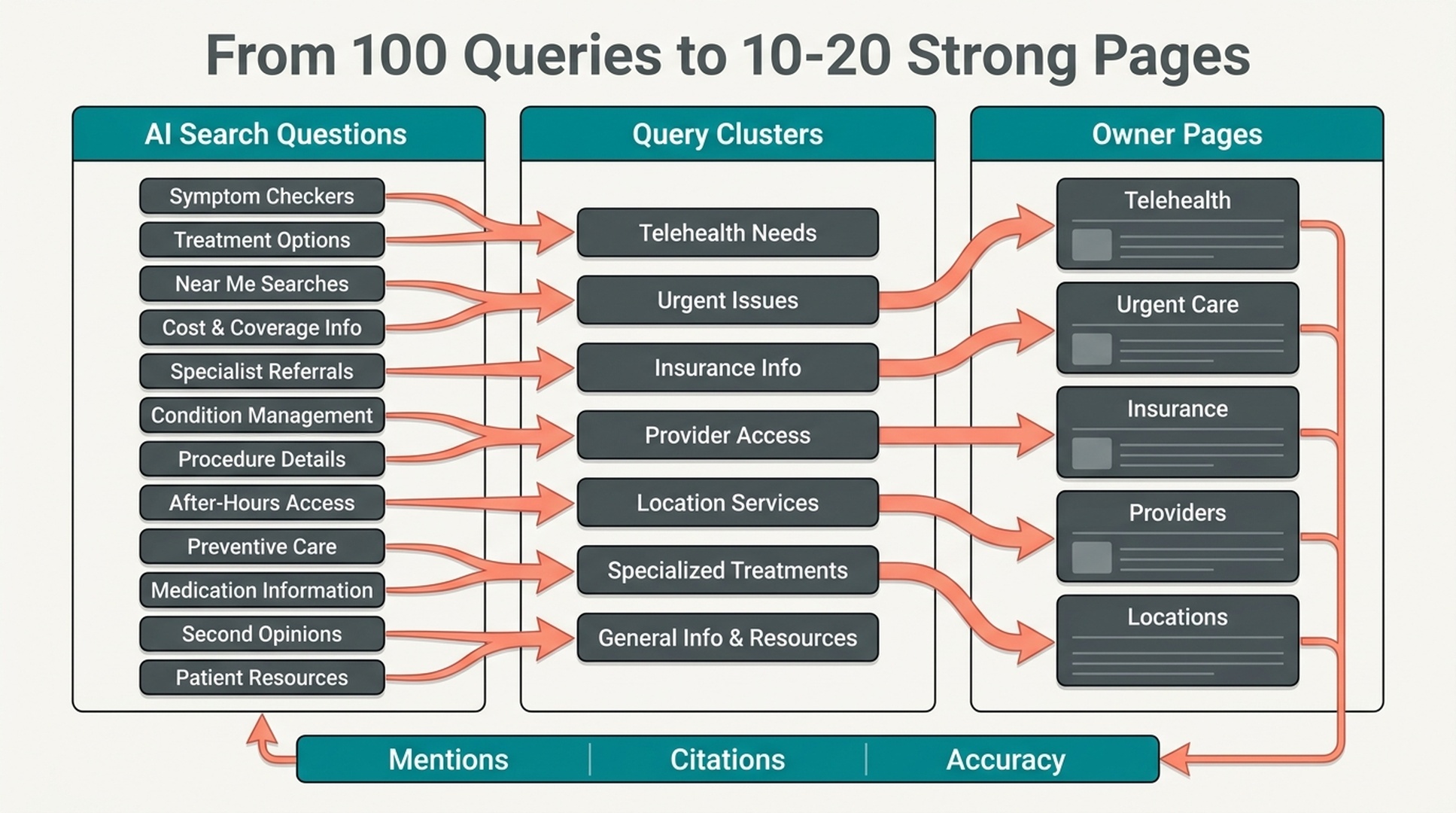
The best GEO workflow turns many patient questions into a smaller set of stronger owner pages.
The First 20 Queries To Prioritize
If you are starting from zero, do not try to optimize all 100 queries at once. Start with 20 that combine decision impact, manageable risk, and clear page ownership.
Priority | Query | Why It Matters | Likely Owner Page |
|---|---|---|---|
1 | How do I choose a primary care doctor? | Directly affects provider selection | Primary care page |
2 | What questions should I ask before choosing a clinic? | Helps patients compare options | Clinic selection checklist |
3 | Urgent care vs emergency room: which should I choose? | High decision impact | Urgent care comparison page |
4 | What should I prepare before a virtual doctor visit? | Low-risk, high utility | Telehealth guide |
5 | When is telehealth not appropriate? | Builds trust by stating limits | Telehealth safety page |
6 | Does insurance cover telehealth visits? | Influences booking | Insurance FAQ |
7 | How much does a primary care visit usually cost? | High conversion friction | Cost guide |
8 | What happens during an annual physical exam? | Common preventive-care question | Annual physical guide |
9 | How do referrals work in healthcare? | Explains patient journey | Referral guide |
10 | How do I transfer medical records to a new doctor? | Supports switching providers | Records transfer guide |
11 | How do I know if a clinic is trustworthy? | Strong trust signal | About / trust page |
12 | What should I look for in a doctor profile? | Improves provider selection | Provider profile hub |
13 | Are online doctor reviews reliable? | Helps reputation interpretation | Reviews guide |
14 | What makes a healthcare website trustworthy? | Supports brand credibility | Editorial standards page |
15 | Can primary care doctors help manage diabetes? | Service-fit query | Chronic care page |
16 | Can primary care doctors help manage high blood pressure? | Service-fit query | Chronic care page |
17 | How long do lab test results usually take? | Practical patient expectation | Lab FAQ |
18 | Can I get lab results through a patient portal? | Patient-resource query | Portal guide |
19 | Healthcare provider near me with online booking | Local conversion query | Location page |
20 | Clinic near me open after work hours | Local conversion query | Location page |
These queries are useful because they do not require a brand to make unsafe medical promises. They require clarity, process, evidence, and transparency.
30-Day Execution Plan
Timeframe | Action | Output |
|---|---|---|
Days 1-3 | Build the healthcare AI Search query library and classify each query | 100-query spreadsheet |
Days 4-7 | Score queries by commercial intent, decision impact, AI answer probability, evidence, risk, and difficulty | Priority backlog |
Days 8-14 | Map the first 20 queries to existing pages or missing page assets | Query-to-page map |
Days 15-21 | Rewrite the top pages with direct answer intros, tables, FAQ, proof blocks, and clear limitations | Updated GEO-ready pages |
Days 22-30 | Test prompts across AI answer surfaces and record mentions, citations, competitors, and inaccurate facts | Mention and citation tracker |
A small healthcare practice can start with five pages: primary care, urgent care, telehealth, insurance/billing, and provider credentials. A larger healthcare system may need specialty pages, location pages, physician profile improvements, medical review workflows, and structured data cleanup.
Common Mistakes
The most common healthcare GEO mistake is treating AI Search as another blog-production channel. GEO is not won by publishing more generic articles about symptoms. It is won by making the right pages more specific, trustworthy, and extractable.
Avoid these mistakes:
- Creating 100 thin posts from 100 queries. Cluster questions into stronger owner pages instead.
- Answering medical questions without review. Healthcare content should have a clear review process and safe boundaries.
- Hiding critical facts. Insurance, hours, locations, credentials, appointment steps, and service limits should be visible in text.
- Using vague trust language. Say who the providers are, what credentials they hold, what services are offered, and what the clinic does not handle.
- Ignoring local intent. Many healthcare AI queries still depend on location, availability, languages, insurance, and hours.
- Forgetting measurement. Track brand mentions, cited URLs, incorrect facts, and competitor mentions for each target query.
FAQ
What is healthcare GEO?
Healthcare GEO is the process of making medical, clinic, provider, and patient-resource pages easier for AI answer systems to understand, summarize, and cite. It combines SEO fundamentals with clearer answers, stronger evidence, structured facts, trust signals, and prompt-level monitoring.
Is healthcare GEO the same as healthcare SEO?
No. Healthcare SEO focuses on search visibility, rankings, technical accessibility, content relevance, and organic traffic. Healthcare GEO builds on those foundations but pays special attention to how AI systems answer patient questions, which sources they mention, and whether brand facts are summarized accurately.
Should every healthcare AI Search query become a blog post?
No. Most healthcare query libraries should become a page map, not a blog calendar. A strong service page, provider page, insurance page, or location page can answer many related queries better than separate thin articles.
What healthcare GEO queries should a clinic start with?
Start with decision-support queries that are useful and low-risk: how to choose a doctor, what to prepare before a visit, urgent care vs emergency care, insurance coverage, appointment steps, provider credentials, clinic reviews, and location-specific access questions.
Can healthcare brands optimize for AI Search without giving medical advice?
Yes. Many high-value GEO opportunities are about service fit, process, access, trust, cost, insurance, credentials, and limitations. For clinical topics, use qualified medical review, avoid diagnosis promises, and make clear when patients should seek professional or emergency care.
How should healthcare teams measure GEO performance?
Track a fixed set of prompts across Google AI Overviews or AI Mode, ChatGPT Search, Perplexity, and other answer surfaces available to your market. Record whether the brand is mentioned, which URL is cited, what competitors appear, and whether any facts are inaccurate.
Auspia Takeaway
Healthcare GEO is not about convincing AI systems with louder marketing language. It is about making patient-relevant facts easier to find, verify, and summarize.
The strongest healthcare GEO programs start with a query map, assign every important query cluster to an owner page, and improve those pages with direct answers, clear limits, provider proof, review signals, insurance details, and local access information.
If you are starting today, build the 100-query library first. Then choose the first 20 queries that are closest to patient decisions and safest to answer with verified facts. That is enough to create the first serious healthcare GEO backlog.
Author: Elena Shaw, Prompt Library Strategist, 3,000+ Buyer Prompts Mapped at Auspia. Elena writes about query maps, prompt libraries, and practical AI Search workflows for growth teams.