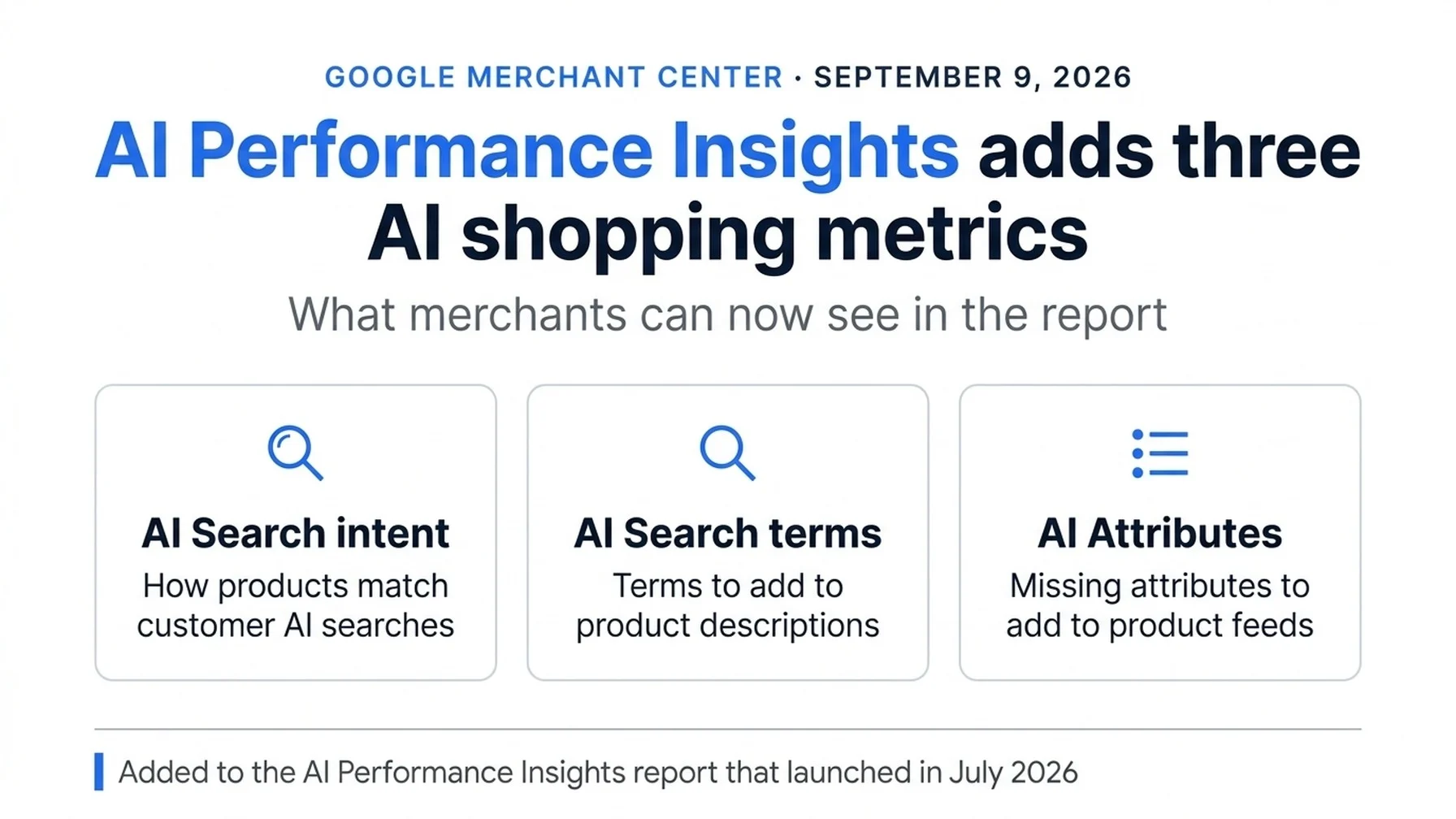
Google has expanded its AI Performance Insights report in Merchant Center with three new metrics that give merchants visibility into how their products perform in AI-powered shopping experiences. The update, spotted September 9, 2026, adds AI Search intent, AI Search terms, and AI Attributes to the report that launched in July 2026.
What Was Announced
The Google Merchant Center AI Performance Insights report, which helps merchants understand how their products are discovered on AI Mode, AI Overviews in Search, and the Gemini app, now includes three new data sections:
AI Search intent: Shows how products match customer AI searches
AI Search terms: Recommends improving visibility by including popular terms in product descriptions for products that appear in AI searches
AI Attributes: Recommends increasing visibility by adding missing attributes to products that show up in AI searches
The update was first identified by SEO professional Brodie Clark, who shared screenshots showing the expanded report interface. Google has also updated its official help documentation to reflect the new metrics.
Background and Context
Google introduced AI Performance Insights in May 2026 as part of its response to the rapid growth of conversational AI shopping. The feature launched in July 2026 and began expanding to additional regions in early September 2026.
The report was designed to address a critical gap: as consumers increasingly use AI-powered interfaces like AI Mode, AI Overviews, and the Gemini app for product discovery, merchants had no way to understand how their products were performing in these new environments. Traditional Search Console and Merchant Center reports focus on classic search results, not AI-generated responses.
The original report provided brand visibility benchmarks against similar brands and shopping funnel performance metrics across discovery, evaluation, and purchase stages. It also included product term insights, though the specific nature of those insights was not fully detailed in the initial announcement. Auspia has covered the wider shift toward agent-driven shopping elsewhere, and this report is Google's answer to the same question from the merchant side.
What Changed — Specific Details
The September 9, 2026 update adds granular, actionable data to the AI Performance Insights report:
AI Search intent allows merchants to see the specific types of queries and intents that lead to their products being surfaced in AI shopping experiences. This goes beyond traditional keyword data to show the conversational patterns and question formats that AI systems are processing.
AI Search terms provides recommendations for optimizing product descriptions. The system identifies popular terms that appear in AI searches related to the merchant's product categories and suggests incorporating those terms into product data. This is distinct from traditional SEO keyword optimization — it focuses on the language patterns that AI systems use to match products to conversational queries.
AI Attributes identifies missing product attributes that could improve visibility in AI shopping results. AI systems often rely on structured product data to generate recommendations, and this metric shows merchants which attributes they should add to their product feeds to increase their chances of being surfaced.
Google's help documentation was updated with detailed descriptions of each new metric section, confirming that these are now live features available to merchants with access to the AI Performance Insights report.
Impact and Implications
For merchants and e-commerce SEO professionals, this update represents a significant shift in how product optimization must be approached:
AI-specific optimization is now measurable. Previously, merchants could optimize for traditional search results and hope that good product data would also perform well in AI responses. Now they can see exactly how their products are performing in AI Mode, AI Overviews, and Gemini app, and get specific recommendations for improvement.
Product data quality becomes even more critical. The AI Attributes metric makes it clear that AI systems rely heavily on structured product data. Merchants who have incomplete or poorly structured product feeds will see lower visibility in AI shopping experiences. This creates a strong incentive to ensure product data is comprehensive and follows Google's specifications. The pressure is not limited to Google: OpenAI's product feed requirements push in the same direction, toward cleaner, more complete product data everywhere a product can be recommended.
Conversational language patterns matter. The AI Search terms metric suggests that AI systems are matching products based on conversational query patterns, not just product names and categories. Merchants may need to rethink how they write product descriptions to align with how consumers ask questions in AI interfaces.
Competitive benchmarking extends to AI. The report's brand visibility benchmarking now includes AI-powered experiences, allowing merchants to compare their AI shopping performance against competitors. This creates new competitive dynamics as brands optimize for both traditional and AI search, the same dynamic already visible in Google Shopping ads inside AI Overviews.
Historical Precedent
This update follows a pattern Google has established with other performance reports. When Google introduced new search features — such as Shopping tabs, Local Packs, or Knowledge Panels — it eventually provided merchants with performance data for those features. The AI Performance Insights report is the AI-era equivalent.
The July 2026 launch of the report was itself a response to merchant demand. As AI-powered shopping grew rapidly in early 2026, merchants reported having no visibility into how their products were performing in AI responses. Google's initial report addressed the visibility gap, and this September update addresses the optimization gap.
Similar patterns can be seen in Google's historical rollout of other AI features. When Google introduced AI Overviews for general search in 2024, it took several months before Search Console provided data on AI Overview performance. The Merchant Center AI Performance Insights report appears to be following a faster timeline, likely because the AI shopping market is moving more quickly.
What Has Not Been Confirmed
Several aspects of the update remain unclear:
Availability: It is not confirmed whether the new metrics are available to all merchants with access to AI Performance Insights, or only to a subset. The report itself has been rolling out gradually since July 2026.
Data freshness: The update does not specify how frequently the AI Search intent, terms, and attributes data is refreshed. Traditional Merchant Center reports typically update daily, but AI-specific data may have different latency.
Integration with ads: It is not clear whether these metrics will eventually integrate with Google Ads reporting, allowing merchants to correlate AI organic visibility with paid performance in AI shopping experiences.
Algorithm impact: Google has not confirmed whether optimizing for the recommended AI Search terms and attributes directly improves AI shopping visibility, or whether the recommendations are correlational rather than causal.
What to Watch Next
Broader rollout: The AI Performance Insights report has been expanding geographically since July 2026. Merchants in additional regions should expect access in the coming weeks.
Additional AI metrics: Given the rapid expansion of this report, additional AI-specific metrics are likely. Merchants should watch for updates to the help documentation and announcements from Google.
Integration with other tools: The AI Performance Insights data may eventually be integrated into other Google tools, such as Google Ads or Google Analytics, providing a more unified view of AI shopping performance.
Competitor responses: As Google provides more AI shopping data to merchants, competing platforms like Amazon, Microsoft Shopping, and AI-native shopping assistants may introduce similar reporting features.
Sources
Google Merchant Center Help, "Insights for AI-powered shopping experiences coming soon." The help document was updated alongside the new report sections. Check Google's current help pages for the latest wording before acting on it.
Brodie Clark, X post, September 9, 2026. The screenshots that first surfaced the expanded report interface.
Author: Sophie Renard, AI Search Briefing Analyst Tracking 30+ Platforms at Auspia. Sophie writes about timely platform changes, AI search product updates, and concise briefings for search teams.