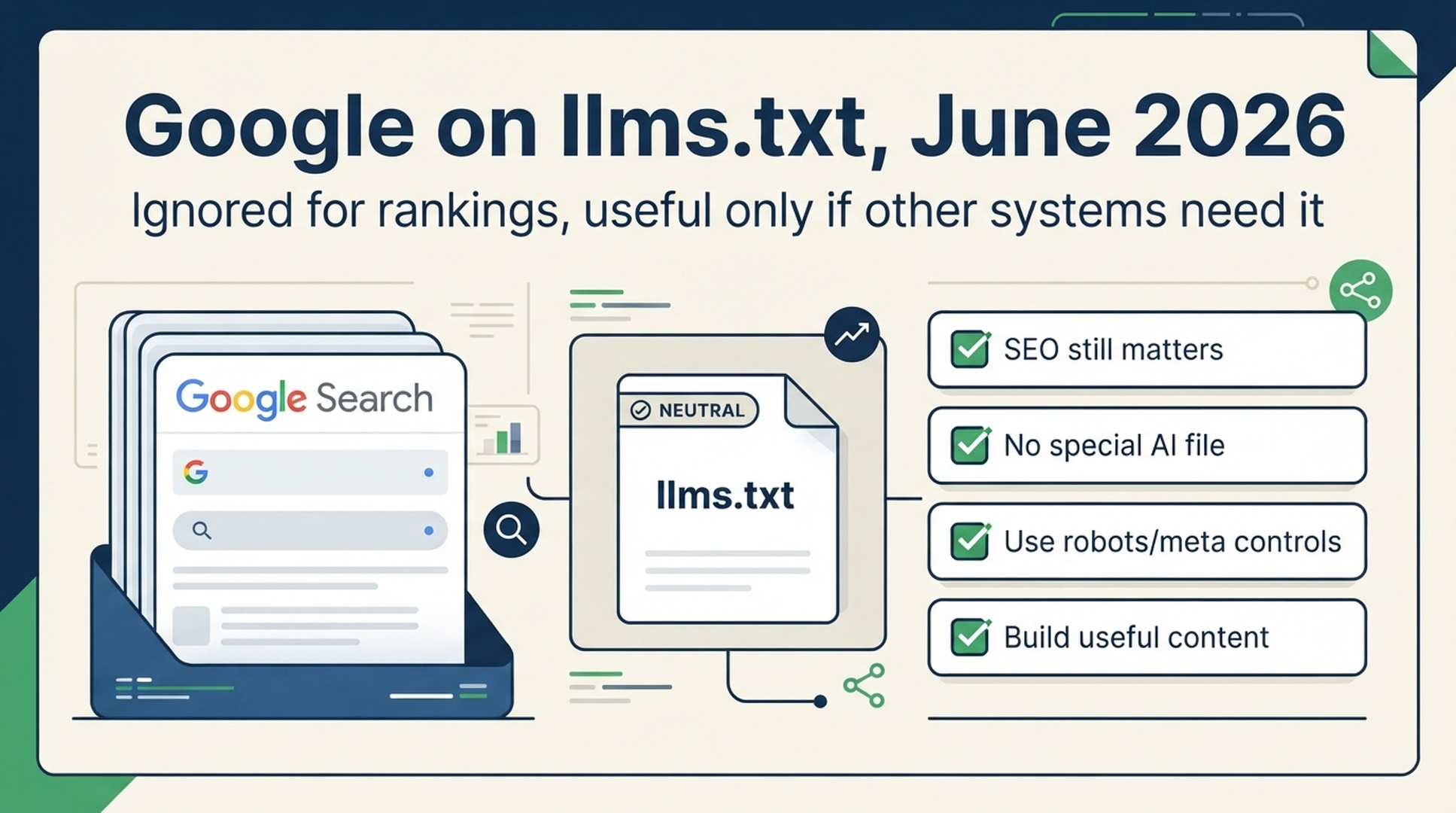
Google's current position is simple: an llms.txt file will not improve Google Search rankings, and it will not damage them either. In Google's own generative AI optimization guide, updated on June 29, 2026, Google says Search ignores these files. That includes Google's generative AI features such as AI Overviews and AI Mode.
That does not make llms.txt useless everywhere. It means it is not a Google ranking lever. If another crawler, partner, internal retrieval system, or AI product wants to read a plain-text guide to your site, maintaining one can still be reasonable. Just do not let it distract the team from the work Google keeps naming: useful non-commodity content, crawlable pages, clear technical structure, and normal search controls.
what Google clarified in June 2026
Search Engine Roundtable reported on June 16, 2026 that Google had updated its guide for optimizing websites for generative AI features. The update addressed a very practical question from the SEO community: should sites create llms.txt files to rank better in Google Search or appear more often in AI answers?
Google's answer is no.
The official guide now says site owners do not need new machine-readable files, AI text files, markup, or Markdown to appear in Google Search, including its generative AI capabilities. Google also adds that llms.txt and similar files are fine to maintain for other services or systems that use them, but they neither help nor hurt visibility or rankings in Google Search because Google Search ignores them.
That is the useful part. Google is not saying every AI system ignores the file. It is saying Google Search does.
the uncomfortable part for llms.txt advocates
llms.txt has been promoted as a way to make a website easier for large language models to understand. The idea is tidy: put a curated, markdown-friendly guide at the root of your domain, point models toward your best pages, and reduce crawler confusion.
For Google Search, that tidy idea runs into a hard boundary. Google is telling site owners that its Search systems do not use the file as a special input.
So the ranking question is settled for now:
Question | Google's June 2026 answer | Practical interpretation |
|---|---|---|
Will | No | Do not sell it as an SEO ranking factor. |
Can it hurt Google Search visibility? | No | A clean file is not a penalty risk by itself. |
Does Google need AI-only markdown files? | No | Google wants normal pages it can crawl, render, and understand. |
Can other systems use | Possibly | Treat it as optional infrastructure outside Google Search. |
The file can still be a neat documentation layer. It just should not sit at the center of a Google SEO or AI Overview strategy.
what Google says matters instead
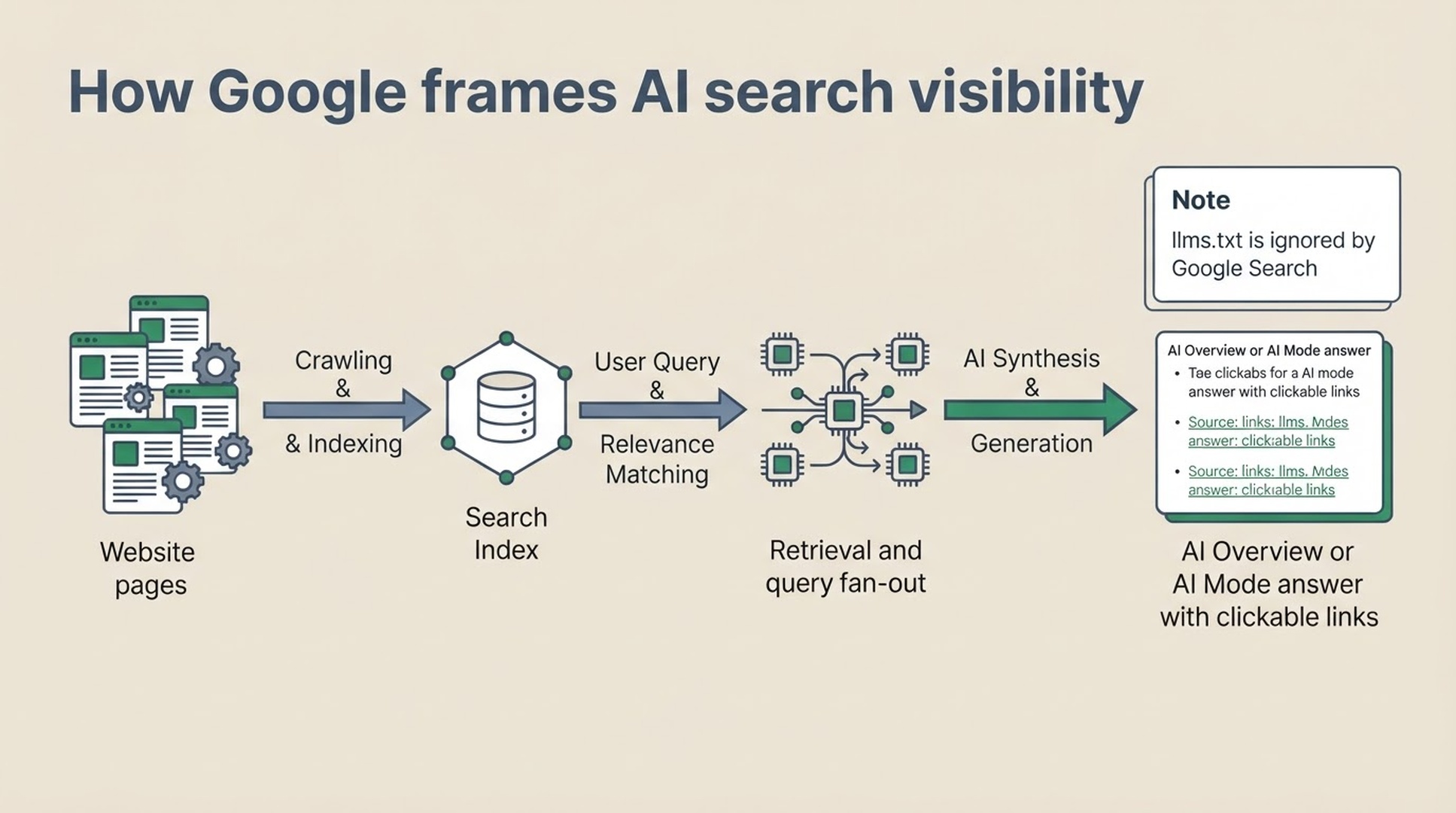
Google's guide is more interesting than the llms.txt footnote. It explains how Google frames generative AI search: still rooted in core Search ranking and quality systems.
Two concepts matter.
First, retrieval-augmented generation. Google describes AI answers as grounded in information retrieved from its Search index. That means the old boring work still matters: indexable pages, useful content, strong page experience, and pages that deserve to be retrieved.
Second, query fan-out. A model may generate related searches around the user's original query, then use those results to support a broader answer. This is where many SEO teams under-plan. A page built for one exact keyword may not answer the adjacent questions the AI system generates.
The practical takeaway: write for the topic and the task, not for a single file or a single phrase.
the Auspia view: llms.txt is a sidecar, not the engine
Auspia's read is blunt: llms.txt belongs in the "nice if needed" bucket. It is not where most teams are losing AI search visibility.
Most gaps are still inside the site itself:
- Important pages are thin, generic, or interchangeable with competitor pages.
- Product, service, and author facts are inconsistent across the site.
- Pages answer the headline query but not the follow-up questions an AI system may fan out into.
- Structured data exists, but the visible page does not support the same facts.
- Teams chase new AI files while leaving crawl, internal linking, and page experience problems unresolved.
There is one place where llms.txt can be useful: as a governance artifact. If your team uses it to decide which URLs, facts, docs, and product explanations deserve to be canonical, it can force useful editorial discipline. But the discipline matters more than the file.
If you want to test whether your site is ready for AI search surfaces, use a diagnostic workflow such as Auspia's AI Search Visibility Checker after you have checked the underlying pages.
a June 2026 operating rule for SEO and GEO teams
Here is the rule I would use for the next quarter: publish llms.txt only after the core search surfaces are healthy.
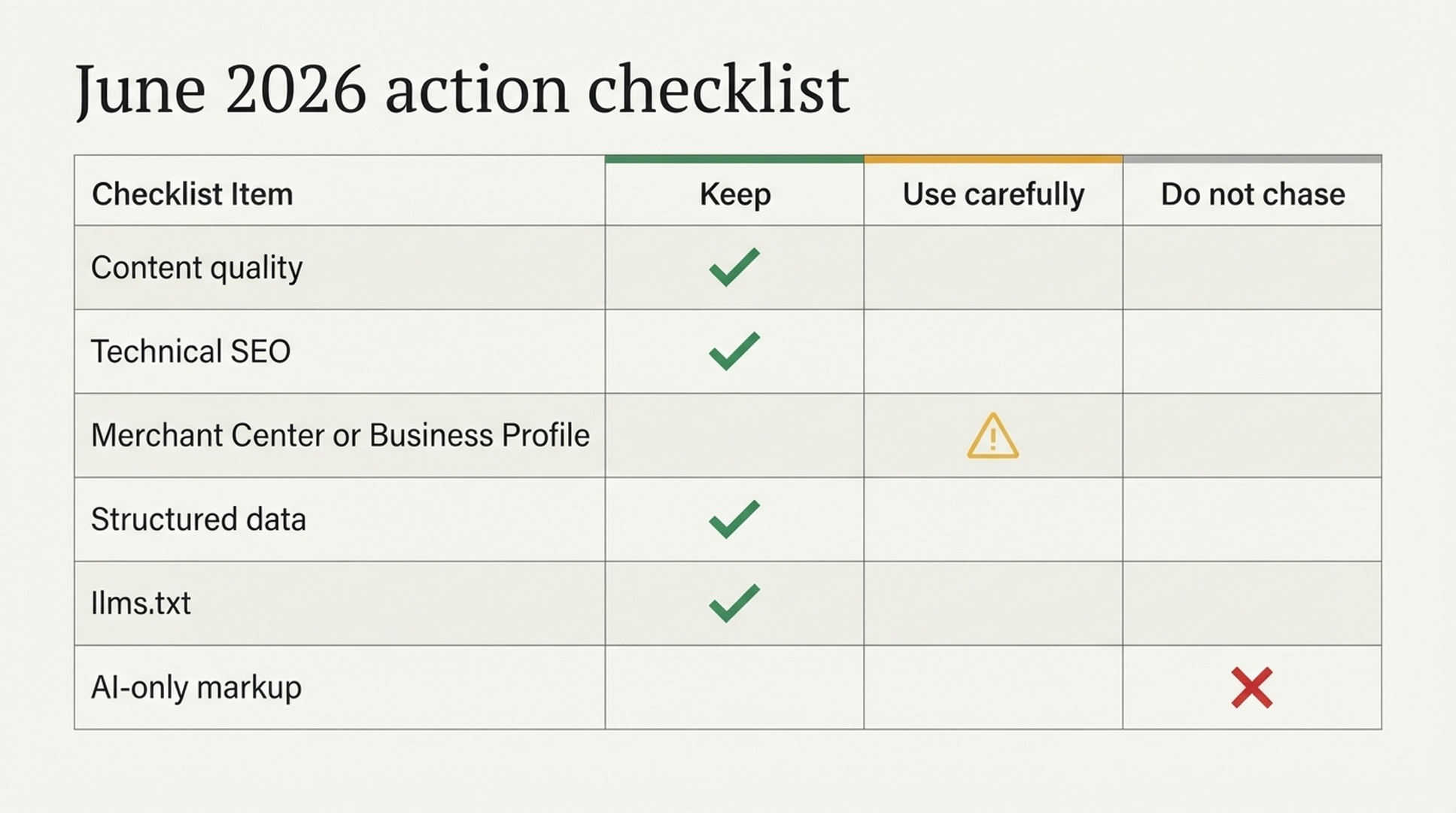
That means your priority order should look like this:
- Make sure your important pages are crawlable, indexable, and internally linked.
- Improve pages that sound like commodity summaries instead of original answers.
- Add clear product, local business, ecommerce, or organization facts where relevant.
- Use structured data for existing Search features and rich result eligibility, not as magic AI markup.
- Control snippets and previews with existing Google-supported tools when you need limits.
- Add
llms.txtonly if another system, partner, crawler, or internal workflow has a reason to read it.
That last point matters. A file maintained for a real consumer is different from a file maintained because everyone on X is suddenly anxious about AI crawlers.
what not to do after this update
The worst reaction would be to swing from hype to dismissal.
Do not tell your team that llms.txt is a secret ranking factor. It is not, according to Google.
Do not tell your team that all AI-readable documentation is pointless. Some systems may use these files, and your own team may benefit from the clarity.
Do not replace SEO with "GEO hacks." Google's guide is explicit that SEO still applies to generative AI features on Google Search. Terms like AEO and GEO may be useful labels for how teams organize work, but Google is asking site owners to evaluate those tactics against how Search actually works.
Do not create fake mentions, filler pages, or AI-only markup. If the visible website is weak, a machine-readable side file will not rescue it.
source notes
This article is based on two public sources:
- Google Search Central's official guide, "Optimizing your website for generative AI features on Google Search", last updated June 29, 2026.
- Search Engine Roundtable's June 16, 2026 report, "Google: LLMS.txt Files Won't Help Or Hurt Your Search Rankings", covering Google's clarification that
llms.txtfiles neither help nor hurt Google Search rankings.
The Search Engine Roundtable article also notes a later wording adjustment around June 29, 2026. The substance is the same for SEO teams: Google Search ignores llms.txt for ranking and visibility.
Author: Julian Mercer, 14-Year Technical SEO Practitioner at Auspia. Julian writes about crawlability, schema, rendering, site architecture, and technical foundations for AI-readable content.