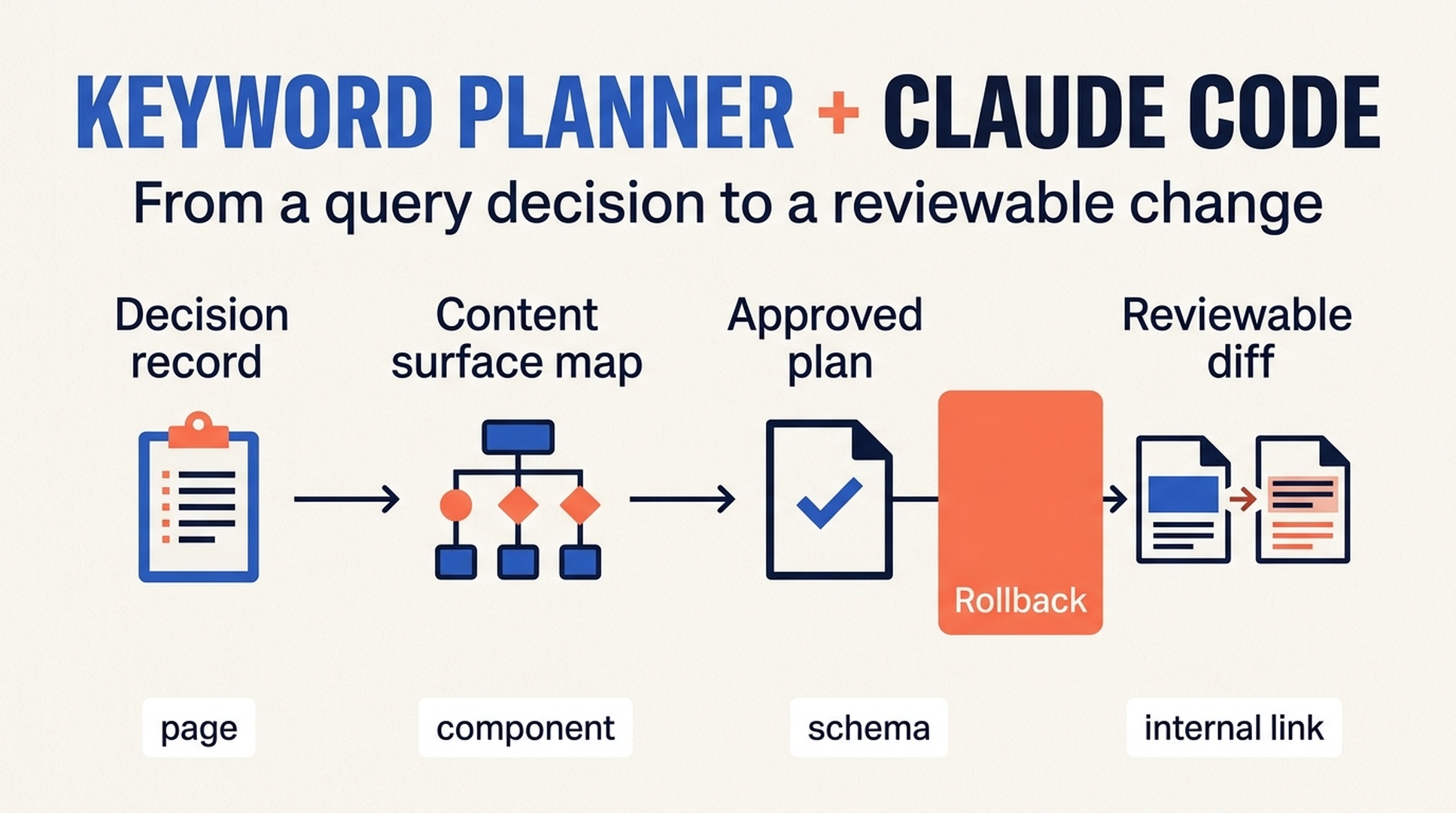
The keyword is a change request
Google Keyword Planner can help your team identify a searcher need. Claude Code is useful after the team has chosen that need and must decide what changes inside a content repository: update an existing guide, add a section, create a new page, or leave the site alone.
This is not a keyword-list workflow. It is an implementation-planning workflow. Claude Code reads a user-approved research pack and the local project rules, maps the decision to actual files, and prepares a plan you can review before it edits anything.
Best for | You will finish with | Required access | Definition of done |
|---|---|---|---|
A team whose site content lives in a Git repository or local project | A proposed content change map, file-level plan, and test checklist | An approved export, a chosen page decision, and a local copy of the project | A reviewer can explain why each proposed file change supports the chosen searcher need |
Do not begin with "find keywords in my repository." Your repository has page structure and brand facts, not current demand data. Keyword Planner or another authorized provider supplies the evidence; the repository tells you whether the site can answer the need without creating duplicate pages.
Map the content surface in the repository
Create a small research packet outside production content files. It should point Claude Code to the decision without asking it to infer business claims.
seo-change-request/
  decision.md
  keyword-planner-export.csv
  serp-notes.md
  page-inventory.csv
Use decision.md to state one chosen searcher job. Example:
Decision: improve our existing consultant expense-tracking guide rather than create a second page.
Target market/language: United States / English.
Evidence: approved Keyword Planner export dated 2026-07-29; manual SERP note; page inventory.
Known advantage: our guide can document the actual checklist used in the product.
Unknowns: final product terminology requires owner review.
Non-goals: do not change product pricing, legal language, navigation, or publishing settings.
Then ask Claude Code to inspect the repository without editing it:
Read CLAUDE.md and any repository instructions first. Then read only the files in
seo-change-request/ and inspect the repository for pages that could serve the
decision recorded in decision.md.

Do not edit files, install packages, run deployment commands, change configuration,
or use external keyword tools. Return a content surface map that names:
- the likely owner page and supporting files;
- pages that might collide with the chosen intent;
- visible brand or product facts that need owner confirmation;
- files you should not touch;
- the evidence or assumptions for every recommendation.
Quality check
The surface map should include file paths and explain their relationship to the visitor's task. A file path without a reason is not a plan.
Recovery path
If Claude Code cannot find a clear owner page, do not create a new one by default. Ask a content owner to supply a page inventory or explain the site's content model. A repository search is not proof that a URL does not exist in the CMS.
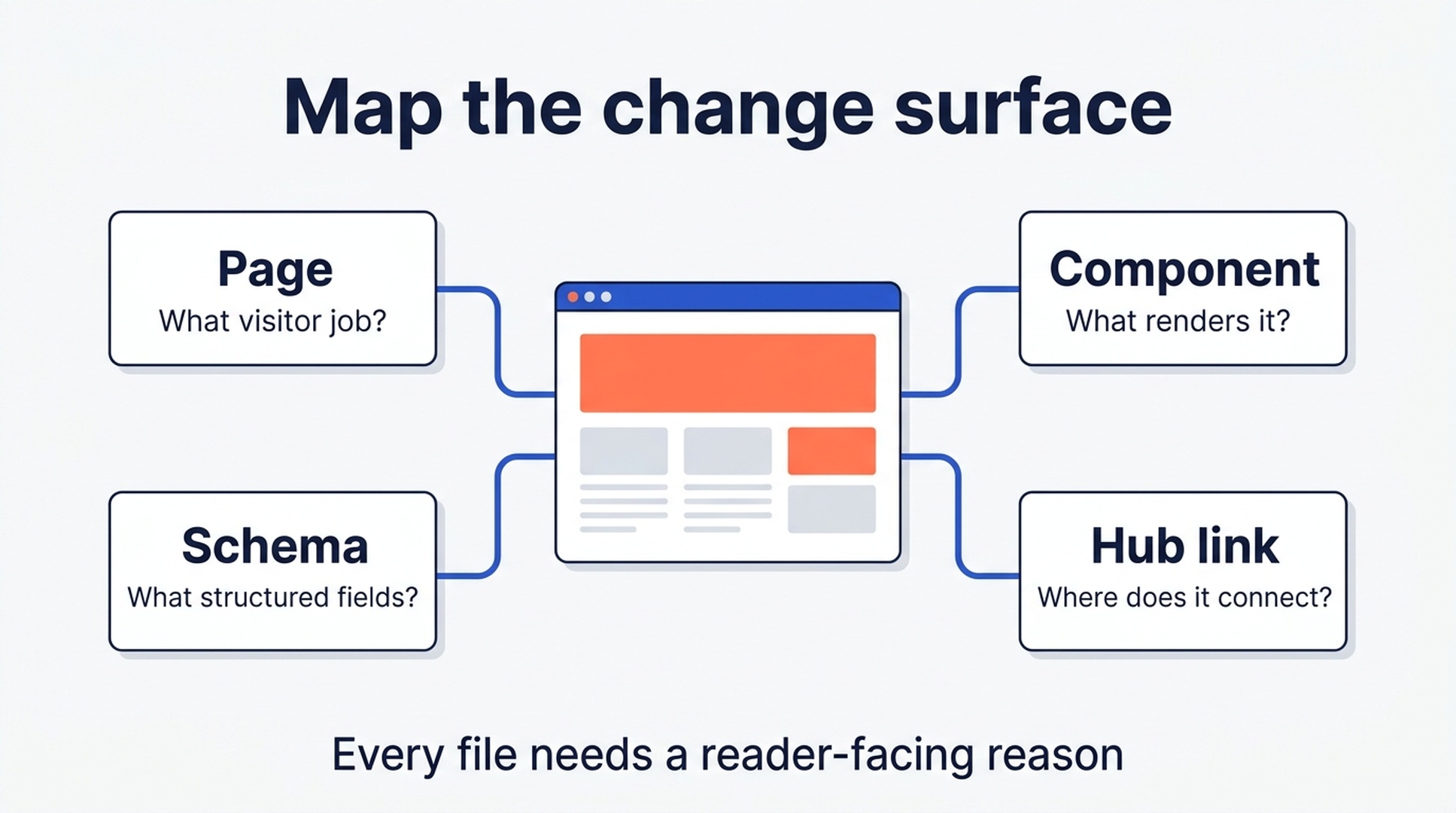
A content surface map makes every proposed file change answer a reader-facing question.
Review a plan before a file changes
Claude Code's strength is connecting a decision to actual implementation details. Use a project-level CLAUDE.md or equivalent instruction file to preserve your editing rules, then request a plan rather than a draft.
Using the approved decision and the content surface map, prepare a plan only.

For every proposed change, include:
1. File path and page URL, if known.
2. Reader problem it addresses.
3. Exact section or component to add, revise, preserve, or remove.
4. Source evidence or owner confirmation required.
5. Duplicate-page or internal-link risk.
6. Test needed after the change.
7. Rollback condition.

Do not write, edit, rename, delete, or deploy any files. Mark unsupported facts
as NEEDS OWNER. End with the smallest safe change set.
This produces a change request a strategist and developer can both read. A proposed page outline is not enough if the page's data source, navigation component, or schema lives somewhere else.
Separate editorial changes from repository changes
One keyword decision can create two kinds of work:
Work type | Example | Owner | Acceptance check |
|---|---|---|---|
Editorial | Add a decision checklist and answer the missing task earlier | Content owner | The guide answers the searcher job with approved facts |
Structural | Add one contextual link from a relevant hub | SEO or developer | The link has a clear destination and natural anchor text |
Technical | Confirm a page template renders the title and canonical correctly | Developer | Preview or staging test passes without template regression |
Measurement | Record the URL, market, language, and comparable review period | SEO owner | The later review can compare like with like |
Claude Code should not merge these into one opaque change. An editor might approve the new section while a developer needs to reject the template modification. Keeping the split visible gives each owner a real approval point.
Turn an approved plan into a reviewable diff
Only after the plan is approved should you authorize a narrow edit. Keep the prompt specific:
Implement only the approved items 1 and 2 from [plan file].

Before editing, repeat the target files and acceptance criteria. Preserve existing
frontmatter, routes, schema, dates, authors, and internal links unless the plan
explicitly changes them. Do not edit global configuration or publish.

After editing, show:
- a concise diff summary;
- every changed file;
- facts that still need owner review;
- commands or preview checks to run;
- a rollback instruction that restores only this change set.
The output is a diff, not a ranking claim. The reviewer still needs to read the revised page in a local preview or staging environment.
Use rollback as a content-quality control
Rollback is not only for broken builds. It protects against a change that technically renders but weakens the page: a duplicated H1, an unsupported product claim, a new section that competes with a better page, or a broken internal link.
Stop condition | What to do |
|---|---|
Product owner rejects a claim | Remove or replace the claim before merge |
Page overlaps a separate owner URL | Revise the page route; do not publish both answers |
Preview differs from the proposed change | Compare the rendered page with the diff and correct the source |
Metadata or schema changes unintentionally | Revert that file and narrow the edit scope |
Do not ask Claude Code to "fix everything it finds." The keyword decision gives the work a boundary. Any broader technical issue should become a separate, reviewed task.
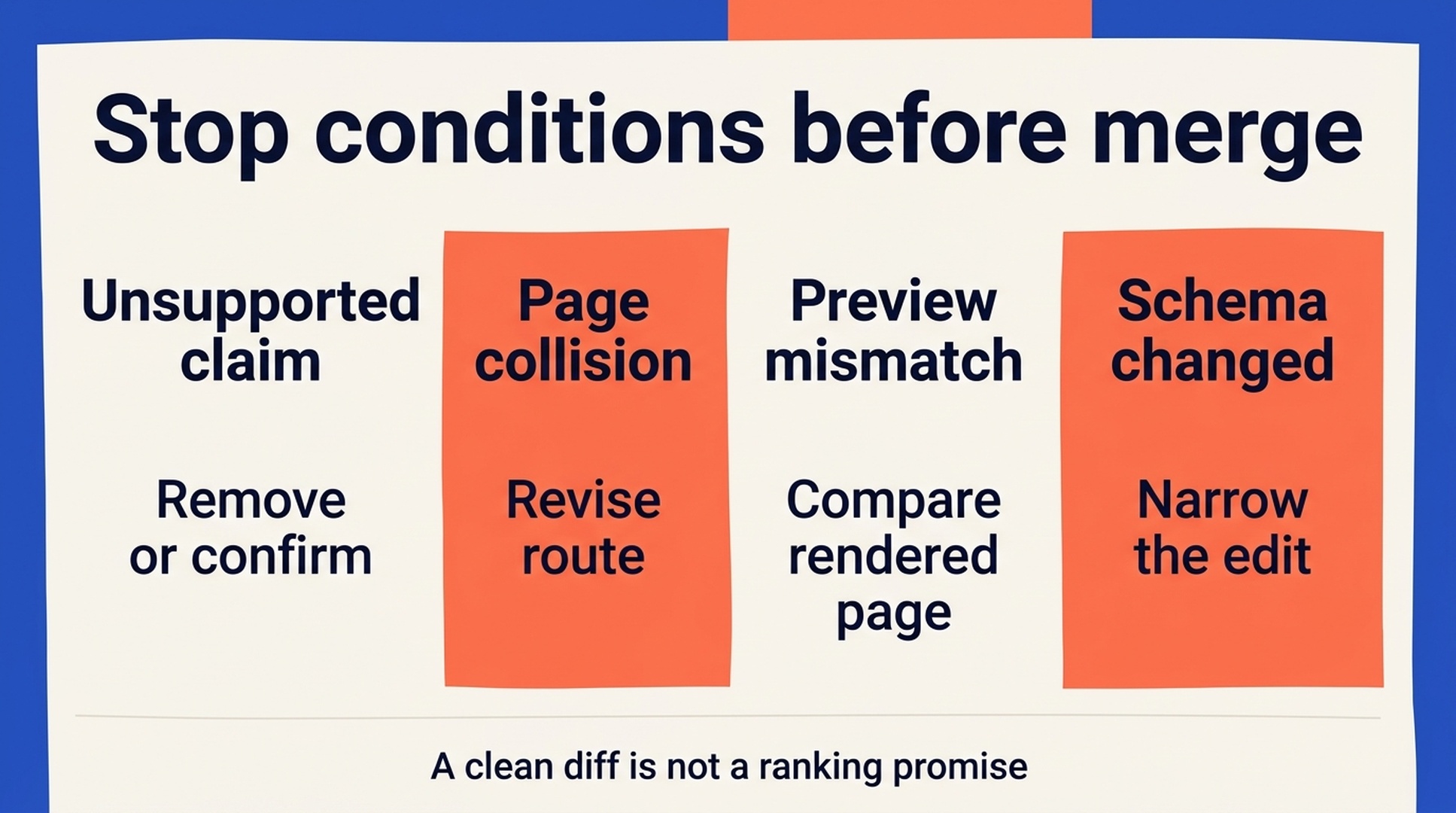
Stop conditions prevent a technically clean edit from becoming a weak content decision.
Verify the change request is ready for a human merge
You are ready for a human merge or CMS handoff when:
- The Keyword Planner export and SERP note are named in the decision record.
- The page route is a conscious choice: refresh, new page, consolidate, or hold.
- Every file change has a reader-facing reason and an owner.
- The diff preserves facts that need approval rather than filling them in.
- Preview checks cover the target page, links, title, headings, and structured fields affected by the edit.
- The rollback instruction is narrow and practical.
For a broader public-page diagnosis before a repository edit, use an appropriate SEO tool separately. A source-code review and a live-page audit answer different questions.
FAQ
Can Claude Code retrieve Keyword Planner data itself?
Only when a user has deliberately configured and authorized that connection. In this workflow, it receives an approved export and uses it as evidence for a repository plan. It should not request passwords, cookies, or API keys in chat.
Should Claude Code write the article immediately after the plan?
Not until the owner approves the plan and the factual inputs. A page can sound polished while still using the wrong product terms or competing with an existing URL. The plan is where those risks become visible.
Does a clean diff mean the page will rank?
No. A clean diff shows that the implementation matches the approved request. Search performance depends on the query, competing pages, discovery, quality, and factors a repository cannot settle.
What if the site is managed entirely in a CMS?
Keep the same decision and approval stages, but replace repository file paths with CMS page IDs, templates, and preview links. Do not give Claude Code live CMS credentials unless the access is explicitly authorized and scoped.
Author: Julian Mercer, 14-Year Technical SEO Practitioner at Auspia. Julian writes about site architecture, reviewable implementation, and technical checks that protect search-facing pages.