Delegate the checks, not the decision
Hermes Agent is an open source AI agent framework from NousResearch. You drive it from the CLI with hermes chat, where it can search and extract the web with web_search and web_extract, automate a browser, run reusable Skills, schedule cron-based tasks, and load MCP toolsets. The official documentation is at hermes-agent.nousresearch.com/docs.
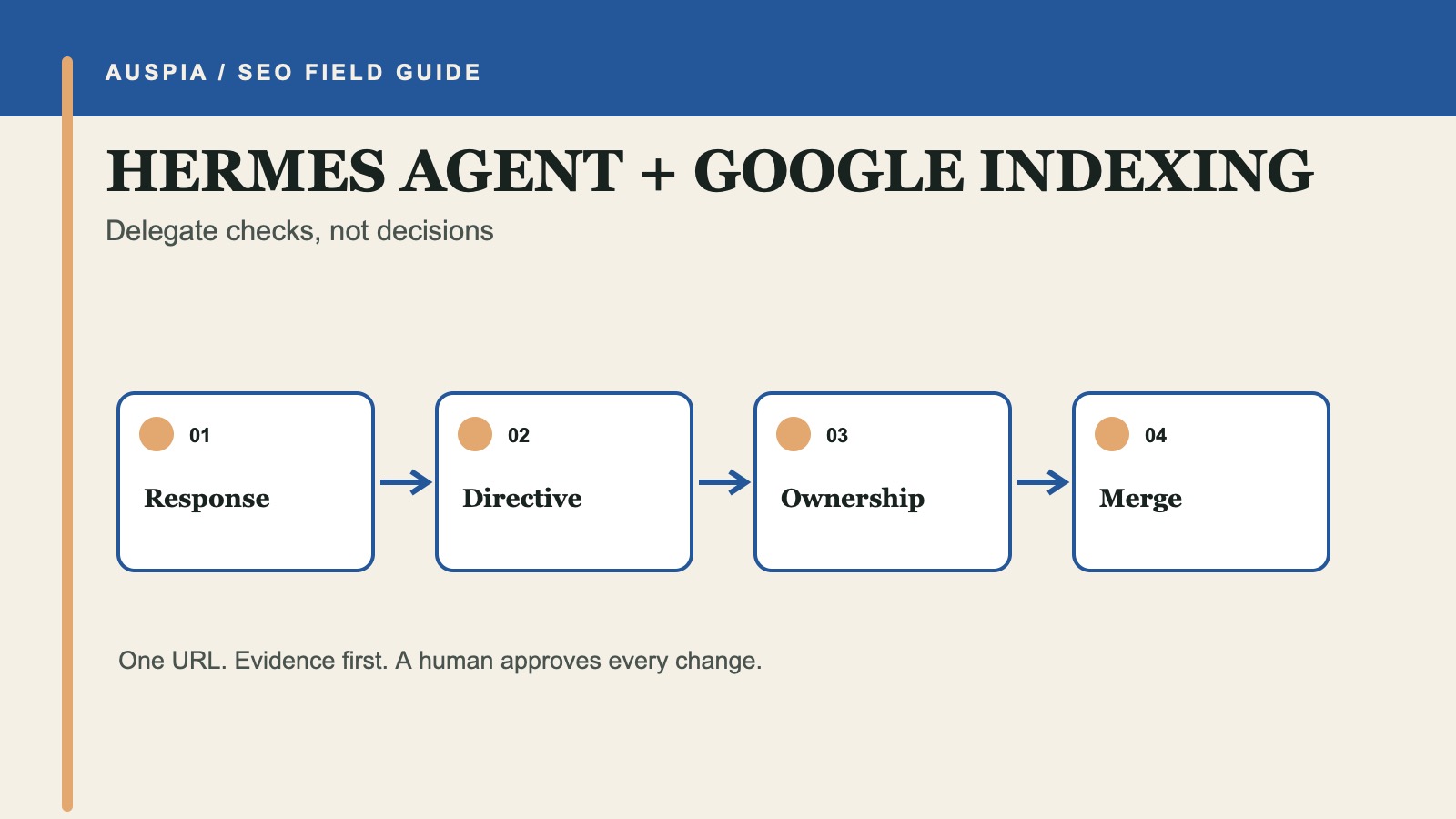
Hermes Agent can delegate work to isolated subagents with their own context and terminal sessions. That is useful for an indexing diagnosis because the evidence comes from different places: a live response, a robots file, a sitemap, a local project, and a human-supplied URL Inspection result.
The danger is obvious: parallel agents can turn uncertainty into a persuasive-looking consensus. Avoid that by giving each delegate one narrow question and asking the parent agent to report evidence, disagreement, and confidence before it proposes a repair.
For a single URL, the goal is a merged diagnosis, not an automated fix. The merge should tell a site owner what is confirmed, what still needs Search Console evidence, and who must approve the next step.
Outcome card
- Who this is for: SEO practitioners and site owners with a single URL missing from Google Search, with Search Console access or the willingness to paste URL Inspection evidence.
- What you will have: a merged diagnosis that separates confirmed causes from hypotheses, a written evidence register, and one smallest repair candidate with owner, risk, rollback, and an acceptance check.
- Prerequisites: the target URL, its expected state (searchable, excluded, or unknown), the intended canonical, page purpose, URL Inspection text if available, and Hermes Agent installed to run the delegation.
- Estimated time: 15 to 30 minutes for one URL with four delegates, plus a short human review before any change.
- Definition of done: the evidence register lists confirmed and likely causes and every not_checked item; exactly one repair candidate is approved with an owner; the run made no changes, requested no indexing, and scheduled nothing.
Create a specialist roster for one URL
Use four delegates. More is not automatically better.
Delegate | Scope | Output |
|---|---|---|
Response checker | Exact URL, redirects, status, headers, public HTML | Response fact sheet |
Directive checker |
| Directive conflict note |
Ownership checker | Canonical candidates, sitemap, relevant internal links | URL ownership comparison |
Value checker | Page purpose and nearby overlap | Page-purpose brief |
Keep URL Inspection outside the delegates unless the user supplies its text. A delegate cannot infer Google's selected canonical, crawl state, or indexing verdict from a browser request.
Start the parent task with the expected state:
Target URL:
Should it appear in Google Search? yes / no / unknown
Intended canonical:
Page purpose:
URL Inspection evidence supplied: yes / no
Allowed public domain:
Local project access: [path / not approved]
Give every delegate the same evidence contract
Use a repeatable instruction, but change the assigned question:
Investigate only [ASSIGNED CHECK] for this exact URL: [URL].

Report each observation as:
- observation;
- source URL or local file path;
- whether it is confirmed, inferred, or not_checked;
- confidence: high, medium, or low;
- smallest next check.

Do not edit files, create or update a Skill, use cron, deploy, log in to an
account, submit a sitemap, request indexing, or contact a third party.
Stop after the report.
Hermes has persistent memory and a system that can create Skills from experience. That is valuable for long-running operations. Keep a one-off investigation from silently becoming a durable memory, newly created Skill, or scheduled task; capture the approved procedure in a versioned project document instead.
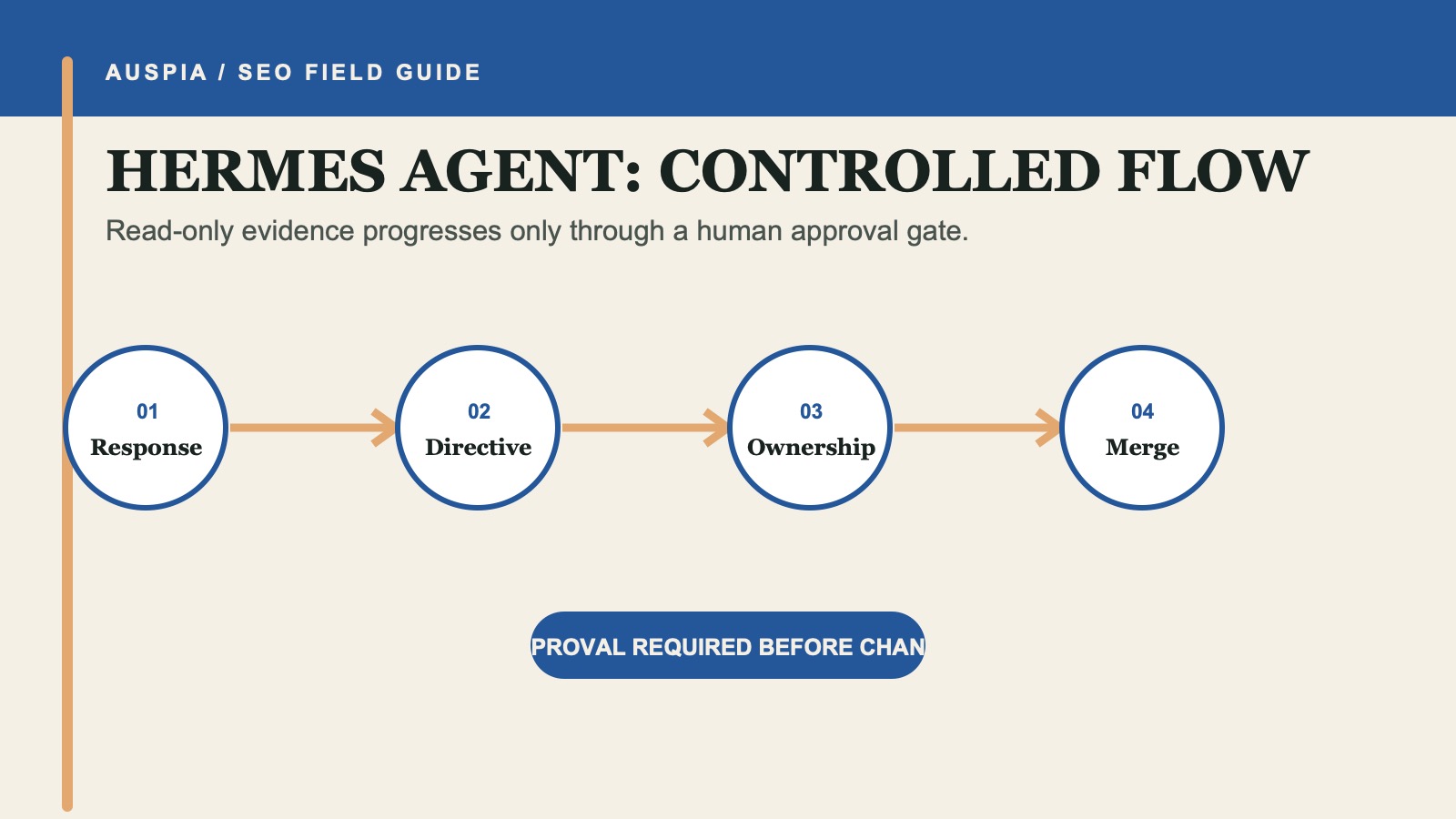
Delegation helps isolate research tasks. The parent agent should merge evidence, not average opinions.
Ask the parent agent to reconcile, not vote
Once the delegates return, have the parent produce this order:
- Expected state: searchable, intentionally excluded, or still undecided.
- Evidence register: observation, source, delegate, and confidence.
- Conflicts: statements that cannot both be treated as final.
- Diagnosis: confirmed causes, likely causes, and
not_checkeditems. - Repair candidates: each with owner, risk, rollback, and acceptance check.
Use this parent prompt:
Merge the delegate reports. Do not vote or invent consensus.

Separate confirmed evidence from hypotheses. Preserve disagreements.
If Search Console evidence was not supplied, do not claim Google indexed,
excluded, crawled, or selected a canonical. Mark those checks not_checked.

Recommend only the smallest repair candidate that is supported by evidence.
For every candidate, include owner, exact interface or file to inspect, risk,
rollback, and staging acceptance check. Make no changes.
Read four common conflict patterns
noindex and a crawl block point in opposite directions
As of mid-2026, Google must crawl a page to discover a page-level noindex or X-Robots-Tag. If the URL is blocked in robots.txt, Google may not see that instruction. The fix depends on whether the page should be searchable or intentionally excluded. It is not "remove both."
A self-canonical exists, but Google selected another URL
The page owner must compare the candidates. As of mid-2026, Google still describes redirects and rel="canonical" as strong canonical signals, while sitemap inclusion is weaker. A delegate can collect the facts; it cannot decide which page owns the user need.
The sitemap contains the URL, but no relevant page links to it
That is a discovery review, not an indexing guarantee. Add a contextual link only where it helps users navigate and points to the canonical page.
Technical checks are clean, but the page has little distinct value
An agent can show overlap and missing facts, but it cannot make a generic page worthy of indexing by padding it. Route the work to an editor or product owner for a specific content brief.
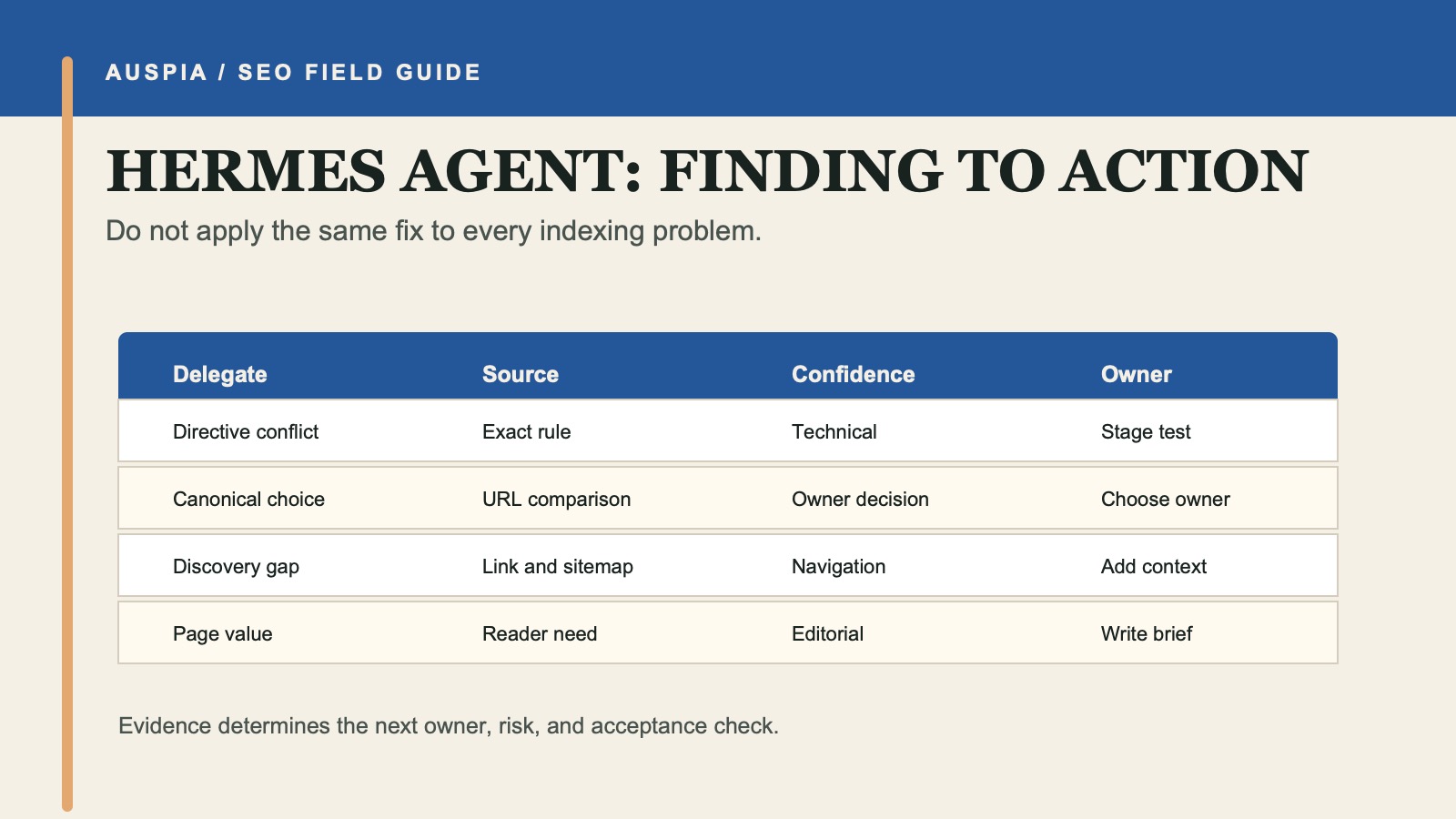
The report should make uncertainty visible. That makes the human decision smaller and safer.
Approve one repair, then use a new task
Hermes delegates inherit tool access, so reusing a wide research task for implementation is tempting but risky. Start a new, bounded task after the owner approves a named change.
Approved action: [exact change]
Approved location: [file, CMS field, or hosting rule]
No other files or interfaces are approved.
Do not deploy, submit a sitemap, request indexing, or create schedules.
Show the proposed diff before editing. After approval, run [named check]
and provide rollback steps.
For production configuration, it may be safer to stop at the repair brief and give the task to the team that owns the CDN, CMS, or deployment pipeline.
Keep scheduled work separate from the first repair
Hermes supports cron-based scheduled tasks and can attach Skills to them. A beginner should not schedule an indexing action after a single diagnosis. The facts change slowly, and as of mid-2026 Google does not reward repeated recrawl requests for an unchanged URL.
If you later monitor a portfolio of pages, create a separate read-only job that compares public responses and writes a report. Its prompt should explicitly prohibit deployments, account actions, and Skill mutation. Review that schedule as a production automation, not a convenience setting.
Verify after release
The human release owner checks the live URL: final URL, status, robots directives, canonical, visible content, sitemap, and internal links. URL Inspection's live test is the next check.
After a meaningful public change, a human may choose Request indexing. As of mid-2026, Google's guidance says crawling can take days to weeks and that inclusion, rankings, traffic, and AI-feature visibility are never guaranteed.
Add the release result to the evidence register. The next delegate run should use that dated record, not reconstruct the earlier investigation from memory.
Troubleshoot the diagnosis
- Delegates disagree on the final URL. One delegate follows redirects and another reports the raw address. Agree on a single fetch recipe before starting, and ask every delegate to report the redirect chain with status codes plus the final URL.
- The live response contradicts URL Inspection. Caching, geo, and user-agent variants explain most mismatches. Timestamp the live fetch, note the user agent, and treat pasted URL Inspection text as the reference for Google's view of that fetch.
- robots.txt blocks the URL while the sitemap lists it. That is evidence, not an error. Record both observations, mark crawl discovery as blocked, and let the human decide between searchable and intentionally excluded.
- The parent proposes a repair nobody approved. Re-run the reconcile prompt, which requires owner, risk, rollback, and an acceptance check for every candidate. Escalate to the human when no candidate meets all four.
Run this indexing diagnosis as a Hermes skill
If you expect to run indexing diagnoses more than once, package this procedure as a Hermes skill instead of retyping the prompts. A skill keeps the delegate roster, the evidence contract, and the conflict patterns in one file that hermes chat loads on demand. The skill below compresses the workflow from this article into a runnable form. If you are new to the setup side, start with How to set up your first Hermes SEO Agent, which covers the installation this article assumes.
---
name: hermes-indexing-diagnosis
description: Diagnose why a single URL is missing from Google Search by delegating response, directive, ownership, and value checks to isolated subagents, then reconciling the evidence into a repair brief. Use this when a site owner asks why a page is not indexed, why Google selected a different canonical, or whether noindex or robots.txt rules are blocking a URL. Run it with the target URL and any URL Inspection evidence the site owner supplies.
---

# Google Indexing Diagnosis

## Goal
Produce a merged, evidence-based diagnosis for one URL and a single smallest repair candidate. Make no changes, request no indexing, and create no schedules.
The parent agent merges evidence, not opinions.

## Inputs
- Target URL
- Expected state: searchable / intentionally excluded / unknown
- Intended canonical
- Page purpose
- URL Inspection evidence supplied: yes / no (paste the text when available)
- Local project access: path / not approved
- Allowed public domain

## Step 1: Create four delegates
Use four isolated subagents, each assigned one check:
- Response checker: exact URL, redirects, status, headers, public HTML
- Directive checker: robots.txt, meta robots, X-Robots-Tag
- Ownership checker: canonical candidates, sitemap, relevant internal links
- Value checker: page purpose and nearby overlap

Evidence contract for every delegate:
- Report each observation as observation; source URL or file path; confirmed, inferred, or not_checked; confidence high, medium, or low; and the smallest next check.
- Do not edit files, create or update skills, use cron, deploy, log in, submit a sitemap, request indexing, or contact third parties.
- Stop after the report.

Keep URL Inspection outside the delegates. Only the site owner's pasted text counts as Search Console evidence.

## Step 2: Reconcile in the parent agent
Merge the reports in this order:
1. Expected state: searchable, intentionally excluded, or undecided.
2. Evidence register: observation, source, delegate, confidence.
3. Conflicts: statements that cannot both be final.
4. Diagnosis: confirmed causes, likely causes, and not_checked items.
5. Repair candidates: owner, risk, rollback, acceptance check.

Without Search Console evidence, mark indexed, excluded, crawled, and canonical-selected as not_checked. Preserve disagreements; do not vote.
Use the dated evidence register from an earlier run when one exists; avoid reconstructing the investigation from memory.

## Step 3: Judge the common patterns
- noindex plus a robots.txt block: Google cannot read a page-level noindex it is blocked from crawling. Ask the human whether the page is searchable or intentionally excluded.
- Self-canonical but Google selected another URL: compare candidates. Redirects and rel=canonical are strong signals; sitemap inclusion is weaker.
- Sitemap lists the URL but no page links to it: discovery gap, not an indexing guarantee. Add a contextual link only where it helps users.
- Technical checks are clean but the page lacks distinct value: route to an editor or product owner. Do not pad the content.

## Step 4: Output the repair brief
Print:
- Expected state and final merged diagnosis
- Evidence register with sources and confidence
- not_checked items and the exact evidence that would resolve them
- One smallest repair candidate with owner, exact file or interface, risk, rollback, and a staging acceptance check
- A closing line: "No change was made. The next step belongs to [owner]."

## Rules
- Do not vote or invent consensus; preserve disagreements.
- Do not make changes, request indexing, or create schedules.
- Recommend only the smallest repair candidate supported by evidence.
- Include owner, risk, rollback, and an acceptance check for every candidate.
Install it
- Save the block above to
~/.hermes/skills/seo/hermes-indexing-diagnosis/SKILL.md. - Run
hermes skills listand confirmhermes-indexing-diagnosisappears in the output. - Start
hermes chatand say: "Use the hermes-indexing-diagnosis skill to diagnose indexing for my site."
Simpler alternative
If you do not want to install a skill file, paste this article's URL into hermes chat and say: "Follow this article and run the indexing diagnosis." Hermes reads the article and applies the workflow in a single session.
FAQ
Can Hermes Agent create a reusable indexing Skill from this workflow?
It can support Skills, but keep it from creating or altering one automatically during the first diagnosis. Review a reusable procedure separately before sharing it across sites.
Why not give every delegate full repository access?
Most delegates need only public evidence. Narrow scopes reduce accidental edits and make it easier to understand why a finding exists.
Can a delegate request indexing when the page looks fixed?
No. That is an external Search Console action and should be separately approved by a human after the live page is verified.
What does a low-confidence finding mean?
It means the agent needs a smaller next check, not a broader edit. For example, ask for copied URL Inspection text rather than changing a canonical based on a guess.
Official references
- Hermes Agent documentation
- Hermes Agent delegation
- Hermes Agent Skills
- Hermes Agent scheduled tasks
- Google: Consolidate duplicate URLs
Author: Victor Lane, GEO Audit Specialist at Auspia. Victor writes about evidence registers, diagnostic confidence, and clear ownership for technical growth work.