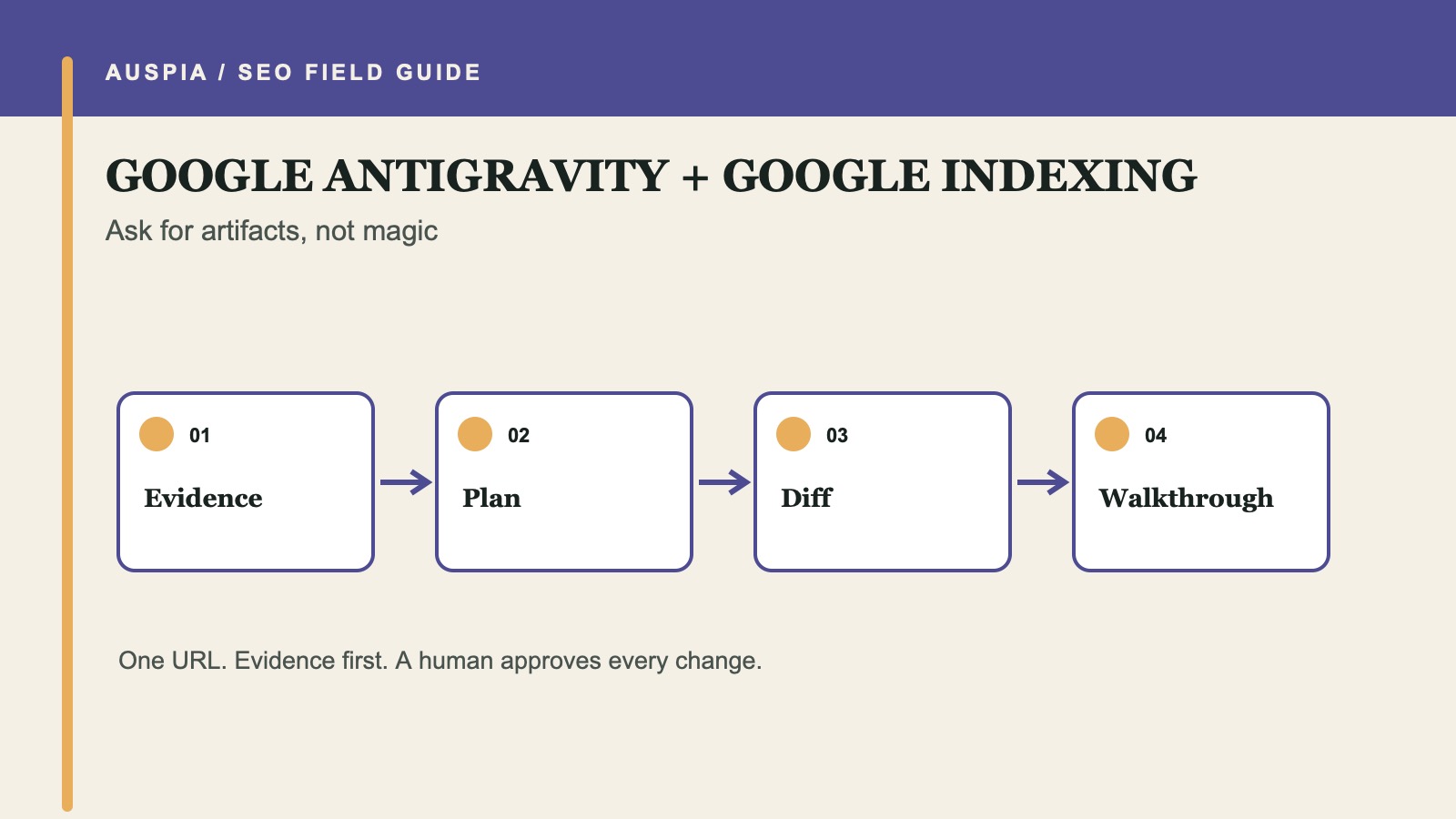
Ask for artifacts, not a magic fix
Google Antigravity is an agentic development platform. Its useful idea for a Google indexing issue is the artifact trail: a task list, implementation plan, code diff, walkthrough, and screenshots or checks that show what changed.
That makes it a strong workflow when you have a codebase and one URL that should be searchable. It does not turn Antigravity into Google Search Console, and it does not let an agent guarantee crawling, indexing, rankings, or AI-feature visibility.
For a beginner, define success as four reviewable artifacts:
1. evidence summary
2. implementation plan
3. scoped diff and walkthrough
4. live verification checklist
If you cannot review all four, the task is not ready for release.
Start in Manager view with a single mission
Use Antigravity's Manager workflow for the investigation. The mission must name one URL, its expected state, and what is outside scope.
Mission: investigate why https://example.com/page may not be indexed by Google.

Expected state: searchable / intentionally excluded / unknown
Intended canonical: [URL / unknown]
Page purpose: [one sentence]
URL Inspection evidence: [paste text / not_checked]

Allowed work: read public same-domain evidence and inspect the local repository.
Required artifacts: evidence summary, task list, implementation plan.
Prohibited work: edits, deployment, Search Console actions, sitemap submission,
Request indexing, secrets, or unrelated route changes.
The Manager is the place to track the investigation, not a reason to create many agents for one small question. Use parallel work only when the tasks are independent: one agent can trace headers and routes while another maps canonical candidates and sitemap generation.
Demand an evidence artifact before an implementation plan
The first artifact should make three categories obvious:
Category | What belongs there |
|---|---|
Confirmed | Exact header, directive, redirect, file path, or supplied URL Inspection result |
Likely | A theory that needs a targeted check |
| Google-selected canonical, last crawl, account setting, logs, or business decision that was not supplied |
Antigravity should link every repository observation to a path and every public observation to a URL. It should not infer Google-specific status from a page that merely loads in the browser.
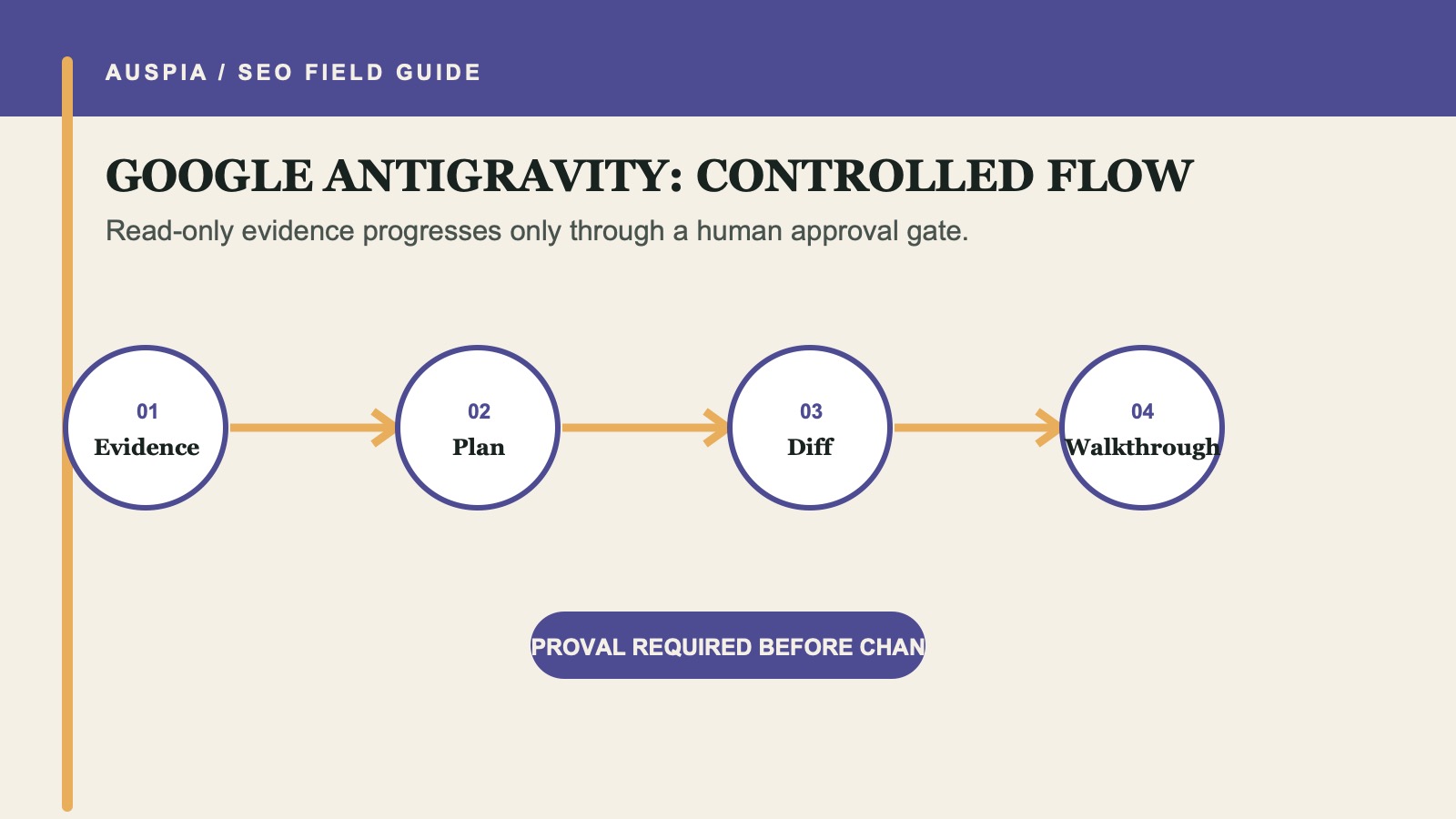
The artifact chain gives a reviewer a place to challenge a conclusion before code changes begin.
Use this instruction after the evidence artifact exists:
Create an implementation plan only from confirmed evidence.
For each proposed change, include:
- exact file or interface;
- expected behavior;
- routes that may be affected;
- risk and rollback;
- staging acceptance check;
- a human decision required before the edit.

Do not edit yet. Do not use a sitemap as proof of indexing. Do not recommend a
canonical change until URL ownership is explicitly decided.
Read the plan by failure mode
A directive excludes a page that should be searchable
Look for meta robots and X-Robots-Tag output, then identify where the directive is produced. Removing it is safe only after the page owner confirms the page is public, useful, and distinct. Google must crawl a URL to discover page-level noindex, so a robots block can create a conflicting setup.
A canonical or duplicate issue is unresolved
Compare the target with the preferred URL. Is the content equivalent? Which one should own the intent? Which URLs do users and internal links reach? Google describes redirects and rel="canonical" as strong canonical signals, while sitemap inclusion is weaker. Do not use noindex or robots.txt as canonicalization mechanisms.
Access or rendering has not been proven
Ask for the final HTTP response, redirect chain, relevant headers, and rendered output. A build passing locally is not proof that a CDN or production middleware returns the same result.
Discovery and value remain weak
Check whether the intended canonical appears in a sitemap and in useful, crawlable internal links. If technical signals are consistent but the page duplicates other content or lacks a clear reader need, make a content brief. Do not pad the page with generic copy.
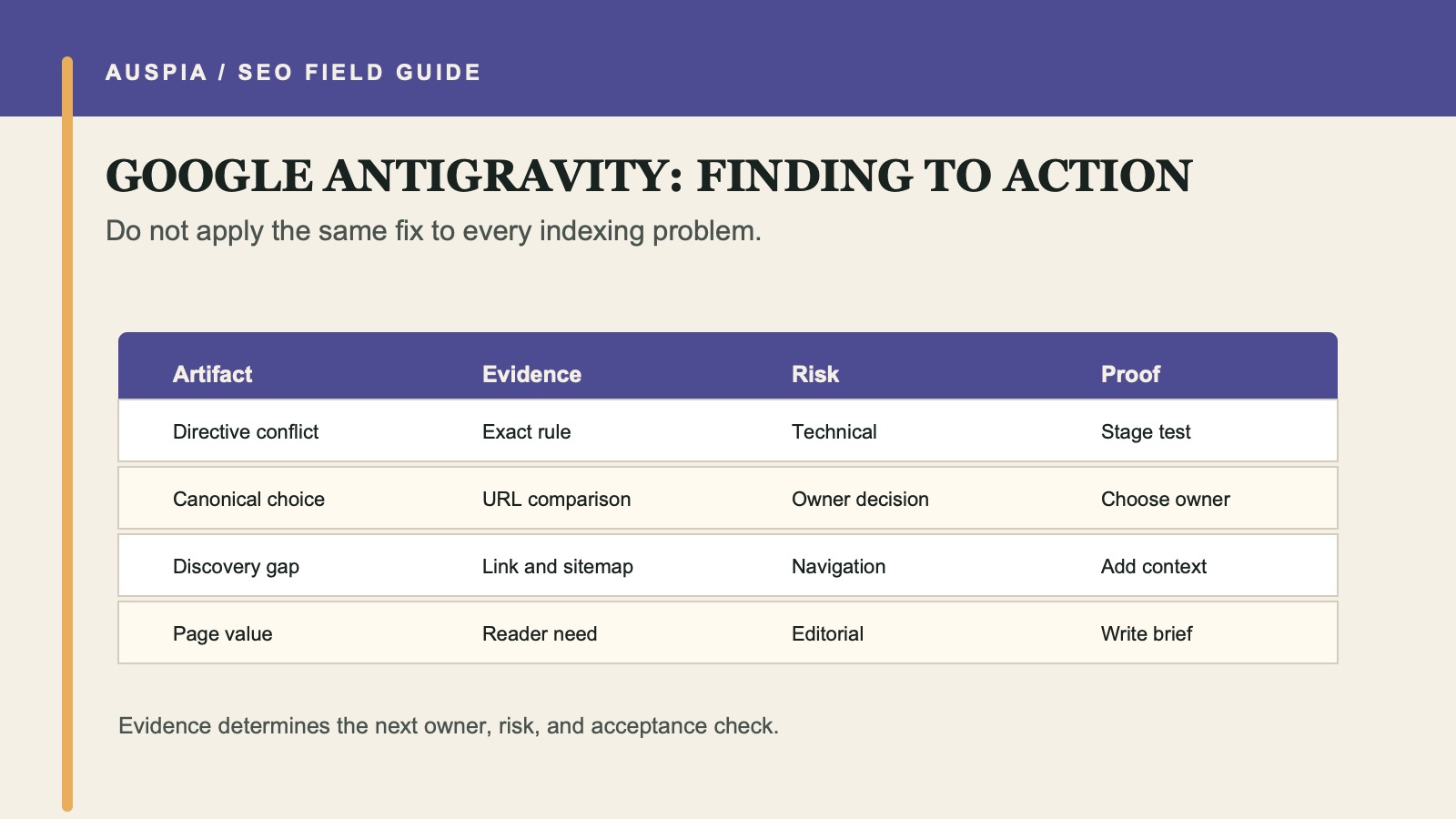
A plan is reviewable when every change has an owner, a rollback, and a way to prove it worked.
Move to Editor view only after approval
When the site owner approves one plan item, open the relevant workspace in Editor view. Keep the edit instruction narrow:
Approved change: [exact behavior]
Approved files: [paths]
Required artifacts after the edit: diff, walkthrough, affected-route list,
test output, rollback note.

Do not alter any other canonical, robots, redirect, sitemap, account, or
deployment setting. Stop if the approved files do not contain the source of the
behavior.
Review the diff before accepting it. A good walkthrough should explain how the route now produces the intended response. It should not merely say "fixed indexing."
If Antigravity finds the behavior in a shared layout, middleware, or infrastructure rule, stop and expand the plan. Shared code can affect many pages, and a one-URL approval is no longer enough.
Use screenshots and checks as verification artifacts
Antigravity can provide screenshots and other artifacts. For an indexing repair, the useful proof is a small set:
- source or response evidence showing the agreed canonical and robots state;
- a route test or staging response for the exact URL;
- a screenshot only when it proves visible content or navigation;
- a list of affected routes when shared code changed.
Avoid fake dashboard screenshots. A screenshot cannot prove Google's indexing status, and a polished agent report cannot replace URL Inspection.
Release and verify outside the agent mission
A human or existing release process deploys the approved change. After deployment, check the public URL, final response, canonical, robots directives, content, sitemap, and internal links.
Then run URL Inspection's live test. A human may choose Request indexing only after a meaningful live change. Google says crawling can take days to weeks, individual URL requests have quotas, and submitting the same unchanged URL again does not make it crawl faster.
Attach the live verification result to the original Manager mission. That closes the chain from observed evidence to verified outcome without claiming that the agent forced Google to do anything.
FAQ
Does Google Antigravity know whether Google indexed my page?
No. It can organize supplied URL Inspection evidence and inspect the code or public response. It cannot infer private Search Console status without that evidence.
What is the most important artifact to review?
The implementation plan before edits. It identifies scope, ownership, risk, rollback, and the acceptance check that prevents a broad accidental change.
Can I ask Antigravity to deploy the fix?
Keep deployment separate unless you explicitly approve that external action and the release process is already authorized. A local diff is not a deployment approval.
Will a canonical correction guarantee indexing?
No. It can make duplicate signals more consistent. Google still crawls and evaluates the page independently.
Official references
- Google Antigravity
- Google Antigravity documentation
- Google Antigravity changelog
- Google: Ask Google to recrawl URLs
- Google: Robots meta tags and X-Robots-Tag
Author: Freya Collins, AI Answer UX Researcher, 900+ Answer Blocks Studied at Auspia. Freya writes about verifiable agent outputs, readable technical workflows, and the checks that turn a plan into a reliable release.