ChatGPT's job is to make the handoff clearer
ChatGPT is useful for a Google indexing problem when you need to turn scattered evidence into a brief another person can act on. It can read a copied URL Inspection result, compare it with page source and official Google documentation, explain an unfamiliar status in plain English, and draft questions for a developer or CMS owner.
It should not be treated as your Search Console operator or website administrator. A good result is a concise, sourced repair brief. A bad result is a confident-sounding diagnosis built from a site: search and an incomplete screenshot.
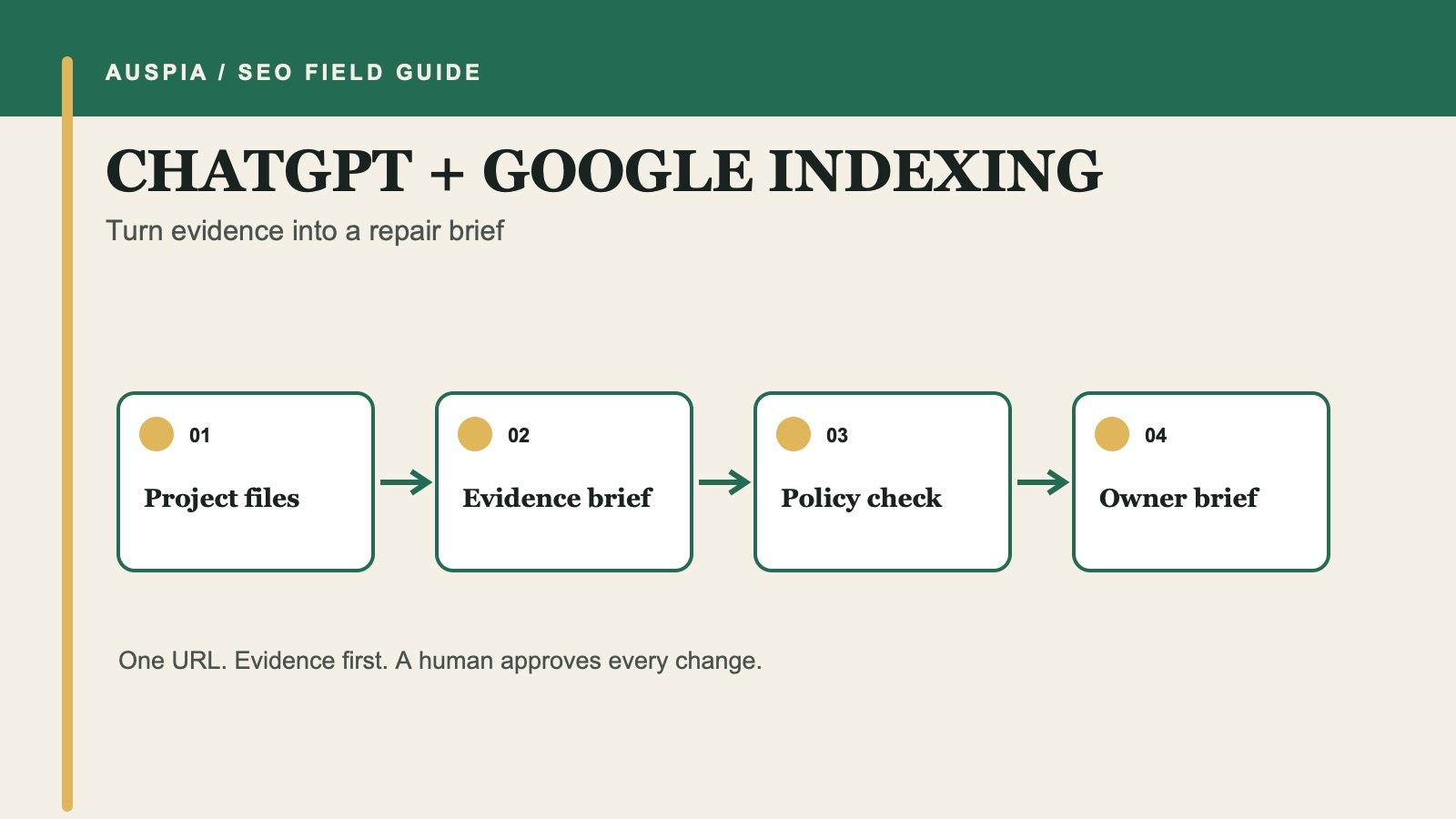
Use this workflow for one URL. The definition of done is simple: a human can state the page's intended search status, distinguish facts from unknowns, and send the next owner a brief with a specific acceptance check.
Create a dedicated Project for the case
ChatGPT Projects keep related chats, files, and instructions together. Create a Project named after the URL or ticket, then add only the material needed for the investigation:
- copied URL Inspection text or a redacted screenshot transcript;
- saved public page source and HTTP/redirect notes;
robots.txtand relevant sitemap excerpt;- a one-sentence page purpose and intended canonical;
- an approved local export, if you have one.
Do not upload passwords, cookies, API keys, raw customer exports, or a whole Search Console archive. If an item is missing, the Project instruction should require the words not_checked rather than an invented conclusion.
Add this Project instruction:
This Project investigates one Google indexing case at a time.
Treat supplied Search Console content as evidence, not account access.
For every conclusion, cite an uploaded file or an official public source.
Separate confirmed facts, hypotheses, and not_checked items.
Do not tell me to change a website, deploy, submit a sitemap, or request
indexing until a human has approved a specific plan.
Ask for an evidence brief before using Deep Research
Start with the files already in the Project. This keeps the first answer tied to the actual URL instead of generic SEO advice.
Create an evidence brief for this target URL: [URL]

Expected state: [searchable / intentionally excluded / unknown]
Intended canonical: [URL / unknown]
Page purpose: [one sentence]

Using only the Project files, return:
1. known facts with source filename;
2. unknown or not_checked items;
3. two to four competing explanations, ranked by evidence;
4. questions for the next owner;
5. no recommended changes yet.
This first pass often reveals the real missing input. If URL Inspection was not supplied, ChatGPT should not state that Google crawled, indexed, excluded, or selected a canonical. Public source code can show what the site intends. It does not show Google's last observation.
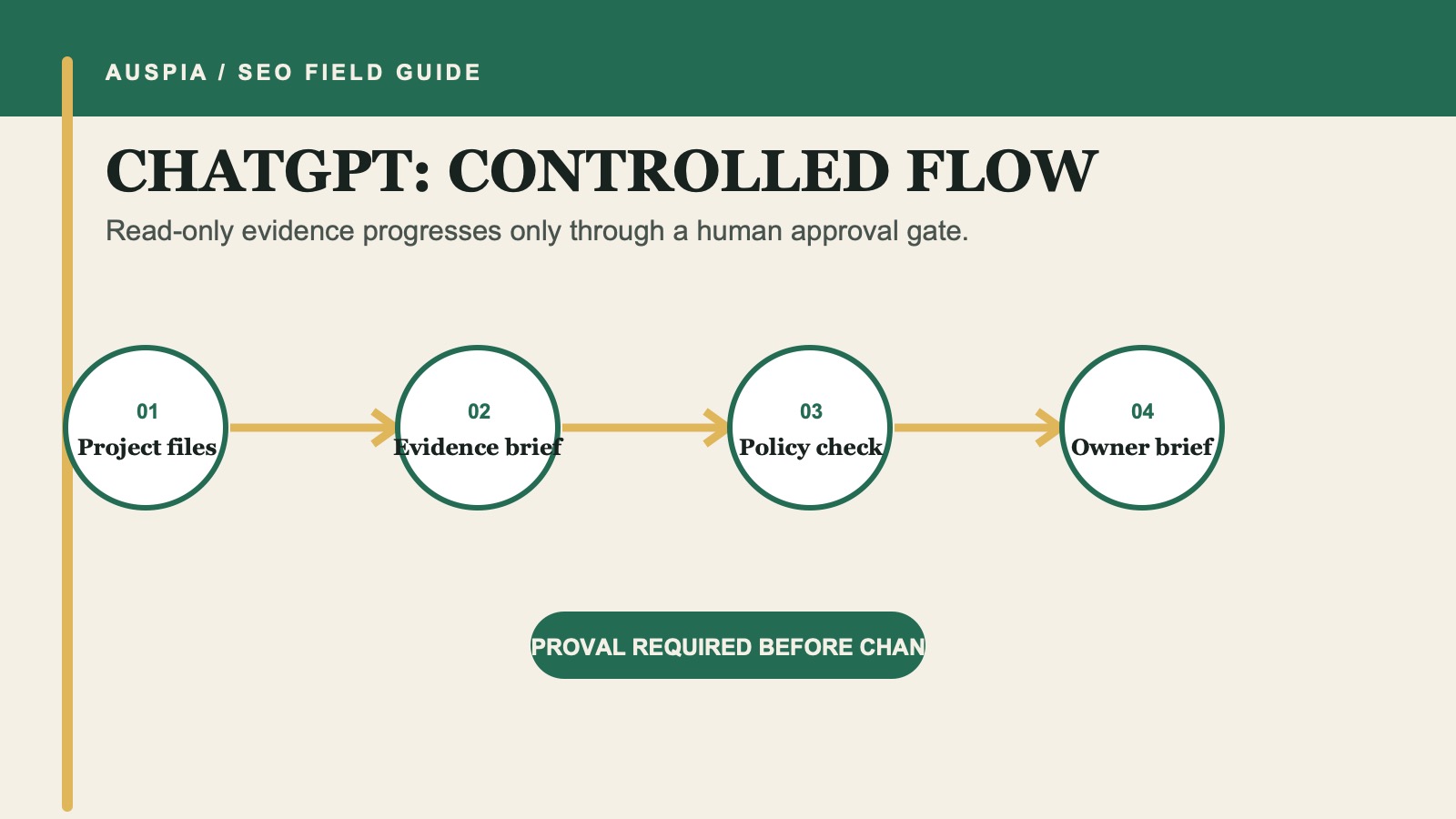
The Project keeps the case materials together, while the brief makes source boundaries visible to the next owner.
Use Deep Research for policy questions, not private-site claims
Deep Research can research and synthesize public sources into a documented report. Use it after the evidence brief to clarify a narrow policy question, such as:
Research these Google Search Central questions using official Google sources only:
1. Can Google apply page-level noindex when robots.txt blocks crawling?
2. Which canonicalization signals are strong versus weak?
3. What does Google say about repeated Request indexing submissions?

Return short answers with source links. Do not infer anything about my site.
The distinction protects the quality of the brief. Official documentation can explain how noindex, canonicals, sitemaps, and recrawl requests work. It cannot confirm why your particular URL is excluded without site-specific evidence.
Turn evidence into a developer-ready repair brief
After you have the case facts and policy references, ask ChatGPT to create a handoff. The format should be compact enough for a ticket, email, or PR description.
## Google indexing repair brief

Target URL:
Expected search state:
What is confirmed:
What is not checked:
Relevant Google policy:
Likely owner: developer / CMS administrator / content owner / hosting owner
Smallest proposed check or change:
Risk if wrong:
Rollback:
Staging acceptance check:
Live verification:
Optional Search Console action for a human:
The phrase "smallest proposed check or change" prevents a common failure. A canonical conflict needs a comparison of the competing URLs before a tag is changed. A noindex directive needs a decision about whether the page should be public. A sparse page needs a content brief, not generic expansion.
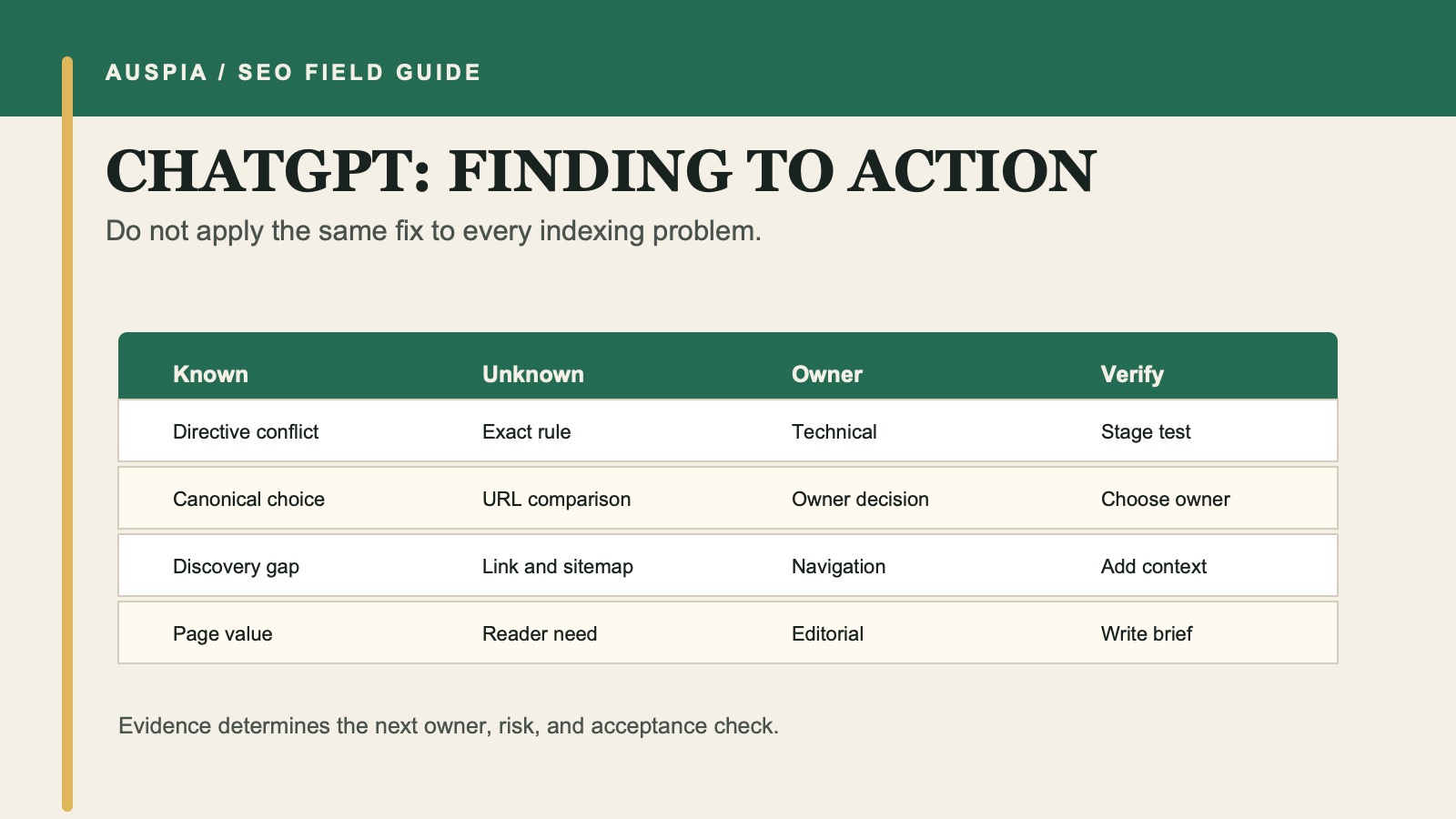
A useful brief routes each finding to an owner, names its risk, and states what must be true before the case can close.
Give the website owner the final authority
ChatGPT may draft a suggested change, but only the website owner can approve it. This is especially important for four categories:
Finding | Human decision required |
|---|---|
| Is the page public, useful, and intended for Search? |
Canonical mismatch | Which URL owns the user intent? |
Redirect or robots rule | What other routes could be affected? |
Weak page value | What distinct information should the page contain? |
Google says it must crawl a URL to see page-level noindex. It also treats redirects and rel="canonical" as strong canonicalization signals, while sitemap inclusion is weaker. Use those facts to sharpen the questions, not to bypass the owner.
Verify the live page outside the chat
Once the responsible person makes and deploys an approved change, check the public page: final URL, HTTP response, canonical, robots directives, visible content, sitemap target, and contextual internal links.
Then use URL Inspection's live test. A human may select Request indexing after a meaningful live change. Google says recrawling can take days to weeks and repeated requests for an unchanged URL do not make it faster.
Save the final brief and verification note in the Project. The next conversation should start from a dated record, not from a vague memory that "ChatGPT said it was fixed."
What ChatGPT should not do in this workflow
- Use a
site:search as a definitive indexing test. - Invent Search Console evidence from page source.
- Ask you to paste authentication data into a chat.
- Produce a code diff it cannot test against the actual repository.
- Promise that a sitemap, canonical, or Request indexing action guarantees inclusion.
- Treat Deep Research citations as evidence about your private website.
FAQ
Can ChatGPT use my Search Console account?
Not in this workflow. Upload or paste only the evidence you are authorized to share, and keep account actions with a human.
Do I need Deep Research for every case?
No. Use it when you need a current, sourced explanation of a Google policy. If the evidence brief already identifies an obvious local directive, a focused owner handoff may be enough.
Can a Project remember the case over time?
Projects can keep chats, uploaded files, and instructions together. Still, include dated verification notes and do not rely on memory as proof of the live state.
Will the repair brief make Google index the page?
No. It improves the quality of the human decision and implementation. Google still evaluates the URL independently.
Official references
- ChatGPT Projects
- Deep research in ChatGPT
- ChatGPT file uploads FAQ
- Google: Block indexing with noindex
- Google: Consolidate duplicate URLs
Author: Iris Campbell, Editorial Evidence Analyst, 2,500+ Sources Reviewed at Auspia. Iris writes about source quality, research boundaries, and turning evidence into decisions people can verify.