The short answer: treat AI as production capacity, not a quality standard
Pages created with AI assistance can be indexed by Google and can rank at the top of search results. What determines how far a page goes is not whether its author opened an AI tool. It is whether the page gives readers information that is specific, reliable, and easy to verify.
The useful lesson in this research is that search performance is not a binary gate. As the estimated share of AI-written text rises, indexing, average ranking position, and organic impressions generally shift gradually. At the same time, pages with a high estimated AI share continue to appear throughout the top 10, including positions 1 through 3.
For content teams in 2026, the practical question is no longer "Should we use AI to write?" It is whether the time AI saves is being invested in original information, expert judgment, and a better page experience.
What the study measured
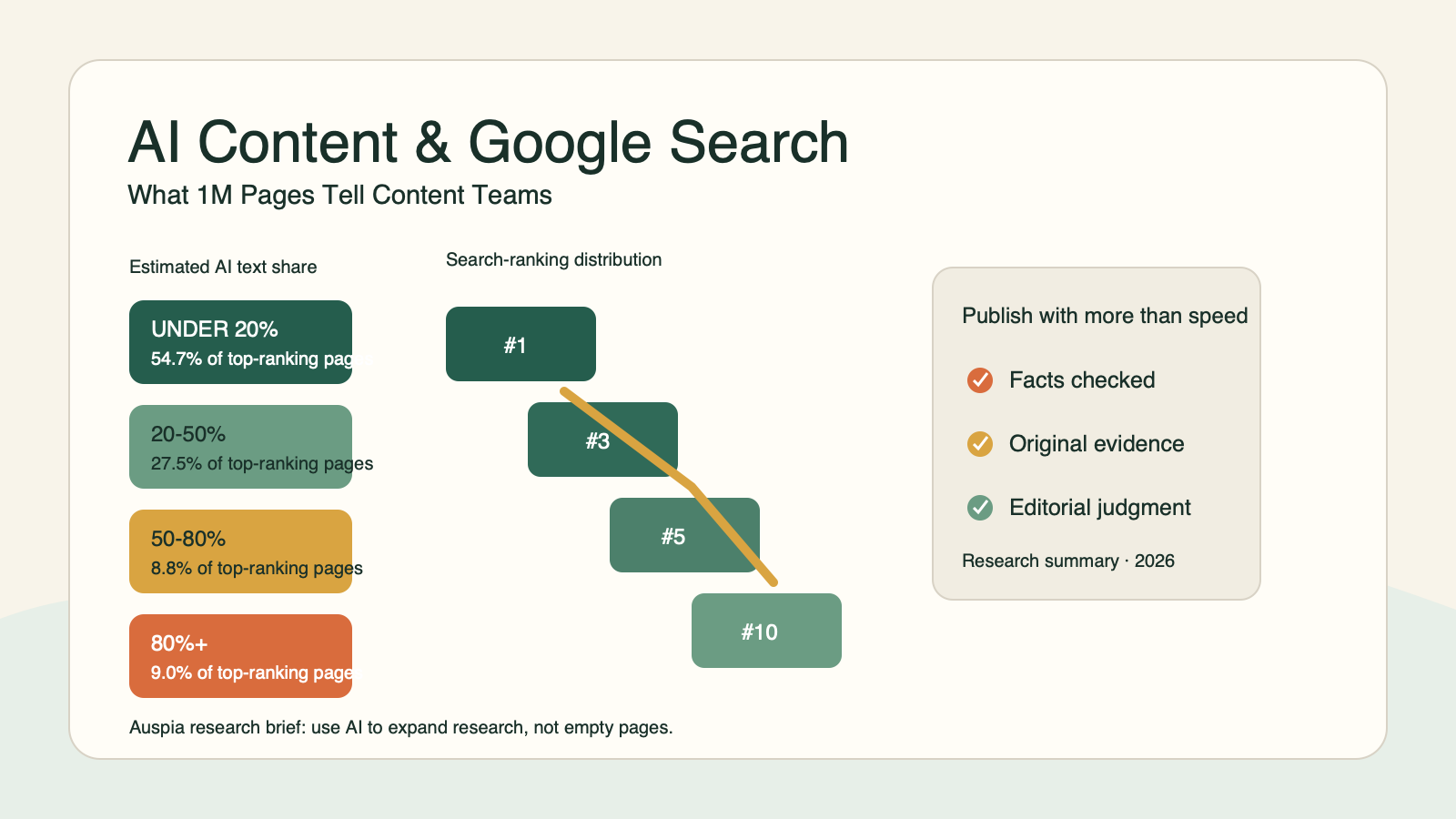
The study sampled one million pages from the top 10 results across 100,000 SERPs in June 2026. About 300,000 pages were available in the crawler database, and about 150,000 had enough body copy for AI-content analysis. The data comes from Ahrefs' crawler and AI-content detector, which evaluates pages with at least 350 words of body text.
Estimated AI text share | Share of top-ranking pages |
|---|---|
Under 20% | 54.7% |
20% to 50% | 27.5% |
50% to 80% | 8.8% |
80% or more | 9.0% |
100% | 5.3% |
Among pages ranking in positions 1 through 3, 82.2% have an estimated AI share below 50%. Low-AI pages still make up most of the top results. But fully AI-generated pages account for 5.3% of the sample, so they are not excluded from high positions.
The top 10 looks like a gradient, not a cutoff
At position 1, 8.4% of pages have an estimated AI share of 80% or more. At position 10, the figure is 11.7%. Here is the complete distribution by position.
Search position | Very high: 80%+ | High: 50-80% | Moderate: 20-50% | Low: under 20% |
|---|---|---|---|---|
1 | 8.4% | 8.1% | 27.5% | 55.9% |
2 | 9.0% | 8.8% | 27.6% | 54.6% |
3 | 9.6% | 9.5% | 27.4% | 53.5% |
4 | 9.8% | 10.0% | 26.9% | 53.3% |
5 | 10.0% | 10.1% | 26.9% | 53.0% |
6 | 10.7% | 10.2% | 26.5% | 52.6% |
7 | 10.2% | 10.1% | 27.7% | 52.0% |
8 | 11.1% | 9.8% | 28.0% | 51.0% |
9 | 11.3% | 10.2% | 28.1% | 50.3% |
10 | 11.7% | 9.5% | 27.7% | 51.1% |
The point is not to label one page. It is that low-AI pages are the majority at every position, while high-AI pages exist at every position. The difference is a slope, not a line that separates AI pages from the rest of the results.
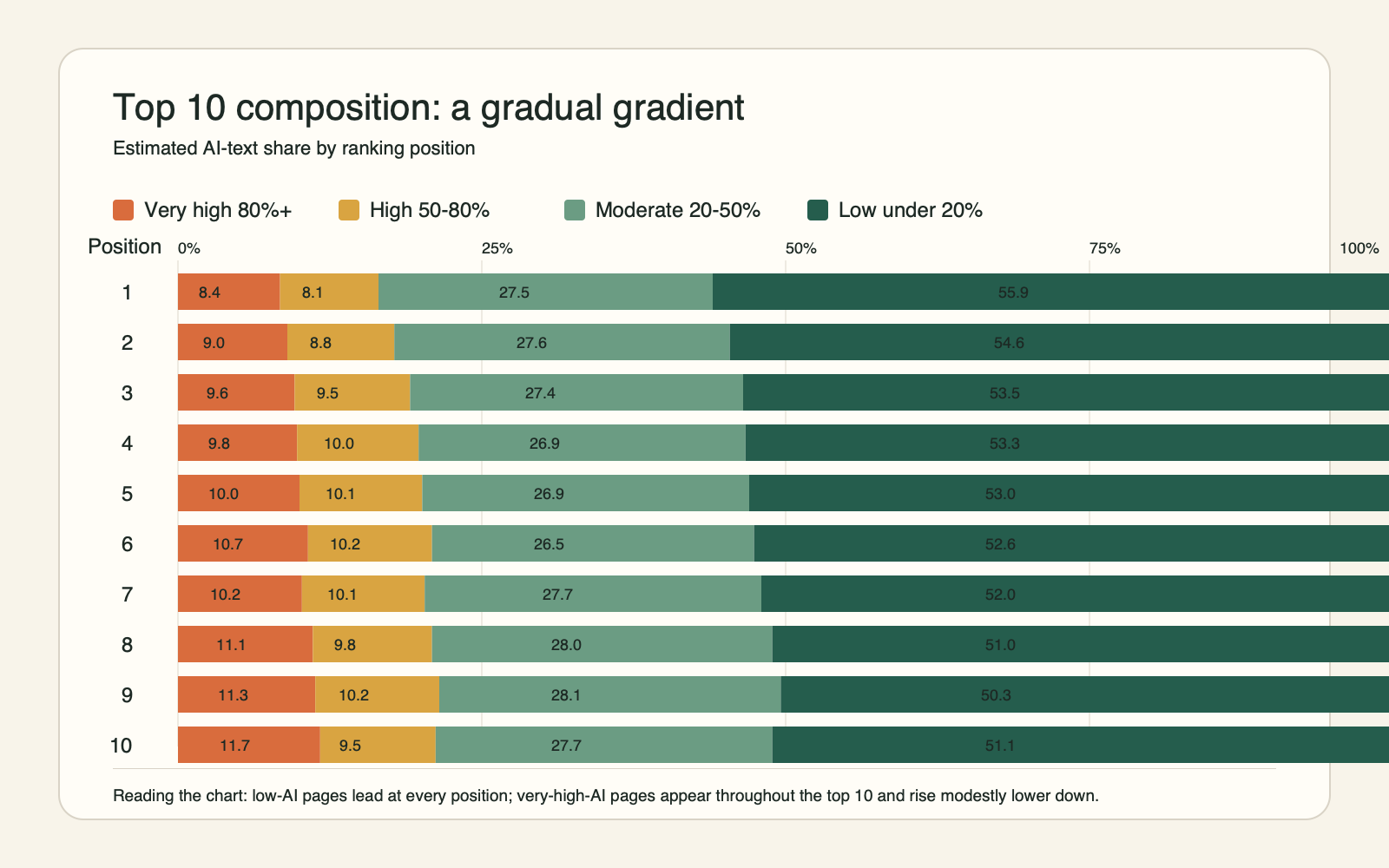
Low-AI pages are the largest group at every position; the share of very-high-AI pages rises modestly from position 1 to position 10.
Average and median values point in the same direction
The study also used a 15,000-page sample at each ranking position to calculate average and median estimated AI text share. Both measures move in the same direction: pages farther down the results have a slightly higher AI share, but the change is small.
Search position | Average AI text share | Median AI text share |
|---|---|---|
1 | 27.1% | 17.1% |
2 | 28.1% | 17.7% |
3 | 28.9% | 18.2% |
4 | 29.4% | 18.3% |
5 | 29.6% | 18.3% |
6 | 30.1% | 18.6% |
7 | 29.8% | 18.9% |
8 | 30.7% | 19.4% |
9 | 31.2% | 19.9% |
10 | 30.9% | 19.5% |
The average moves from 27.1% at position 1 to 30.9% at position 10. The median moves from 17.1% to 19.5%. These figures are useful for understanding a large-sample pattern. They are not a way to predict where one article will rank.
Search systems evaluate the finished page
It is easy to treat "AI writing" as a single variable. Readers do not encounter a page that way. They encounter a complete page: whether the opening answers the question, whether examples are real, whether conclusions can be traced, and whether visuals and links help them understand the subject.
The indexing analysis used one million pages from the crawler database, one per domain; roughly 100,000 pages had enough text for analysis. A page counted as indexed if it had at least one identifiable organic keyword, at least one Google Search Console impression since January 2026, or an exact-URL hit in a Google site: query.
Estimated AI text share | Indexing rate |
|---|---|
Under 20% | 49.28% |
20% to 50% | 43.38% |
50% to 80% | 40.72% |
80% or more | 40.35% |
Low-AI pages had a 49.28% indexing rate and pages with 80% or more AI text had a 40.35% rate. Both groups reached the index. The gap is meaningful, but it is not a binary exclusion.
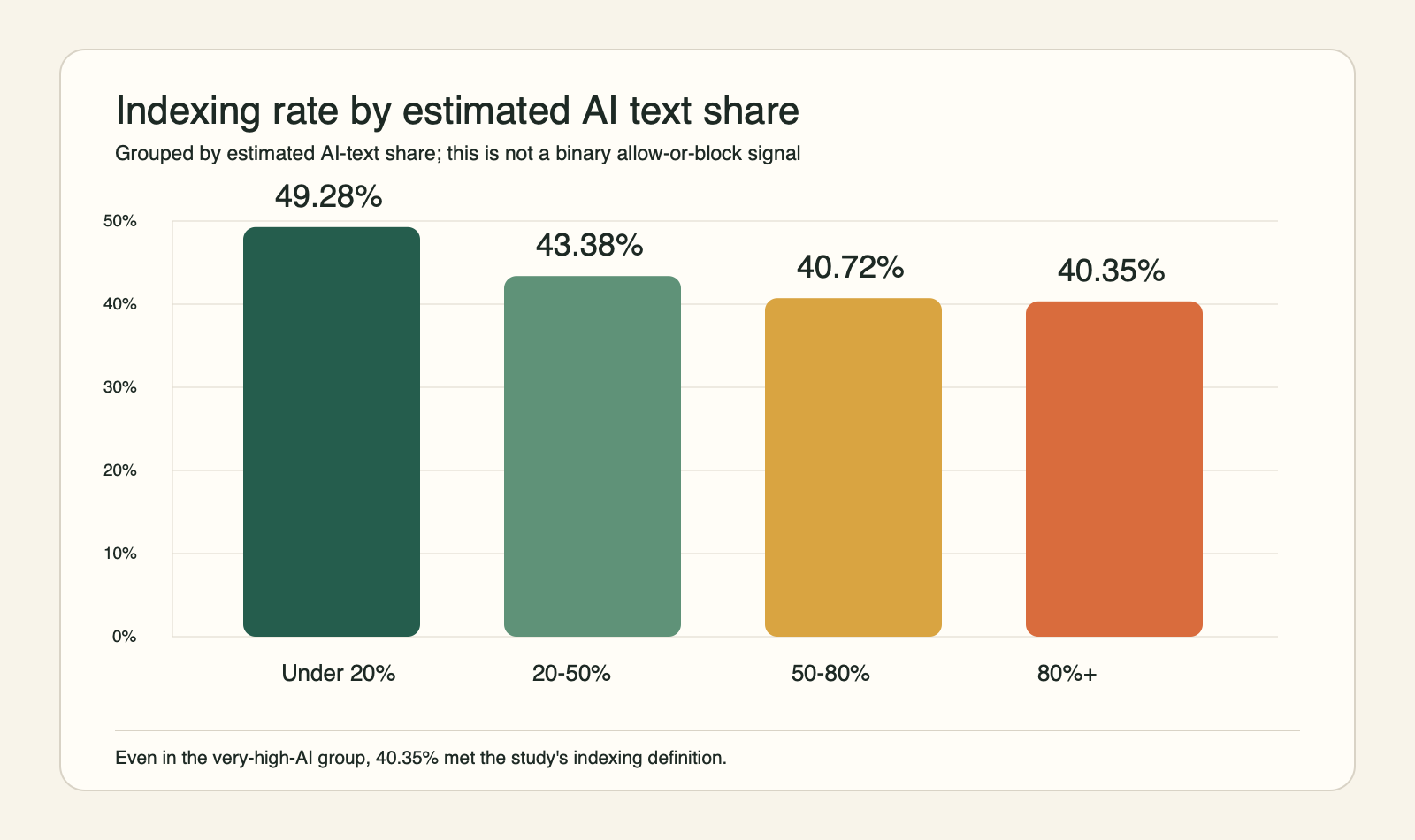
Even in the very-high-AI group, 40.35% of pages met the study's indexing definition.
Organic impressions are also worth watching. The study paired live URLs with Google Search Console data: 28,643 low-AI pages, 23,498 moderate-AI pages, 12,911 high-AI pages, and 15,809 very-high-AI pages. It reviewed June 2025 to January 2026, then January to June 2026.
The original impressions charts do not provide point-by-point values, so it would be wrong to redraw a precise-looking line. The confirmed observations are simpler:
- Low- and moderate-AI pages received roughly two to three times the organic impressions of high- or very-high-AI pages.
- The high- and very-high-AI groups followed similar, broadly stable patterns across both windows.
- The charts did not show one uniform, steep drop that applied to all high-AI pages.
In content terms, a page built mostly from common knowledge has fewer chances to match more search needs. A page that adds distinctive evidence, clear tradeoffs, and a real operating context is easier for both readers and search systems to understand.
Move from faster drafting to deeper pages
AI is well suited to speed-oriented work: organizing existing material, summarizing interview notes, drafting a structure, or adapting a known idea for different readers. The time it saves should go into the work a model cannot fill in alone.
Page layer | AI can help produce | The team should add before publishing |
|---|---|---|
Problem definition | Common questions and terminology | The specific reader and decision this page serves |
Information structure | Outline, summary, and table drafts | A useful sequence and removal of repeated material |
Facts | A list of claims to check | Primary sources, dates, constraints, and numbers |
Expertise | Several possible recommendations | Tradeoffs, operating conditions, and recovery paths |
Page experience | A first pass at captions | Screenshots, diagrams, case detail, and useful links |
That is a division of labor, not a restriction. AI gets a team to an editable version faster; people make the page worth publishing.
A better release gate than an AI score
Instead of deciding whether an article can ship from its estimated AI percentage, ask five questions:
- Can a reader understand the answer and its conditions within the first 150 words?
- Does the article add at least one piece of new information: first-party data, a checkable source, a specific example, an operating step, or a clear judgment?
- Has someone checked every number, product capability, and time-sensitive claim against original material?
- Does the page use a table, diagram, screenshot, or example to reduce the cost of understanding a complex point?
- After publication, does the team know what it will measure: indexing, query coverage, impressions, clicks, or conversion behavior?
If one answer is missing, fill that layer before the next editorial step. AI participation then returns to its proper place: a production variable, not a substitute for quality judgment.
Auspia's working view: use AI to expand research, not empty pages
The most useful AI workflow for an SEO team is rarely creating many pages in one pass. It is widening the research radius of one page. For a page about what a B2B SaaS pricing page should include, AI can first map the common modules found on competing pages. An editor can then add actual buying questions, the impact of price changes, product and sales tradeoffs, and page options for different stages of evaluation.
The final reader does not get another module checklist. They get material that helps them decide. That gives the page a recognizable point of view, traceable information, and a longer useful life.
Keep three handoffs in the workflow:
- After research: confirm the question, reader, and source scope before moving from a vague prompt to a long draft.
- After the draft: add facts, experience, and examples section by section; remove sentences that add no information.
- Before release: check that the title promise, body evidence, image captions, and update date agree.
The aim is not to maximize how much a human writes. It is to give every page a clear owner and a reason for a reader to save or revisit it.
What to monitor next
The time-series results did not show a uniform cliff in impressions for high-AI pages. This is not a causal experiment, though. Ranking pages are already a selected group, and site age, authority, competition, and publishing method may all influence both AI usage and search outcomes. Treat the results as a large-sample trend, not a prediction for one URL.
Weekly check | What it tells you | Follow-up action |
|---|---|---|
New-page indexing | Whether new URLs reach the index | Check crawl access, site structure, and content completeness |
Query coverage | Which specific searches the page begins to match | Add definitions, conditions, or examples readers need |
Impression trend | Whether similar pages gain stable visibility | Compare topic, intent, and update cadence |
Page-update record | Which facts and assets were improved by people | Identify editorial actions that add information density |
Keep the record for eight to twelve weeks. It will tell a team more than an isolated AI-detector score: which content steps improved discoverability and which only made drafts faster.
Final takeaway
AI can participate in content production. Search performance still accumulates from the value a finished page gives readers.
There is no need to treat AI as a trace to hide. Spend the effort on research, verification, examples, and editorial judgment. Before each release, ask: "What did this page add for the reader?" If the answer is specific, AI is helping the team make better content faster.
FAQ
Can AI-written content rank on the first page of Google?
Yes. Every position in the top-10 sample contained high-AI pages, and the first three positions also included fully AI-generated pages. Sustained visibility still depends on how well the page serves the search need and on its overall quality.
Should an AI-detector score decide whether we publish?
It is better used as a signal for editorial review. A release decision should return to verifiable facts, distinctive information, clear structure, reader usefulness, and later performance data.
Which parts of AI-assisted content should remain human-owned?
Topic judgment, fact checking, expert tradeoffs, examples, and final editing. They determine whether a page has its own information value and whether a team can maintain it over time.
Author: Nora Whitfield, AEO Specialist for 800+ Answer Patterns at Auspia. She writes about turning complex topics into clear, verifiable answers people can use.