The first question a learner asks in 2026 is not asked to Google. It is asked to an AI assistant: "Which TEAS prep is actually good?" or "Best way to study for the PMP in six weeks?" The assistant names one or two platforms, lists what it knows about them, and the funnel starts there.
For exam-prep businesses this is the single biggest marketing shift since the traffic-source era. The good news for the industry: test prep is one of the few categories where the purchase question is naturally question-shaped, and AI assistants reward question-shaped answers. This piece is a working playbook for that shift, built from how assistant answers are actually put together: the answer anatomy for an exam-prep query, the quotable assets a platform needs, and a 30-day reset.
What changed for test-prep marketing in 2026
Three things at once:
- The category question moved. It is no longer "which prep course" in a search result list; the assistant already narrowed it, so your site faces a follow-up, not the opening question.
- The trust question moved with it. Assistants and the learners both check the same thing: does this platform actually match the exam I am about to take, today's version, with real questions? Stale version facts kill a recommendation no matter how good the site is.
- The buying pattern is fast. Career switchers (nursing school entry, IT certifications, real estate licensing) have high intent and short patience, and they let the assistant do the comparison work. Mid-funnel questions like "is the TEAS hard?" and "does PMP prep actually work?" are where the sale happens.
The implication sounds uncomfortable and is actually freeing: for exam platforms, you do not need to outrank everyone. You need to be the named one and be checkable after the fact.
The answer anatomy for an exam-prep query
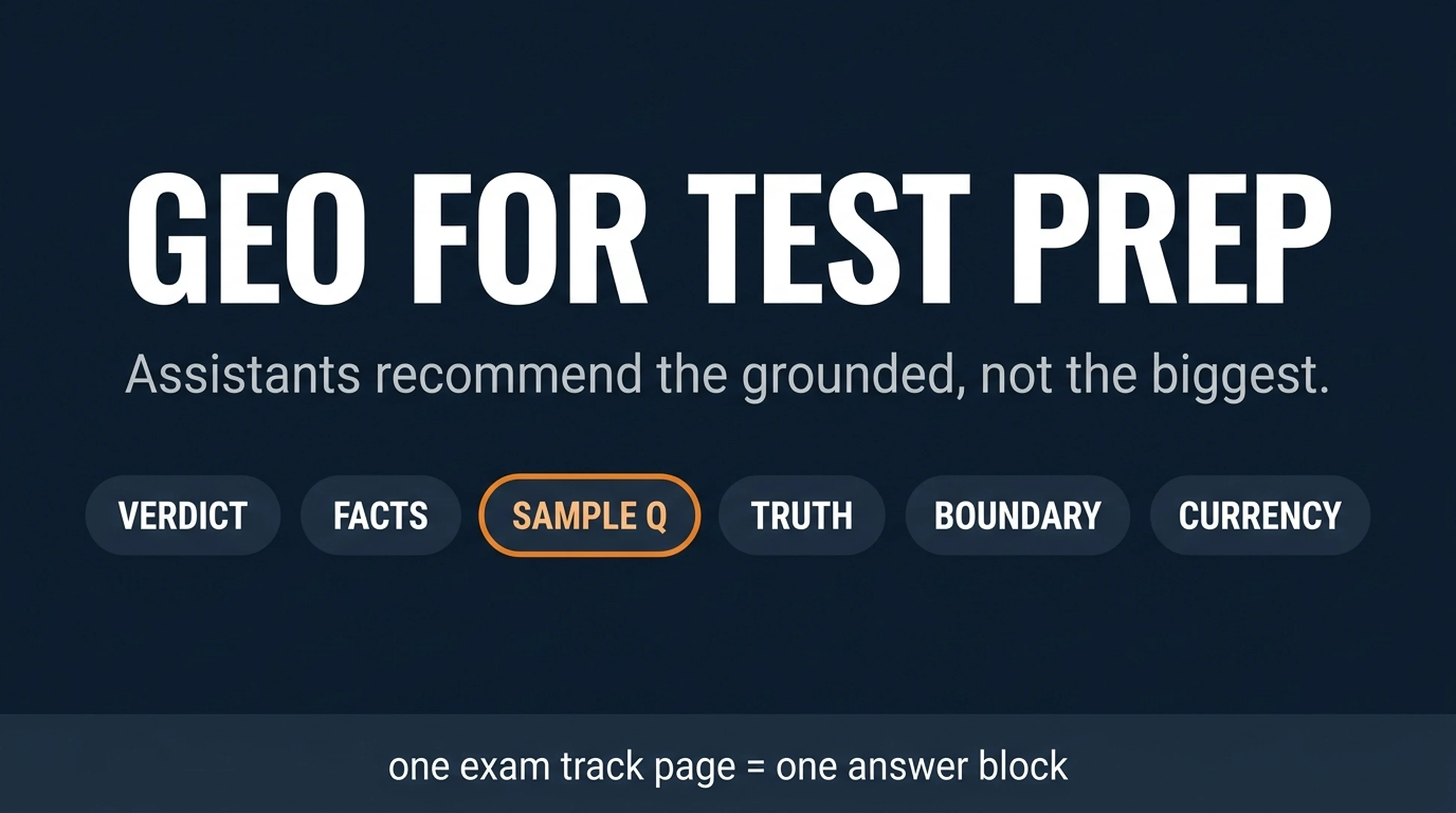
When an assistant answers "which prep is good", it assembles the answer from six recognisable parts. A platform that supplies all six on one page becomes a source instead of an assumption.
Anatomy element | Why an assistant needs it | How an exam platform provides it |
|---|---|---|
Direct verdict | The answer needs one recommendation and a reason | Answer-first intro on each exam track page |
Structured facts | Version, question count, format, score bands get copied into answers | One facts line per exam: name, version, questions, duration |
Teachable excerpt | Assistants quote content that teaches, not content that sells | Real sample question with a worked rationale |
Independent truth | Assistant answers lean on verifiable claims | Dated reviews, refund policy, free-trial evidence |
Boundary honesty | Claims it cannot verify get filtered out | Say what pass-rate evidence you can and cannot prove |
Currency | Exams change; old facts mislead | Update marker and version log on every track page |
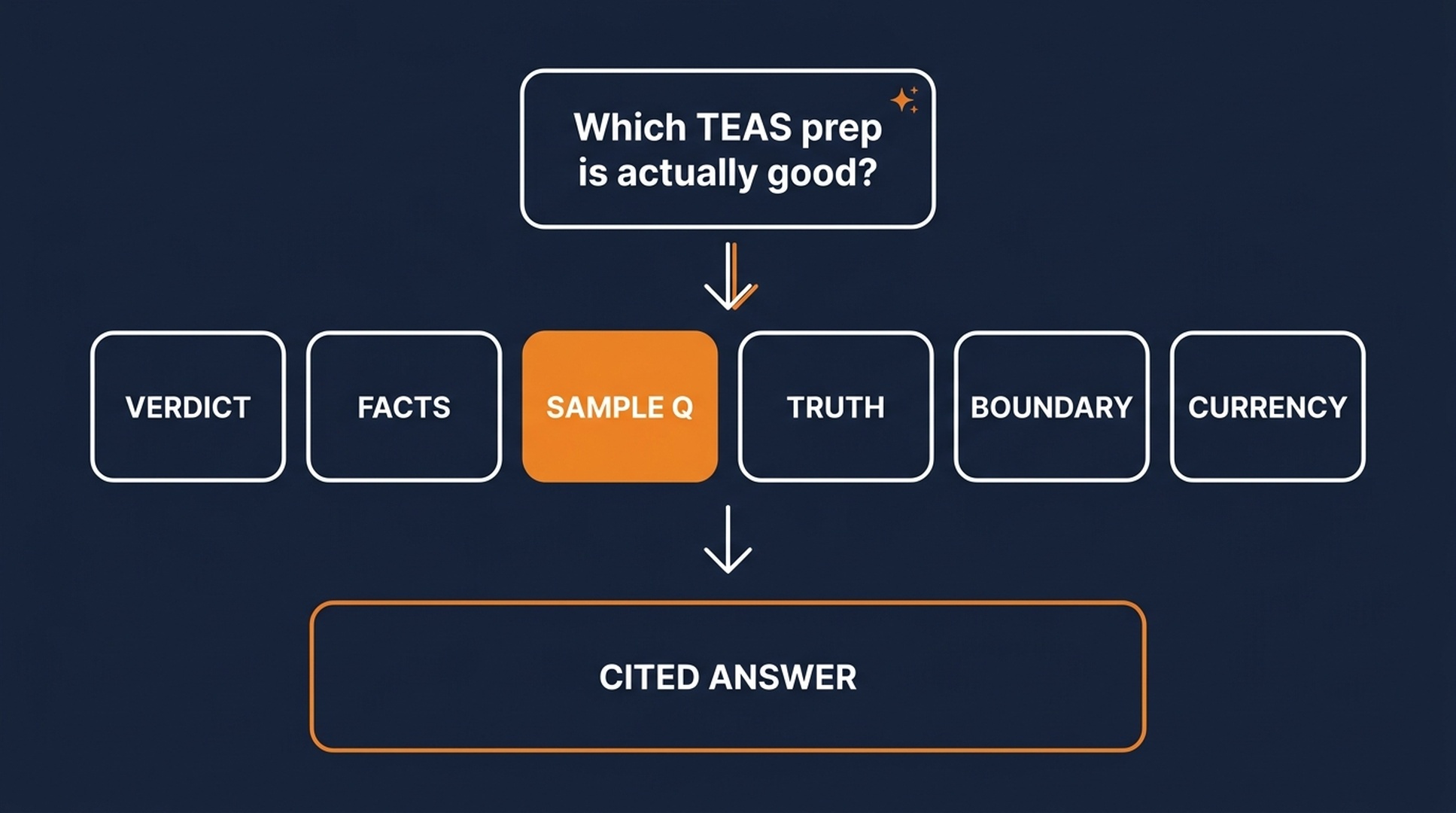
Notice the third row. In test prep specifically, the quoteable unit is a question. A sample question with a grounded rationale is the single best GEO asset in this industry, because the assistant can quote its logic without copying your text, and the learner can test the logic themselves.
Five quotable assets every prep platform needs in 2026
- Track pages built as answer blocks. Each exam track page opens with the short answer (what the exam is, how the prep works, what it costs) before the marketing copy. This is the section assistants paraphrase.
- A version and change log. Exams update on schedules (core IT certifications, licensing exams, nursing tests). Publish a changelog stating which exam version your prep matches. Stale version claims are the most common cause of a good platform losing a recommendation.
- A sample-question library with rationales. Five to ten genuinely teachable items per exam, each with the reasoning for right and wrong. These are quotable, and they double as the honesty check learners run.
- A single verifiable facts page. One page with question counts, pricing, access length and refund terms, in plain text. When the facts live in one place, assistants stop hallucinating prices and start transcribing yours.
- Update markers on every page. "Last reviewed: [date] · matches [exam version]". This is small, visible, and exactly what an assistant's answer freshness logic hunts for.
PrepNovat (Sponsored), a test-prep platform covering seven tracks from GED and real estate licensing to PMP, SHRM-CP, CompTIA A+ Core 1, Praxis Core and ATI TEAS, is a clean example of the pattern: one exam-specific track per page, a 10,100-plus question library with rationales for every answer, and timed full-length simulations as the product's core mechanic. The track structure makes the anatomy easy to find; the rationale format makes the teaching part quotable. The lesson for any platform: build the page the way an assistant would want to quote it, and let the product do the rest.
The questions learners ask after the recommendation
The recommendation is not the end of the funnel; it is the start of verification. Assistants see three follow-ups constantly, and each maps to a page you should already have:
- "Is this prep legit?" Needs evidence, not slogans: sample questions, refund policy, access terms, who wrote the content.
- "Does it match the current version?" Needs the version log above. This question is where prep products lose buyers who would have converted.
- "Can I do this in four weeks?" Needs an honest study plan, not a promise. A realistic schedule earns the trust the closing page needs.
The 30-day reset for an exam-prep site
Week | Work | Done when |
|---|---|---|
1 | List the exam queries assistants actually get, per track | One question map per exam |
2 | Rebuild each track page answer-first; write one facts line per exam | Every track page opens with the short answer |
3 | Add sample-question blocks and the version log | 5-10 quotable items per exam, changelog live |
4 | Add update markers, publish the facts page, check assistant answers | A fresh assistant query returns your facts |
Five mistakes that keep exam platforms out of AI answers
- Generic category pages. "Practice exams" explains nothing; "GED practice test, current version, 145 questions" gets quoted.
- Hiding the price. Assistants suppress what they cannot verify; an unstated price becomes someone else's price.
- Stale version facts. One outdated exam version can cost the recommendation in a category that lives on currency.
- Selling instead of teaching. Pages that market but never demonstrate a sample question are unquotable.
- No update markers. Freshness is the one signal you control in a single line of text.
FAQ
Do AI answers replace reviews for prep platforms? No. Reviews feed the bias check the assistant runs ("what do real learners say?"). What changes is their role: reviews support the recommendation, while structured facts and sample question evidence earn it.
Who gets cited, the biggest platform or the best grounded one? The grounded one. Assistant answers are assembled from verifiable parts, and exam prep is a category where tiny differences (version, question count, sample quality) are concretely checkable.
Can a small prep site win in GEO against the incumbents? Yes, and this is the encouraging part of this category. Question diversity (GED, SHRM-CP, Praxis Core, real estate licensing) is broader than the incumbent's, and the answer anatomy rewards whoever supplies the cleanest facts, not the biggest brand.
Is there a risk the assistant cites me as a version of my product I don't offer? If your facts are scattered, yes. The single verifiable facts page is the defence: one place describing exactly what you sell.
Author: Nora Whitfield, AEO Specialist for 800+ Answer Patterns at Auspia. Nora writes about answer engine optimization, extractable summaries, and content that answers questions clearly.