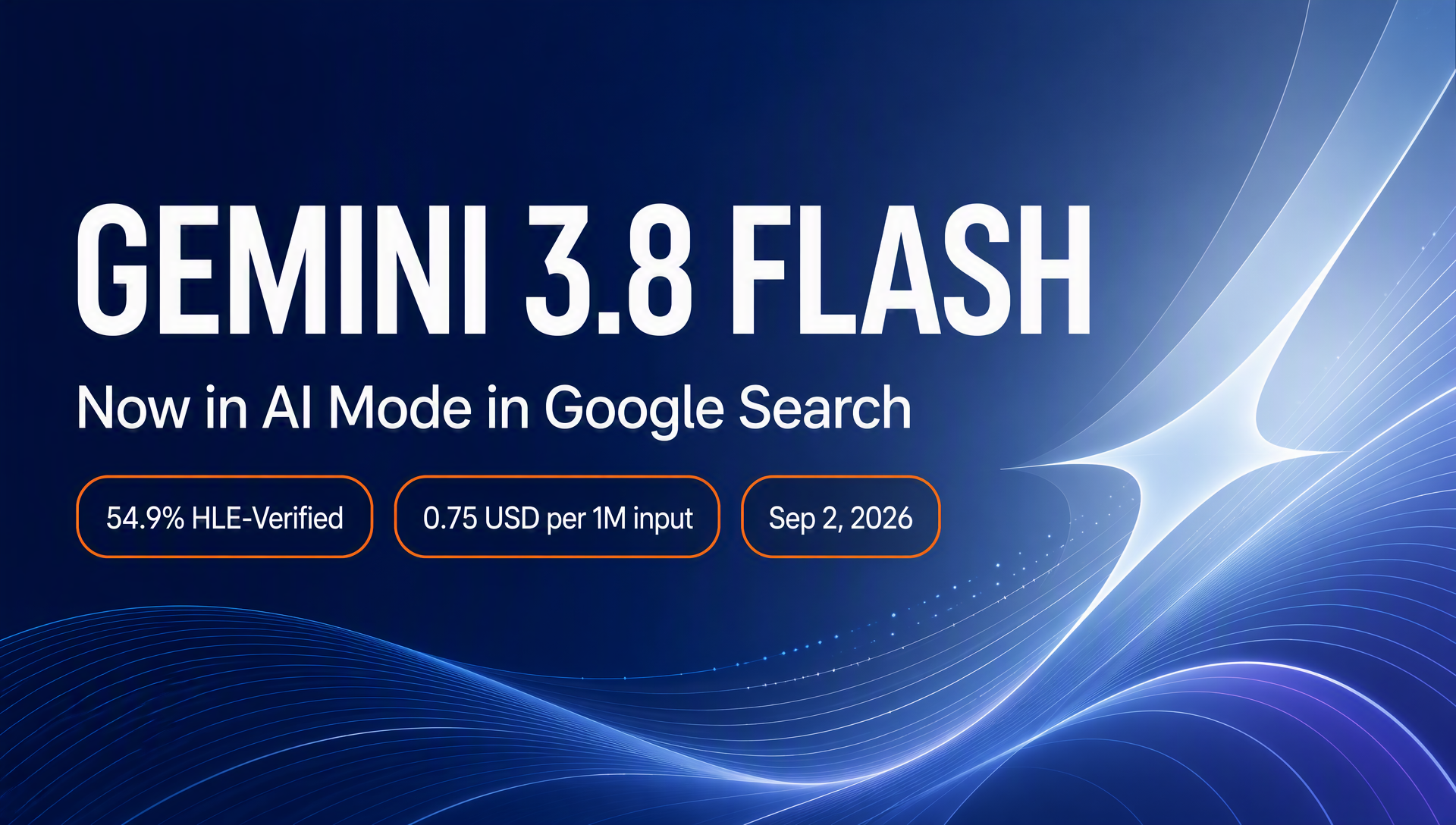
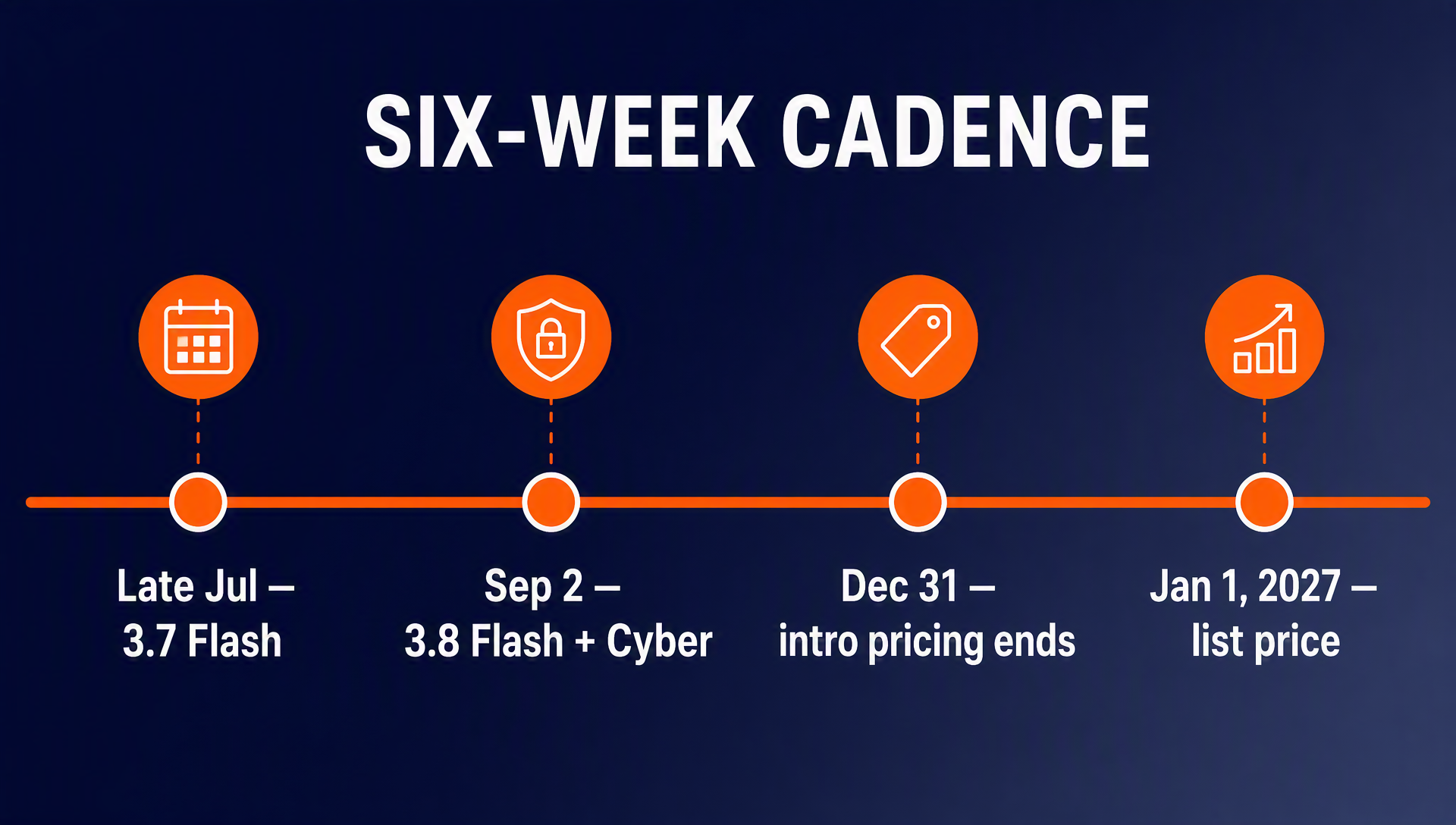
Google announced Gemini 3.8 Flash and a cybersecurity-specialized Gemini 3.8 Flash Cyber on September 2, 2026, and the announcement lists AI Mode in Google Search among the consumer surfaces where the new model is available. It is the third Flash release in six weeks, and Google positions 3.8 Flash as "our most intelligent workhorse model" — the default-class model that now powers Google's AI answer surface for subscribers. The release changes no ranking systems by itself, and Google has said nothing about citations or algorithm behavior. It changes the economics and the serving behavior of the surface where AI answers are generated — which is why search teams are watching it closely.
What Google announced
The announcement, on Google's official blog, covers a model release rather than a search update. Key facts from the post:
Item | Detail |
|---|---|
Models | Gemini 3.8 Flash and Gemini 3.8 Flash Cyber |
Date | September 2, 2026 |
Positioning | "Most intelligent workhorse model"; third Flash release in six weeks |
Developer access | Gemini API via Google AI Studio, Google Antigravity, Android Studio, Stitch |
Enterprise access | Gemini Enterprise |
Consumer access | Google AI Pro and Ultra subscribers via the Gemini app, AI Mode in Google Search, and Gemini in Google Sheets |
Cyber variant | Gemini 3.8 Flash Cyber, gated to trusted defenders through the Fairwind Program |
Context window | Not stated |
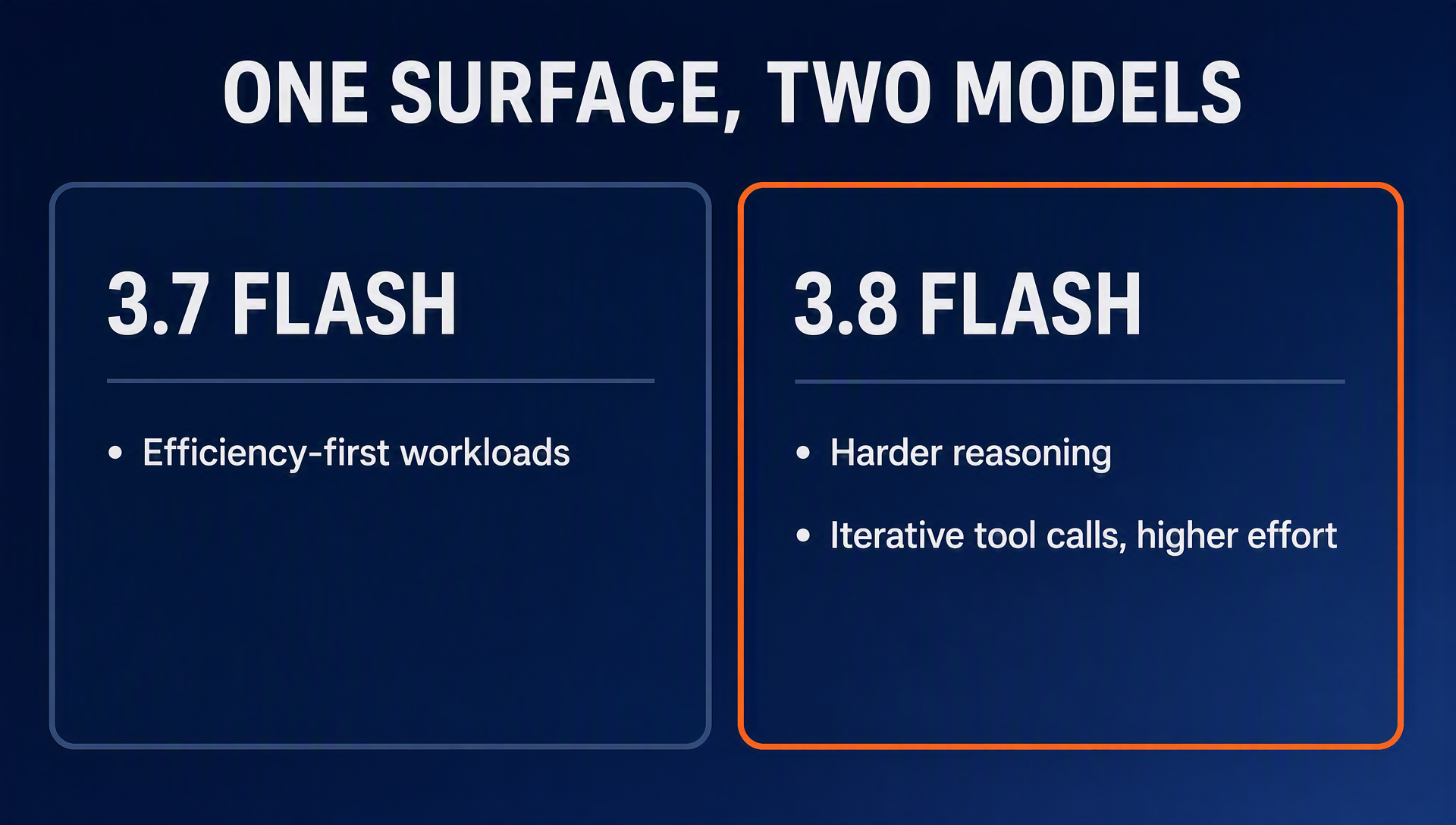
Google describes 3.8 Flash as working harder on complex tasks — more reasoning steps and iterative tool calls, especially at higher effort levels — while noting that 3.7 Flash "remains supported for efficiency-first workloads."
What is new in the model
Google's own benchmark claims, as published in the announcement:
- HLE-Verified: 54.9% — the announced headline reasoning figure for 3.8 Flash.
- Long-horizon software engineering: DeepSWE v1.1, where Google says 3.8 Flash outperforms most larger frontier models.
- Agentic work: Vals Finance Agent V2 and Harvey's Legal Agent Benchmark, where Google says 3.8 Flash beats 3.7 Flash and other frontier models.
- Cyber variant: CyberGym autonomous vulnerability discovery surpassing 3.5 Flash Cyber and larger frontier models; a Google internal benchmark across 20 programming languages with success "exceeding 70%"; and a CWE-Bench patching pass@1 of 47.2% run by Collinear — versus 47.8% for a leading frontier model at "significantly lower cost."
Pricing is the part with the clearest near-term consequence:
Pricing | Per 1M input tokens | Per 1M output tokens |
|---|---|---|
Introductory (until December 31, 2026) | $0.75 | $3.75 |
From January 1, 2027 | $1.50 | $7.50 |
The introductory rates are roughly half the announced 2027 list price. Anyone building experiments or automated checks against the Gemini API has a three-month window at the lower rate.
What this changes in Google Search — and what it doesn't
What it changes: the model generating answers in AI Mode is now 3.8 Flash for the surfaces listed above. A different model at the same surface can change which documents get quoted, how long answers run, and how many tool calls happen before an answer is produced. Google made no statement about ranking systems, citation logic, or how AI Mode decides which pages to cite.
What it doesn't change: Google has said nothing about AI Overviews or classic search ranking in this announcement. There is no new schema, no new file, and no "optimize for Gemini 3.8" requirement — consistent with Google's existing position that AI features reuse the same crawl, indexing, and structured-data foundation as classic search, which we decoded in our earlier guide to Google's AI-feature guidance. Claims that a model release "reset" rankings or citation behavior are not supported by anything Google published on September 2.
Five changes SEO teams will be watching
1. Citation source mix inside AI Mode answers
The observable change is a model swap at a live answer surface. When the underlying model changes, the retrieval mix in AI Mode answers can shift even when no policy changed. The tracking habit that matters: dated answer snapshots. Save AI Mode answers for your priority queries — sources, order, and phrasing — before and after the rollout reaches your market, and diff them. Without dated snapshots, a shift in which domains get quoted will be invisible until it shows up in traffic.
2. AI Mode session volume and economics
Cheaper and faster inference lowers the marginal cost of every AI Mode session. Pricing at roughly half the future list price suggests Google is buying usage and feedback volume now. For search teams, the metric to watch is behavioral, not technical: whether AI Mode session share grows on commercial and comparison queries through Q4, and whether referral traffic from AI answers changes as session volume rises.
3. Answer length and effort shaping on complex queries
Google states that 3.8 Flash "works harder" on complex tasks — more reasoning steps and iterative tool calls at higher effort levels. On multi-step commercial queries (comparisons, configuration questions, "what should we use for X" prompts), AI Mode answers may get longer and more tool-call-heavy even when the simple-query experience stays the same. Content implication to test, not assume: whether deeper reasoning pulls more of its evidence from a wider document set, which would reward comprehensive, well-structured pages over thin FAQ-style answers.
4. A dual-model lineup instead of a single default
3.7 Flash remains supported for efficiency-first workloads, and 3.8 Flash handles the harder tasks. That means AI Mode's behavior may vary by task complexity in a way it did not before — a lightweight query and a long-horizon query can be served by different models with different retrieval behavior. Treat "how AI Mode behaves" as a range, not a single profile, and test both ends of it.
5. Model specialization as a trend
Flash Cyber is a security-domain variant with its own gating (Fairwind Program), and it signals that Google will ship surface- and domain-specific models rather than one universal answer engine. For search teams the practical consequence is temporal: model behavior is a moving target, and any vendor or tool that promises a fixed "AI search citation profile" is selling a snapshot that will be outdated by the next release in the six-week cadence Google is currently on.
What Google hasn't said
The announcement does not include a context window, does not publish AI Mode usage numbers, does not describe any change to how AI Mode selects or cites sources, and does not address AI Overviews. Search teams should treat every claim beyond the announcement — benchmark comparisons, retrieval behavior, citation shifts — as hypothesis until measured. The measurement tools are the same ones that have applied since AI Mode launched: dated prompt logs, citation capture, and referral analysis against Google Search Console data.
Author: Sophie Renard, AI Search Briefing Analyst Tracking 30+ Platforms at Auspia. Sophie writes timely, evidence-grounded briefs on AI search platform changes for search teams.