

WorkBuddy is a better fit for E-E-A-T evidence work when the people doing the review are content, marketing, legal, product, or subject-matter owners rather than developers. Tencent's public WorkBuddy page presents it as an agent workbench for work tasks; its useful role here is the deliverable packet: source register, claim board, reviewer questions, and an acceptance memo that tells the team what can move forward.
The official product name is Tencent WorkBuddy. This article uses that name even though the reusable Auspia taxonomy slug is workbubby-seo.
WorkBuddy can help collect and format the material. It cannot decide that a document is publishable, that a person has approved a biography, or that a customer statement can be used as social proof. Treat every polished deliverable as a draft until the responsible owner accepts it.
The packet, not the prose, is the outcome
Item | Result |
|---|---|
Best for | A non-technical team reviewing one important page |
Inputs | Public URL, page goal, approved files, named reviewers, and known evidence gaps |
Main output | One evidence review packet with a source register and acceptance memo |
Human decision | Accept, revise, reject, or request proof for each material claim |
Definition of done | No recommendation enters the editorial queue without a named source and owner decision |
This workflow is useful for a service page, product comparison, expert guide, case-style page, or another page where multiple teams own different facts. It is not a full-site scorecard.
Define five deliverables before you start
Give WorkBuddy a concrete delivery contract. A useful packet contains these files or sections:
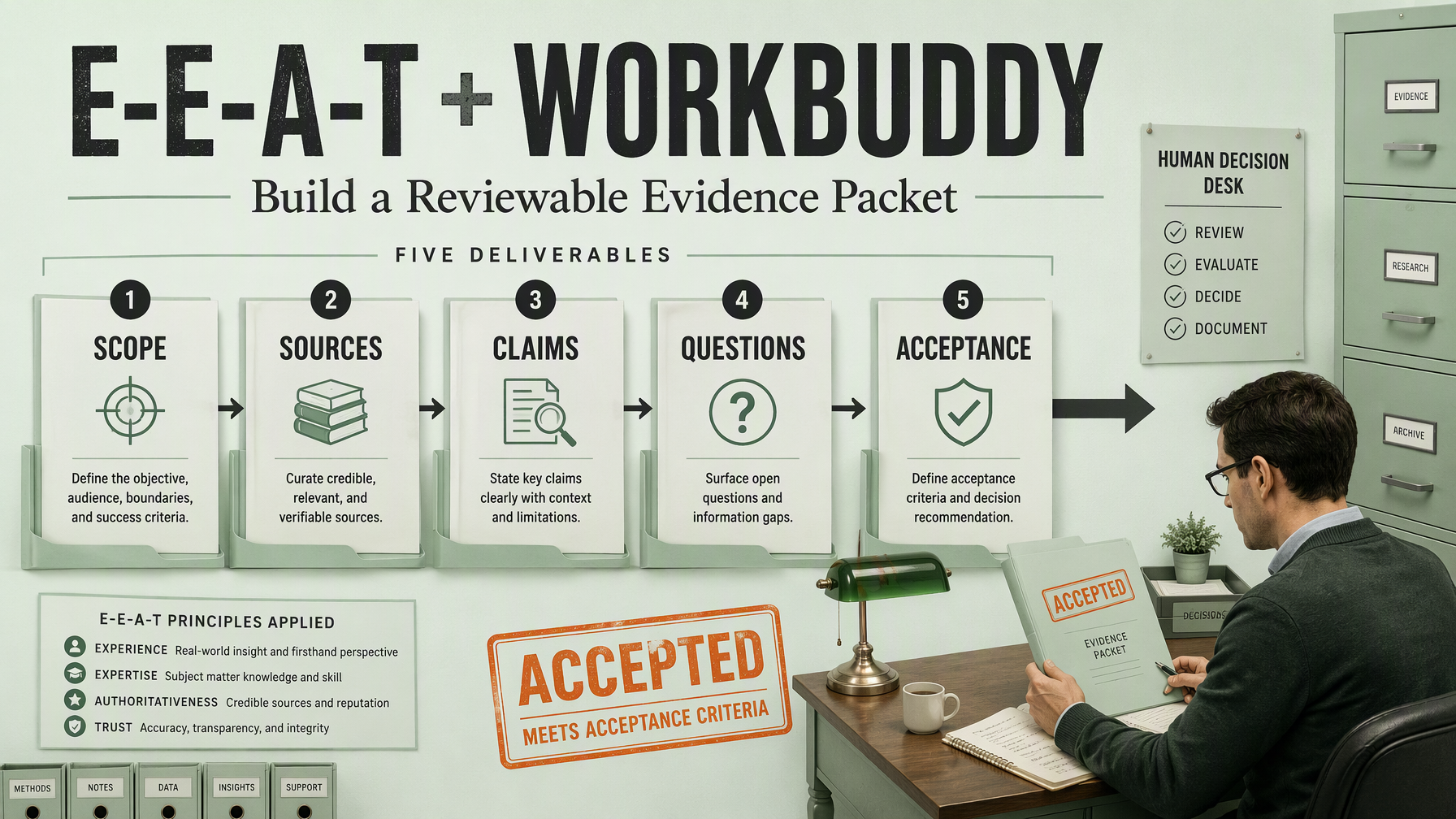
page-scope.md: the URL, audience, visitor task, market, language, and review date.source-register.csv: every supplied source, its owner, date, access level, and supported claim.claim-board.md: material claims labeled supported, uncertain, contradicted, or not provided.reviewer-questions.md: questions grouped by the person or team who can answer them.acceptance-memo.md: the final accept, revise, reject, or hold decision for each proposed change.
This structure prevents a common failure: receiving a twenty-page report with no clear way to tell which statements have actually been approved.
Use a bounded WorkBuddy request
The following prompt is designed for one page. It asks for office-style artifacts rather than an automatic rewrite.
Create an E-E-A-T evidence review packet for one page.

Page: [PUBLIC URL OR ATTACHED DRAFT]
Audience: [AUDIENCE]
Visitor task: [WHAT THE READER NEEDS TO DECIDE OR DO]
Market and language: [MARKET, LANGUAGE]
Approved input files: [LIST]
Review owners: [NAME OR ROLE FOR CONTENT, PRODUCT, LEGAL, AUTHOR, OR OTHER FACTS]

Deliver five items:
1. page scope;
2. source register;
3. claim board;
4. reviewer questions grouped by owner; and
5. an empty acceptance memo for human decisions.

For every material claim, record the exact page location, supplied source, source date, owner, and status: visible, owner_supplied, needs_human_verification, or not_provided.

Do not rewrite the page, publish, contact anyone, log in to private services, or create new evidence. Do not invent experience, expertise, credentials, reviews, citations, customer results, product features, policies, dates, rankings, traffic, or endorsements. If a source does not support the exact claim, mark the mismatch.
Do not attach whole drives or mailboxes because they might contain something relevant. Give the agent the smallest approved set. If a reviewer needs to add a source later, add it to the register with a date and owner.
Build a source register that can survive handoffs
The source register is the spine of the packet. Without it, the rest is just formatted opinion.
Field | What to record |
|---|---|
| A stable identifier such as |
| The real document or page title |
| Public URL or approved internal filename |
| Person or team responsible for accuracy |
| Date the source was reviewed |
| Public, internal-approved, or restricted |
| Exact claim IDs supported by the source |
| Market, plan, date, test scope, or other boundary |
An internal document can support an editorial decision without being suitable for public disclosure. Keep those two questions separate. The register should say where the evidence came from; the acceptance memo decides how it may be used.
Ask the right reviewer, not the nearest colleague
WorkBuddy can group questions by owner so the review does not become a long shared chat. For example:
- The named author confirms first-hand experience and approved biography wording.
- The product owner confirms current feature and plan claims.
- Legal or the customer owner confirms whether a testimonial or result is publishable.
- The editorial owner checks that a source supports the exact sentence.
- The web owner checks that visible content, metadata, and Schema remain consistent.
If no one owns a claim, that is an important finding. Put it on hold. Do not assign authority to the agent simply because it assembled the packet.
Use the acceptance memo as the release gate
The packet becomes actionable only after people record decisions. Use this minimum format.
# E-E-A-T evidence acceptance memo

Page:
Review date:
Final editorial owner:

| Claim ID | Proposed action | Evidence IDs | Decision | Decision owner | Required wording or limit |
| --- | --- | --- | --- | --- | --- |
| CLM-001 | Keep / revise / remove / request proof | SRC-001 | Accept / revise / reject / hold | | |

## Release conditions

- [ ] Every accepted factual claim has a named source.
- [ ] Every experience or biography claim has named-person approval.
- [ ] Restricted material is not copied into public text.
- [ ] Rejected claims are removed from body copy, metadata, and structured data.
- [ ] A human content owner approves the final page preview.
The memo should be boring. That is a compliment. It needs to preserve decisions, not sell the reader on the sophistication of the process.
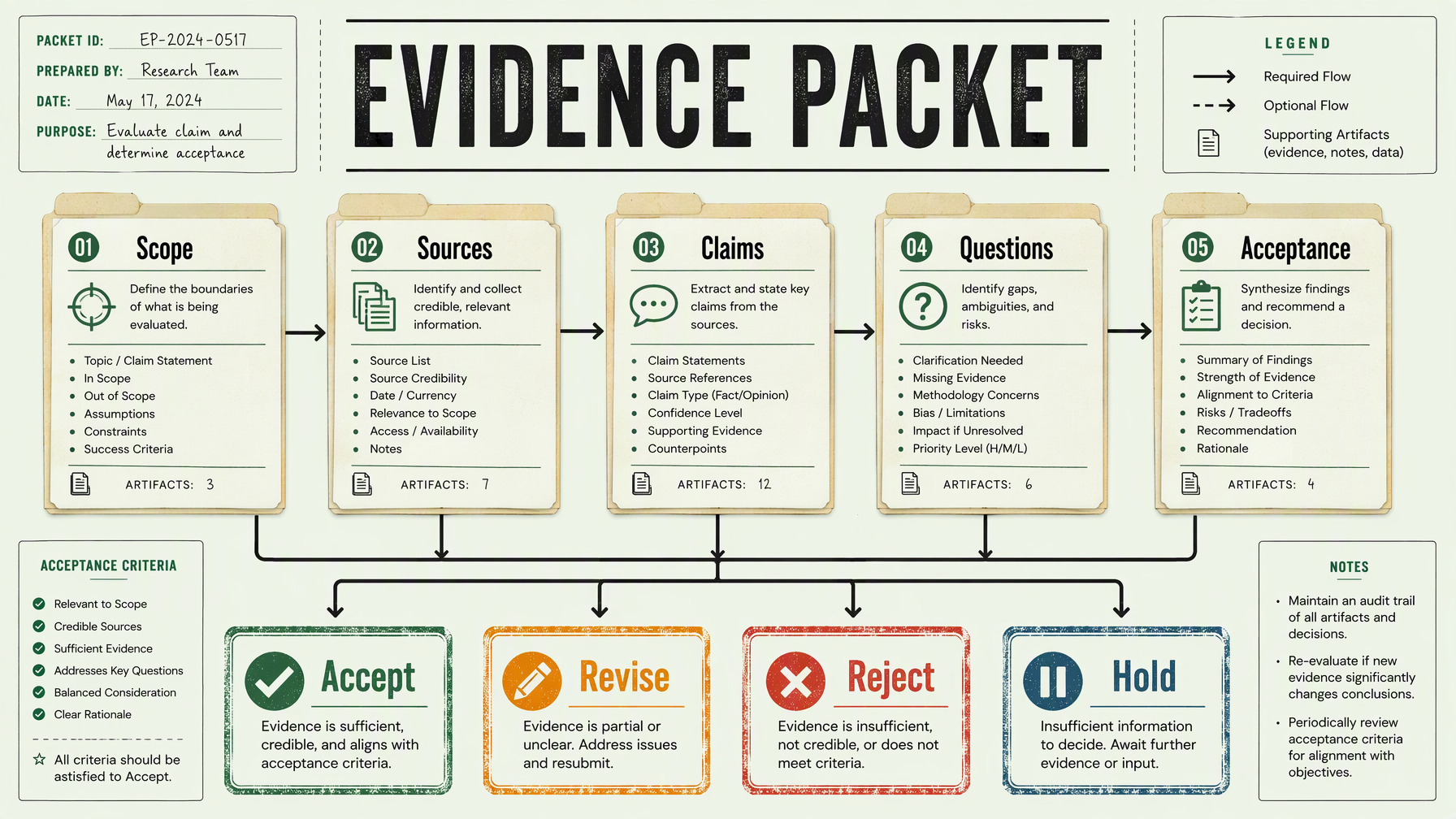
Illustrative workflow: the evidence packet stays a decision record until a named human owner makes the acceptance call.
Example: when three sources tell different stories
Imagine a SaaS page says the product supports real-time exports in every plan. The current public documentation says exports are available, an internal sales deck says "real-time," and a pricing page limits the feature to an enterprise plan.
WorkBuddy should not average those sources into a smoother claim. It should create a contradiction entry, point to all three locations, and assign the question to the product owner. The acceptance memo might approve: "Exports are available on eligible plans; check the current pricing page for plan details." Or it might hold the claim until the documentation is corrected.
The useful output is the visible disagreement. Hiding it would make the packet easier to read and less trustworthy.
Inspect the packet before requesting copy
Run this five-minute acceptance check:
- Can a reviewer open every public source?
- Does each internal source have an owner and approved access status?
- Are source dates and product limitations visible?
- Are unsupported claims listed instead of quietly omitted?
- Does every question go to someone who can answer it?
- Is the acceptance memo empty until humans make decisions?
If a source is missing, ask for it. If the packet contains a private document that was not authorized, remove it from the task and regenerate the affected sections. Do not solve either problem by asking WorkBuddy for a more confident answer.
Hand the approved packet to the right implementation owner
WorkBuddy's final task is to create a small editorial brief from accepted memo rows. It should not publish the page.
The brief should contain the current wording, approved replacement, source IDs, owner, allowed page locations, and verification method. A CMS editor can apply a copy change. A developer can handle template or Schema work. A legal reviewer can require further approval. The packet makes those handoffs explicit.
After release, compare the public page with the acceptance memo. Check body copy, author blocks, citations, metadata, images, captions, and structured data. A correct memo with an incorrect implementation is still a failed workflow.
Where WorkBuddy should stop
Keep these actions outside the agent's authority unless a person gives specific approval through the normal system:
- contacting authors, customers, or partners;
- opening private accounts or restricted folders;
- accepting terms or permissions;
- publishing or scheduling a page;
- changing a testimonial, legal statement, or credential;
- claiming that the packet improves rankings or proves trust.
The packet supports a decision. It is not the decision.
Frequently asked questions
Is WorkBuddy an E-E-A-T scoring tool?
No. It is an agent workbench that can organize a bounded review task. The evidence status and owner decisions matter more than a synthetic score.
Can the packet include confidential evidence?
Only when the user is authorized to provide it and the task is configured to protect it. Even then, mark it as restricted and do not copy it into public recommendations. A public source is preferable when the same claim can be supported accurately.
Should WorkBuddy write the final page?
It can prepare copy based on accepted evidence, but a human should review the exact wording and page preview. The packet is designed to keep that approval visible.
Does a completed packet guarantee better SEO performance?
No. It can reduce unsupported claims and improve editorial accountability. Search performance depends on many factors and should be monitored without promising an outcome.
Author: Tessa Clarke, Content Governance Lead for 120+ Editorial Systems at Auspia. Tessa writes about review ownership, evidence controls, and publishing standards.