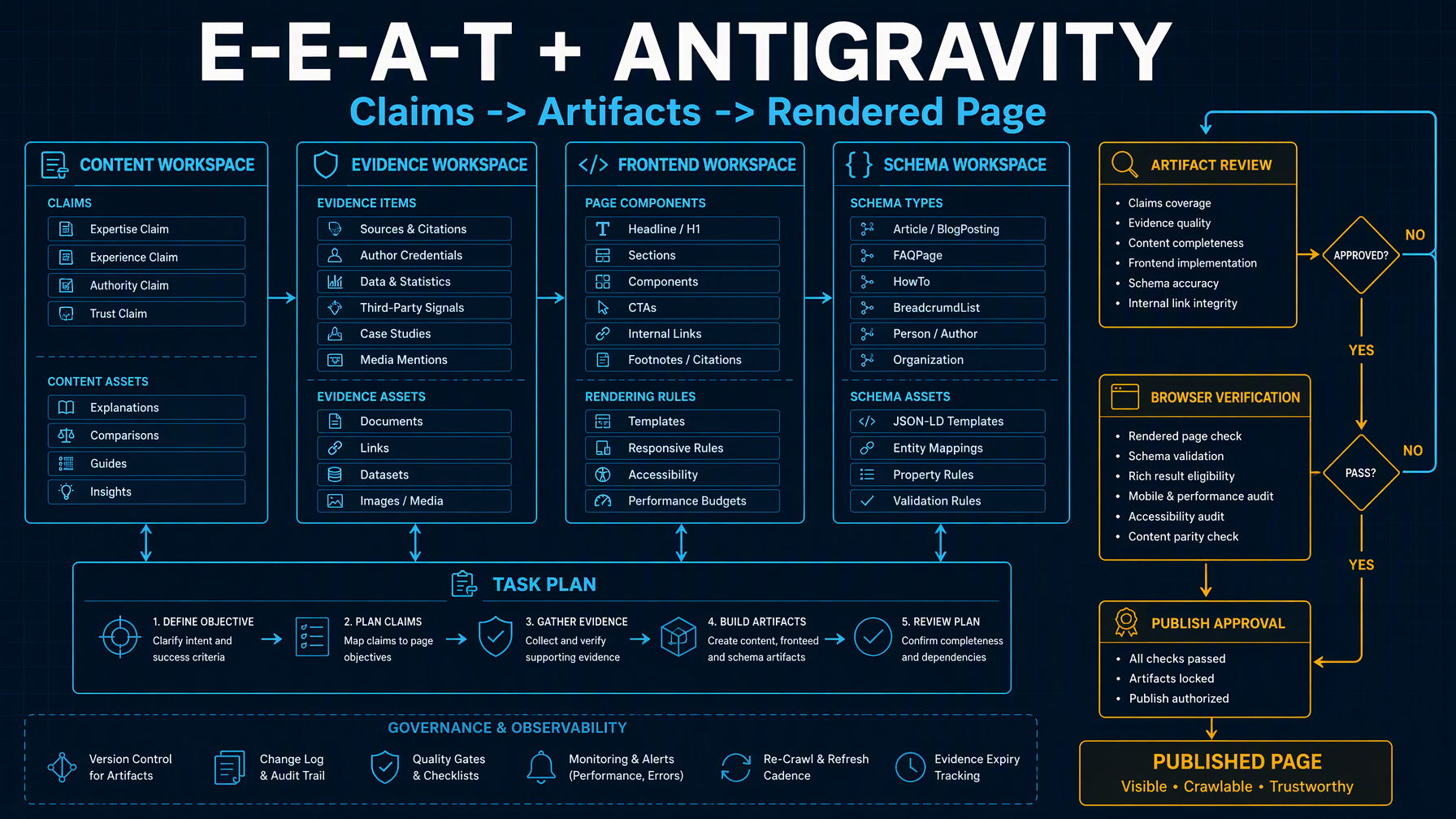
Google Antigravity is an agentic development platform built around projects, workspaces, plans, and agent artifacts. That makes it useful when an E-E-A-T issue crosses more than one surface: the article lives in a content repository, author data comes from a shared component, structured data is generated elsewhere, and the public page must be checked in a browser.
The core control is artifact review. An agent can plan and investigate, but a plan is not evidence and an artifact is not approval. Each proposed change must trace back to a claim record that a human has accepted.
Map the project before assigning agents
Workspace | What it may contain | Audit question |
|---|---|---|
Content | Article Markdown, CMS export, author copy | What does the page actually claim? |
Frontend | Templates, components, metadata | Where else is the claim rendered? |
Structured data | Schema generators or page data | Does markup match visible facts? |
Evidence | Approved sources, method notes, owner decisions | What supports the claim? |
Tests or QA | Build checks, snapshots, link checks | Can the approved change be verified? |
Do not grant every agent access to every workspace by default. A source-review agent does not need deployment credentials. A browser-verification agent does not need to edit author records. Match access to the task.
What you will finish with
This workflow produces a project evidence map, a Task Plan, three review artifacts, a human approval record, a bounded implementation, and a rendered-page reconciliation report.
It is done when:
- every changed claim maps to approved evidence;
- the visible page, metadata, and structured data agree;
- artifacts show what was checked and what remains unknown;
- no agent expands the project or writes outside the approved workspaces;
- a human reviews the final page state.
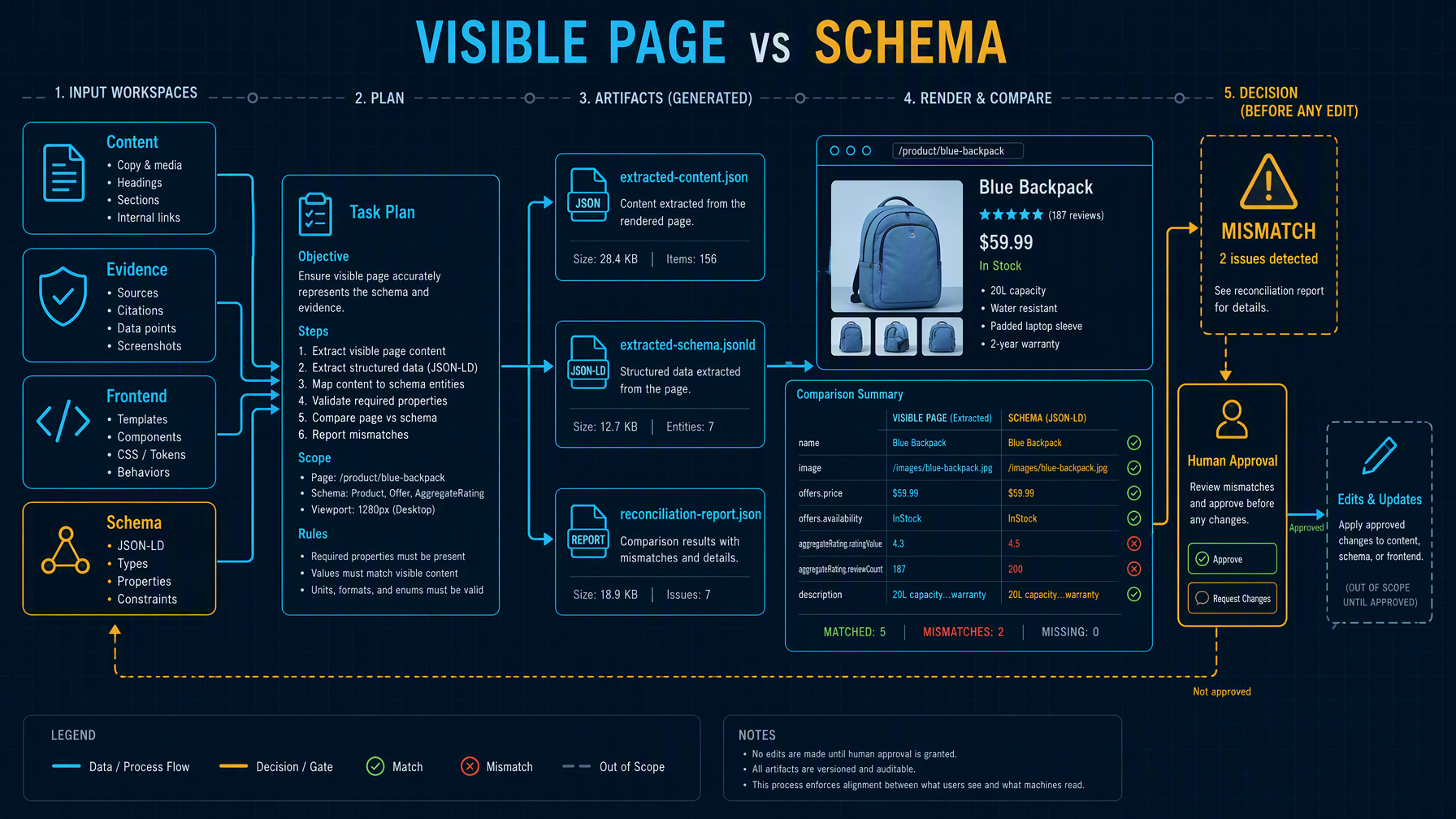
Illustrative workflow: a visible-page and structured-data mismatch is sent to human review before an implementation changes either workspace.
Write a Task Plan around claims, not vague quality goals
Use a plan like this:
# E-E-A-T evidence review Task Plan

Target page:
Audience:
Visitor task:
Market and language:

## Allowed workspaces

- content: read
- evidence: read and write audit artifacts only
- frontend: read
- structured data: read
- tests: run existing checks

## Prohibited actions

- no content, component, Schema, CMS, deployment, or external write during investigation
- no private account access
- no invented experience, credentials, reviews, sources, customers, results, or dates

## Required artifacts

1. page-claim-map.md
2. evidence-support-matrix.md
3. render-and-schema-reconciliation.md
4. approval-needed.md

## Completion condition

The artifacts preserve source locations, workspace paths, contradictions, unknowns, and the exact human decisions needed before implementation.
The Task Plan should be reviewed before agents begin. If the plan says "improve trust signals across the site," send it back. The scope should name one page and the relevant workspaces.
Produce three different artifacts
The article and code need separate views.
Page claim map
This artifact lists the visitor-facing statements and where they appear. Include body copy, author blocks, footnotes, image captions, metadata, reusable components, and calls to action when they make factual claims.
Evidence support matrix
This artifact links each claim to visible or owner-approved evidence.
Claim ID | Claim location | Evidence location | Status | Owner | Limitation |
|---|
Use visible, owner supplied, needs human verification, or not provided. Do not calculate a score.
Render and Schema reconciliation
This artifact compares what the user sees with what machines receive.
Entity or property | Visible page | Metadata or Schema | Evidence | Decision |
|---|---|---|---|---|
Author role | "Product editor" |
| Approved bio says "Product editor" | Correct Schema |
Review date | No visible review date |
| Build timestamp only | Do not present as expert review date |
Rating | No visible rating | AggregateRating present | No approved review source | Remove markup and investigate source |
This is where the Antigravity workflow earns its place. A content-only review can miss facts generated by code.
Inspect artifacts before authorizing edits
Agent artifacts should answer four questions:
- Which source or workspace supports each finding?
- Which claims remain uncertain or contradictory?
- Which exact files or page properties would change?
- What test or rendered-page check will verify the approved result?
Reject an artifact that says "add stronger authority signals" without naming a supported fact. Reject a plan that adds a reviewer, rating, date, or credential solely because the relevant Schema property exists.
Approve a bounded implementation
After reviewing the artifacts, create an approval record:
# Approved E-E-A-T implementation

approved_claim_ids:
  - [CLM-001]

allowed_files:
  - [EXACT PATH]

allowed_changes:
  - [VISIBLE COPY OR CODE CHANGE]

required_evidence:
  - [EVIDENCE ID]

required_checks:
  - existing build and tests
  - rendered page review
  - visible content versus Schema comparison

not_approved:
  - new claims
  - new reviewer identities
  - new ratings or testimonials
  - publication or deployment
An agent can now implement the accepted items and produce a diff artifact. Publication or deployment remains a separate decision unless the approval record explicitly includes it.
Use browser verification as evidence of implementation
A browser capture can show that approved wording appears on the rendered page and that a source link is visible. It cannot prove that the underlying experience, credential, or customer result is genuine.
The verification artifact should record the URL or local preview, time, viewport, visible text, source-link destination, structured-data result, and any mismatch. If a screenshot is used, capture a real page state. Do not generate a fake dashboard or treat a screenshot as proof of performance.
Example: the content is right and the Schema is wrong
Suppose the article accurately names its author as an editor. An old component still generates jobTitle: Medical Reviewer, and the page has no visible medical review statement or approved source for that role.
The claim map may show no problem in the article file. The reconciliation artifact exposes the mismatch in another workspace. The approved implementation can correct or remove the unsupported property, run the relevant tests, and verify the rendered page and structured data again.
The workflow improves consistency. It does not prove that Google will rank the page differently or display a rich result.
Control parallel work
Antigravity can orchestrate multiple agents across projects and workspaces. For this audit, parallel work is useful only when ownership stays clear.
- One agent maps visible claims.
- One agent traces repository and evidence locations.
- One agent compares the rendered page with metadata and Schema.
- A human reviews all artifacts before any implementation agent starts.
Do not let multiple agents edit overlapping files. Do not ask an implementation agent to resolve an evidence contradiction. Send factual conflicts to the responsible owner.
Recovery paths
If an artifact lacks source locations, rerun the investigation for those claims. If workspaces disagree, add the issue to the reconciliation artifact rather than choosing one silently. If the build fails, fix only the approved implementation. If browser verification shows a different page state, stop and identify the deployment, cache, locale, or template responsible.
When evidence is missing, the recovery path is always human proof, narrower wording, or removal. More agent work cannot create the missing real-world fact.
Frequently asked questions
Is Google Antigravity required for an E-E-A-T audit?
No. It is useful when evidence, content, code, and structured data live across multiple development workspaces. A simple page can be reviewed with a smaller workflow.
Are Task Plans and artifacts evidence?
They are evidence of the agent's recorded process and findings. They do not prove the page's experience, credentials, reputation, reviews, or outcomes.
Can an agent fix content and Schema in parallel?
Only after the same approved claim record defines both changes and file ownership prevents conflicts. Verify the combined rendered result before release.
Does correcting a Schema mismatch guarantee a rich result?
No. Structured data should accurately describe visible content. Eligibility and display remain subject to search-engine systems and policies.
Author: Bennett Hayes, Applied GEO Analyst Across 400+ Implementation Reviews at Auspia. Bennett writes about practical audits, controlled implementation, and page-level verification.