Choose tools around the page system you are building
For SaaS companies and content-driven websites, the best AI SEO tools are not necessarily the ones with the best text generator. The useful stack helps the team map buyer intent, maintain a large content inventory, create differentiated briefs, protect technical quality, and connect search visits to sign-ups, trials, demos, subscriptions, or reader value.
SaaS SEO has a particular complication: one site may need product pages, use cases, integrations, documentation, comparisons, pricing explanations, templates, and editorial education. A publisher may instead need topic coverage, refresh discipline, authority signals, reader engagement, and monetization. Both need a system that makes pages distinct rather than multiplying variations.
Match the stack to the content model
Site model | Highest-value AI SEO capability | What to avoid |
|---|---|---|
Early SaaS category creator | Intent research, customer-language analysis, product-page briefs | Producing dozens of generic thought-leadership posts |
Product-led SaaS | Topic maps, comparison workflows, internal linking, conversion reporting | Treating every feature as a separate keyword page |
Documentation-heavy SaaS | Query-to-doc mapping, content decay alerts, technical checks | Letting AI change product instructions without owners |
Editorial publisher | Content inventory analysis, refresh priorities, source-aware briefs | Publishing interchangeable summaries of other sources |
Programmatic content site | Data validation, templates, duplicate detection, QA gates | Scaling URL count before proving page-level value |
The core tool categories
Search intelligence
Use a reliable research suite or keyword dataset to understand demand, competitors, ranking movement, and query patterns. AI is most useful here for clustering, finding overlap, and turning a large list into a manageable topic map. It should not decide content priorities without business context.
Content intelligence and editorial workflow
SaaS teams need briefs that combine the searcher's question with product truth. A page about an integration needs technical accuracy. A comparison page needs fair criteria. A template needs an actual usable artifact. Look for tooling that preserves source notes, owners, product facts, review stages, and a content history.
Technical monitoring
Fast, crawlable, well-linked pages remain the foundation. An AI layer can summarize crawl issues, identify broken internal-link patterns, or flag content decay. It does not replace a technical SEO workflow for rendering, canonicalization, migrations, indexation, structured data, and site architecture.
Measurement for organic and AI search
Rank tracking and Search Console show conventional search demand. Product analytics and CRM data reveal whether a page supported a qualified action. A prompt-based measurement layer can show where a brand appears in answer-oriented search, but it should be reported separately from traditional rank positions.
The SaaS page types that deserve special care
Comparison and alternative pages
These pages often attract high-intent visitors, but they are easy to make untrustworthy. AI can collect common evaluation criteria and draft an outline. A human needs to ensure the comparison is accurate, current, fair, and useful even to a reader who does not choose your product.
Integration pages
An integration page should answer what connects, who needs it, setup requirements, limitations, data flow, and the result the user can expect. Avoid keyword-only pages for integrations that do not exist or workflows the product cannot support.
Documentation and help content
AI can spot questions with no answer, summarize recurring support language, or flag outdated articles. It should never silently invent a product step. Product owners must control factual documentation.
Template and tool pages
If a page promises a template, calculator, generator, or checklist, give the visitor a functional or genuinely actionable asset. The search query is an invitation to be useful, not a reason to wrap a generic article in a tool-shaped title.
A content operating model that scales
Start with a shared content record for every priority URL: purpose, audience, query cluster, owner, evidence sources, conversion action, related URLs, last review, and key metrics. AI can enrich this record by identifying overlap and extracting recurring themes. The record prevents a fast-growing team from treating content as an anonymous pile of drafts.
For a practical AI-search layer, Auspia can help teams examine whether priority questions reveal the brand or its content in answer-oriented results. The AI Search Visibility Checker works best when paired with a controlled prompt library drawn from customer research, product positioning, and high-value search clusters. It is a measurement habit, not a substitute for product-led pages.
How to decide between an all-in-one suite and a focused stack
Choose an all-in-one suite when the team is losing time moving between research, content, auditing, and reporting tools, and the suite integrates with the CMS and analytics you actually use. Choose focused tools when one function is clearly superior or when the team already has a working source of truth.
Run the decision against a live workflow. Ask a vendor to show how an integration-query insight becomes an approved brief, then a published page, then a tracked outcome. A feature grid cannot show whether the workflow will survive a product update or a busy editorial week.
Metrics that matter for these sites
For SaaS, group metrics by page role: non-brand impressions and clicks for discovery pages, qualified conversion rate for product-led pages, assisted pipeline where attribution is credible, activation for documentation, and retention signals for help content. For publishers, include returning readership, newsletter starts, subscriptions, and content freshness alongside organic traffic.
The aim is not to make every article sell. It is to know what each page is supposed to do and whether the site is becoming more useful to the audience it attracts.
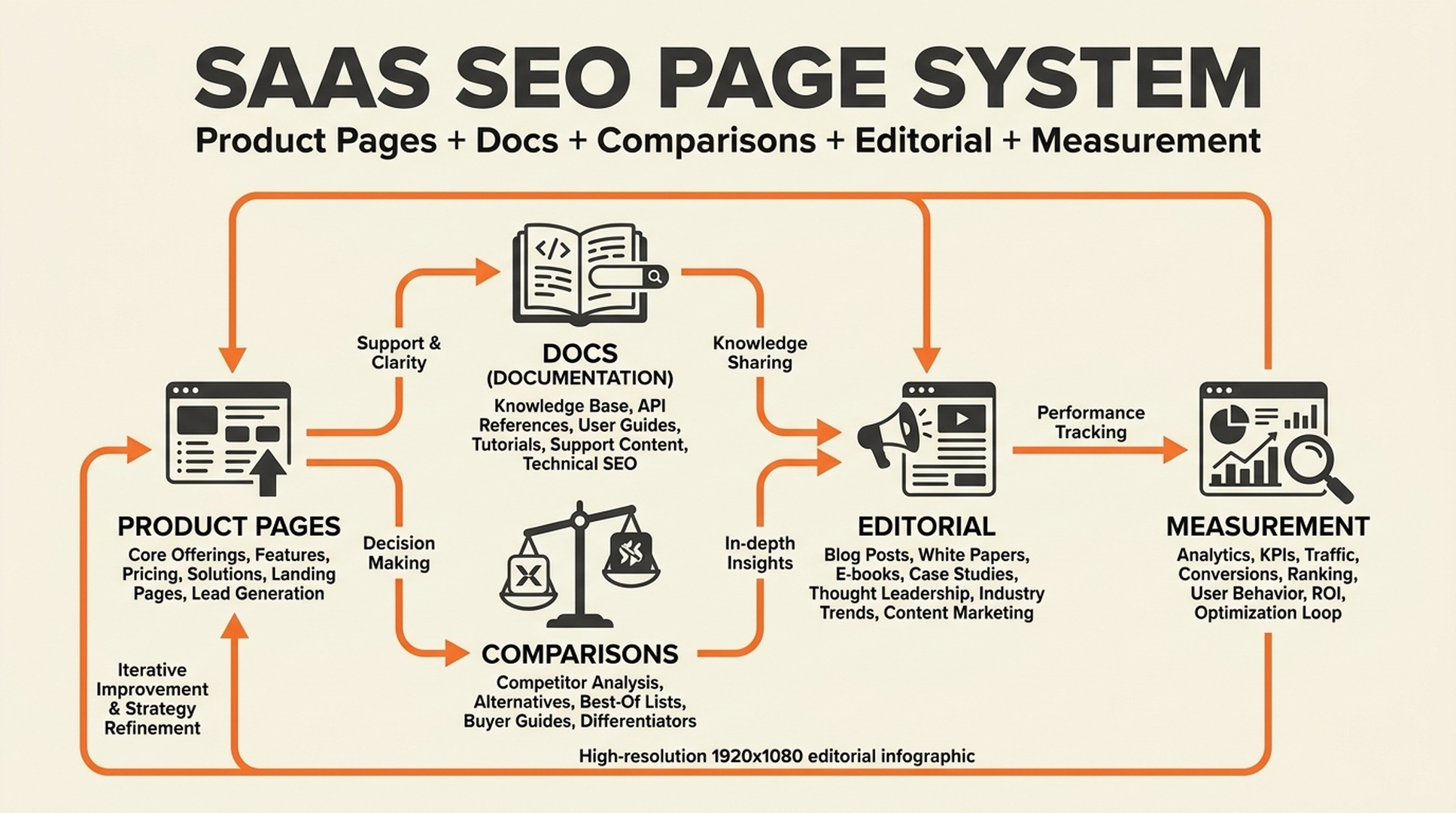
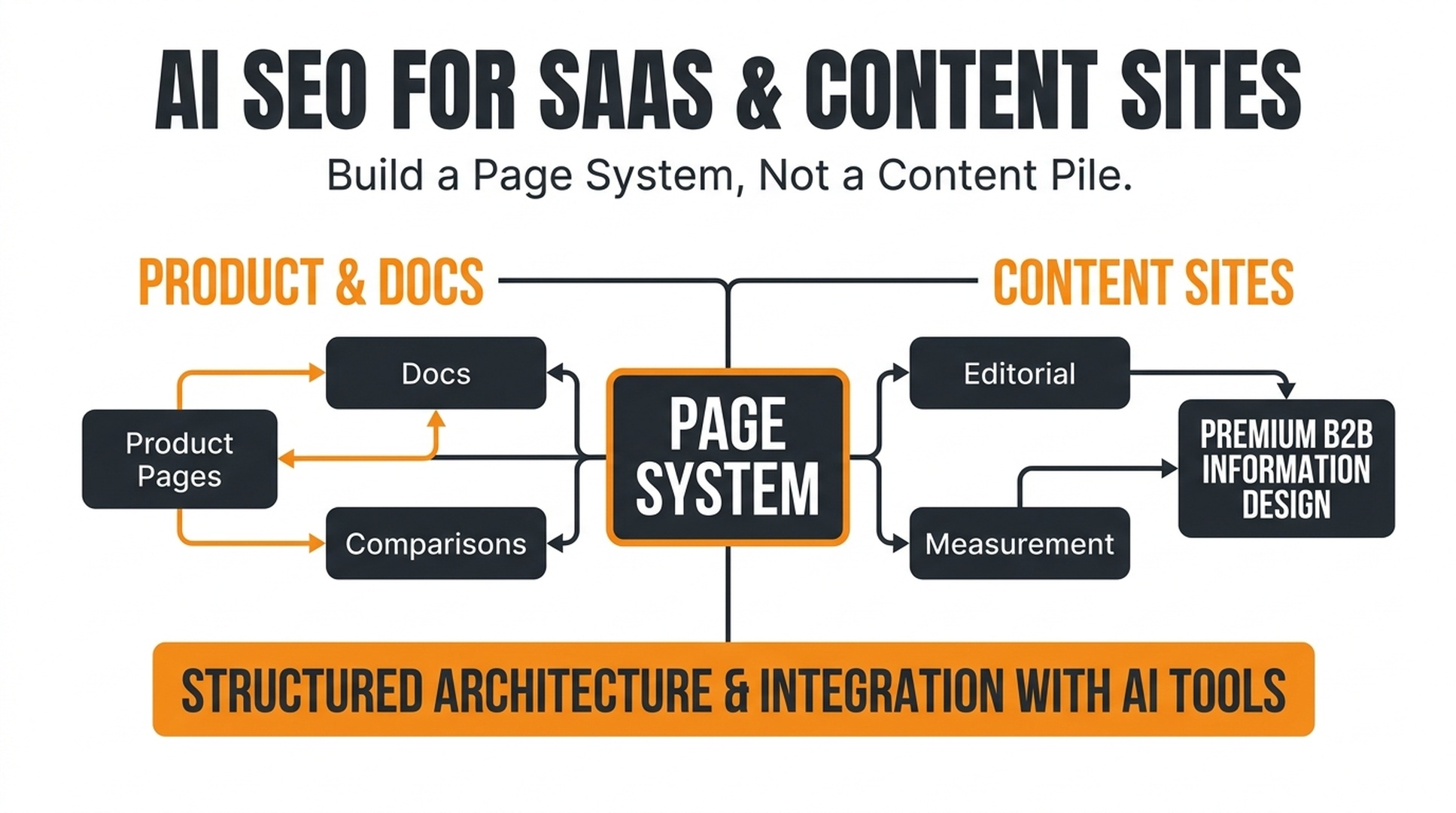
SaaS SEO page system connecting product pages, documentation, comparisons, editorial content, and measurement
FAQ
Do SaaS companies need separate AI SEO tools for content and product pages?
Not always. They do need different editorial rules. Product pages require controlled product facts and conversion context; editorial pages need evidence, intent fit, and topical relationships.
Are AI-generated comparison pages safe to publish?
Only after careful review. Comparisons can go stale quickly and can make unsupported claims about competitors or your own product.
Can AI help maintain a large documentation library?
Yes, for finding gaps, grouping questions, and flagging stale content. Product owners should approve any operational instruction or factual change.
What principles should guide scalable AI content?
Google's guidance on creating helpful, reliable, people-first content is a sound quality bar for both SaaS and publisher workflows.
Author: Caleb Brooks, SaaS SEO Strategist for 100+ Product-Led Pages at Auspia. Caleb writes about product-led search, documentation discovery, and content systems that support real buyer decisions.