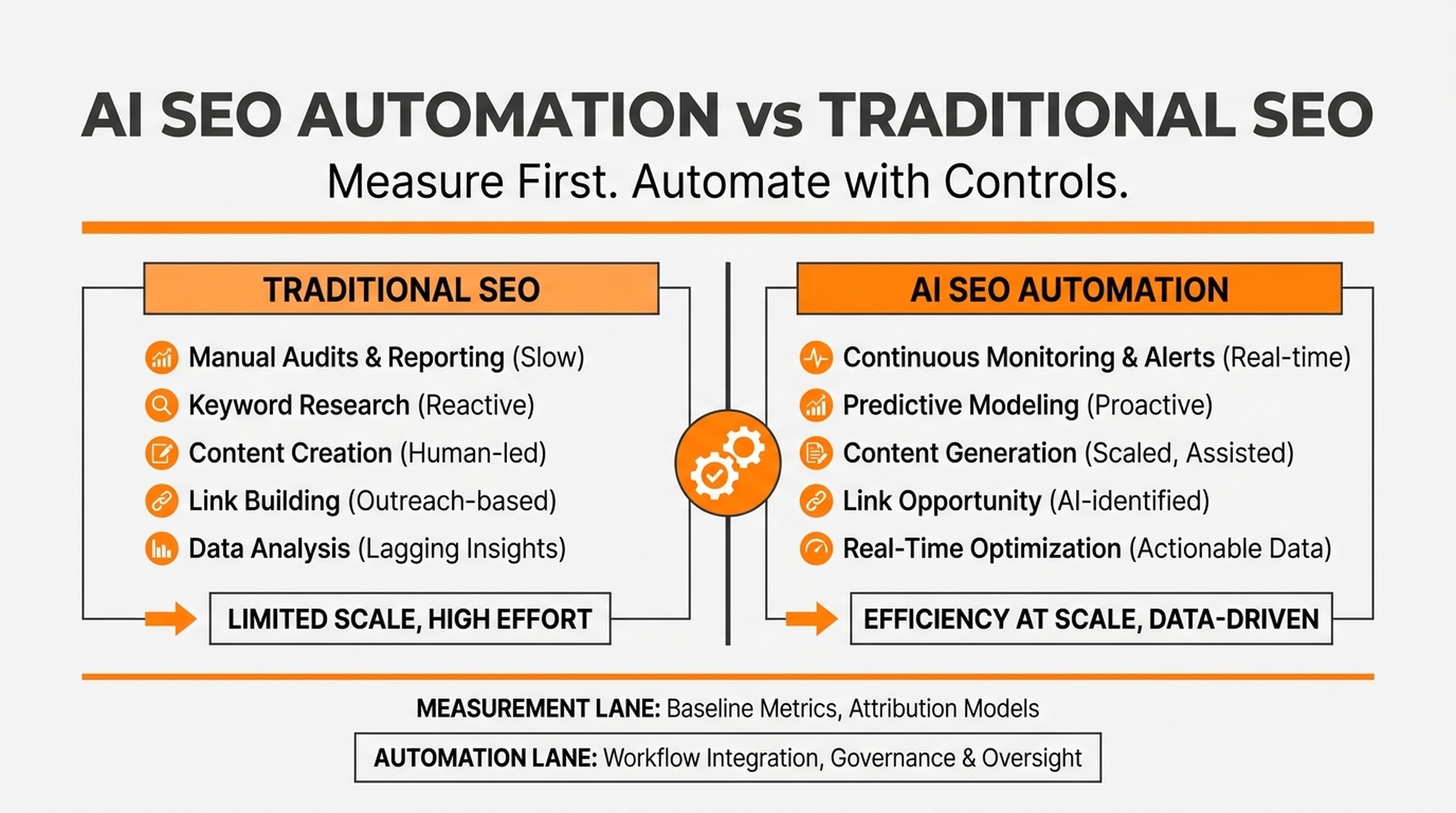
The difference is assistance versus observation, not old versus new
Traditional SEO software is built to collect, organize, and report search data: rankings, backlinks, crawls, site errors, keywords, competitors, and traffic. AI SEO automation tools use models to turn that information into clusters, briefs, draft content, prioritized tasks, summaries, and sometimes CMS actions.
The categories overlap. Established SEO suites now include AI features, while AI-first tools increasingly add keyword and audit data. The practical distinction is whether the product helps you observe the search environment, act on it, or both. A team still needs reliable measurements before it can automate good decisions.
Side-by-side comparison
Dimension | Traditional SEO software | AI SEO automation tools | What a team should retain |
|---|---|---|---|
Primary job | Data collection, diagnostics, monitoring | Analysis assistance and workflow execution | A clear source of truth for search data |
Typical inputs | Crawls, keyword indices, links, analytics connections | Those inputs plus briefs, brand rules, content, and prompts | Verified data and documented assumptions |
Typical outputs | Reports, issue lists, rank charts, exports | Clusters, drafts, task queues, summaries, recommendations | Human-approved priorities |
Strength | Repeatable measurement at scale | Faster first-pass research and production | A link between work and outcomes |
Main risk | Dashboard overload | Plausible but incorrect or generic work | Review gates and audit trails |
Traditional tools answer questions such as "Which URLs lost clicks?" and "What does the crawler see?" Automation tools can help answer "What should we investigate first?" and "Can we turn this approved brief into a draft?" Neither question should be answered without the other.
The data problem comes first
An AI feature is only as useful as the data and instructions supplied to it. A model working from an incomplete crawl may miss an indexation problem. A model working from an outdated keyword export may recommend a stale topic. A model that cannot see your product documentation may create generic copy that sounds reasonable but does not describe the product.
Before adopting automation, establish where rankings, Search Console data, analytics, crawl status, content inventory, and conversion events live. Then decide which systems may send data to the AI layer and what must remain private. That groundwork often produces more value than adding a new writing tool.
What automation changes in a real workflow
Consider a quarterly content refresh. A conventional workflow might export query data, identify declining pages, inspect each URL, create tickets, and ask writers for outlines. An AI-assisted workflow can group the declining queries, summarize page overlap, flag missing answers, draft refresh briefs, and prepare internal-link suggestions. The editor still decides which page to update, what new evidence is needed, and whether an observed decline reflects content quality, seasonality, or a technical fault.
The win is less manual sorting. The standard for the published page should remain the same.
When traditional software is enough
If your immediate problem is crawlability, a migration, canonicalization, broken templates, index coverage, or rank monitoring, traditional SEO tooling and technical expertise may be the right answer. Adding AI drafting will not repair a blocked page or resolve a JavaScript rendering problem.
Similarly, a new site with few pages may learn more from Search Console, customer interviews, and a handful of carefully chosen pages than from a large automation platform. Tools should match the bottleneck.
Use the bottleneck to choose the first capability
The wording in a vendor category can hide the real decision. If the team cannot explain which pages are indexed or why a template is producing duplicate URLs, begin with crawl and indexation diagnostics. If it already has reliable data but cannot convert it into owned work, begin with topic mapping and an editorial queue. If writers keep producing overlapping pieces, establish page ownership and a content inventory before adding generation.
AI becomes helpful after the team has defined the repeated task. It can sort a large crawl backlog, group a query export, or prepare a first brief. It cannot decide which part of the business matters most this quarter. That remains a strategy decision, and it should be visible before any new software is purchased.
When an AI automation layer earns its place
Automation is useful when a team has enough recurring work that manual triage is slowing it down. Common triggers include a growing content inventory, multiple markets, many similar support questions, a recurring refresh cycle, or an editorial team that needs consistent briefs and review standards.
Auspia is most relevant for teams adding AI-search visibility to this workflow. Its AI Search Visibility Checker can extend a conventional measurement stack with repeatable answer-surface checks. That should inform priorities alongside rankings, clicks, and conversion data, rather than replace them.
The hidden trade-off: speed versus review load
Automation can shift work rather than eliminate it. A tool that generates twenty briefs a day may create a review queue no one can clear. A tool that publishes drafts through an API can introduce brand or factual errors faster than a manual system. Measure the full cycle: time from opportunity to approved page, corrections per draft, publication defects, and post-publish value.
The healthiest workflow has an explicit stop button. If sources are weak, the intent is unclear, or the topic overlaps another page, the system should create a research task, not a new URL.
A sensible combined stack
Use conventional tools for crawl, rank, and traffic truth. Use AI for clustering, draft briefs, content-inventory analysis, routine summaries, and focused quality checks. Use your CMS and analytics as the record of what actually shipped and what happened afterward. For AI search, add a controlled prompt library and measure it as an emerging channel.
That model is less exciting than a promise of autonomous SEO. It is also much more likely to survive contact with a real site.
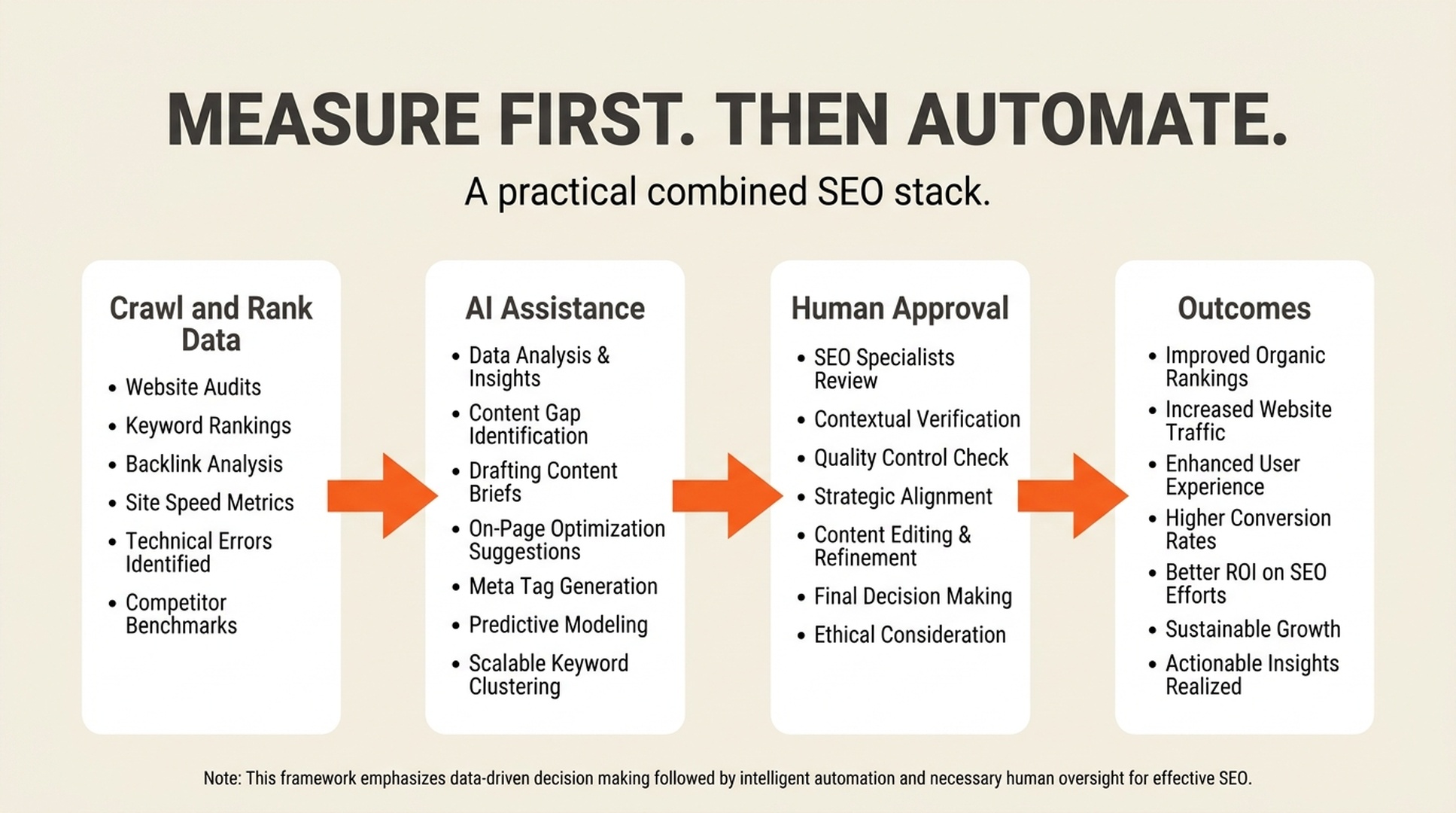
Combined SEO stack from reliable data through AI assistance and human approval
FAQ
Are AI SEO tools better than traditional SEO tools?
Neither is universally better. Traditional tools are often stronger at dependable measurement and diagnostics. AI tools are often stronger at accelerating repetitive analysis and production tasks. Most mature teams need both capabilities.
Can AI automation perform technical SEO?
It can summarize crawl data and flag common issues. Technical diagnosis and implementation still require inspection of the site, code, rendering, and search-engine behavior.
Does Google prefer traditional or AI-assisted SEO work?
Google evaluates content and technical accessibility, not the label on the tool. Its guidance on generative AI content stresses value and compliance rather than a particular production method.
Author: Julian Mercer, 14-Year Technical SEO Practitioner at Auspia. Julian writes about crawlability, structured data, site architecture, and the technical foundations that automation cannot skip.