一句话答案
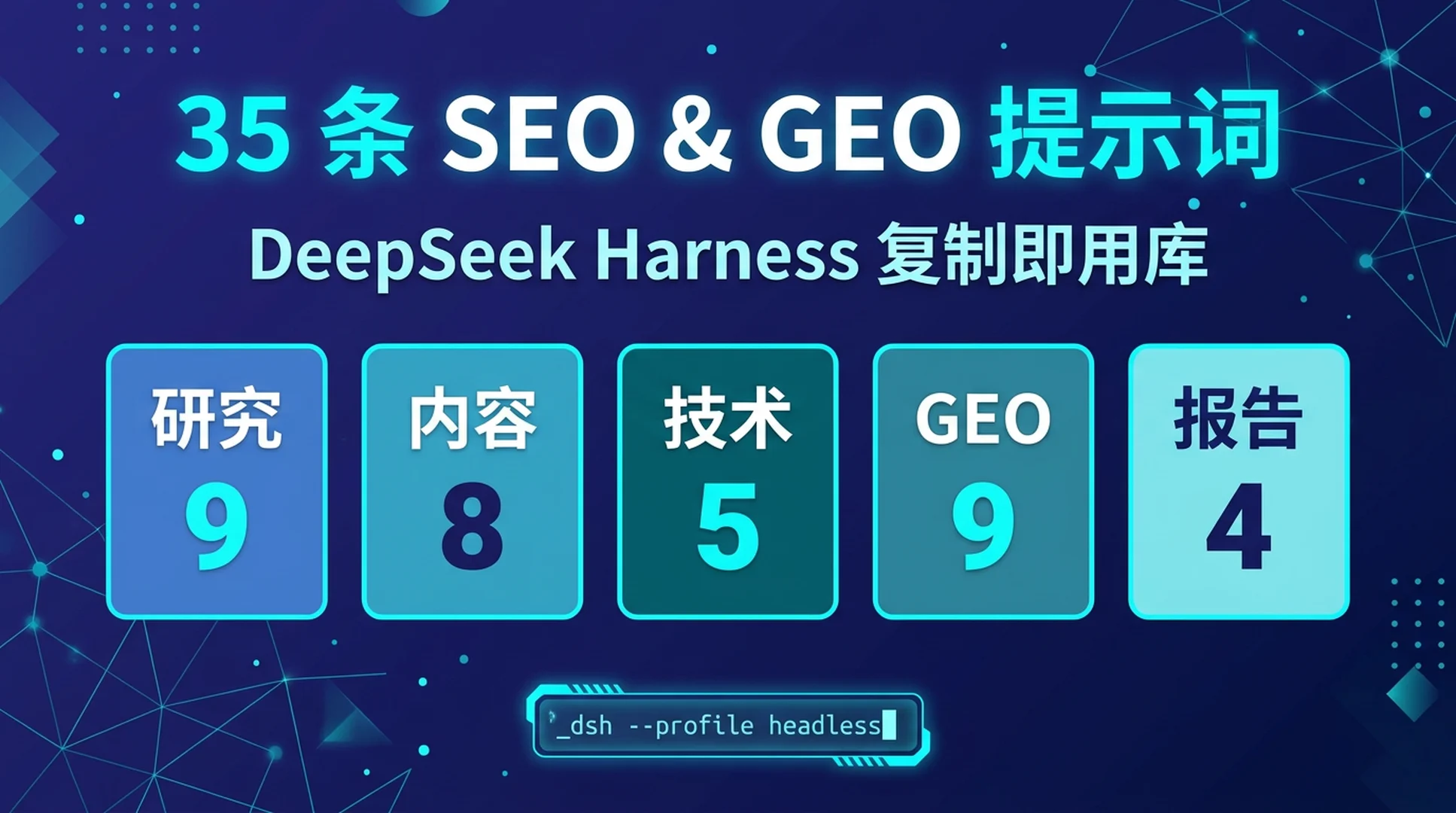
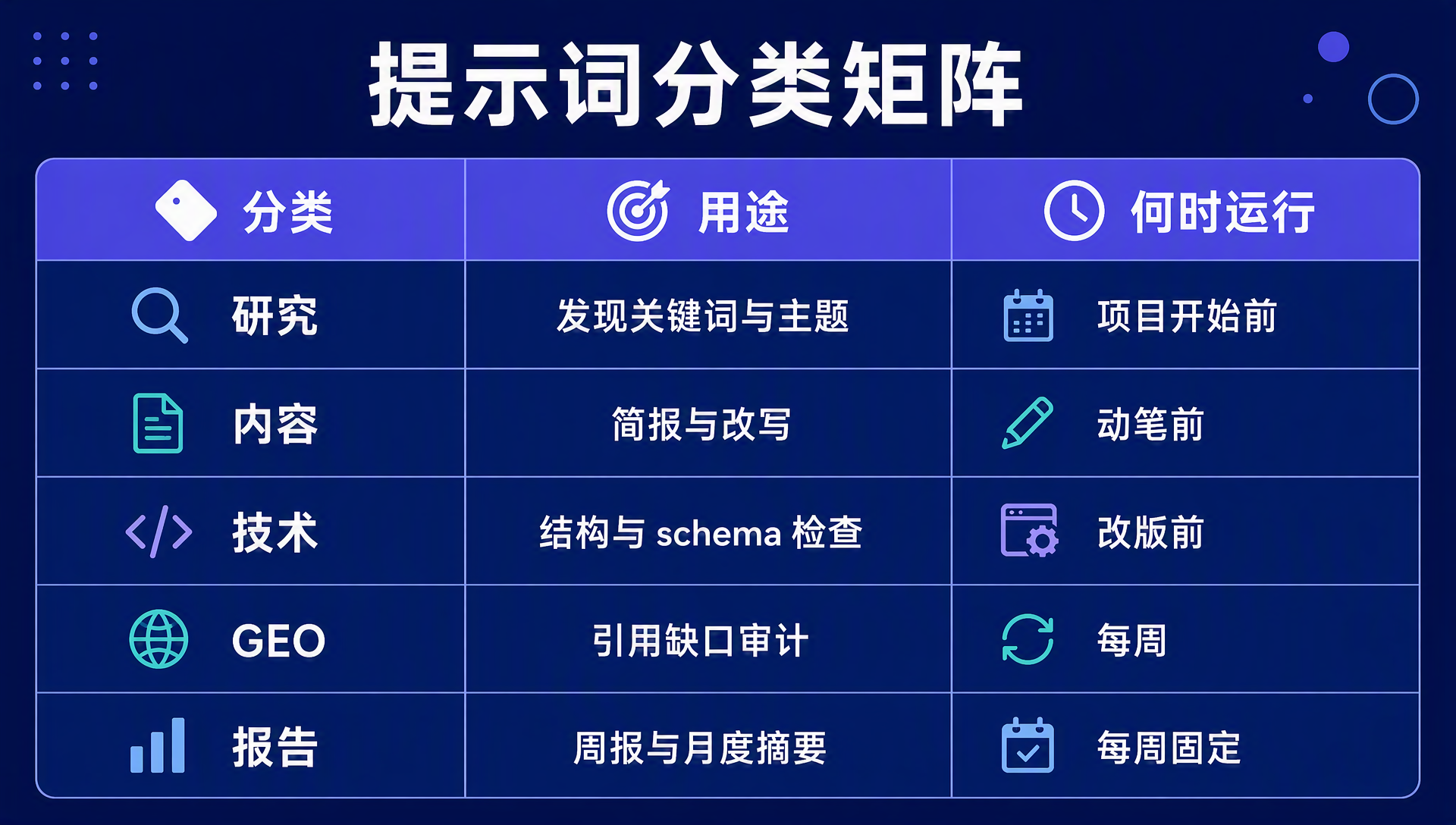
这 35 条提示词把 DeepSeek Harness 从"一个有趣的工具"变成能干活儿的 SEO/GEO 助理。它们分成五组——研究、内容、技术、GEO & AI 答案、报告——并且可以在任何会话里直接跑:粘贴到输入框,或丢给无头模式做批量任务。每条提示词都是原创的,并且在本系列的真实演练里测过;把方括号里的部分换成你自己的业务、细分领域或 URL 即可。
两条规则能让它们全都更好用:
- 给智能体一个角色和一份文件。 以
Act as an SEO strategist(作为 SEO 策略师)开头、并指向真实文件(read sitemap.xml in this workspace)的提示词,稳定地胜过空泛的问题。 - 要求格式。
Output as a markdown table或reply in 5 bullet points是区分可用的答案和一篇散文的分界线。
怎么跑这些提示词
- 单次运行: 粘贴到网页 UI(
dsh web)的输入框发送。 - 批量: 用无头模式包住提示词:
dsh --profile headless "PASTE PROMPT HERE"。 - 可重复: 把周期性提示词(周报、GEO 复查)存进工作区里的笔记文件,让智能体随时重新加载——本系列的自动化文章会详述。
1. 研究类提示词(9 条)
1.1 关键词聚类发现
Act as an SEO strategist. For [business description], propose 6 keyword
clusters with 3-5 query examples each and the search intent behind each
cluster. Output as a markdown table: Cluster | Example queries | Intent.
1.2 SERP 搜索意图拆解
Act as a search intent analyst. For the query "[your keyword]", analyze what
searchers actually want: list the dominant intent (informational, commercial,
transactional, navigational), the content formats that rank (lists, reviews,
tools, forums), and 3 angles a new page could take. Be specific, not generic.
1.3 竞品缺口分析
Act as a competitive SEO analyst. [If you have competitor URLs, list them
here; otherwise describe your 3 main competitors.] Compare their content
coverage against [our site / this workspace's content] and list 5 topics
they rank for that we don't cover, ranked by business value.
1.4 实体与主题地图
Act as a topical authority strategist. For [niche, e.g., "specialty coffee
subscriptions"], build a topical map: the core entity, 4-6 supporting
sub-entities, and 3-5 questions per sub-entity that a pillar page should
answer. Output as a nested markdown outline.
1.5 内容更新判断
Read [URL or file path] in this workspace. Act as a content decay analyst.
Judge whether this page needs a refresh: list signs of decay (old dates,
thin sections, missed entities), the top 3 updates you'd make, and whether
the page is worth refreshing vs consolidating. Be decisive.
1.6 查询到页面类型的映射
Act as an SEO architect. For the following list of queries [paste queries],
map each one to the best existing or new page type (home, category, product,
guide, comparison). Flag queries with no good target. Output as a table.
1.7 站点地图与结构审计
Read sitemap.xml (or list the site structure files) in this workspace.
Act as a technical SEO auditor. Identify: pages likely orphaned, duplicate
title patterns, thin sections, and 3 structural improvements. Output as a
prioritized list with file names.
1.8 趋势与需求检查
Act as a search trend researcher. For [topic], list the 3 questions about it
that are most likely to rise in the next quarter, and 3 facts a content
brief on this topic should not be missing. State your reasoning in one
sentence per item.
1.9 内链机会地图
Read [list of pages or files] in this workspace. Act as an internal linking
analyst. For each page, list 3 other pages in the workspace it should link
to (context, authority, or conversion value), and 1 anchor-phrase suggestion
per link. Output as a table: Page | Suggested link | Why.
2. 内容类提示词(8 条)
2.1 内容简报生成器
Act as an SEO content strategist. Write a content brief for a [word count]-
word article targeting "[keyword]": target entity, searcher intent, outline
with H2s, 3 entities to cover, suggested internal links, and a meta
description. Be concise.
2.2 答案优先的开头改写
Read [file path] in this workspace. Rewrite the opening two paragraphs so a
reader can get the core answer in under 30 seconds: state the answer first,
then the key evidence, then the detail. Keep the facts identical; change only
structure and phrasing.
2.3 实体丰富的小节扩写
Read [file path]. Find the section about [sub-topic]. Expand it to cover the
entities and facts an AI answer engine would quote: definitions, named
entities, numbers, and a one-sentence summary. Do not add opinions or claims
not supported by the existing text.
2.4 从真实问题写 FAQ
Act as an answer-optimization editor. For the page [URL or file path], write
5 FAQ questions a real searcher would ask, and answer each in 2-3 sentences
using only facts already on the page. No invented claims.
2.5 标题与描述批量优化
Read the title and meta list in this workspace. For each page, rewrite the
title (under 60 characters) and meta description (under 155 characters) to
match searcher intent. Output as a table: Page | Current | New title | New
description | Why.
2.6 前后对比式 GEO 改写
Read [file path]. Here is an AI answer for a query this page should be cited
for: "[paste AI answer]". Rewrite the page's key section so it directly
answers that query in the same structure (short definition, named entities,
numbers), without copying the AI answer's wording.
2.7 内链建议
Read the files in this workspace. Act as a link architect. Propose 5 internal
links between these pages with the exact anchor text, and explain the
relevance signal each link sends. Output as a table: From | To | Anchor | Why.
2.8 摘要转博客
Read [file path or paste text]. Convert this into a [word count]-word blog
post for [audience]: one clear answer in the first paragraph, H2 structure,
one table or list, and a short conclusion. Preserve every fact; add no new
claims.
3. 技术类提示词(5 条)
3.1 Robots 与可索引性检查
Read robots.txt and the HTML head of [URL or local file] in this workspace.
List everything that blocks or weakens indexing (directives, missing meta
robots, duplicate canonicals) and the exact fix for each.
3.2 Schema 健康检查
Read [page file] in this workspace. Evaluate its structured data: which
schema types are present, which required properties are missing, and what
entity signals an AI system would extract. Suggest concrete additions.
3.3 从 HTML 做页面速度分诊
Read [page file] in this workspace. List the 5 heaviest elements (images,
scripts, inline styles) that would slow this page and rank them by impact.
Do not run benchmarks; judge from the file contents.
3.4 孤岛与关键词蚕食扫描
Scan the files in this workspace. Identify pages that likely cannibalize
each other for the same query (similar titles/intent) and pages that appear
orphaned (no internal links). Output: Cannibalization | Orphaned | Fix.
3.5 日志式爬取问题
Act as a technical SEO auditor. For [site], list the 3 crawl or rendering
questions whose answers would change the most SEO decisions, and for each:
what data you'd need, where to get it, and how you'd use it.
4. GEO & AI 答案类提示词(9 条)
4.1 引用缺口分析
Here is what [ChatGPT/Perplexity/Gemini] answered for "[query]":
"[paste the AI answer verbatim]".
Our site is [site description, e.g., "moonlightroasters.example, a Portland
coffee roaster"]. We are not cited. Analyze the citation gap: why we are
likely not cited, what the cited pages have in common, and 3 concrete fixes.
Be specific.
4.2 答案相邻段落改写
Read [file path]. Rewrite the section most likely to be quoted for the query
"[query]" so it matches how AI engines assemble answers: one-sentence
definition up top, named entities, numbers, and no buried lead.
4.3 实体清晰度检查
Read [file path]. List every fact an AI system would need to describe this
business as an entity (name, category, location, offering, pricing,
distinguishing claims), and flag which ones are missing or ambiguous on the
page.
4.4 来源资格评审
Act as an AI citation analyst. Read [file path]. Rate this page on the 5
signals that make AI engines cite a source: authority signals, factual
specificity, update freshness, extractable structure, and named entities.
Score each 1-5 with one line of evidence, then the single highest-impact fix.
4.5 AI 答案监控快照
Generate the weekly GEO snapshot for [site] and [3 target queries]: for each
query, paste the current AI answer, note whether we are mentioned or cited,
and list any new sources that appeared. Output as a table. Keep the answer
under 200 words.
4.6 "有排名无引用"诊断
[site] ranks on page 1 for "[query]" but is not cited in AI answers. List
the 3 most likely reasons specific to this situation, and for each, the
cheapest test to confirm it.
4.7 备选答案面检查
For the query "[query]", list 5 AI answer surfaces where a business like
[site] could appear (ChatGPT, Perplexity, Google AI Overviews, Gemini,
Copilot, niche assistants), and for each surface, the one factor that most
determines inclusion. Be honest about what is and isn't verifiable.
4.8 引用来源模式审计
We are cited for "[query]" in [ChatGPT/Perplexity/Gemini]. Paste the AI
answer that cites us. Analyze exactly which part of which page earned the
citation: the quoted sentence, the page structure, and what the AI reused.
Then list 3 other sections of the site that could earn citations the same
way. Be specific.
4.9 AI 答案声明核验
Here is what [ChatGPT/Perplexity/Gemini] says about [site]: "[paste the AI
answer verbatim]". Verify every claim against [our pages / workspace files]:
mark each claim SUPPORTED, UNSUPPORTED, or WRONG with the file that proves
it. For unsupported claims, name the exact fix on our side. Output as a
table.
5. 报告类提示词(4 条)
5.1 每周 SEO 快照
Act as an SEO manager. Produce a weekly SEO snapshot checklist for [site]:
what to check (rankings, AI answer presence, content freshness, backlinks),
which task to run for each check, and the expected output. Keep it under
200 words.
5.2 月度进展摘要
Read the reports in this workspace (or paste your numbers). Summarize this
month's SEO/GEO progress in 5 sentences for a non-technical founder: what
changed, what worked, what didn't, and the single most important next step.
5.3 审计转行动计划
Read [audit file] in this workspace. Convert the findings into a 2-week
action plan: for each task, the owner, the effort (S/M/L), the expected
impact, and a way to verify it's done. Output as a table.
5.4 提示词校准评审
Review these 5 prompts I use weekly: [paste prompts]. For each, suggest one
edit that would make the output more consistent or more specific. Then list
2 prompts I should add for [goal].
真正起作用的提示词格式规则
- 角色放最前面。
Act as an SEO strategist为整个回答定调。 - 明确输出格式。 表格、条数限制、字数——智能体会遵守。
- 按文件名引用文件。 Harness 能读你的工作区,文件引用能把空泛的回答变成有依据的回答。
- 一个提示词只干一件事。 把"分析并改写"拆成两条提示词,比一条长提示词效果好。
- 说清楚不要做什么。
No invented claims、do not add opinions是便宜但效果巨大的护栏。 - 复用你的赢家。 某条提示词产出了你愿意交付的结果,就把它存进工作区文件——你现在多了一个可重复的任务。
该期待什么(预期校准)
- 没文件时:答得快,但浅。 没有工作区上下文时,智能体凭通用知识作答——框架类问题表现好,站点具体决策上没用。
- 有文件时:有依据、具体。 指向你的站点地图、草稿或 AI 答案转录后,输出变得可审计、具体。
- 不是排名追踪器。 这些提示词产出分析和草稿,不是实时排名数据。搭配你的测量工具使用。
- Token 成本可以忽略。 这里一次典型问答成本不到一分钱;真正烧钱的习惯是问模糊的问题然后迭代五次。
FAQ
这些提示词是 DeepSeek Harness 专属的吗?在 Harness 里效果最好,因为它能读你的工作区文件、能用无头模式批量跑——但在任何能力够的模型聊天里都能用。Harness 的优势在于可重复性和文件访问。
能把提示词存成文件批量跑吗?能。存进工作区,然后告诉智能体读哪个文件(见 5.4 和本系列的自动化文章)。
为什么同一条提示词输出不一样?模型每次运行都会采样新的回答。要可重复,就要求固定输出格式,并保留上次运行结果做对比——这就是每周监控模式。
Harness 会编造事实吗?会,和任何模型一样。提示词里的护栏(禁止编造、只用页面上的事实)加上文件引用能把它控制住。发布任何内容前先核实。
本系列其他文章
- DeepSeek Harness 是什么?93k 星开源智能体平台入门指南
- 如何安装 DeepSeek Harness 并运行第一个任务(2026 图文教程)
- DeepSeek Harness 做 SEO:7 个工作流 + 复制即用提示词
- DeepSeek Harness 做 GEO:如何让 ChatGPT、Perplexity 和 Google AI Overviews 引用你
- 搭建你的第一个自动化:用 dsh 无头模式做每周 GEO & SEO 监控
- DeepSeek Harness CLI 速查表 + 新手故障排查
作者:Priya Nair,Auspia LLM 内容优化研究员,研究过 700+ 条提示词。Priya 撰写提示词设计、答案友好型内容,以及面向搜索团队的 LLM 友好结构。