Zyppy 2026 Google Ranking Factors Expert Survey Finds Content Relevance, Backlinks, and Quality Remain Top Signals
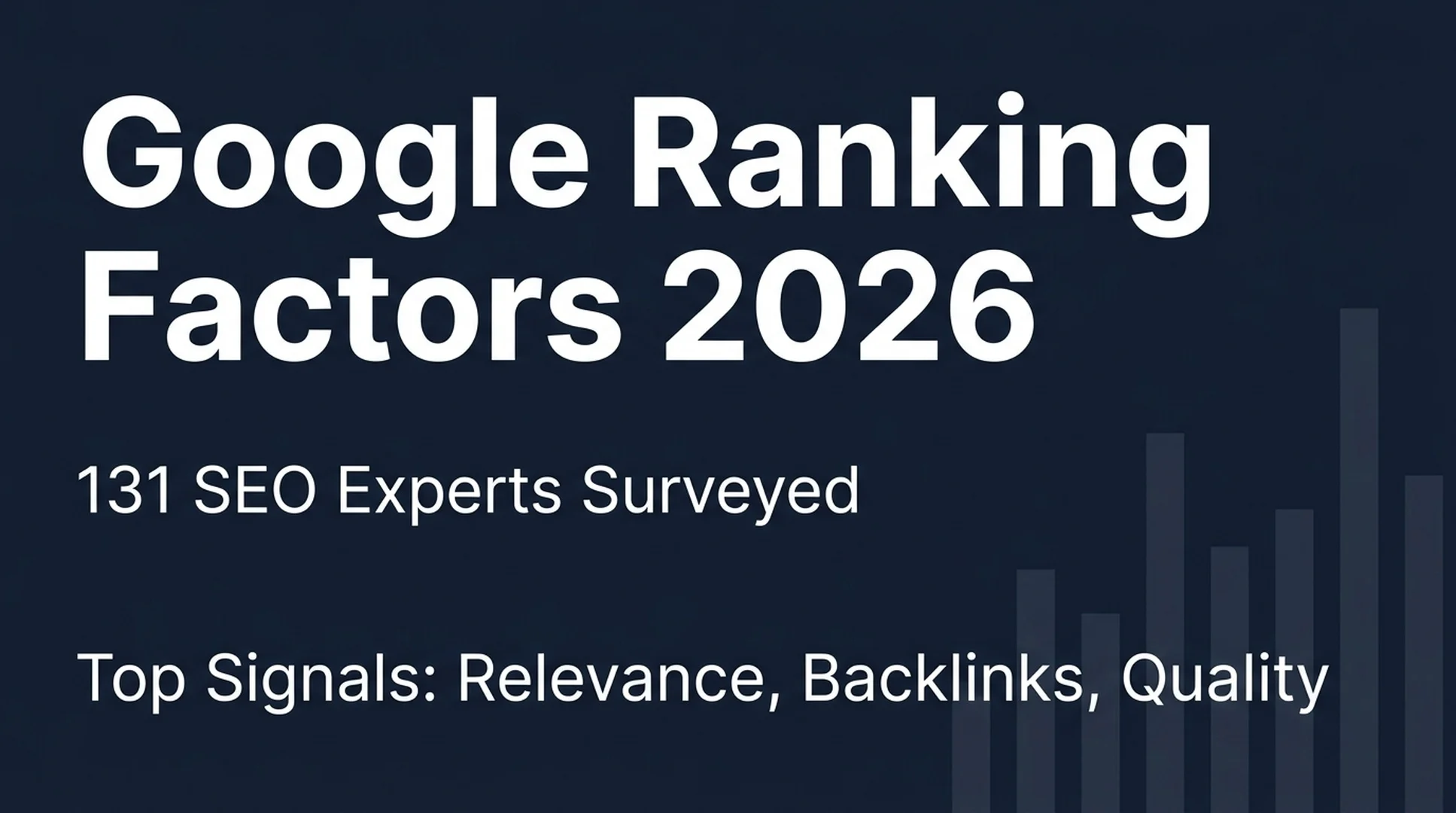
A comprehensive new survey of 131 leading SEO practitioners reveals that content relevance, backlinks, and content quality continue to dominate Google's ranking factors in 2026, despite the emergence of AI search, API leak revelations, and multiple algorithm changes. The survey, conducted by Cyrus Shepard and Dawn Shepard at Zyppy and published September 9, 2026, collected 13,665 ranking-factor data points from experts including many of the industry's most respected practitioners.
Background and context
The SEO industry has undergone significant transformation since the last major ranking factors surveys. Google's introduction of AI Overviews, the expansion of AI Mode in Search, revelations from the DOJ antitrust trial about internal ranking systems, and the leaked Google API documentation have all changed how practitioners understand search visibility.
The Zyppy survey was designed to capture these shifts. Each of the 131 respondents evaluated more than 100 potential Google ranking factors on a 7-point scale from +3 (Strongly Positive) to -3 (Strongly Negative), then answered an open-ended question about the three most important ranking factors. The contributors represent a cross-section of the SEO industry, including Aleyda Solis, Lily Ray, Dr. Pete Meyers, Michael King, Will Critchlow, Barry Schwartz, and many other recognized experts.
The timing is significant. Google's John Mueller stated on Reddit on September 10, 2026, that "Search results pages have a lot of ways for users to interact nowadays, so the old 'position 1 - 10' is hard to map, or to make useful for site owners." This acknowledgment from Google itself underscores how the traditional model of ranking positions has fragmented in the AI search era.
What the survey found — specific results
The survey asked experts to identify their top three ranking factors. The results formed three clear tiers:
Top Tier (selected by over 45% of experts):
- Content Relevance — 57.1%: Content that matches and satisfies user search intent. The survey defined this as semantically matching what the user is looking for and satisfying their needs.
- Backlinks — 54.8%: Links from trusted, relevant sites. The survey noted that "the rumor of the death of backlinks has been greatly exaggerated," with experts emphasizing links from pages with real visitors.
- Content Quality — 47.6%: Originality, accuracy, and freshness. Nearly half of experts listed content quality elements as a top-three factor.
Mid Tier (25% – 40%):
- Authority & Trust — 36.5%: How much Google trusts the website, creator, or brand.
- Behavior / Click Signals — 29.4%: How users select search results and interact with pages.
- Brand Signals — 27.0%: Being a brand or entity that people search for, trust, and visit.
Foundational Tier (under 20%):
- User Satisfaction — 19.8%: Task completion as the ultimate outcome.
- Technical SEO Health — 17.5%: Crawling and indexing as the foundation.
- Topical Authority — 14.3%: How well a brand or site is associated with expertise on a particular topic.
- Internal Links — 11.1%: Site architecture and internal linking structure.
What changed — deeper insights
While the top three factors may seem familiar, the survey revealed significant shifts in how experts understand these factors in 2026.
Content quality has evolved. "Original Research" and "First-Party Data" topped the content quality sub-factors, reflecting the importance of producing unique, non-commodity content in the age of AI. One expert noted: "AI has made content cheap. Anyone can spin up a thousand articles overnight. And Google knows it. That's why quality is becoming the filter. When the volume of content explodes, the cost of publishing drops to zero... but the cost of trust goes up."
However, the survey found nuance. AI-generated content was viewed negatively only when scaled without added value. One respondent reported "positive results from high-quality AI generation at scale" on sites with substantial unique content and human editorial review.
Click signals gained prominence. Evidence from Google's antitrust trial and API leak helped user-based signals take "a big leap in this year's survey," according to the researchers. "Satisfaction/Task Completion" was rated highest among user signals, while "Return to SERP" (when a searcher returns to Google's results after visiting a page) was rated negatively.
One expert stated: "Navboost is still a monster. As such, sites really should create a satisfaction metric (often by page type) to try to emulate satisfaction. Because there is a ranking ceiling when click signals are worse than other SERP competitors."
Brand signals are increasingly critical. "Online Reputation/Trust" and "Branded Search Volume" (how many people search for a brand by name) ranked as two of the most important factors. One expert summarized: "Brand signals are the strongest factor in my opinion. You can get away with a website technically in a very bad shape, without having optimized content as long as people search and talk about the brand."
Another noted: "Branded Search is the new link, since 2012, if a Google patent is to be believed."
Backlinks remain powerful but have changed. Links from highly trusted domains and topically relevant pages were two of the highest-rated factors across the entire survey. One expert observed a direct connection between links and AI visibility: "With AI, links can have an even greater effect. A client recently got mentioned and linked from a Reuters article a few weeks ago. Their visibility in ChatGPT went up 4x over the next week."
The survey also found that spam links remain one of the biggest negative ranking factors, despite Google's statements that it ignores most spam links.
Technical SEO is table stakes. Most respondents described technical SEO as necessary but not sufficient. "Tech SEO is a commodity at this point. It won't necessarily win the race, but it can absolutely lose it," one expert wrote. Bad technical SEO can definitely hurt, but good technical SEO alone won't elevate mediocre content.
Impact and implications
The survey results have direct implications for SEO practitioners working in 2026:
Prioritize search intent over keyword matching. The clear winner among individual factors was "Search Intent Match" — defined as how well a page satisfies the type of result or task the searcher appears to want. This goes beyond semantic relevance. As one expert put it: "You can have technically perfect content with pristine headings and a gorgeous URL structure, but if the person searching wanted one thing and you answered another, none of that saves you."
Invest in original research and first-party data. In an era where AI can generate commodity content instantly, unique data and original research become the differentiator. The survey suggests that information gain — adding something competitors don't have — is increasingly important.
Build brand presence and branded search volume. The survey reinforces that being a recognized brand that people search for by name is a powerful ranking signal. This has implications for content strategy, PR, and overall brand building.
Optimize for user satisfaction, not just clicks. With click signals playing a larger role, pages need to deliver on their promise. High bounce rates and pogo-sticking (users returning to search results after visiting a page) appear to be negative signals.
Don't neglect backlinks, but focus on quality. Links from real audiences and trusted domains matter more than volume. One expert summarized: "A hundred links from real audiences beat a thousand links nobody ever clicks."
Historical precedent
Ranking factors surveys have been conducted periodically by various SEO organizations over the past decade. The Zyppy survey is notable for its timing — coming after the Google antitrust trial revelations and the leaked API documentation that confirmed many long-debated factors about user signals and content processing.
The consistency of the top three factors (relevance, links, quality) across multiple surveys over the years suggests these remain foundational to Google's ranking systems. However, the rising importance of click signals, brand signals, and user satisfaction reflects how Google's understanding of quality has evolved with AI and changing user behavior.
What has not been confirmed
The survey captures expert opinion, not confirmed Google algorithm details. Several important questions remain:
- How AI Overviews and AI Mode specifically affect traditional ranking factors is not fully addressed. The survey mentions a follow-up study on AI ranking factors is forthcoming.
- The exact weight of individual factors cannot be determined from expert opinion alone. The percentages reflect how many experts selected a factor as top-three, not its actual algorithmic weight.
- How Google measures satisfaction and task completion in practice remains unclear, though experts believe it plays a significant role.
- The long-term impact of agentic AI browsing on ranking signals is uncertain. One expert asked: "User signals are the final verdict of search engines. My question is: when most browsing becomes agentic, how will they measure them?"
What to watch next
The Zyppy team announced a follow-up survey specifically focused on Google AI ranking factors — how to get noticed, recommended, and cited by Google's AI Answers and AI Mode. This will address the growing importance of AI search visibility alongside traditional organic ranking.
Google's acknowledgment that traditional position rankings are "hard to map" in the AI era suggests that measurement and reporting tools will continue to evolve. SEO practitioners should watch for changes in Search Console's generative AI performance reporting and how Google defines and measures visibility in AI-generated responses.
The survey also highlights the growing importance of brand signals and branded search volume as ranking factors. As AI search engines increasingly prioritize known, trusted sources, brand building may become as important as traditional SEO tactics.
Sources
- Zyppy Signal. "Google Ranking Factors Expert Survey 2026." Cyrus Shepard and Dawn Shepard, September 9, 2026. https://signal.zyppy.com/p/google-ranking-factors-expert-survey
- John Mueller (Google). Reddit post on how impressions are counted for generative AI in Search Console. r/SEO, September 10, 2026. https://www.reddit.com/r/SEO/comments/1wamz5g/howareimpressionscountedforgenerativeai_in/
- Google Search Central. "How impressions and clicks are counted in the Performance report." Google Search Console Help Documentation. https://support.google.com/webmasters/answer/7522353