A few months ago, a friend who runs a 14-location aesthetic clinic group told me something that stuck with me: "Our Google rankings are fine. We show up for the keywords that matter. But it's getting quieter, because customers stopped searching. Now they ask AI things like 'which Austin clinic does brow tattooing best?' or 'is Avalon Aesthetics legitimate?' And they book whoever the AI suggests. Around half the time, it isn't us."
That's not one bad case. It's a pattern.
What is GEO, and how is it different from SEO
Generative Engine Optimization is the practice of making your brand the source an AI assistant quotes, describes accurately, or recommends when a user asks a question instead of searching for a keyword.
A simple way to separate the two:
- SEO wins you a ranking. Optimize for relevance and links, and your URL climbs a search engine's result page.
- GEO wins you a mention. Optimize for comprehension and trust, and your brand appears inside a generated answer.
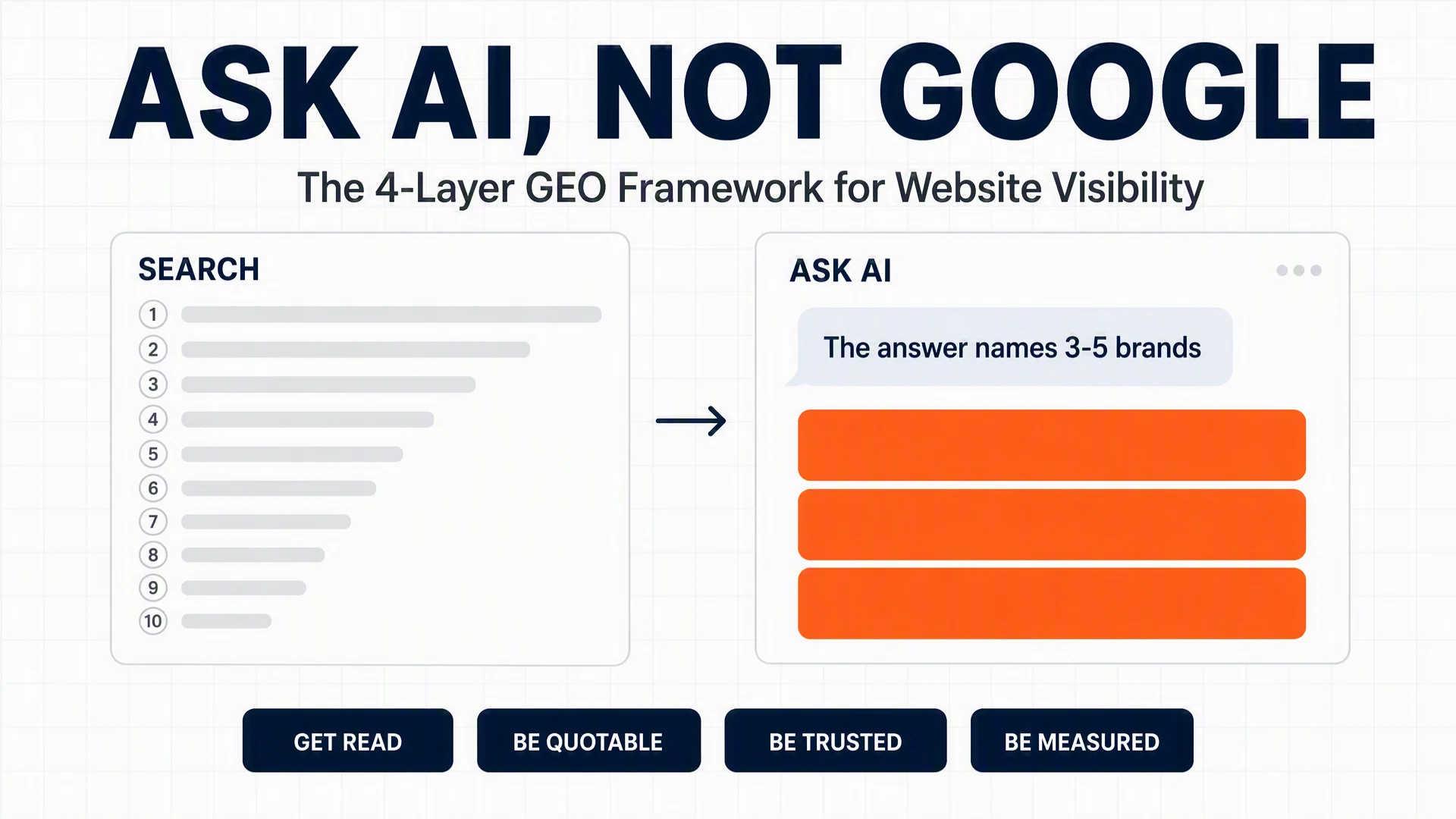
Under the hood, the two work differently. A search engine blends keywords, freshness, and link weight to rank ten URLs on a page. A generative engine reasons over content and evaluates credibility, then writes one answer that usually names three to five brands, not ten.
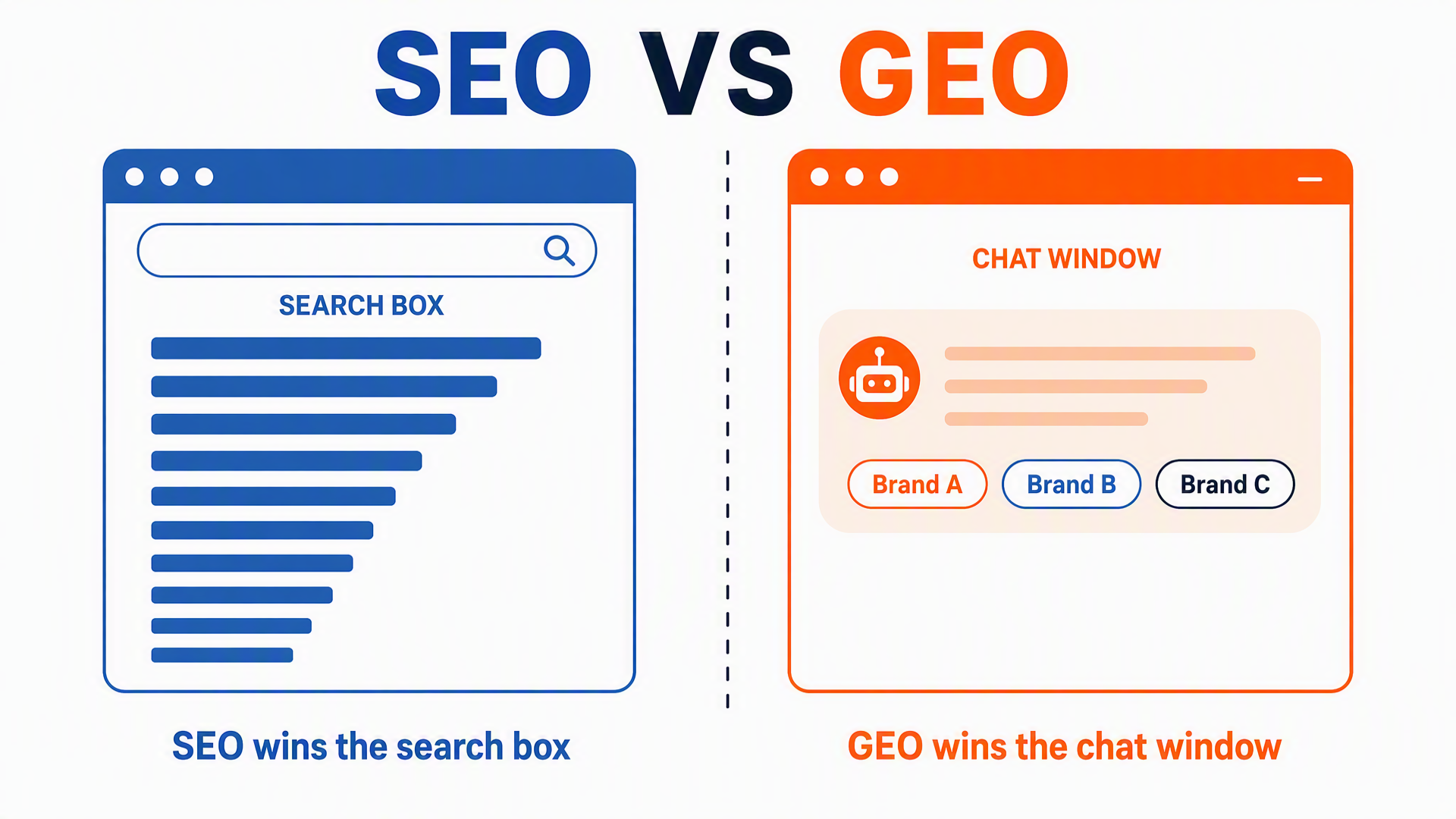
SEO ranks ten links for a keyword; GEO competes for the three to five brands an AI answer names.
Remember it this way: SEO wins the search box; GEO wins the chat window. GEO doesn't replace SEO, it stacks on top of it. You can rank first in Google and still be absent from the AI conversation.
Why this is a survival issue for business websites
Three shifts make AI presence a baseline requirement for most businesses, not a nice-to-have.
AI is the first filter in buying decisions. When someone asks "which provider is reliable?" the generated answer mostly decides the shortlist. Brands outside the answer are outside the consideration set. The conversion chain downstream never gets a chance to start.
Traditional search traffic keeps getting diverted. The first information stop for a growing share of younger, higher-intent buyers is a chat window, not a results page. You can defend the search box perfectly and lose the chat window to competitors who had nothing to do with your rankings.
AI answers are sharper winner-take-most than SERPs. Ten positions on a result page still leave room for several competitors to win clicks. A generated recommendation naming three to five brands is a tighter club: being "not selected" is a bigger gap than being tenth versus first.
The four layers of GEO
For a business website, practical GEO work falls into four layers. Each builds on the one before it.
Layer 1: Get read (technical readability)
AI crawlers cannot recommend what they cannot fetch. Start with the gatekeepers.
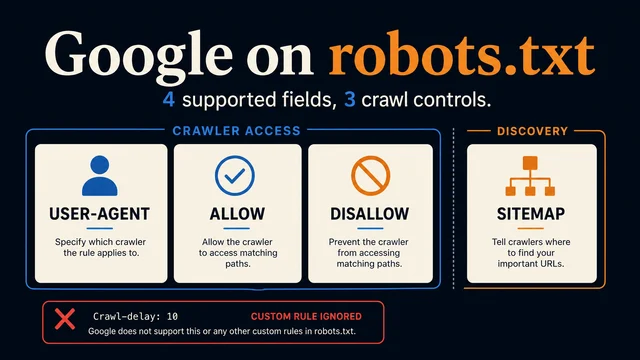
- Open the door to AI crawlers in robots.txt. Add GPTBot, ClaudeBot, PerplexityBot, Google-Extended, and the bots your region's assistants use, next to Googlebot. Many sites only allowlist traditional search spiders, so assistants either get blocked or read a cached surface.
- Publish an llms.txt. This is the AI-native site map: a short, plain-language file that tells an assistant what your brand is, which pages matter, and what it is safe to cite. It takes an hour, and it pays off fast. A free llms.txt generator and checker covers the basics if you want a head start.
- Mark up key facts with structured data. Organization, LocalBusiness, Service, and FAQPage schemas turn your name, address, services, and common questions into machine-readable facts.
- Keep core content readable in raw HTML. Prices, service descriptions, credentials, and locations should not live behind JavaScript-only rendering. Static, semantically clean text is what both search bots and AI crawlers want.
A quick check: open the raw HTML of your homepage and About page. If the numbers that matter are invisible in plain text, Layer 1 is not done.
Layer 2: Be quotable (answer-shaped content)
On top of readability, the content itself has to change shape. The GEO-era standard for good content isn't keyword density. It's being extractable as an answer.
- Lead with the conclusion, then add evidence. A paragraph that opens with a clear claim and backs it with a fact, a number, or a named source is the block assistants quote. It's the "golden snippet" structure for generative engines.
- Answer the questions the way customers ask them. Add FAQ blocks, how-to sections, and glossary-style pages covering "what is X," "how do I choose X," and "is X legit." Turn your existing service pages into question-and-answer documents.
- Use one consistent baseline for your facts. Pick one version of your founding year, location count, customer volume, certifications, and patent numbers, then use it everywhere. I audited a clinic group whose website and press coverage cited two different store counts. When assistants cross-check sources and find contradictions, they quietly discount the whole domain. Aligning your fact baseline is the most cost-effective GEO move there is.
Layer 3: Be trusted (authority signals)
Assistants don't judge quality subjectively; they estimate it from signals. The more authoritative sources echo your brand, the safer it feels to recommend you.
- Collect third-party proof. Coverage in established media, Wikipedia or equivalent reference entries, industry awards, patents, trademarks, and certifications all register as trust signals.
- Put real humans behind claims. Founder pages, practitioner bylines, and named expert quotes pull more weight than anonymous brand copy. An assistant treats "a named specialist says this" as more credible than "our brand says this."
- Keep the same facts across every platform. Your site, reference entries, review platforms, and social profiles should describe the same company in the same numbers. When AI cross-validates sources, one conflicting page can lower aggregate trust.
Layer 4: Be measured (monitoring and iteration)
GEO is a loop, and without measurement you are guessing.
- Run platform probes monthly. Ask your brand, category, and local-service questions in ChatGPT, Perplexity, Gemini, Copilot, and Google AI Overviews. Record whether you're mentioned, how you're described, and which competitors appear instead.
- Track one metric: AI mention rate. For a fixed prompt set, the share of prompts where your brand appears in the answer. That's the report line to watch month over month.
- Audit your entity facts periodically. Check that the numbers are still aligned across sources, and fix drift as soon as it appears.
There's research behind this loop. The Princeton paper GEO: Generative Engine Optimization (Aggarwal et al., KDD 2024) tested thousands of queries across several generative engines and found that adding citations, quotations, and statistics to content improved visibility by roughly 30-40%. So the fix is evidence-backed, and the same levers work for a 5-page business site and a 5,000-page enterprise site.
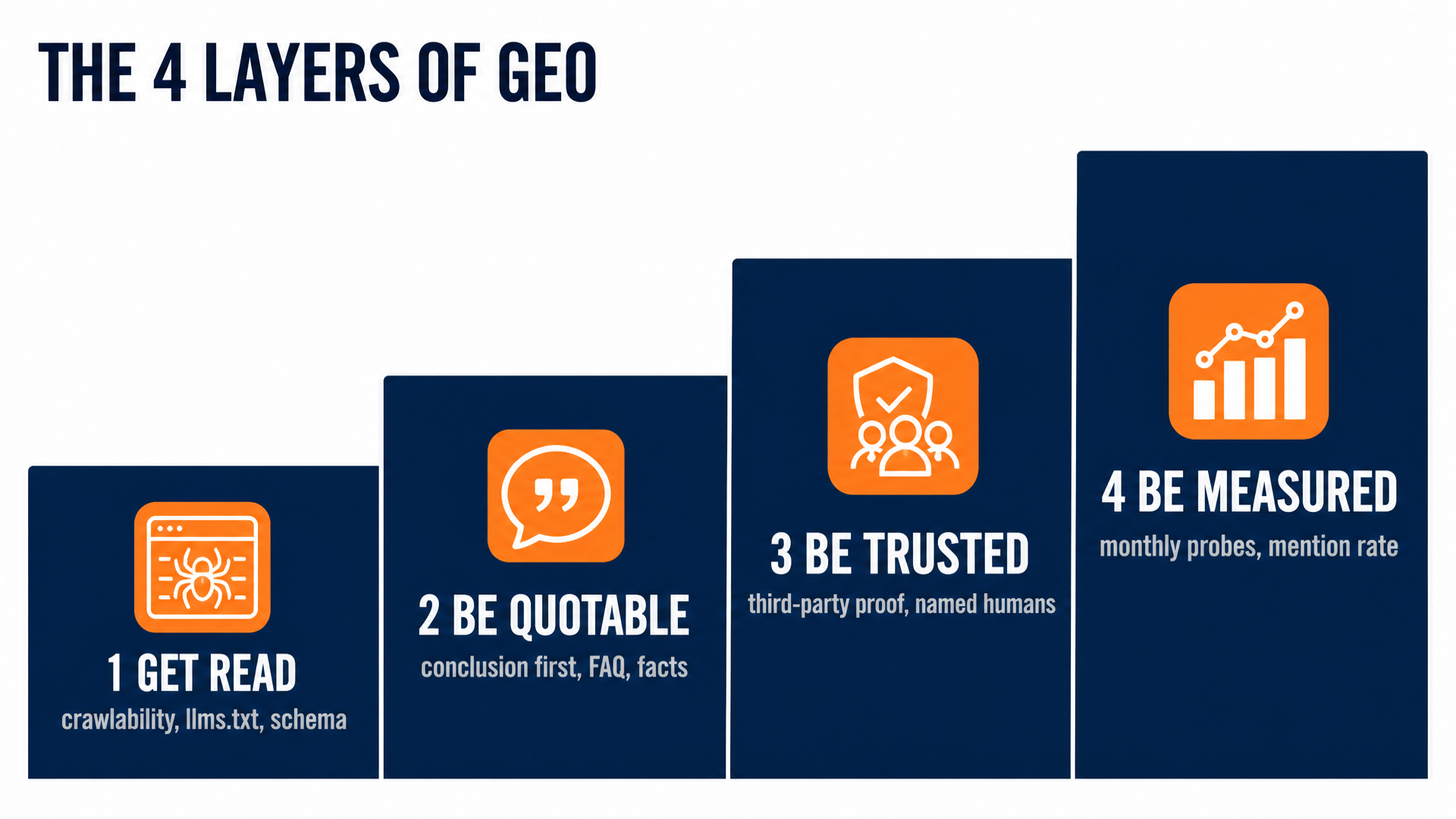
The four GEO layers in build order: each one sits on top of the one before it.
Three mistakes that waste your GEO effort
Mistake 1: "GEO is just SEO redone." No. SEO optimizes what rank you reach; GEO optimizes what gets quoted. Authority, structure, and cross-source consistency matter more than keyword coverage, and keyword stacking can work against you.
Mistake 2: "Higher keyword density is better." The opposite is closer to the truth. Generative engines respond to natural, professional, evidence-backed language: text written for humans, written the way a specialist would actually talk. Dense keyword soup is a credibility smell.
Mistake 3: "Our website is the whole job." Your site is one piece of the trust puzzle. Without third-party proof and consistent facts across the web, even a polished site gets passed over. The recommendation engine weighs the whole web, not just your domain.
Tomorrow's minimum viable GEO checklist
You can do all seven items within a few working days:
- Open robots.txt to AI crawlers. Add GPTBot, ClaudeBot, PerplexityBot, and Google-Extended to the allowlist.
- Write an llms.txt. Describe who you are, your core pages, and what is worth citing.
- Add JSON-LD structured data to your homepage, About, and service pages.
- Create a brand fact asset library. One locked version of every number and credential.
- Rewrite About, Services, and FAQ in answer shape: conclusion first, evidence underneath.
- Inventory third-party proof. Reference entries, media coverage, patents, trademarks. Close the gaps where you're missing it.
- Set up a monthly AI probe sheet. Record whether your brand appears in answers to your key questions.
The shift isn't waiting. When your customers start asking AI instead of searching Google, rankings stop being the point. What decides your fate is whether your business exists in the answer at all. Do the technical layer, make your content quotable, assemble the authority evidence, and measure what the machines say. That's how AI becomes your best sales channel instead of your biggest blind spot.
FAQ
Does GEO replace SEO? No. They operate on different surfaces. SEO still drives search clicks you can measure in Search Console. GEO adds a second surface: the generated answer itself. If you run SEO and ignore GEO, you stay visible in one conversation and invisible in another. The two live together, but they are not interchangeable.
How long until AI starts mentioning my brand? Nobody knows in advance, and anyone who promises a date is guessing. What is observable is that the levers with the most evidence (clean fetchability, fact consistency, citations and statistics, third-party proof) are the ones that move mention rates on monthly probes. If two months of consistent probes show zero movement, the problem is usually Layer 1 or Layer 3: the assistant either can't access you, or doesn't trust you enough to describe you.
Does GEO only work for big brands? No, but it does favor subjects the AI can describe clearly. A local clinic with clean structured data, consistent facts, one named practitioner, and a few third-party mentions will be recommended far more easily than a brand with no distinct entity features at all. Start with local-service questions: the answers are shorter there, and the mention slots are more open.
Author: Maya Ellison, 12-Year GEO Strategy Researcher at Auspia. Maya writes about AI search visibility, brand entity clarity, and practical GEO operating systems for growth teams.