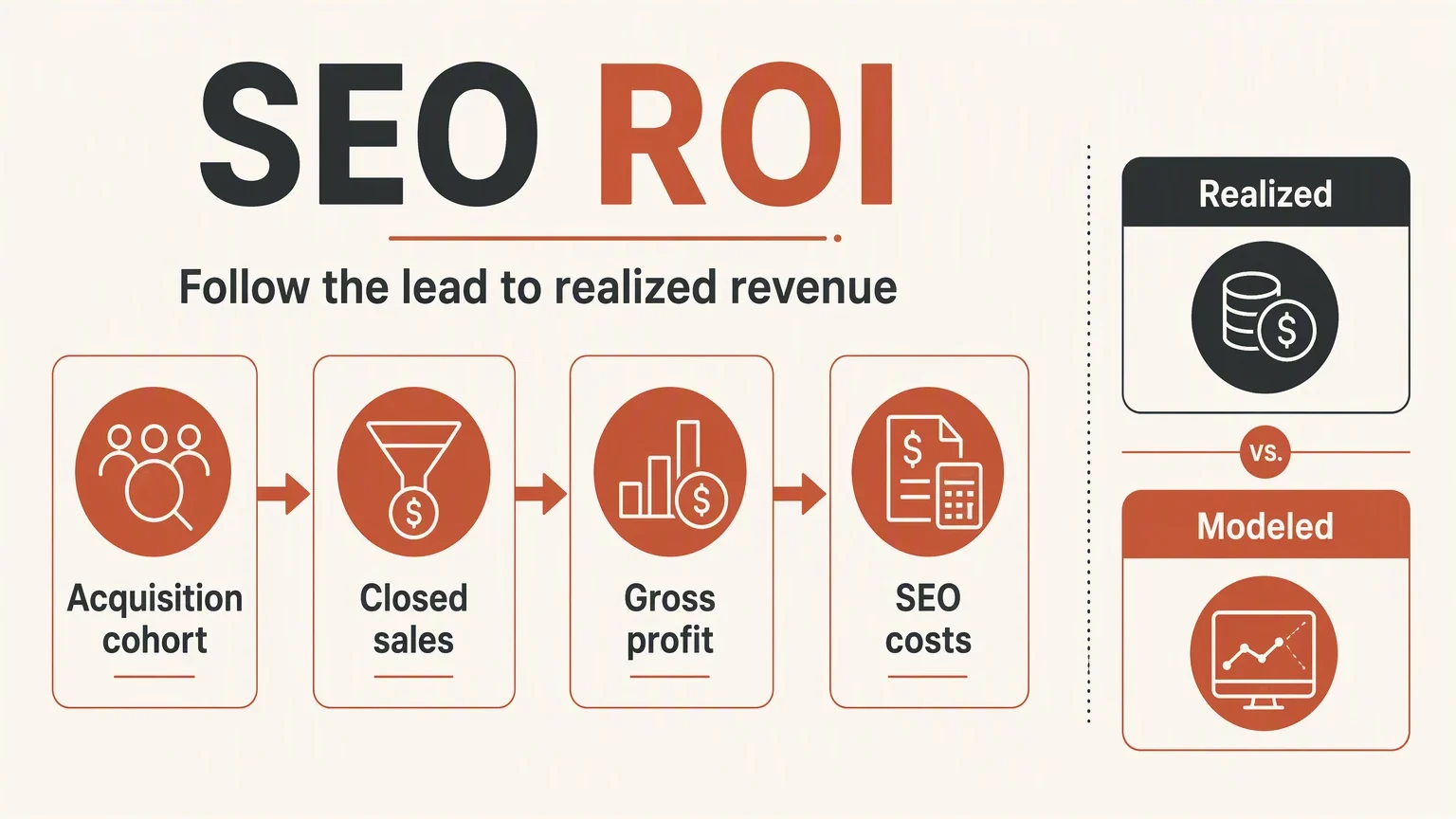
SEO ROI compares the return credited to an organic-search program with the cost of that program. A defensible calculation needs a defined period, an attribution rule, reconciled revenue, and an agreed meaning of "return." Counting form submissions and assigning each a sales value produces a forecast, not realized revenue.
For a practical management view, start with contribution after the direct cost of delivering the product or service, then subtract SEO program costs:
Contribution ROI =
(attributed gross profit − SEO program cost) ÷ SEO program cost × 100%
A revenue-based version is also useful, provided you label it:
Revenue-based ROI =
(attributed net revenue − SEO program cost) ÷ SEO program cost × 100%
The first formula is closer to the money available to cover the marketing program. Neither formula is a complete accounting profit calculation or proof that SEO caused every credited sale.
Completed report: One acquisition cohort reconciled to sales records, a cost ledger, and a calculation with the attribution and margin basis stated. People involved: The search owner, the analytics owner, and someone who can verify sales and costs. Inputs: Analytics records, CRM or order data, relevant program costs, and enough time for the cohort's sales cycle. Done means: A second person can trace the reported return to transactions and explain which value remains estimated.
Start by choosing the question the report will answer
A monthly operating report and a campaign investment review can use different boundaries. Choose one before calculating anything.
For an SEO program review, a useful question is: "What return can we attribute to people acquired through organic search during this period, after giving them enough time to buy?"
That is a cohort question. The acquisition window defines who enters the group. A later observation cutoff defines how long you watch their outcomes. A quarterly cost period defines which program expenses you compare with that return.
Write these dates and the attribution rule at the top of the report. If the program's costs cannot reasonably be associated with one cohort, use a broader reporting window or a documented allocation. The goal is a stable convention another reviewer can understand, not false precision.
Reporting choice | What it measures | Limitation to retain |
|---|---|---|
Revenue recorded this month | Current cash or transaction activity under the selected source rule | Some buyers may have been acquired long before this month's spending |
Acquisition cohort followed to a cutoff | Outcomes for visitors or leads acquired during a defined window | Newer cohorts may still be incomplete |
Incremental test | Difference against a credible counterfactual | Requires a test design that addresses other causes |
Attribution assigns credit. Incrementality asks what would have happened without the work. Keep that distinction visible when making a budget decision.
Define organic search at one consistent scope
Choose the analytics dimension that matches your question. GA4 distinguishes session-level, first-user, and event-level channel dimensions; they represent different parts of the journey. Mixing a first-user acquisition count with revenue credited under a different event attribution rule can produce a report with an unclear denominator. GA4's channel-dimension documentation
For a simple cohort review, retain the original acquisition source in the CRM where your implementation permits it, then reconcile the associated deals. Record that this is your chosen credit rule. For a broader marketing attribution review, use a consistent event-level model and label the credited revenue accordingly.
The choice can materially change which channel receives the sale. Google's paid-and-organic last-click model, for example, credits the last eligible non-direct channel. A buyer discovered through organic search who later converts after an email visit may therefore appear differently under that model and an original-acquisition cohort. GA4 attribution models
Use one rule for the main calculation and, if useful, a second view as a comparison. Do not add the views together.
Google's current channel definitions include AI Mode and AI Overviews in Organic Search; AI Assistant is a separate channel for sources such as ChatGPT and Gemini. Keep assistant traffic separate when the report is specifically about organic search. GA4 channel definitions
Reconcile leads to actual outcomes
For lead generation, join each valid lead to its CRM record and eventual deal outcome using your authorized first-party reporting. Remove duplicate submissions and test records. Separate qualified opportunities, open deals, closed wins, and closed losses.
A lead does not become revenue because a form event was assigned a value. If the deal has not closed, retain it as pipeline or expected value. If the sale cannot be matched, put it in an unresolved bucket rather than guessing its source.
For ecommerce, reconcile orders with the store's transaction records and refunds. GA4's web-stream purchase deduplication relies on unique transaction IDs; an empty or reused ID can distort counts. Google's transaction-ID guidance
The output should be a ledger of unique outcomes and their eligible net revenue. Check a sample against the CRM or order system before calculating a total. If analytics and sales records disagree, resolve instrumentation or matching problems first and report the remaining discrepancy.
Put the full program cost beside the cohort
Build a cost ledger for the agreed period. Include the work required to deliver and maintain the program, not only the writer's invoice.
Typical rows include content research and production, technical implementation, agency or contractor fees, reporting tools, and allocated internal labor. Explain how you allocated a shared tool or employee cost.
Do not count the same expense twice. If an agency fee already includes content production, adding the same production amount as a separate cost inflates the denominator. Conversely, omitting engineering work can make an expensive program appear unusually profitable.
Keep product-delivery costs inside the gross-profit calculation and SEO costs in the program-cost ledger. If a cost appears in both, correct the overlap before presenting ROI.
Work through one completed cohort
This is an invented example for teaching the arithmetic. It is not an Auspia campaign result.
A program spends $6,000 during the selected acquisition window. Under the agreed credit rule, the cohort ultimately produces 12 closed-won deals, each with $1,500 in eligible net revenue. The business uses a 60% gross margin for this example.
Item | Calculation | Amount |
|---|---|---|
Attributed net revenue | 12 × $1,500 | $18,000 |
Attributed gross profit | $18,000 × 60% | $10,800 |
SEO program cost | Reconciled cost ledger | $6,000 |
Contribution after SEO cost | $10,800 − $6,000 | $4,800 |
Contribution ROI | $4,800 ÷ $6,000 | 80% |
Revenue-based ROI | ($18,000 − $6,000) ÷ $6,000 | 200% |
Revenue-to-cost ratio | $18,000 ÷ $6,000 | 3.0× |
The final three rows describe different things. "3.0× revenue to cost" is not the same statement as "300% ROI."
Use your finance-approved margin basis. If the margin varies by product, calculate eligible gross profit at the relevant product or deal level instead of applying a convenient blended margin to every sale.
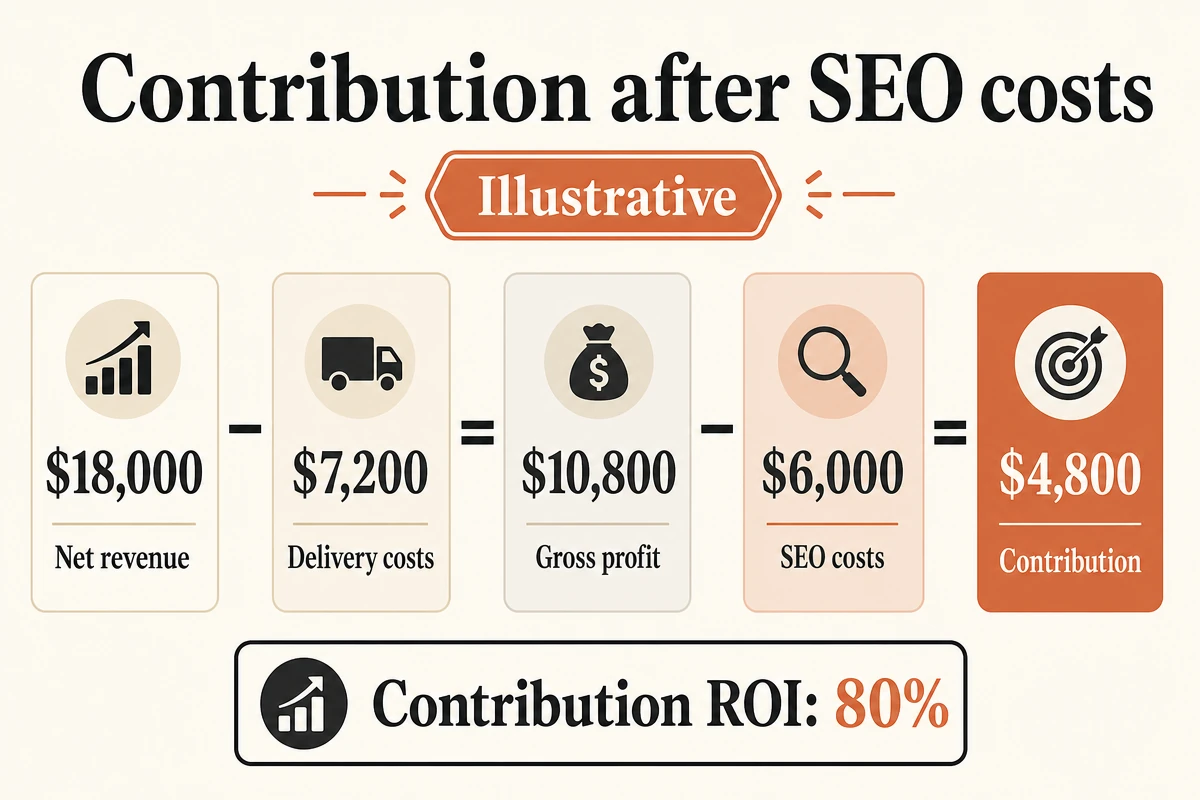
Illustrative example: $4,800 remains after delivery and SEO program costs.
Keep expected lead value in a separate column
Suppose the same program generated 60 qualified leads, but their outcomes are still pending. You might estimate a 20% win rate and $1,500 in eligible revenue per won deal:
Expected revenue = 60 × 20% × $1,500 = $18,000The result happens to match the realized example. Its status is different: two assumed inputs still need to materialize.
Label it "modeled revenue" and show the basis for the win rate. If you later replace it with actual closed-won revenue, replace the estimate rather than adding actual revenue on top. Otherwise the same cohort contributes twice.
Projected lifetime value needs similar care. State the retention period, margin assumptions, and whether future payments are included. For a simple first report, an agreed realized-revenue horizon is easier to reconcile than a speculative lifetime figure.
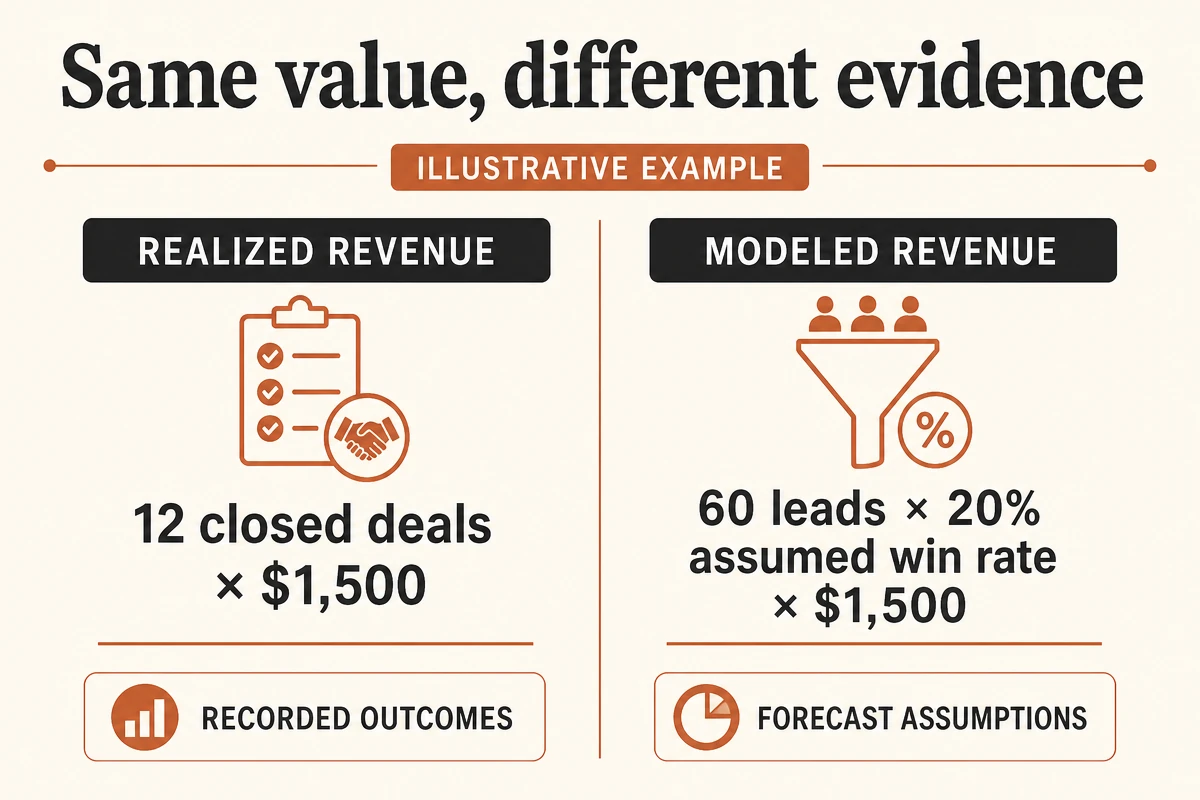
Illustrative example: a matching amount can have a different evidence status.
Verify the report before making a budget claim
Run a reconciliation pass with someone outside the search program. They should be able to trace the sales total, identify the costs, and explain the selected credit rule.
Confirm that:
- Acquisition dates, outcome cutoff, and cost period are stated.
- Leads and orders have been deduplicated.
- Refunds and cancellations follow the agreed revenue convention.
- Realized revenue, pipeline, and modeled value are separate.
- Each credited outcome appears once in the main total.
- The margin basis and cost allocation are documented.
- The report describes attributed return unless a credible incremental test was conducted.
At Auspia, we would rather publish a smaller reconciled return than a larger number assembled from assumptions no one can inspect. An incomplete cohort should remain incomplete. Add a scheduled follow-up date and update it when the sales cycle has matured.
FAQ
How soon should SEO ROI turn positive?
There is no useful universal deadline. Timing depends on delivery, existing visibility, purchase cycle, margins, and spending. Compare mature cohorts over a stated horizon and keep recent cohorts provisional.
Can I include assisted conversions?
Report them as a separate view with a defined model. Adding assisted revenue to fully credited revenue can count the same sale more than once.
What if I cannot connect leads to revenue yet?
Report the tracking gap, lead counts, qualification, and costs. A modeled value can support planning if its assumptions are visible, but it should not be presented as realized ROI.
Author: Hannah Pierce, 12-Year B2B SEO Growth Practitioner at Auspia. Hannah writes about pipeline-focused content, buyer journeys, and connecting search work to business outcomes.