The 2026 Google Ranking Factors Expert Survey has been summarized everywhere by now, and every summary says the same thing: relevance, backlinks, and content quality still lead. Accurate, and also the least useful part of the study, because it is the same top three the surveys of a decade ago produced.
The operational detail sits in a section the coverage skipped. Zyppy published 24 unattributed expert comments across the eight factor groups, which gives you the mechanism without the personality. Read together, they contradict standard advice often enough to be worth more than another ranking of the top ten.
Seven of those contradictions follow. Each has what the respondents said, what it changes, a next step, and a way to check whether it applies to you.
How to read the comments
Cyrus Shepard and Dawn Shepard published the survey on September 9, 2026. One hundred and thirty-one practitioners rated 103 candidate factors from −3 to +3, then named their three most important factors. That produced 13,665 ratings from 2,620 minutes of work.
The percentages are nominations, the share of respondents who put a factor in their personal top three. They are not weights, and the panel is not Google. The comments carry the same caveat, which is why they are more actionable than a weight estimate: they tell you what a working practitioner does differently. Respondents are not named against their comments in the source, so nothing below is credited to a specific person.
1. The content line is added value, not depth or authorship
The standard instruction is to go deeper than the competition and to keep AI out of the pipeline. The survey complicates both halves.
On depth, the warning runs opposite to the usual advice. "Too much consensus, and you're invisible for not being relevant enough. Too much information gain, and you're shadowbanned for being too contrarian." Another respondent is blunter about the same risk, saying content that becomes too expert level is "actually harmful to visibility." The stated target is a Goldilocks zone where a page appeals broadly enough to be shared, mentioned, and linked.
On AI, the dividing line the panel draws is not authorship. Objections cluster on scaled output with little added value, and one respondent reports positive results from AI generation at scale on a site that also carries original content and user contributions, with intensive human editing on every piece. Another sums up the economics: publishing cost has collapsed, and trust cost has gone up.
What to do. For each page that carries revenue, write down what a competitor cannot reproduce. Your pricing, your test results, your support transcripts, your own measurements. If the list comes back short, the list is your brief. A longer version of an argument that already has ten versions on page one is the behaviour the panel warns about, not the behaviour it rewards.
Check. Search your target query and read your page next to the top three. If your most distinctive paragraph could be transplanted to a competitor's site without anyone noticing, you are competing on consensus.

2. Technical SEO is maintenance, not a growth lever
"Tech SEO is a commodity at this point. It won't necessarily win the race, but it can absolutely lose it."
Respondents treat technical health as table stakes, and the survey's own example of a technical win is a repair rather than an optimization: a client whose canonicals pointed at unrelated pages, once fixed, saw impressions and clicks move by roughly 60% almost immediately.
A second comment points at where the work is heading instead, describing technical SEO as "infrastructure for machine understanding as well as retrieval."
What to do. Move technical work out of the optimization backlog and into a loss-prevention checklist. Four categories earn a standing check, because each can silently disqualify a page that is otherwise fine:
Category | What to look for |
|---|---|
Canonicalization | Canonicals pointing at a different or unrelated URL |
JavaScript dependence | Main content or links that only exist after JavaScript runs |
Duplicate content | The same page reachable at more than one URL |
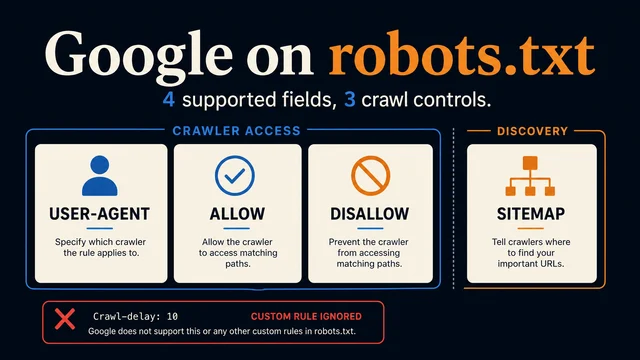
Crawl blocking | Pages blocked in robots.txt that you still expect to rank |
Redirect chains and hreflang accuracy belong on the same list for large or multilingual sites.
Check. Take one commercial page and fetch it with JavaScript disabled. Then compare the rendered version with a crawler simulator such as the Googlebot Spider Simulator. If the two differ in the body copy, you have a rendering problem, not a content problem.

3. Click signals set a ceiling, not a score
Behaviour and click signals climbed to fifth in the nominations at 29.4%, and the comments explain why the position undersells the change.
"Navboost is still a monster. As such, sites really should create a satisfaction metric (often by page type) to try to emulate satisfaction. Because there is a ranking ceiling when click signals are worse than other SERP competitors."
That last clause is the part most teams miss. Click signals are not points you accumulate. They are the ceiling above which your other advantages stop paying. A page with a better link profile than every competitor and worse satisfaction will plateau, and the plateau will look like a mystery from inside a rank tracker.
The highest-rated factor inside the group is satisfaction and task completion. Long clicks, where the searcher stays, rate positive. Return to SERP, where the searcher comes back to Google after opening your page, rates negative.
What to do. Define completion by page type, which is what the panel recommends. On a pricing page, completion is a scroll to the plan table plus a click into a plan. On a how-to, it is a scroll past the last step or a copy event. On a comparison page, it is the scroll to the comparison table. Then watch the pages where your definition fails.
Check. Take your ten highest-impression pages and name, for each, the single action that would prove the visitor got what they came for. Pages where you cannot name one are the pages where satisfaction is a guess.
4. Bounce rate is the wrong number to report
"Bounce rate is a bad metric, but sites where users pogo-stick to another result, I believe that is a clear signal that Google is absolutely taking."
The factor list takes the same position from the other direction. There is a factor for return to SERP and one for long clicks. There is no bounce rate factor. A monthly report that still leads with bounce rate is reporting a number the practitioner panel does not believe measures anything.
One respondent raises an open question worth knowing before you build a dashboard on click data: when a growing share of browsing is performed by agents rather than people, what happens to a signal built on human clicking? The survey has no answer.
What to do. Replace bounce rate with a return-to-SERP proxy. In GA4, a session with an engagement time under roughly ten seconds and no conversion is far closer to a pogo-stick than a 100% bounce on a long-read page. Set the threshold per page type, because fifteen seconds means different things on a news update and on a documentation page.
Check. Pull your worst pages under the proxy and look at position alongside them. If the same pages are losing position, you are looking at the ceiling from finding 3, not at a content problem.
5. Links: audiences and anchor share, not counts
Two comments replace two common metrics.
"A hundred links from real audiences beat a thousand links nobody ever clicks." The factor list supports this with a separate entry for links from pages that themselves receive measurable traffic, sitting alongside links from highly trusted domains and from topically relevant pages.
"Exact match anchors cut both ways. They drive real gains up to a point and suppress performance past it. The variable is what share of the anchor profile they represent, not the raw count."
The second one turns a perennial argument into a measurement. The question is not whether to use exact match anchors. It is what proportion of a link profile they occupy before the effect reverses.
What to do. Sort referring pages by whether they have traffic of their own rather than by domain rating, and compute the exact-match share of anchors for your five most important URLs. Where exact match dominates, the property that produced the early gains is now working against the page.
Check. For one target URL, list the last ten links pointing at it and count how many come from pages with traffic. Fewer than half means your link acquisition is being judged on an axis the panel does not use.
6. Internal links are the highest-control lever in the survey
Internal links placed tenth at 11.1% and drew the warmest comments of any factor in the report. "I often discuss with colleagues that a good internal link is as valuable as a very good external backlink." And: "Internal linking is the ranking lever a site controls end to end... Internal links decide which pages collect equity, which pages Google reads as important, and how topics connect across the site."
The rank measures how many experts named internal links in their personal top three. The comments measure what they say when asked to explain their reasoning. The two disagree, and the disagreement is the useful part: internal linking loses prioritization meetings to link building while being the one item on the list that needs no outreach, no vendor, and no budget.
What to do. Start with the page you most want to rank. Find five existing pages that already cover adjacent ground and add one in-body link from each, with anchor text that describes the destination. Then check the two structural factors from the survey's definition list: click depth from the homepage, and orphaned pages with no internal links pointing at them.
Check. Read each new anchor text out loud on its own, without the sentence around it. If it does not describe the destination page, it is not pulling weight.
7. Brand signals outrank technical health, and ads do not buy rankings
The harshest comment in the report is the most useful one for planning. "You can get away with a website technically in a very bad shape, without having optimized content as long as people search and talk about the brand."
That does not make technical SEO optional. It sets the order of operations. Technical health is the floor, brand demand is the ceiling, and a team that spends a quarter on rendering fixes while almost nobody searches for the brand by name has spent the quarter on the floor.
Branded search volume and online reputation sit at the top of the brand group, and one respondent calls branded search "the new link." Google Ad Spend rates barely positive, with the explanation attached: no direct effect on rankings, though it can move other signals.
What to do. Track branded search volume beside organic sessions as a first-class metric rather than a vanity one, and treat it as the outcome ad spend is actually buying. If a paid campaign does not move branded queries, it is not buying anything the ranking systems can see.
Check. Plot branded search volume and organic sessions over the same eight weeks. When both lines move together, content is building demand. When organic moves alone, it is renting it.
Which one to start with
Your situation | Start with | Why |
|---|---|---|
Pages rank but do not convert from search | Findings 3 and 4 | Click behaviour sets the ceiling, so improvements elsewhere stop paying first |
Publishing volume keeps rising, rankings do not | Finding 1 | The panel's objection is added value, which more output does not fix |
Strong content, almost no links | Finding 6 | Internal linking is the only lever here that needs no outreach |
Large or JavaScript-heavy site | Finding 2 | Rendering and canonical faults disqualify pages outright |
Steady rankings, no branded demand | Finding 7 | Brand demand carries factors that page edits cannot reach |
Where this stops being useful
Three limits worth holding before you rebuild a strategy on any of it.
The panel reports perception, not measurements. No respondent has access to Google's weights, and the authors say plainly that the factor list was whittled down from a larger pool and that no panel of experts is ever complete.
The case studies are single observations. The canonical repair with the 60% gain happened to one client at one agency. Treat it as evidence that technical faults can cost real visibility, not as a benchmark you can promise.
The AI companion study has not been published. Zyppy has announced a second survey on visibility inside Google's AI answers. Until it lands, nothing here tells you how to get cited, because the panel has not been asked yet.
FAQ
Does the survey say AI-generated content is penalized? No. The negative ratings cluster on scaled AI output with little added value, and one respondent reports positive results from AI generation at scale on a site that also carries original content, user contributions, and intensive human editing. The panel objects to added value, not authorship.
Are these findings based on measured ranking data? No. They are expert perception, collected from 131 practitioners who rated 103 factors. That makes them a reliable map of where experienced operators spend attention, and a poor source for how much any single factor weighs.
What should a small site do first? Run finding 2 and finding 6, in that order. Rendering and canonical faults cost visibility outright on sites that cannot absorb the loss, and internal links are the only lever on this list that a small team can pull completely on its own.
Author: Martin Hayes, GEO Playbook Builder for 200+ Execution Checklists at Auspia. Martin writes about turning search research into step-by-step operating guides that teams can run without outside help.